
Another Word for Social: 30 Synonyms With Examples
The closest everyday alternatives to social are sociable, outgoing, friendly, and gregarious when describing a person. For society-wide matters, use societal, communal, civic, or public; for a social event, use gathering, get-together, party, or function.
“Social” has several meanings, so the best replacement depends on context. It can describe a person who enjoys company, an activity shared with others, a community or society, or an informal event.
Quick list: sociable, outgoing, friendly, gregarious, convivial, companionable, communal, societal, civic, gathering.
This article explains 30 alternatives with meanings, IPA, usage notes, examples, and the contexts in which each word works best.
At a Glance: Social Synonyms and Related Alternatives
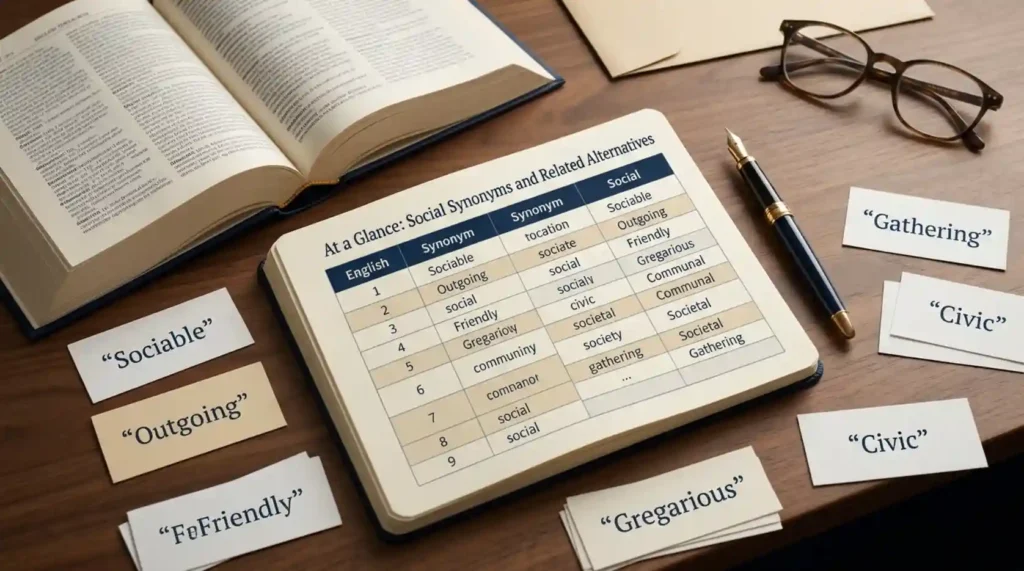
| Alternative | Part of Speech | Meaning | Register / Tone | Ideal Context |
| Sociable | Adjective | Enjoying the company of other people | Neutral | People, conversations, personalities |
| Outgoing | Adjective | Friendly, energetic, and comfortable meeting people | Neutral, positive | Personality descriptions |
| Friendly | Adjective | Kind, welcoming, or showing goodwill | Neutral | People, places, behavior |
| Gregarious | Adjective | Enjoying being with other people; tending to form groups | Slightly formal | People and animals |
| Convivial | Adjective | Cheerful, lively, and fond of good company | Formal, warm | Parties, meals, atmospheres |
| Companionable | Adjective | Pleasant to be with; quiet and friendly | Formal, gentle | Colleagues, walks, shared activities |
| Communal | Adjective | Shared by a community or group | Neutral | Spaces, resources, decisions |
| Societal | Adjective | Relating to society as a whole | Formal | Issues, change, structures |
| Civic | Adjective | Relating to a city, community, or citizenship | Formal | Duties, organizations, engagement |
| Gathering | Noun | A group of people who meet together | Neutral | Events and meetings |
Which Word Should You Use?
| If you want to… | Use | Why |
| Describe a person who enjoys company | Sociable | It is the closest everyday adjective for a person who likes being with others. |
| Describe someone confident with new people | Outgoing | It emphasizes energy and ease in meeting people. |
| Describe kind, welcoming behavior | Friendly | It is broad, simple, and natural in most situations. |
| Describe someone who loves groups and activity | Gregarious | It suggests a strong enjoyment of company. |
| Describe a warm party atmosphere | Convivial | It suggests lively, cheerful company. |
| Describe something shared by a community | Communal | It refers to shared ownership, use, or responsibility. |
| Discuss society-wide problems or institutions | Societal | It is more formal and precise than “social” for society as a whole. |
| Replace the noun “a social” | Gathering, get-together, party, or function | These nouns name the event itself rather than describe it. |
Exploring the Multiple Meanings of “Social”
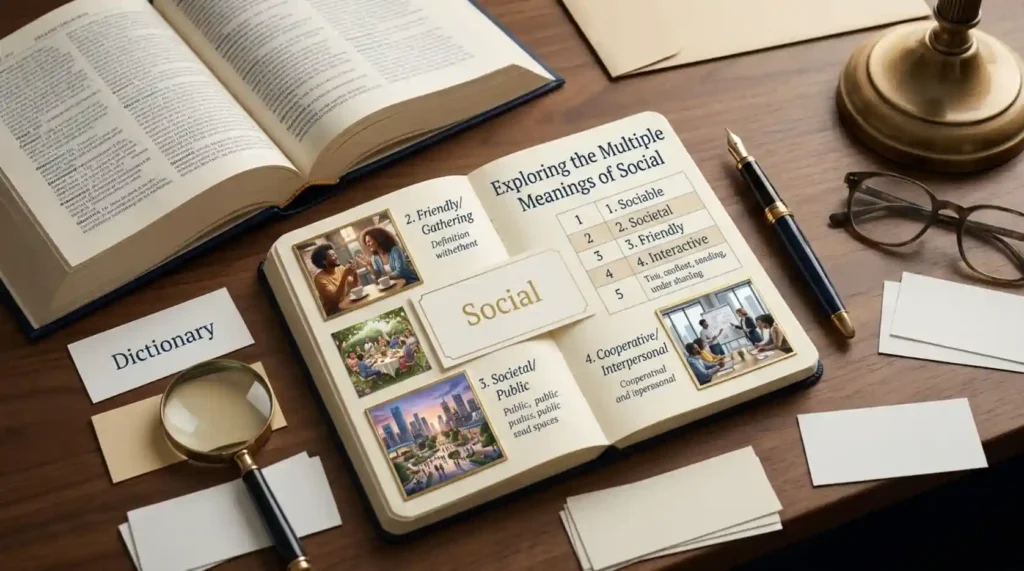
1. Enjoying Company
- Meaning: Likely to seek or enjoy the company of other people.
- Explanation: This sense describes a person’s personality. Sociable, outgoing, and gregarious are the closest alternatives.
- Example: My new roommate is very social and loves meeting people.
2. Relating to Friendly Companionship
- Meaning: Spent in, marked by, or designed for friendly interaction.
- Explanation: Here, “social” describes an occasion, club, activity, or atmosphere rather than a person. Convivial and companionable are close in tone.
- Example: We had a relaxed social evening after work.
3. Relating to Society
- Meaning: Connected with human society, its organization, or people’s welfare within it.
- Explanation: This is the formal and academic sense, as in “social policy” or “social class.” Societal is often the closest direct substitute.
- Example: Housing affordability is an important social issue.
4. Living in Groups
- Meaning: Tending to live, work, or interact cooperatively with others; not solitary.
- Explanation: This sense is common in biology and psychology. Gregarious, cooperative, and communal may fit, depending on the sentence.
- Example: Wolves are social animals that hunt in packs.
5. Relating to Rank or Status
- Meaning: Connected with a person’s position, class, or status in society.
- Explanation: This older or more specialized sense appears in phrases such as “social standing” and “social set.” Societal can work in some cases, but “class” or “status” may be clearer.
- Example: She came from a wealthy social background.
6. An Informal Gathering
- Meaning: A friendly event arranged so people can meet and spend time together.
- Explanation: As a noun, “a social” means an informal gathering. Get-together, gathering, party, and function are natural replacements.
- Example: The school is holding a social for new students.
Sources: Merriam-Webster; Collins English Thesaurus; Cambridge English Thesaurus.
Analyzing 30 Social Alternatives in Detail
Some alternatives below are direct synonyms, while others are useful only in particular contexts.
Friendly and Outgoing Alternatives
1. Sociable
- IPA: /ˈsoʊʃəbəl/ (US and UK)
- Definition: Enjoying or seeking the company of other people.
- Usage: This is usually the closest everyday synonym for “social” when describing a person. It is neutral and natural.
- Example: She is sociable and quickly made friends at college.
2. Outgoing
- IPA: /ˈaʊtɡoʊɪŋ/ (US and UK)
- Definition: Friendly, energetic, and comfortable meeting or talking to people.
- Usage: Use it for personality. It suggests confidence and ease with strangers more strongly than “sociable.”
- Example: Our outgoing tour guide made everyone feel welcome.
3. Friendly
- IPA: /ˈfrɛndli/ (US and UK)
- Definition: Kind, pleasant, and showing goodwill toward others.
- Usage: “Friendly” is broader than “social.” It can describe people, places, behavior, or environments, but it does not always mean someone enjoys large groups.
- Example: The staff were friendly and helpful.
4. Gregarious
- IPA: /ɡrɪˈɡɛəriəs/ (US and UK)
- Definition: Enjoying the company of other people; tending to live or gather in groups.
- Usage: This is a slightly formal synonym. It can describe people and animals, especially those that prefer company over solitude.
- Example: He is a gregarious child who loves playing with classmates.
5. Extroverted
- IPA: /ˈɛkstrəvɜːrtɪd/ (US and UK)
- Definition: Energetic and confident in the company of other people.
- Usage: Use it mainly for personality. It is related to “social,” but it specifically contrasts with “introverted.”
- Example: Her extroverted nature makes her well suited to sales work.
6. Communicative
- IPA: /kəˈmjuːnɪkətɪv/ (US and UK)
- Definition: Willing to talk to people and share information or feelings.
- Usage: This is a related alternative, not an exact synonym. It emphasizes conversation and openness rather than general enjoyment of company.
- Example: The manager is communicative and always explains decisions clearly.
7. Clubby
- IPA: /ˈklʌbi/ (US and UK)
- Definition: Friendly in a way that suggests a close, exclusive group.
- Usage: This informal word can mean sociable, but it often implies that outsiders may feel excluded.
- Example: The office had a clubby atmosphere after the merger.
Warm and Welcoming Alternatives
8. Convivial
- IPA: /kənˈvɪviəl/ (US and UK)
- Definition: Cheerful, lively, and enjoyable because people are together.
- Usage: Use it for meals, parties, celebrations, and friendly atmospheres. It is more formal and literary than “social.”
- Example: The dinner had a convivial atmosphere.
9. Companionable
- IPA: /kəmˈpænjənəbəl/ (US and UK)
- Definition: Pleasant, relaxed, and easy to be with.
- Usage: This word suggests quiet, comfortable companionship rather than lively party behavior. It is a close but more specific alternative.
- Example: They enjoyed a companionable walk through the park.
10. Hospitable
- IPA: /hɒˈspɪtəbəl/ (US and UK)
- Definition: Welcoming and generous to guests or visitors.
- Usage: This is related to “social” when it describes a welcoming person, home, or place. It does not mean someone necessarily enjoys parties.
- Example: The family was hospitable and invited us to stay for dinner.
11. Neighborly
- IPA: /ˈneɪbərli/ (US and UK)
- Definition: Kind, helpful, and friendly in the way a good neighbor is.
- Usage: Use it for local relationships and everyday kindness. It is more specific than “social.”
- Example: It was neighborly of them to collect our mail while we were away.
12. Cordial
- IPA: /ˈkɔːrdʒəl/ (US and UK)
- Definition: Warm, polite, and friendly.
- Usage: This formal word describes polite friendliness. It may feel less personal than “sociable.”
- Example: The two leaders had a cordial meeting.
Personable and Pleasant Traits
13. Genial
- IPA: /ˈdʒiːniəl/ (US and UK)
- Definition: Cheerful, kind, and easy to talk to.
- Usage: This is a formal, positive word for a pleasant personality. It is related to “social,” but it emphasizes warmth.
- Example: The professor had a genial manner that put students at ease.
14. Affable
- IPA: /ˈæfəbəl/ (US and UK)
- Definition: Friendly, good-humored, and easy to talk to.
- Usage: Use it for people, especially in formal writing. It suggests approachability more than active socializing.
- Example: The new coach is affable and approachable.
15. Amiable
- IPA: /ˈeɪmiəbəl/ (US and UK)
- Definition: Friendly and pleasant.
- Usage: This is a formal alternative for a person’s character. It suggests good nature rather than a love of crowds.
- Example: He is an amiable colleague who gets along with everyone.
16. Congenial
- IPA: /kənˈdʒiːniəl/ (US and UK)
- Definition: Pleasant and enjoyable because people get along well.
- Usage: Use it for people, company, workplaces, or atmospheres. It means “agreeable” more than “outgoing.”
- Example: We worked in a congenial atmosphere.
Group and Community Alternatives
17. Communal
- IPA: /kəˈmjuːnəl/ (US and UK)
- Definition: Shared by, belonging to, or involving a community or group.
- Usage: This is a strong alternative when “social” means shared or collective, as in “communal kitchen” or “communal decision.”
- Example: The apartment building has a communal garden.
18. Collective
- IPA: /kəˈlɛktɪv/ (US and UK)
- Definition: Done, shared, or experienced by members of a group together.
- Usage: This is related, not always interchangeable. Use it when a group acts or decides as one.
- Example: The team made a collective decision to postpone the launch.
19. Cooperative
- IPA: /koʊˈɒpərətɪv/ (US and UK)
- Definition: Willing to work with others for a shared purpose.
- Usage: This is a contextual alternative for “social” in the sense of working or living together. It emphasizes collaboration.
- Example: The children were cooperative during the group project.
20. Interactive
- IPA: /ˌɪntərˈæktɪv/ (US and UK)
- Definition: Involving communication or action between people or things.
- Usage: This is related when “social” describes contact or exchange. It is especially common for activities, media, and technology.
- Example: The museum has interactive exhibits for children.
21. Interpersonal
- IPA: /ˌɪntərˈpɜːrsənəl/ (US and UK)
- Definition: Relating to relationships or communication between people.
- Usage: Use this in formal or professional contexts. “Interpersonal skills” is more precise than “social skills” in many workplace settings.
- Example: Strong interpersonal skills are important for teachers.
Public and Civic Contexts
22. Group
- IPA: /ɡruːp/ (US and UK)
- Definition: Involving or consisting of several people considered together.
- Usage: This is a related adjective in phrases such as “group activity” or “group discussion.” It is not an exact synonym for “social.”
- Example: The class did a group activity after lunch.
23. Community
- IPA: /kəˈmjuːnəti/ (US and UK)
- Definition: Relating to the people living in a particular area or sharing common interests.
- Usage: Use it as an adjective in phrases such as “community center” or “community event.” It emphasizes local connection.
- Example: The library hosts community events every month.
24. Public
- IPA: /ˈpʌblɪk/ (US and UK)
- Definition: Relating to the people of a country, community, or society as a whole.
- Usage: This is a contextual alternative for “social” in expressions such as “public health” or “public services.” It emphasizes the community rather than private life.
- Example: The city improved its public transportation system.
25. Civic
- IPA: /ˈsɪvɪk/ (US and UK)
- Definition: Relating to a town, city, or the duties and activities of citizens.
- Usage: This is a formal, specific alternative when “social” refers to community life or citizenship.
- Example: She received an award for her civic work.
Society-Wide and Event Alternatives
26. Societal
- IPA: /səˈsaɪətəl/ (US and UK)
- Definition: Relating to society or its structure, organization, and development.
- Usage: This is the closest formal substitute for “social” in academic and policy contexts, especially with “change,” “issues,” and “norms.”
- Example: Climate change requires societal change.
27. Cultural
- IPA: /ˈkʌltʃərəl/ (US and UK)
- Definition: Relating to the ideas, customs, arts, and way of life of a group or society.
- Usage: This is related, not equivalent. Use it when the focus is traditions, beliefs, or arts rather than society generally.
- Example: The festival celebrates the city’s cultural diversity.
28. Economic
- IPA: /ˌiːkəˈnɒmɪk/ (US and UK)
- Definition: Relating to the production, use, and distribution of money, goods, and services.
- Usage: This is a paired term rather than a synonym. Writers often contrast “social and economic” issues.
- Example: The report examined the social and economic effects of the policy.
Social Event Replacements
29. Gathering
- IPA: /ˈɡæðərɪŋ/ (US and UK)
- Definition: A group of people who have come together, especially for a purpose or occasion.
- Usage: Use this noun to replace “a social.” It is neutral and can be formal or informal.
- Example: The neighborhood association held a gathering on Saturday.
30. Get-together
- IPA: /ˈɡɛt təˌɡɛðər/ (US and UK)
- Definition: An informal meeting or small party.
- Usage: This is the most natural casual replacement for “a social.” It suggests a relaxed event among friends, family, or colleagues.
- Example: We’re having a little get-together this weekend.
Sources: Merriam-Webster; Merriam-Webster Thesaurus; Collins English Thesaurus; Cambridge English Thesaurus.
Social vs. Sociable vs. Societal
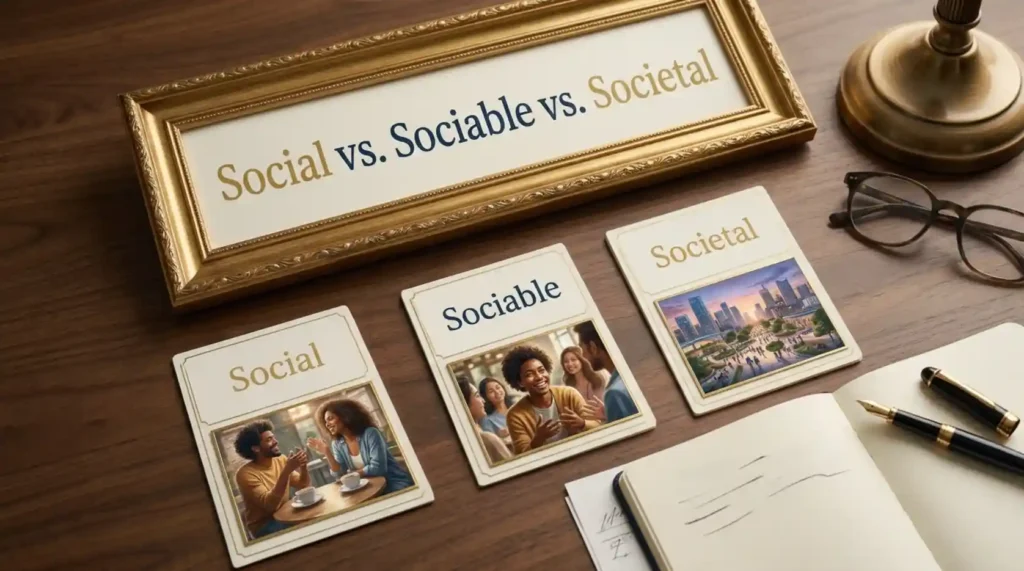
“Social” is broad, while sociable describes people and societal describes society. Choosing the right word depends on whether you mean personality, shared activity, or society-wide matters.
| Word | Main Focus | Example |
| Social | Company, society, or group life in general | She has an active social life. |
| Sociable | A person who enjoys company | He is sociable and easy to talk to. |
| Societal | Society as a whole | The law led to societal change. |
| Communal | Shared by a group or community | They use a communal kitchen. |
| Convivial | A lively, cheerful atmosphere | The party was warm and convivial. |
Sources: Merriam-Webster; Collins English Thesaurus.
Social and Opposite/Paired Word Pairs
| Word | Paired Word | Note |
| Social | Solitary | “Solitary” contrasts with living or spending time with others. |
| Sociable | Unsociable | “Unsociable” describes someone who avoids company. |
| Gregarious | Solitary | This contrast is common for people and animals. |
| Social | Private | “Private” contrasts with public or community life. |
| Communal | Individual | “Communal” means shared; “individual” means belonging to one person. |
| Societal | Personal | “Societal” concerns society; “personal” concerns one person. |
| Social | Economic | These words are often paired when discussing policy or conditions. |
These pairs help show the different directions of “social”: toward company, community, society, or public life. The best opposite depends on whether you are describing a person, a resource, or a large-scale issue.
Sources: Merriam-Webster; Cambridge English Thesaurus.
Common Word Partners of “Social”

| Pattern | Common Partners | Example |
| Social + life | Social life, social calendar, social circle | She moved to the city for a better social life. |
| Social + event | Social event, social gathering, social occasion | The charity hosts a social event each spring. |
| Social + media | Social media, social media platform | Many small businesses use social media to reach customers. |
| Social + issue | Social issue, social problem, social concern | Poverty remains a major social issue. |
| Social + policy | Social policy, social program, social welfare | The government expanded its social welfare programs. |
| Social + skills | Social skills, interpersonal skills | Group projects can help children build social skills. |
| Social + group | Social group, social class, social network | He joined a social group for new parents. |
Sources: Merriam-Webster; Collins English Thesaurus.
Idiomatic Phrases Featuring “Social”
1. Social butterfly
- Meaning: A person who enjoys going to many social events and meeting many people.
- Example: My sister is a social butterfly; she knows everyone in town.
2. Social climber
- Meaning: Someone who tries to improve their social status, often by making useful friends.
- Example: The novel portrays him as a social climber who only attends parties with influential people.
3. Social animal
- Meaning: A person or animal that naturally lives, works, or interacts with others.
- Example: Humans are social animals, so isolation can be difficult.
4. Social life
- Meaning: A person’s activities and relationships outside work, school, or family duties.
- Example: After starting her new job, she had little time for a social life.
Sources: Merriam-Webster; Collins English Thesaurus.
Word Formation of “Social”
Etymology & Structure
“Social” comes from Latin socialis, meaning “of companionship,” “of allies,” or “living with others.” It derives from socius, meaning “companion” or “ally.” English received the word through French as well as directly from Latin.
Date and History
Etymonline records “social” in English from the early 1400s, first meaning “devoted to or relating to home life.” By the 1560s, it meant “living with others”; by the 1660s, it could mean enjoyed in the company of others. The noun “social,” meaning a friendly informal gathering, is recorded from 1870.
Word Class Variations
- Adjective: social — “a social event”
- Noun: social — “a school social”
- Noun, plural: socials — “two school socials”
- Related noun: society — “modern society”
- Related adjective: societal — “societal change”
- Related noun: socialization — “early socialization”
- Related verb: socialize — “They socialize after work.”
Sources: Etymonline; Merriam-Webster.
Common Word-Choice Mistakes
- “He is very societal”: “He is very sociable.”
- “A societal event at school”: “A social event at school.”
- “She has strong social abilities”: “She has strong social skills” or “strong interpersonal skills.”
- “The wolves are societal animals”: “The wolves are social animals” or “gregarious animals.”
- “We had a convivial meeting with the bank manager”: “We had a cordial meeting with the bank manager.”
- “The communal issue of poverty”: “The social issue of poverty” or “the societal issue of poverty.”
- “They attended a friendly”: “They attended a get-together” or “a social gathering.”
Frequently Asked Questions
What is the closest synonym for social?
For a person, sociable is usually the closest synonym. For society-wide matters, societal is often the best formal replacement.
What is the difference between social and sociable?
“Social” can describe people, activities, society, and events. “Sociable” describes a person who enjoys being with other people.
What is a formal alternative to social?
Societal is formal when discussing society. Cordial, convivial, and companionable are formal alternatives in certain people-and-atmosphere contexts.
What is a good alternative for “social animal”?
Use gregarious animal if you mean an animal that lives or gathers in groups. You can also say social species in scientific writing.
What can replace “social media”?
There is no exact one-word synonym. Depending on context, use online platforms, digital platforms, or networking platforms.
What is the opposite of social?
For people, unsociable or solitary is often the opposite. For resources or spaces, private or individual may be the better contrast.
Can “social” describe an event?
Yes. As a noun, “a social” means an informal gathering. Natural replacements include get-together, gathering, party, and function.
Is “friendly” the same as “social”?
No. “Friendly” means kind or welcoming, while “social” can also mean relating to society, groups, or shared activities. A friendly person is not necessarily highly social.
What is a literary alternative to social?
Convivial is a literary and formal alternative for a cheerful, sociable atmosphere. Genial and companionable are also more literary than everyday alternatives.
Is “communal” the same as “social”?
Not exactly. “Communal” means shared by a group or community, while “social” has a much wider range of meanings.
Conclusion
The most common alternatives to social are sociable, outgoing, friendly, and gregarious for people. For society-wide topics, societal, communal, civic, and public are usually stronger choices.
Because “social” covers personality, companionship, community, society, and events, no single synonym fits every sentence. The surrounding noun and the writer’s purpose determine the best word.
Choose sociable for a person, convivial for a lively atmosphere, communal for something shared, societal for society-wide issues, and get-together or gathering for an event.
