Does Acceptable Really Fit? 30 Other Words to Express Your Meaning
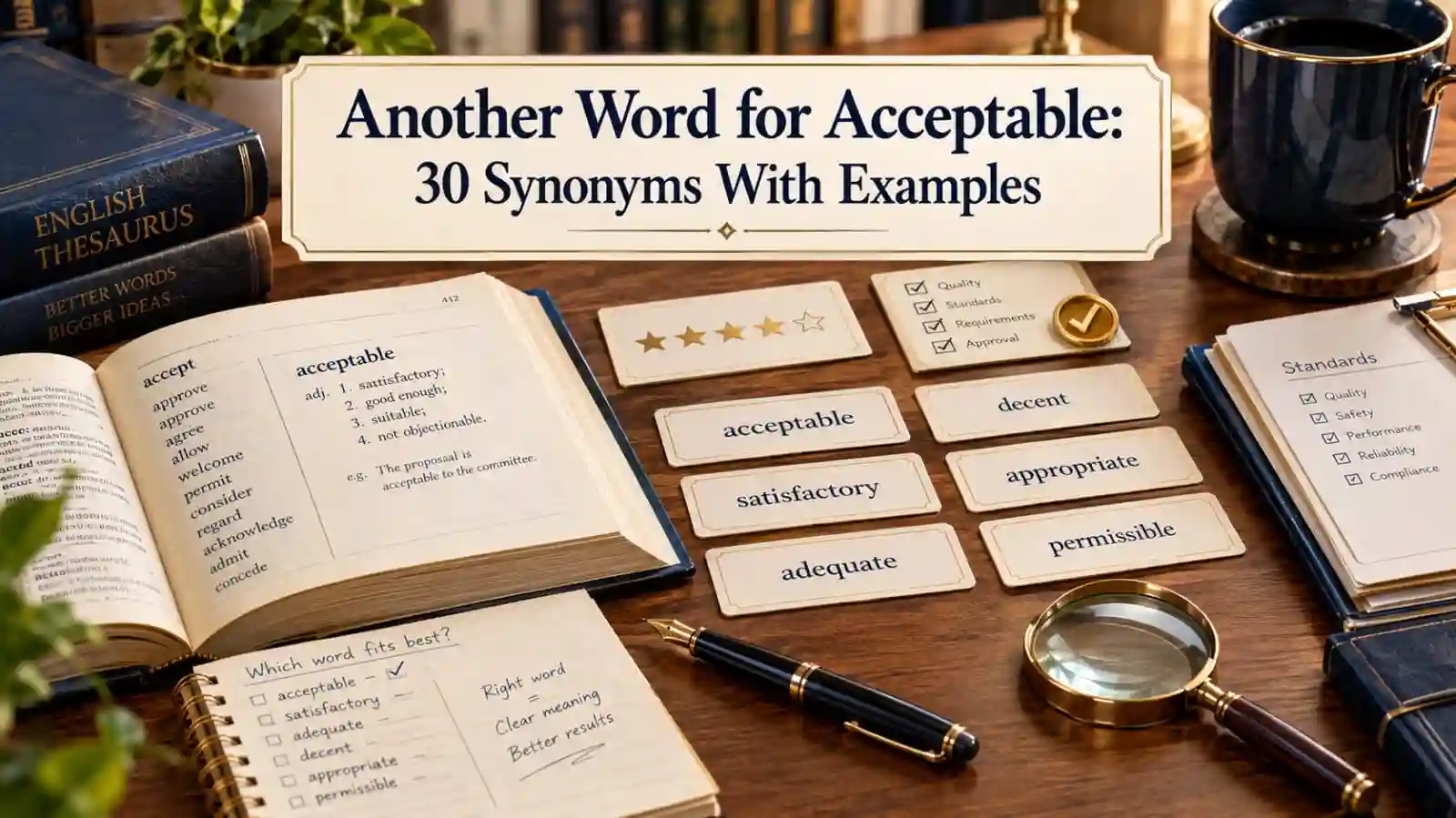
Another word for “acceptable” is satisfactory, adequate, fine, okay, or decent. These words work when something is good enough to pass.If you mean “allowed,” try permissible. If the context calls for something “fitting for the situation,” go with appropriate. When you only mean “just barely good enough,” opt for tolerable or passable.
The best choice depends on what you mean. “Acceptable” can describe quality, rules, manners, or feelings. It can be warm, as in a welcome gift, or lukewarm, as in an average meal. A word that fits one sense can sound odd in another.
Quick list: satisfactory, adequate, decent, fine, okay, reasonable, tolerable, passable, permissible, appropriate
This article looks at 30 alternatives. Each one has a meaning, IPA, usage note, and example sentence, and the words are grouped by context.
At a Glance: Acceptable Synonyms and Related Alternatives
| Alternative | Part of Speech | Meaning | Register / Tone | Ideal Context |
| Satisfactory | Adjective | Good enough to meet a need or standard | Neutral to formal | Grades, reports, service |
| Adequate | Adjective | Enough for a purpose | Neutral | Supplies, skills, performance |
| Decent | Adjective | Of fairly good quality | Informal to neutral | Everyday quality |
| Fine | Adjective | Good enough; no problem | Casual | Replying to offers or plans |
| Tolerable | Adjective | Able to be put up with | Neutral, lukewarm | Mild complaints |
| Passable | Adjective | Barely good enough | Neutral, slightly negative | Low-quality but usable things |
| Permissible | Adjective | Allowed by rules | Formal | Rules, law, policy |
| Appropriate | Adjective | Right for the situation | Neutral to formal | Behavior, clothing, language |
| Agreeable | Adjective | Pleasing or welcome | Polite, slightly formal | Plans, terms, offers |
| Accepted | Adjective | Generally approved or used | Neutral | Customs, theories, methods |
Which Word Should You Use?
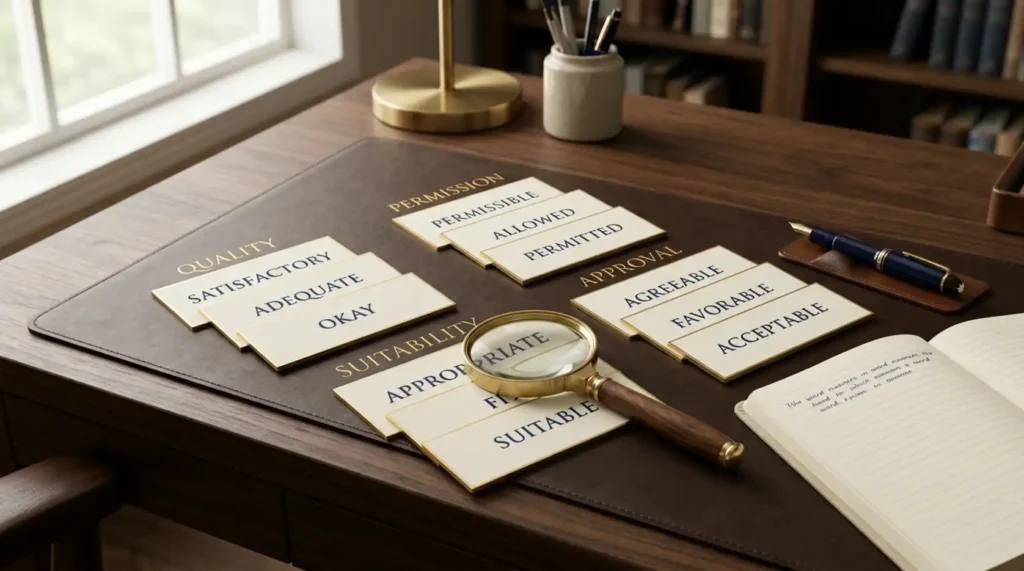
| If you want to… | Use | Why |
| Say something meets the standard | satisfactory | It suggests a standard was checked and met. |
| Say there is just enough | adequate | It focuses on being enough for the purpose. |
| Sound relaxed and casual | okay or fine | Both are common in speech and informal writing. |
| Say it is barely good enough | passable or tolerable | Both suggest low quality that can still be used. |
| Say the rules allow it | permissible | It is about permission, not quality. |
| Say it fits the setting or manners | appropriate | It points to what is right for the situation. |
| Say something is welcome or pleasing | agreeable | It points to a pleasing or welcome result. |
| Say most people approve of it | accepted | It points to general agreement. |
Exploring the Multiple Meanings of “Acceptable”
1. Worthy of Being Accepted
- Meaning: Capable or worthy of being accepted.
- Explanation: This is the main sense. Something meets a standard or need, so people will take it. It can describe terms, excuses, offers, or ideas.
- Example: Both sides agreed on a plan that was acceptable to everyone.
2. Socially or Morally Allowed
- Meaning: Within the limits of approved behavior or rules.
- Explanation: Here the word is about what a group, community, or rule set will allow. This is why “socially acceptable” is so common. It is stronger on approval than on quality.
- Example: Shouting in a library is not acceptable.
3. Welcome or Pleasing
- Meaning: Welcome, pleasing.
- Explanation: This sense is warmer and a little formal. It often describes gifts, news, or gestures that people are glad to receive.
- Example: A cool drink is always acceptable on a hot day.
4. Barely Good Enough
- Meaning: Barely satisfactory or adequate.
- Explanation: The word can be lukewarm. Saying a meal was “acceptable” suggests it was not bad but not memorable either. Tone and context decide If it is praise or mild criticism.
- Example: The hotel room was acceptable, but nothing special.
Sources: Merriam-Webster; Dictionary.com; Vocabulary.com
Analyzing 30 Acceptable Alternatives in Detail
Some of these words are close synonyms of “acceptable,” while others fit only one sense or context. Each usage note says which is which.
Core Everyday Alternatives
1. Satisfactory
IPA: /ˌsætɪsˈfæktəri/ (US and UK)
Definition: Good enough to meet a need, standard, or requirement.
- Usage: A close synonym for the “meets the standard” sense. It is neutral to formal and common in school, work, and service settings.
- Example: Her work was satisfactory, and she passed the review.
2. Adequate
IPA: /ˈædɪkwət/ (US and UK)
Definition: Enough in amount or quality for a particular need.
- Usage: A close synonym. It stresses sufficiency, not praise, so it can sound lukewarm.
- Example: The room was small but adequate for one night.
3. Decent
IPA: /ˈdiːsənt/ (US and UK)
Definition: Of a fairly good standard or quality.
- Usage: A close synonym in everyday speech. It sounds a little warmer than “adequate.”
- Example: We found a decent restaurant near the station.
4. Fine
IPA: /faɪn/ (US and UK)
Definition: Good enough; without a problem.
- Usage: A casual alternative. It is common as a reply, but it can sound flat or reluctant depending on tone.
- Example: “Is Tuesday acceptable?” “Tuesday is fine.”
5. Okay
IPA: US /ˌoʊˈkeɪ/ · UK /ˌəʊˈkeɪ/
Definition: Acceptable or satisfactory, but not outstanding.
- Usage: A close, informal synonym. It suits speech and messages but is less suitable for formal writing.
- Example: The food was okay, but the service was slow.
6. Reasonable
IPA: US /ˈriːzənəbəl/ · UK /ˈriːznəbl/
Definition: Fair, sensible, and not extreme.
- Usage: A related alternative. It fits prices, requests, and terms that are fair, and it does not fit every use of “acceptable.”
- Example: We thought the price was reasonable.
Alternatives for “Barely Good Enough”
7. Sufficient
IPA: /səˈfɪʃənt/ (US and UK)
Definition: Enough to meet a need.
- Usage: A related alternative. It is about amount, not quality, so it works best with things you can measure.
- Example: Two hours is sufficient time to finish the test.
8. Tolerable
IPA: US /ˈtɑːlərəbəl/ · UK /ˈtɒlərəbl/
Definition: Good enough to be put up with, though not good.
- Usage: A close synonym for the weaker sense. It often suggests something was not good but could be endured.
- Example: The heat was tolerable once we sat in the shade.
9. Passable
IPA: US /ˈpæsəbəl/ · UK /ˈpɑːsəbl/
Definition: Good enough to pass, but not very good.
- Usage: A close synonym for “barely good enough.” It sounds mildly critical.
- Example: His French is passable, but he still needs practice.
10. Bearable
IPA: US /ˈbɛrəbəl/ · UK /ˈbeərəbl/
Definition: Possible to endure.
- Usage: A related alternative. It is used for unpleasant things you can get through, not for things that are simply fine.
- Example: The long trip was bearable with good music.
11. Middling
IPA: /ˈmɪdlɪŋ/ (US and UK)
Definition: Of medium quality; neither good nor bad.
- Usage: A related alternative. It describes average quality, so it is only a loose match for “acceptable.”
- Example: The reviews were middling, so we waited for better ones.
12. Serviceable
IPA: US /ˈsɜːrvɪsəbəl/ · UK /ˈsɜːvɪsəbl/
Definition: Useful and able to do the job, but plain.
- Usage: A related alternative. It fits tools, clothes, and equipment that work but are not fancy.
- Example: The old car was serviceable and got us home.
Alternatives for “Allowed”
13. Permissible
IPA: US /pərˈmɪsəbəl/ · UK /pəˈmɪsəbl/
Definition: Allowed by rules or law.
- Usage: A close synonym for the “allowed” sense. It is formal and about permission, not quality.
- Example: Phones are permissible in class only during breaks.
14. Allowable
IPA: US /əˈlaʊəbəl/ · UK /əˈlaʊəbl/
Definition: Able to be allowed, especially within set limits.
- Usage: A close synonym for the “within the rules” sense. It often appears with limits, costs, and amounts.
- Example: The form lists the allowable expenses.
15. Admissible
IPA: US /ədˈmɪsəbəl/ · UK /ədˈmɪsəbl/
Definition: Able to be accepted or considered, especially in a court or official process.
- Usage: A context-specific alternative, mainly for evidence, claims, and applications.
- Example: The judge ruled that the video was admissible.
16. Legitimate
IPA: /lɪˈdʒɪtəmət/ (US and UK)
Definition: Allowed by law, rules, or reasonable standards.
- Usage: A related alternative. It stresses that something is valid or lawful, not that it is merely good enough.
- Example: She gave a legitimate reason for being late.
17. Sanctioned
IPA: /ˈsæŋkʃənd/ (US and UK)
Definition: Officially approved or permitted.
- Usage: A related, formal alternative. It points to approval from an authority. Note that “sanction” can also mean “penalty,” so context matters.
- Example: It was a school-sanctioned event.
Alternatives for “Fitting and Proper”
18. Appropriate
IPA: US /əˈproʊpriət/ · UK /əˈprəʊpriət/
Definition: Right or suitable for a particular situation.
- Usage: A close synonym for the social sense of “acceptable.” It is common for clothing, behavior, and language.
- Example: A suit is appropriate for the interview.
19. Proper
IPA: US /ˈprɑːpər/ · UK /ˈprɒpə/
Definition: Right according to accepted rules or customs.
- Usage: A related alternative. It can sound strict or old-fashioned, so it suits rules and manners more than quality.
- Example: It is not proper to interrupt a speaker.
20. Suitable
IPA: US /ˈsuːtəbəl/ · UK /ˈsuːtəbl/
Definition: Right or fitting for a purpose or person.
- Usage: A related alternative. It says something fits a need, and it is less about approval or standards.
- Example: This film is suitable for young children.
21. Seemly
IPA: /ˈsiːmli/ (US and UK)
Definition: Fitting or proper in manners or behavior.
- Usage: A formal, somewhat old-fashioned alternative. It is more often used in the negative, as in “unseemly.”
- Example: Loud arguing was not seemly at the funeral.
22. Respectable
IPA: US /rɪˈspɛktəbəl/ · UK /rɪˈspektəbl/
Definition: Fairly good, or proper enough to earn respect.
- Usage: A related alternative. It can mean decent in quality or acceptable in social standing, depending on the sentence.
- Example: The team made a respectable score in its first match.
Alternatives for “Welcome and Pleasing”
23. Agreeable
IPA: US /əˈɡriːəbəl/ · UK /əˈɡriːəbl/
Definition: Pleasant, or willing to accept something.
- Usage: A close synonym for the warm sense. It is polite and slightly formal.
- Example: The terms were agreeable to both sides.
24. Welcome
IPA: /ˈwɛlkəm/ (US and UK)
Definition: Received gladly or with pleasure.
- Usage: A close synonym for the “pleasing” sense. It does not fit the “barely good enough” sense.
- Example: The rain was a welcome change after weeks of heat.
25. Pleasing
IPA: /ˈpliːzɪŋ/ (US and UK)
Definition: Giving pleasure or satisfaction.
- Usage: A related alternative. It is warmer than “acceptable” and suggests real enjoyment.
- Example: The colors in the room were pleasing to the eye.
26. Gratifying
IPA: /ˈɡrætɪfaɪɪŋ/ (US and UK)
Definition: Giving satisfaction or pleasure.
- Usage: A related, formal alternative. It is stronger than “acceptable” and is used for results or news.
- Example: It was gratifying to see the students improve.
Formal and Agreement-Based Alternatives
27. Accepted
IPA: /əkˈsɛptɪd/ (US and UK)
Definition: Generally approved or used.
- Usage: A related alternative. It means most people agree or use it, and it works for customs, methods, and theories.
- Example: This is the accepted way to cite a source.
28. Workable
IPA: US /ˈwɜːrkəbəl/ · UK /ˈwɜːkəbl/
Definition: Able to be used or carried out successfully.
- Usage: A related alternative. It suits plans and agreements that can work in practice.
- Example: They found a workable solution to the schedule problem.
29. Tenable
IPA: US /ˈtɛnəbəl/ · UK /ˈtenəbl/
Definition: Able to be defended or held against criticism.
- Usage: A context-specific, formal alternative. It fits arguments, positions, and theories, not food, rooms, or behavior.
- Example: Her argument was no longer tenable after the new data came in.
30. Unexceptionable
IPA: US /ˌʌnɪkˈsɛpʃənəbəl/ · UK /ˌʌnɪkˈsepʃənəbl/
Definition: Not open to objection; with nothing to criticize.
- Usage: A rare, formal alternative that is easy to confuse with “unexceptional.” It says no one could object, not that something is outstanding.
- Example: The board found her conduct unexceptionable.
Sources: Merriam-Webster; Dictionary.com; Vocabulary.com
Acceptable vs. Adequate vs. Satisfactory vs. Tolerable
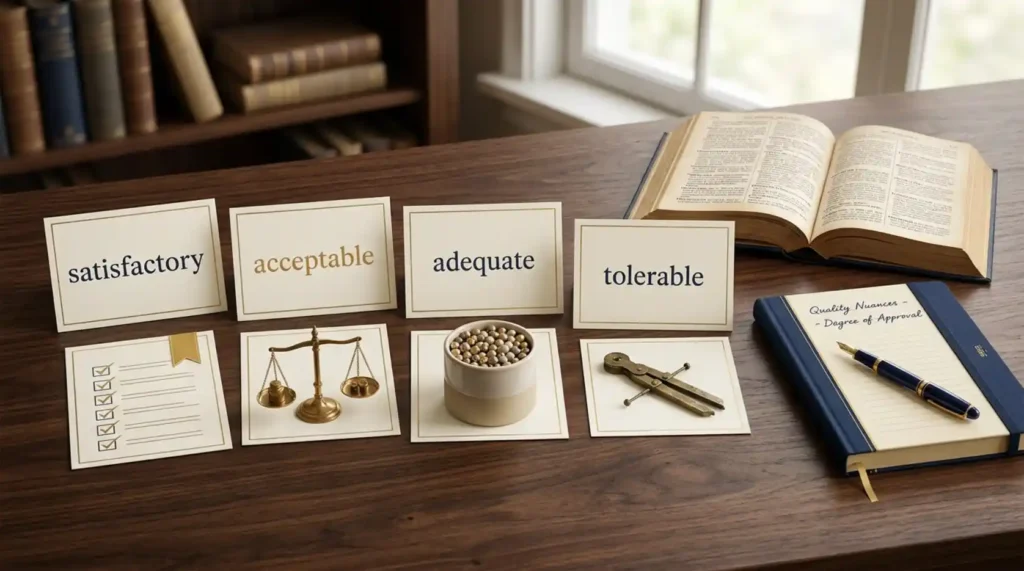
These four words are close, but they carry different amounts of approval. In general, “satisfactory” sounds the most positive, and “tolerable” the least.
| Word | What it stresses | Typical feeling |
| Satisfactory | The standard was met | Neutral to positive |
| Acceptable | It can be accepted | Neutral, sometimes lukewarm |
| Adequate | There is enough | Neutral to cool |
| Tolerable | It can be endured | Mildly negative |
Context can shift these shades. “Acceptable” can be warm in “a welcome and acceptable gift,” or cool in “an acceptable but dull meal.”
Sources: Merriam-Webster; Dictionary.com
Acceptable and Opposite/Paired Word Pairs
| Word | Paired Word | Note |
| Acceptable | Unacceptable | The most direct opposite. |
| Acceptable | Unsatisfactory | Opposite for quality and standards. |
| Acceptable | Objectionable | Used when people would object. |
| Acceptable | Inadmissible | Used for evidence or claims that cannot be accepted. |
| Acceptable | Unwelcome | Opposite for the “welcome” sense. |
| Acceptable | Excellent | A contrast in degree, not a true opposite. |
The right opposite depends on the sense. “Unacceptable” works almost everywhere, but “inadmissible” fits only formal or legal settings. “Excellent” is not an antonym, but it shows how modest “acceptable” can sound.
Sources: Merriam-Webster; Vocabulary.com
Common Word Partners of “Acceptable”
| Pattern | Common Partners | Example |
| Adverb + acceptable | perfectly, socially, generally, widely, mutually | It is perfectly acceptable to ask for help. |
| Acceptable + noun | level, standard, behavior, risk, range, alternative | The noise stayed at an acceptable level. |
| Acceptable + to | someone or a group | The plan was acceptable to both sides. |
| Acceptable + for | a purpose or person | The paper is acceptable for classroom use. |
| Acceptable + as | a role or form | A photocopy is acceptable as proof. |
Sources: Merriam-Webster (usage examples)
Idiomatic Phrases Featuring “Acceptable”
“Acceptable” has few true idioms. The phrases below are established expressions, not figurative idioms.
1. Acceptable risk
- Meaning: A level of danger that people judge to be worth taking.
- Example: The engineers called the small delay an acceptable risk.
2. Acceptable losses
- Meaning: Damage, cost, or loss that planners expect and are willing to bear.
- Example: The company treated a few late deliveries as acceptable losses.
3. Mutually acceptable
- Meaning: Agreeable to everyone involved.
- Example: The two teams found a mutually acceptable time to meet.
4. Acceptable use policy
- Meaning: A set of rules about how a system or service may be used.
- Example: Employees must read the acceptable use policy before logging in.
Sources: Merriam-Webster (entry for acceptable)
Word Formation of “Acceptable”
Etymology & Structure
“Acceptable” is a Middle English word borrowed from Anglo-French, which took it from Late Latin acceptābilis. That word comes from Latin acceptāre, “to accept,” plus -bilis, meaning “capable of being acted upon.” In modern terms, it is built as accept + -able.
Date and History
Merriam-Webster dates the first known use of “acceptable” to the 14th century.
Word Class Variations
- Adjective: acceptable
- Adverb: acceptably
- Nouns: acceptability, acceptableness
- Verb (root): accept
- Opposite: unacceptable
Sources: Merriam-Webster
Common Word-Choice Mistakes
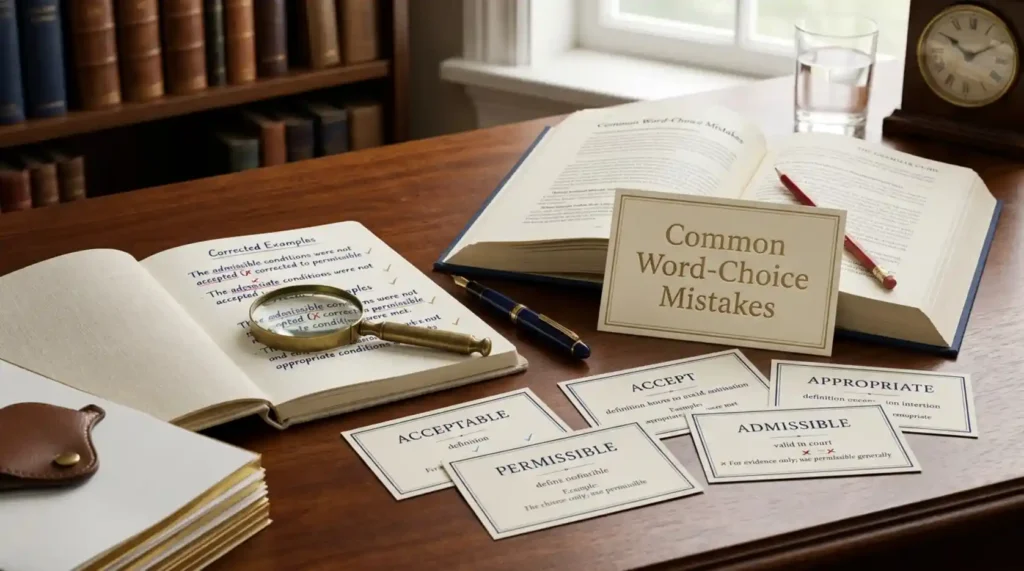
- “The cake was acceptable and I loved every bite”: use “delicious” or “excellent.” “Acceptable” is too mild for strong praise.
- “I acceptable your offer”: use “accept.” “Acceptable” is an adjective, not a verb.
- “That outfit is permissible for the party”: use “appropriate.” “Permissible” is about rules, not fit.
- “The judge ruled the photo acceptable evidence”: use “admissible” in a legal setting.
- “The price was acceptable for me”: use “acceptable to me.” “Acceptable to” is the usual pattern for a person or group.
- “It was exceptable work”: the spelling is “acceptable,” from “accept,” not “except.”
- “The speech was tolerable and moved everyone”: use “excellent” or “moving.” “Tolerable” suggests something merely endured.
Frequently Asked Questions
What is the closest synonym for “acceptable”?
“Satisfactory” is one of the closest, especially for work or quality that meets a standard. “Adequate” is also close when you mean “enough.”
What is a casual alternative?
“Okay” and “fine” are common in speech and informal writing.
What is a formal alternative?
“Satisfactory,” “permissible,” and “appropriate” fit formal writing, depending on the meaning.
Is “acceptable” the same as “good”?
No. “Acceptable” often means “good enough” and can sound lukewarm. “Good” is stronger.
What is the difference between “acceptable” and “permissible”?
“Permissible” means allowed by rules. “Acceptable” can also describe quality or fit, not just permission.
What is the difference between “acceptable” and “adequate”?
“Adequate” focuses on having enough for a purpose. “Acceptable” focuses on being worth accepting.
Can “acceptable” mean “welcome”?
Yes. In a warm sense, it can describe something pleasing, such as “a welcome and acceptable gift.”
What is the opposite of “acceptable”?
“Unacceptable” is the direct opposite. “Unsatisfactory” and “objectionable” fit some contexts.
Can “acceptable” describe people?
It can, but carefully. It usually describes behavior, work, or terms, and it can sound cold when applied to a person.
Is “acceptable” a strong compliment?
Usually not. It tends to suggest that something meets the minimum or is simply fine.
Conclusion
Common alternatives for “acceptable” include satisfactory, adequate, decent, fine, and okay. For weaker meanings, tolerable and passable fit. For rules and manners, permissible and appropriate fit better.
Context matters because “acceptable” covers quality, permission, social fit, and welcome news. A word that works for one sense can sound wrong in another. “Permissible” is not a good choice for a meal, and “tolerable” is not a good choice for praise.
To choose well, first decide which sense you mean. Then pick a word that matches the degree of approval you want. When unsure, “satisfactory” and “appropriate” are safe, clear choices in most settings.