

Another Word for Hinder: 30 Synonyms With Examples
The closest everyday alternatives to hinder are obstruct, impede, hamper, delay, and prevent. These words describe ways of making an action, process, or goal more difficult. However, each has a slightly different meaning. For example, delay means to make something happen later, while prevent means to stop it from happening.
The best alternative depends on what is causing the problem and how it affects the result. You might obstruct a path, hamper someone’s progress, impede development, or undermine a person’s confidence. Understanding these differences will help you choose the right word for everyday conversations, school assignments, business writing, and formal documents.
Quick list: Obstruct, impede, hamper, delay, prevent, block, restrain, inhibit, obstruct, interfere with.
Some of these alternatives overlap, but they are not interchangeable in every sentence. This guide explores 30 synonyms and related alternatives with definitions, IPA pronunciations, usage notes, natural examples, word relationships, common expressions, and practical tips for choosing the most accurate word.
At a Glance: Hinder Synonyms and Related Alternatives

| Alternative | Part of Speech | Meaning | Register / Tone | Ideal Context |
| Obstruct | Verb | Block a path or process | Neutral/formal | Roads, investigations |
| Impede | Verb | Slow progress or movement | Formal | Development, progress |
| Hamper | Verb | Make an activity harder | Neutral | Work, research |
| Delay | Verb | Make something happen later | Neutral | Travel, plans |
| Prevent | Verb | Stop something from happening | Neutral | Accidents, mistakes |
| Block | Verb | Stop movement or access | Neutral | Roads, access |
| Inhibit | Verb | Limit or hold back an action | Formal | Growth, behavior |
| Restrain | Verb | Hold back or control | Neutral/formal | Actions, emotions |
| Thwart | Verb | Stop a plan from succeeding | Formal | Plans, attempts |
| Interfere with | Verb phrase | Get in the way of an activity | Neutral | Work, decisions |
Which Word Should You Use?
| If you want to… | Use | Why |
| Describe something blocking a road or entrance | Obstruct | It suggests a barrier to movement or access. |
| Explain why progress is slow | Impede | It focuses on slowing movement or development. |
| Describe something making work difficult | Hamper | It fits tasks, research, and everyday activities. |
| Say that something makes an event happen later | Delay | It focuses on timing rather than complete prevention. |
| Explain why an action cannot happen | Prevent | It emphasizes stopping an action or event. |
| Describe a rule that limits choices | Restrict | It focuses on reducing freedom or options. |
| Explain why a plan failed | Thwart | It suggests defeating an effort or intention. |
| Describe something limiting natural growth or response | Inhibit | It often refers to development, reactions, or behavior. |
Exploring the Multiple Meanings of “Hinder”
The verb hinder has several closely related senses. In most cases, it means making progress, movement, or an action more difficult. It does not always mean stopping something completely.
1. To Make Progress More Difficult
- Meaning: To make it harder for someone or something to move forward or improve.
- Explanation: This is one of the most common uses of hinder. A lack of money, poor planning, or missing information can make progress slower.
- Example: A lack of trained staff can hinder the growth of a small business.
2. To Obstruct Movement
- Meaning: To get in the way of movement or passage.
- Explanation: This sense often describes physical barriers, crowded spaces, damaged roads, or conditions that make travel difficult.
- Example: Fallen trees hindered traffic after the storm.
3. To Delay an Action or Process
- Meaning: To slow something down or make it take longer.
- Explanation: When a problem hinders a process, the process may continue, but it takes more time or effort.
- Example: Bad weather hindered the rescue operation.
4. To Prevent or Stop Something
- Meaning: To stop someone from acting or stop an event from happening.
- Explanation: In this sense, hinder comes close to prevent. However, hinder often suggests difficulty or resistance rather than a complete stop.
- Example: Strict safety rules can hinder people from taking unnecessary risks.
5. To Limit Ability or Performance
- Meaning: To make it harder for someone to do something well.
- Explanation: Physical conditions, limited resources, or a lack of experience can hinder someone’s ability to perform a task.
- Example: Poor lighting hindered the students’ ability to read the instructions.
Analyzing 30 Hinder Alternatives in Detail

The following alternatives include direct synonyms and words that fit particular situations. The usage notes explain where their meanings differ from hinder.
Group 1: Closest Everyday Synonyms
1. Obstruct
IPA: US /əbˈstrʌkt/ · UK /əbˈstrʌkt/
Definition: To block or get in the way of something.
- Usage: A close synonym for hinder, especially when something blocks movement, access, or a process.
- Example: Parked cars obstructed the entrance to the building.
2. Impede
IPA: US /ɪmˈpiːd/ · UK /ɪmˈpiːd/
Definition: To slow down or make progress difficult.
- Usage: A formal alternative often used with progress, movement, growth, and development.
- Example: Poor internet access can impede students’ learning.
3. Hamper
IPA: US /ˈhæmpər/ · UK /ˈhæmpə/
Definition: To make an activity difficult or less effective.
- Usage: A natural alternative when a problem makes work or progress harder without necessarily stopping it.
- Example: A lack of funding hampered the research project.
4. Block
IPA: US /blɑːk/ · UK /blɒk/
Definition: To stop movement, access, or progress.
- Usage: More direct and everyday than impede. It can describe a physical barrier or an obstacle to an idea or plan.
- Example: A fallen tree blocked the road.
5. Delay
IPA: US /dɪˈleɪ/ · UK /dɪˈleɪ/
Definition: To make something happen later than expected.
- Usage: Use it when the main effect is lost time. It is not an exact replacement when something makes a task harder without changing its timing.
- Example: A computer problem delayed the launch.
Group 2: Stopping Actions and Defeating Plans
6. Prevent
IPA: US /prɪˈvent/ · UK /prɪˈvent/
Definition: To stop something from happening or someone from doing something.
- Usage: Stronger than hinder when the result is that an action does not happen at all.
- Example: Regular maintenance can prevent serious equipment failures.
7. Thwart
IPA: US /θwɔːrt/ · UK /θwɔːt/
Definition: To stop someone from achieving a goal or carrying out a plan.
- Usage: A strong, somewhat formal alternative for efforts, schemes, or intentions that are defeated.
- Example: The quick response thwarted the thieves’ plan.
8. Foil
IPA: US /fɔɪl/ · UK /fɔɪl/
Definition: To prevent a plan or attempt from succeeding.
- Usage: Closely related to thwart. It often emphasizes defeating a planned action rather than simply slowing it.
- Example: The security team foiled an attempt to enter the building.
9. Frustrate
IPA: US /ˈfrʌstreɪt/ · UK /frʌˈstreɪt/
Definition: To prevent a person, plan, or effort from achieving its purpose.
- Usage: Useful when obstacles defeat an effort or cause disappointment. It can also describe the emotional reaction to those obstacles.
- Example: Repeated technical problems frustrated our efforts to finish the project.
10. Stop
IPA: US and UK /stɒp/
Definition: To bring an activity or movement to an end.
- Usage: A simple, direct alternative when hinder means prevent. Unlike hinder, stop usually suggests that the action ends rather than merely becomes harder.
- Example: The guard stopped visitors from entering the restricted area.
Group 3: Limiting Freedom, Ability, or Development
11. Restrict
IPA: US /rɪˈstrɪkt/ · UK /rɪˈstrɪkt/
Definition: To limit the size, range, amount, or freedom of something.
- Usage: Best when rules, conditions, or limits reduce someone’s choices. It is related to hinder but does not always imply that progress becomes slower.
- Example: The new rules restrict access to the laboratory.
12. Inhibit
IPA: US /ɪnˈhɪbɪt/ · UK /ɪnˈhɪbɪt/
Definition: To prevent or slow an action, process, or response.
- Usage: A formal alternative often used for growth, development, natural processes, or behavior.
- Example: Fear of failure can inhibit creativity.
13. Restrain
IPA: US /rɪˈstreɪn/ · UK /rɪˈstreɪn/
Definition: To hold back, control, or limit someone or something.
- Usage: Emphasizes control rather than general difficulty. It fits actions, emotions, behavior, and movement.
- Example: The driver restrained his anger during the argument.
14. Curb
IPA: US and UK /kɜːrb/
Definition: To control or reduce something unwanted.
- Usage: Often used with spending, growth, violence, and pollution. It is a contextual alternative when hindering involves limiting an activity.
- Example: The city introduced new rules to curb air pollution.
15. Suppress
IPA: US /səˈpres/ · UK /səˈpres/
Definition: To stop something from developing, spreading, or being expressed.
- Usage: Stronger than hinder in many contexts. It may imply deliberate control over feelings, information, protests, or activity.
- Example: The policy was criticized for suppressing public debate.
Group 4: Creating Difficulties or Disadvantages
16.Hindered
IPA: US /ˈhændiˌkæp/ · UK /ˈhændɪkæp/
Definition: To put someone at a disadvantage.
- Usage: A contextual alternative when a condition makes success more difficult compared with others. It can sound insensitive when used carelessly about disability.
- Example: Limited equipment hindered the visiting team.
17. Hamstring
IPA: US /ˈhæmˌstrɪŋ/ · UK /ˈhæmˌstrɪŋ/
Definition: To severely limit someone’s ability to act or succeed.
- Usage: A vivid, informal-to-neutral alternative suggesting a serious restriction on a person’s or organization’s options.
- Example: A shortage of workers hamstrung the company’s expansion plans.
18. Hobble
IPA: US /ˈhɑːbəl/ · UK /ˈhɒbəl/
Definition: To make movement or progress difficult.
- Usage: Works literally for walking with difficulty and figuratively for progress that is severely limited.
- Example: High costs hobbled the small business.
19. Encumber
IPA: US /ɪnˈkʌmbər/ · UK /ɪnˈkʌmbə/
Definition: To burden or weigh someone or something down.
- Usage: A formal alternative when burdens, duties, possessions, or restrictions make action more difficult.
- Example: Too many approval steps encumbered the process.
20. Burden
IPA: US /ˈbɜːrdən/ · UK /ˈbɜːdən/
Definition: To place a heavy responsibility, cost, or difficulty on someone or something.
- Usage: Related to hinder when a burden reduces someone’s ability to make progress. It emphasizes the load or responsibility, not simply the obstruction.
- Example: Rising expenses burdened the family and delayed its plans.
Group 5: Disruption and Interference
21. Interfere with
IPA: US /ˌɪntərˈfɪr wɪð/ · UK /ˌɪntəˈfɪə wɪð/
Definition: To get in the way of an activity, process, or person’s actions.
- Usage: A natural alternative when one thing disturbs or affects another. It can also mean becoming involved in a matter without permission.
- Example: Loud music interfered with my ability to concentrate.
22. Disrupt
IPA: US /dɪsˈrʌpt/ · UK /dɪsˈrʌpt/
Definition: To interrupt the normal progress or operation of something.
- Usage: Emphasizes interruption or disorder rather than general difficulty.
- Example: The power outage disrupted classes across the school.
23. Interrupt
IPA: US /ˌɪntəˈrʌpt/ · UK /ˌɪntəˈrʌpt/
Definition: To stop something briefly by breaking into its progress.
- Usage: Use it for activities, conversations, or processes that are stopped temporarily. It is narrower than hinder.
- Example: Frequent phone calls interrupted her work.
24. Stall
IPA: US /stɔːl/ · UK /stɔːl/
Definition: To stop moving or progressing, often temporarily.
- Usage: A useful alternative when progress comes to a standstill. It can describe a process that stops advancing, rather than the cause of the problem.
- Example: The negotiations stalled over disagreements about cost.
25. Hold back
IPA: US and UK /hoʊld bæk/ in common US pronunciation; UK /həʊld bæk/
Definition: To prevent or slow progress, movement, or development.
- Usage: A common phrasal verb for personal, academic, or professional progress. It can also mean choosing not to reveal or express something.
- Example: A lack of confidence held him back during interviews.
Group 6: Discouragement and Other Contextual Alternatives
26. Deter
IPA: US /dɪˈtɜːr/ · UK /dɪˈtɜː/
Definition: To discourage someone from doing something or make them less likely to do it.
- Usage: Use it when fear, cost, risk, or another factor discourages action. It is not the best choice for a physical obstruction.
- Example: High travel costs deterred many visitors.
27. Dishearten
IPA: US /dɪsˈhɑːrtən/ · UK /dɪsˈhɑːtən/
Definition: To make someone lose confidence, hope, or courage.
- Usage: A related alternative when a person’s motivation is hindered by disappointment. It describes an emotional effect rather than a general obstacle.
- Example: Early failures did not dishearten the young inventor.
28. Undermine
IPA: US /ˌʌndərˈmaɪn/ · UK /ˌʌndəˈmaɪn/
Definition: To weaken something gradually or secretly.
- Usage: Best when confidence, trust, authority, or a plan is weakened over time. It is not an exact synonym for every kind of hindrance.
- Example: Constant criticism undermined her confidence.
29. Stymie
IPA: US /ˈstaɪmi/ · UK /ˈstaɪmi/
Definition: To prevent or make progress difficult.
- Usage: A useful but less common alternative, especially in journalism, business, and formal writing about efforts or plans.
- Example: A lack of reliable data stymied the investigation.
30. Throttle
IPA: US /ˈθrɑːtəl/ · UK /ˈθrɒtəl/
Definition: To restrict or control the flow, growth, or activity of something.
- Usage: A contextual alternative when something is deliberately limited or choked off. In ordinary use, it often refers to an engine’s power or the flow of a resource, so it does not replace hinder in every sentence.
- Example: Excessive red tape can throttle innovation.
Hinder vs. Impede vs. Hamper vs. Obstruct

These four words are among the most useful alternatives to hinder, but they emphasize different kinds of difficulty.
| Word | Main Focus | Example |
| Hinder | Make progress more difficult | Lack of sleep hindered his performance. |
| Impede | Slow movement or progress | Snow impeded traffic. |
| Hamper | Make an activity harder | Poor planning hampered the project. |
| Obstruct | Block a path, process, or access | A truck obstructed the entrance. |
Use hinder when you want a broad, flexible word. Choose impede for slower progress, hamper for difficulties that affect an activity, and obstruct when something gets directly in the way. These are useful distinctions, not absolute rules; the words can overlap in many sentences.
Hinder and Opposite/Paired Word Pairs
| Word | Paired Word | Note |
| Hinder | Help | Make progress difficult versus make it easier. |
| Obstruct | Clear | Block a route versus remove the blockage. |
| Impede | Facilitate | Slow a process versus make it easier. |
| Delay | Expedite | Make something later versus speed it up. |
| Prevent | Enable | Stop an action versus make it possible. |
| Restrict | Allow | Limit freedom versus permit it. |
| Suppress | Encourage | Hold something back versus promote its expression or growth. |
| Discourage | Motivate | Reduce willingness versus increase willingness. |
These pairs are useful for explaining the opposite of hinder in different situations. The closest general opposites are help, assist, aid, and facilitate. The best choice depends on If the original sentence concerns progress, access, timing, freedom, or motivation.
Common Word Partners of “Hinder”
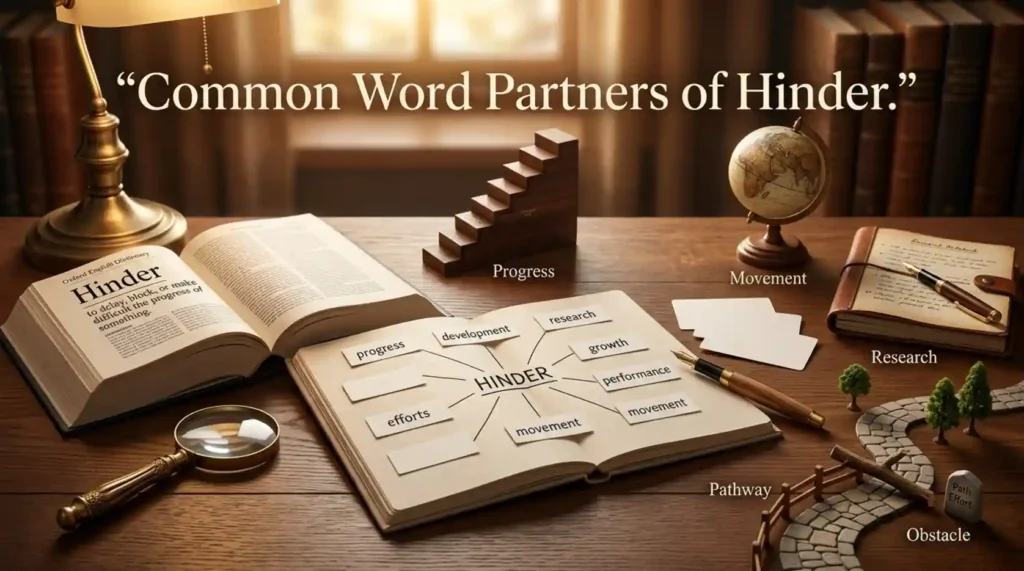
A collocation is a group of words that commonly appear together. These patterns help you use hinder naturally in speaking and writing.
| Pattern | Common Partners | Example |
| Hinder + progress | progress, development, growth | Poor planning hindered progress. |
| Hinder + activity | work, research, learning | Noise hindered my learning. |
| Hinder + effort | efforts, attempts, recovery | The shortage hindered recovery efforts. |
| Hinder + movement | movement, travel, access | Heavy snow hindered movement. |
| Hinder + process | process, investigation, negotiations | Missing records hindered the investigation. |
| Hinder + performance | performance, success, achievement | Stress can hinder performance. |
| Hinder + person | students, workers, teams | The lack of equipment hindered the team. |
| Be hindered by + cause | weather, costs, delays, lack of resources | The project was hindered by rising costs. |
| Hinder someone from + -ing | acting, moving, succeeding | Fear hindered him from speaking openly. |
The pattern hinder someone from doing something is especially useful when explaining why a person cannot act freely or confidently. The pattern be hindered by is helpful when describing the cause of a delay or difficulty.
Idiomatic Phrases Featuring “Hinder”
There are few widely recognized idioms containing the exact word hinder. However, several established expressions communicate the same idea of blocking, delaying, or limiting progress.
1. Stand in the Way
- Meaning: To prevent or make it difficult for someone to achieve something.
- Example: Do not let fear stand in the way of your education.
2. Hold Someone Back
- Meaning: To stop someone from making progress or reaching their full ability.
- Example: His lack of experience held him back at work.
3. Throw a Spanner in the Works
- Meaning: To cause an unexpected problem that disrupts a plan; this expression is especially common in British English. The common US equivalent is throw a wrench in the works.
- Example: The sudden cancellation threw a spanner in the works.
4. Put a Spoke in Someone’s Wheel
- Meaning: To interfere with someone’s plans or make success more difficult.
- Example: The unexpected rule change put a spoke in the team’s wheel.
These expressions are not interchangeable in every context. Stand in the way is broad, hold someone back often focuses on personal progress, and the two mechanical expressions emphasize interference with a plan.
Word Formation of “Hinder”
Etymology & Structure
The verb hinder comes from Old English hindrian, meaning to harm, injure, impair, or hold back. It is related to words in other Germanic languages, including German hindern and Dutch hinderen, both meaning to hinder or obstruct. Its central idea is to hold something back or make progress more difficult.
In modern English, hinder is mainly a verb. It can take a direct object, as in “The storm hindered our progress.” It can also appear in passive constructions, such as “The project was hindered by bad weather.”
Date and History
Dictionary.com records the verb’s first appearance in English before 1000. The modern verb developed from Old English hindrian, while the related adjective hinder, meaning situated toward the back, has a separate history of use and pronunciation. The verb is pronounced /ˈhɪndər/ in American English and /ˈhɪndə/ in standard non-rhotic British English.
Word Class Variations
| Word Form | Part of Speech | Meaning | Example |
| Hinder | Verb | Make progress difficult | Noise can hinder learning. |
| Hindered | Past tense / past participle | Made difficult or delayed | Rain hindered the match. |
| Hindering | Present participle / adjective | Causing difficulty or delay | The hindering conditions slowed the work. |
| Hindrance | Noun | Something that causes difficulty | Poor communication was a hindrance. |
| Hinderer | Noun, uncommon | Someone or something that hinders | The term is rare in everyday English. |
| Unhindered | Adjective | Not blocked or restricted | The team continued unhindered. |
The most useful related words are hindrance, hindering, hindered, and unhindered. The noun hindrance refers to the obstacle or difficulty, while unhindered describes progress that occurs without interference.
Common Word-Choice Mistakes

- Using delay when you mean complete prevention: Use prevent when an event is stopped from happening, not merely postponed.
- Using obstruct for every kind of difficulty: Use hamper or impede when the problem slows progress without physically blocking a route.
- Using deter for a physical barrier: Use obstruct for a blocked passage; deter means to discourage someone from acting.
- Confusing restrict with hinder: A rule may restrict someone’s choices without necessarily slowing their progress.
- Using thwart for a minor delay: Reserve thwart for cases where an effort or plan is defeated.
- Confusing interfere with and prevent: Something can interfere with your work without stopping it completely.
- Using hinder as a noun: Write “The delay was a hindrance,” not “The delay was a hinder.”
Frequently Asked Questions
1. What is the closest synonym for hinder?
Obstruct, impede, and hamper are among the closest synonyms. Use obstruct for a blockage, impede for slowed progress, and hamper when an activity becomes more difficult.
2. What is a simple word for hinder?
Block is a simple alternative when something gets in the way. Delay works when it makes something happen later, while make harder is a clear everyday phrase for the broader meaning.
3. Is impede stronger than hinder?
Not always. Impede sounds more formal and often emphasizes slowing progress, while hinder is broader and more common in general writing.
4. What is the difference between hinder and prevent?
Hinder means to make something more difficult or slow it down. Prevent means to stop something from happening or stop someone from doing something.
5. What is a formal alternative to hinder?
Impede, inhibit, and obstruct are useful formal alternatives. Choose the word that best matches the situation rather than selecting one simply because it sounds more academic.
6. What is a strong word for hinder?
Thwart is strong when someone defeats a plan or attempt. Hamstring suggests severely limiting someone’s ability to act or succeed.
7. What is the opposite of hinder?
Common opposites include help, assist, aid, facilitate, and promote. The best choice depends on If you mean supporting a person, speeding up a process, or encouraging development.
8. Can hinder be used for people?
Yes. You can say, “The lack of training hindered the workers.” You can also say, “He hindered his colleague’s progress,” meaning he made it harder for the colleague to succeed.
9. What is the noun form of hinder?
The main noun form is hindrance, meaning something that causes difficulty or delay. For example: “Poor planning became a hindrance to the project.”
10. Is hinder a negative word?
Usually, yes. It describes something that makes progress, movement, or an action more difficult. However, it does not always suggest that someone is deliberately causing the problem.
Conclusion
The most useful alternatives to hinder include obstruct, impede, hamper, delay, and prevent. Each expresses a slightly different kind of difficulty, from blocking movement to slowing progress or stopping an action.
Context matters when choosing a synonym. Impede suits formal writing about progress, hamper works well for difficult tasks, and thwart describes a plan that has been defeated. Related words such as restrict, deter, and undermine fit more specific situations.
To choose the right word, consider what is being affected and how. Is something blocking access, slowing progress, limiting freedom, or stopping a plan? Once you identify the exact meaning, you can choose a clear, natural alternative that fits your sentence.