Another Word for Shy: 30 Synonyms With Examples
The closest everyday alternatives to “shy” are timid, bashful, and reserved. For a more formal tone, try diffident. For someone who is nervous or easily scared, try timorous or skittish.
The best word depends on what kind of shy you mean. A shy person may be nervous around strangers, embarrassed in front of others, quiet by nature, or simply cautious. “Shy” can also describe a frightened animal or mean “short of,” as in “two dollars shy of the price.”
Quick list: timid, bashful, reserved, diffident, retiring, self-conscious, sheepish, reticent, withdrawn, demure
This article looks at 30 alternatives. Each one comes with a meaning, IPA, a usage note, and an example, so you can choose the right word for the situation.
At a Glance: Shy Synonyms and Related Alternatives
| Alternative | Part of Speech | Meaning | Register / Tone | Ideal Context |
| Timid | adjective | Lacking courage or confidence | Neutral | Describing people or animals that avoid risk |
| Bashful | adjective | Shy and easily embarrassed | Neutral, slightly gentle | Children, compliments, first meetings |
| Reserved | adjective | Slow to share thoughts or feelings | Neutral to formal | Describing a person’s manner |
| Diffident | adjective | Lacking self-confidence; hesitant to speak | Formal | Writing about someone unsure of their worth |
| Retiring | adjective | Avoiding attention and company | Formal, slightly old-fashioned | Describing a private, modest person |
| Self-conscious | adjective | Uncomfortably aware of being watched | Neutral | Moments of embarrassment |
| Sheepish | adjective | Embarrassed, often after a mistake | Informal to neutral | Awkward smiles and apologies |
| Reticent | adjective | Unwilling to speak openly | Formal | Reluctance to share information |
| Withdrawn | adjective | Pulling back from others socially | Neutral | Someone who avoids company |
| Demure | adjective | Modest and quiet in manner | Formal, literary | Describing reserved, polite behavior |
Which Word Should You Use?
| If you want to… | Use | Why |
| Describe someone who is nervous around people | timid | It is the plainest and most common alternative. |
| Describe a child who goes red when praised | bashful | It suggests gentle, easy embarrassment. |
| Describe someone who keeps feelings private | reserved | It suggests control, not fear. |
| Write formally about low self-confidence | diffident | It fits essays, reviews, and reports. |
| Describe embarrassment after a mistake | sheepish | It focuses on the awkward feeling, not personality. |
| Describe someone who avoids company | withdrawn | It suggests pulling away, not just being quiet. |
| Describe a frightened animal | skittish | It means easily startled. |
| Say someone avoids something because of past trouble | gun-shy | It means wary because of a bad experience. |
Exploring the Multiple Meanings of “Shy”

1. Nervous or Uncomfortable Around People
- Meaning: Feeling nervous or awkward with other people, especially strangers.
- Explanation: This is the most common sense. It describes a person’s manner, and it can be a lasting trait or a short-term feeling.
- Example: She was too shy to ask a question in class.
2. Easily Frightened (Animals)
- Meaning: Easily scared or startled, especially of animals.
- Explanation: This is the oldest English sense. It was first used of horses, and it still describes wild or nervous animals.
- Example: The deer is shy and will run if you move too fast.
3. Wary or Unwilling
- Meaning: Cautious about doing something, or unwilling to do it.
- Explanation: This sense appears in “shy of” and “shy away from.” It often points to a specific fear or a past bad experience.
- Example: After losing money once, he became shy of risky investments.
4. Lacking or Short Of (Informal)
- Meaning: Short of a required amount or number.
- Explanation: This sense is not about personality at all. It is used with “of” and has no link to nervousness.
- Example: We were two votes shy of a majority.
5. To Recoil or Avoid (Verb)
- Meaning: To move back suddenly in fear, or to avoid something.
- Explanation: As a verb, “shy” is most often used in the phrase “shy away from.”
- Example: The horse shied at the loud noise.
Sources: Etymonline (shy, shyness); Merriam-Webster; Collins Dictionary.
Analyzing 30 Shy Alternatives in Detail
Some of these words are direct synonyms of “shy,” while others are related alternatives that fit only certain contexts. Each Usage note says which is which.
Core Synonyms
1. Timid
IPA: /ˈtɪmɪd/ (US and UK)
Definition: Lacking courage or self-confidence; easily frightened.
- Usage: A direct synonym and the most common everyday alternative. It leans more toward fear than “shy” does.
- Example: The timid puppy hid behind the sofa.
2. Bashful
IPA: /ˈbæʃfəl/ (US and UK)
Definition: Shy and easily embarrassed in front of others.
- Usage: A direct synonym with a gentle, slightly old-fashioned tone. It often describes children or blushing reactions.
- Example: The bashful boy hid his face when everyone clapped.
3. Reserved
IPA: US /rɪˈzɜːrvd/ · UK /rɪˈzɜːvd/
Definition: Slow to show feelings or share thoughts with others.
- Usage: A close synonym, but it suggests self-control more than fear. A reserved person may be confident and simply private.
- Example: He is reserved at work but talkative with close friends.
4. Diffident
IPA: /ˈdɪfɪdənt/ (US and UK)
Definition: Lacking confidence in oneself and unwilling to speak up.
- Usage: A direct synonym in formal English. It focuses on self-doubt, not just nervousness.
- Example: She was diffident about showing her paintings.
5. Retiring
IPA: /rɪˈtaɪərɪŋ/ (US and UK)
Definition: Preferring to avoid attention and company.
- Usage: A close synonym with a formal, somewhat dated tone. It describes a quiet, private nature.
- Example: The retiring author rarely gave interviews.
Quiet and Private Personalities
6. Quiet
IPA: /ˈkwaɪət/ (US and UK)
Definition: Not speaking much; calm and not noisy.
- Usage: A related alternative, not an exact synonym. A quiet person may not be nervous at all.
- Example: He is a quiet student who prefers to listen.
7. Introverted
IPA: US /ˈɪntrəvɜːrtɪd/ · UK /ˈɪntrəvɜːtɪd/
Definition: Focused on one’s own thoughts and feelings; preferring time alone.
- Usage: A related alternative. Introversion is about preference, while shyness is about discomfort, so the two are not the same.
- Example: As an introverted person, she needs time alone after parties.
8. Reticent
IPA: /ˈrɛtɪsənt/ (US and UK)
Definition: Unwilling to speak freely or share information.
- Usage: A related alternative in formal English. It describes holding back words, often by choice.
- Example: The witness was reticent about what she had seen.
9. Withdrawn
IPA: /wɪðˈdrɔːn/ (US and UK)
Definition: Quiet and avoiding contact with other people.
- Usage: A related alternative. It suggests pulling away from people, and it can imply sadness or stress, so it is stronger than “shy.”
- Example: After the move, the boy became withdrawn at school.
10. Unassuming
IPA: US /ˌʌnəˈsuːmɪŋ/ · UK /ˌʌnəˈsjuːmɪŋ/
Definition: Not drawing attention to oneself; modest.
- Usage: A related alternative. It is positive in tone and describes a lack of showiness, not nervousness.
- Example: He was an unassuming man who never talked about his success.
Self-Conscious and Embarrassed
11. Self-conscious
IPA: US /ˌsɛlfˈkɑːnʃəs/ · UK /ˌsɛlfˈkɒnʃəs/
Definition: Feeling uncomfortably aware of how others see you.
- Usage: A close alternative. It describes a feeling in a moment, not always a lasting trait.
- Example: She felt self-conscious about singing in front of the class.
12. Sheepish
IPA: /ˈʃiːpɪʃ/ (US and UK)
Definition: Embarrassed because you know you have done something silly or wrong.
- Usage: A related alternative. It describes a short moment of embarrassment, not a shy personality.
- Example: He gave a sheepish grin when he arrived late.
13. Coy
IPA: /kɔɪ/ (US and UK)
Definition: Pretending to be shy, or unwilling to give clear information.
- Usage: A related alternative, not an exact synonym. Coy often suggests playful or deliberate shyness, and it can mean avoiding a direct answer.
- Example: She was coy about where she had bought the dress.
14. Abashed
IPA: /əˈbæʃt/ (US and UK)
Definition: Embarrassed and ashamed.
- Usage: A related alternative in formal or literary English. It describes a reaction to embarrassment, not a lasting trait.
- Example: The boy looked abashed when the teacher praised him.
15. Demure
IPA: US /dɪˈmjʊr/ · UK /dɪˈmjʊə/
Definition: Modest and quiet in manner.
- Usage: A close alternative in formal or literary English. It often suggests politeness and calm modesty, and it has traditionally been used for women.
- Example: She gave a demure smile and said nothing.
Fearful and Nervous
16. Timorous
IPA: /ˈtɪmərəs/ (US and UK)
Definition: Easily frightened and lacking courage.
- Usage: A close synonym of “timid” in formal or literary English. It is stronger and less common in everyday speech.
- Example: The timorous child would not cross the dark hall.
17. Fearful
IPA: US /ˈfɪrfəl/ · UK /ˈfɪəfəl/
Definition: Afraid or full of fear.
- Usage: A related alternative. It shows fear but does not suggest the social awkwardness that “shy” often does.
- Example: She felt fearful about meeting so many strangers.
18. Nervous
IPA: US /ˈnɜːrvəs/ · UK /ˈnɜːvəs/
Definition: Worried or anxious about something.
- Usage: A related alternative. It describes a feeling, not a personality, and anyone can be nervous before a big event.
- Example: He was nervous about speaking to the new manager.
19. Skittish
IPA: /ˈskɪtɪʃ/ (US and UK)
Definition: Easily frightened or startled.
- Usage: A related alternative that matches the “easily scared” sense of “shy.” It is most often used for animals, but it can describe jumpy people.
- Example: The skittish horse bolted at the sound of the gate.
20. Apprehensive
IPA: /ˌæprɪˈhɛnsɪv/ (US and UK)
Definition: Worried that something bad may happen.
- Usage: A related alternative. It is about worry over what is coming, not about social discomfort.
- Example: She felt apprehensive about the first day at her new school.
Meek and Modest
21. Meek
IPA: /miːk/ (US and UK)
Definition: Quiet, gentle, and not likely to argue.
- Usage: A related alternative. It suggests a mild, easily led nature more than shyness.
- Example: The meek clerk never complained about anything.
22. Modest
IPA: US /ˈmɑːdɪst/ · UK /ˈmɒdɪst/
Definition: Not talking much about one’s own abilities or success.
- Usage: A related alternative. It describes humility, not nervousness, so it fits only when “shy” means “not showing off.”
- Example: She is modest about winning the prize.
23. Mousy
IPA: /ˈmaʊsi/ (US and UK)
Definition: Shy, quiet, and unremarkable in appearance or manner.
- Usage: A related alternative with a slightly negative, informal tone. It can sound unkind.
- Example: The mousy assistant spoke so softly that no one noticed her.
24. Soft-spoken
IPA: US /ˌsɔːftˈspoʊkən/ · UK /ˌsɒftˈspəʊkən/
Definition: Speaking in a quiet, gentle voice.
- Usage: A related alternative. It describes how someone speaks, not If they are nervous.
- Example: He is a soft-spoken teacher who rarely raises his voice.
25. Self-effacing
IPA: /ˌsɛlf ɪˈfeɪsɪŋ/ (US and UK)
Definition: Not drawing attention to oneself, especially about one’s own abilities.
- Usage: A related alternative. It suggests deliberate modesty, not fear.
- Example: Her self-effacing speech made the audience like her more.
Cautious and Reluctant
26. Wary
IPA: US /ˈwɛri/ · UK /ˈweəri/
Definition: Careful because you think something may be dangerous or wrong.
- Usage: A related alternative that fits the “wary of” sense of “shy of.” It does not describe social shyness.
- Example: The cat was wary of the stranger.
27. Chary
IPA: US /ˈtʃɛri/ · UK /ˈtʃeəri/
Definition: Careful and unwilling to take risks or give too much.
- Usage: A related alternative in formal English, usually followed by “of.” It is not a social term.
- Example: He was chary of giving his opinion in public.
28. Hesitant
IPA: /ˈhɛzɪtənt/ (US and UK)
Definition: Slow to act or speak because of doubt or nervousness.
- Usage: A related alternative. It describes a pause before acting, which can come from shyness but does not have to.
- Example: She was hesitant to join the conversation.
29. Leery
IPA: US /ˈlɪri/ · UK /ˈlɪəri/
Definition: Suspicious or cautious about someone or something.
- Usage: A related, informal alternative, usually used with “of.” It means distrust, not social shyness.
- Example: I am leery of offers that sound too good to be true.
30. Gun-shy
IPA: /ˈɡʌn ʃaɪ/ (US and UK)
Definition: Afraid of something because of a bad earlier experience.
- Usage: A related alternative built on “shy.” It began with hunting dogs scared by gunshots and now covers people who avoid something after being hurt by it.
- Example: After the failed launch, the company became gun-shy about new products.
Sources: Merriam-Webster; Collins Dictionary; Etymonline (gun-shy, shy).
Shy vs. Introverted vs. Timid vs. Reserved
These four words are often mixed up, but they describe different things.
| Word | What it describes | Key idea | Example |
| Shy | Discomfort with people | Wants to join in but feels nervous | He is shy and wants friends but finds it hard to speak. |
| Introverted | Natural preference | Likes time alone and may feel no fear | She is introverted but enjoys talking with her close friends. |
| Timid | Lack of courage | Avoids risk, often from fear | The timid kitten would not leave its box. |
| Reserved | Self-control | Keeps thoughts and feelings private | He is reserved and rarely shares personal news. |
A person can be more than one of these, but the words are not interchangeable. Someone can be introverted without being shy, or reserved without being timid.
Sources: Merriam-Webster; Collins Dictionary.
Shy and Opposite/Paired Word Pairs
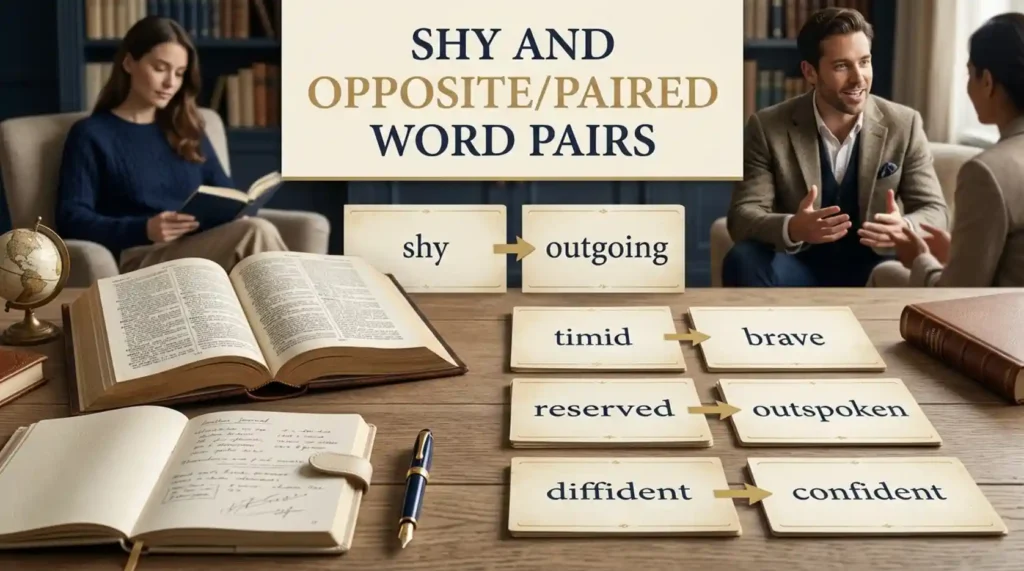
| Word | Paired Word | Note |
| Shy | Outgoing | The most common everyday opposite for people. |
| Shy | Bold | Describes a person who acts without fear. |
| Timid | Brave | Contrasts fear with courage. |
| Bashful | Brazen | “Brazen” means openly shameless, so it is a strong contrast. |
| Reserved | Outspoken | Contrasts private people with those who speak freely. |
| Diffident | Confident | A formal contrast about self-belief. |
| Introverted | Extroverted | A pair about energy and preference, not fear. |
“Shy” has no single perfect opposite because it covers several senses. For a person who is easy in company, “outgoing” and “sociable” work best. For a person who acts without fear, “bold” and “confident” are better. Pick the opposite that matches the sense you mean.
Sources: Merriam-Webster; Collins Dictionary.
Common Word Partners of “Shy”
| Pattern | Common Partners | Example |
| adverb + shy | painfully, extremely, naturally, a little | He was painfully shy as a child. |
| shy + noun | smile, child, person, glance | She gave a shy smile. |
| shy of + noun | the mark, the target | The team finished just shy of the record. |
| shy away from | questions, risks, attention, conflict | He does not shy away from hard questions. |
| shy + about | speaking, asking, singing | I am shy about singing in public. |
| number + shy of | two votes, a dollar | We are ten dollars shy of the total. |
Sources: Merriam-Webster; Collins Dictionary.
Idiomatic Phrases Featuring “Shy”
1. Once bitten, twice shy
- Meaning: After a bad experience, a person becomes more careful the next time.
- Example: He lost money on a bad deal, so now it’s once bitten, twice shy.
2. Shy away from
- Meaning: To avoid something because you are nervous or unwilling.
- Example: She does not shy away from difficult tasks.
3. Fight shy of
- Meaning: To avoid something on purpose, especially because it seems unpleasant or risky. This expression is mostly British.
- Example: Many politicians fight shy of talking about taxes.
4. Don’t be shy
- Meaning: A friendly way to tell someone to speak up, ask, or help themselves.
- Example: There is plenty of food, so don’t be shy.
Sources: Merriam-Webster; Collins Dictionary.
Word Formation of “Shy”
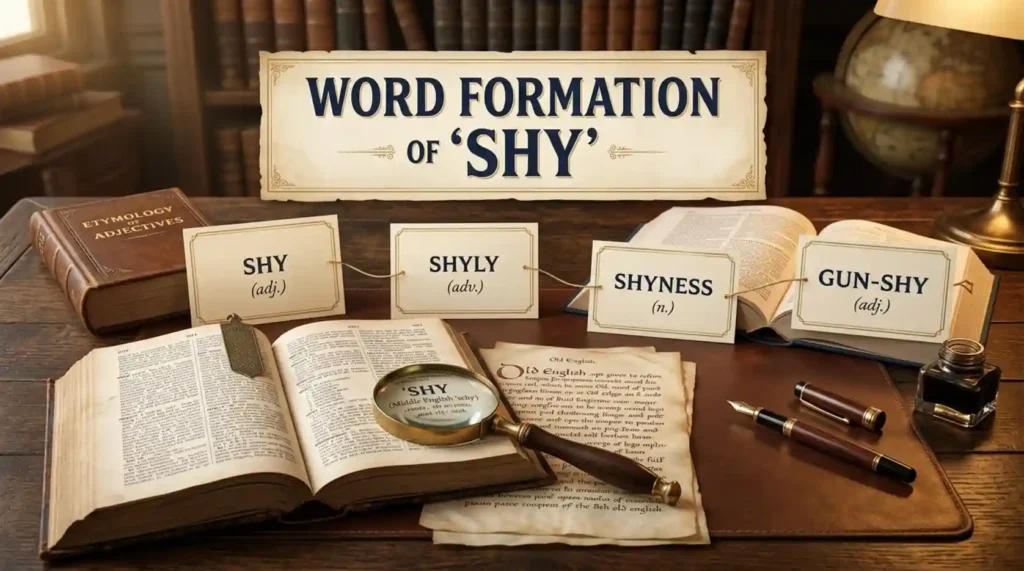
Etymology & Structure
“Shy” comes from Middle English shei, meaning “easily frightened or startled,” used of horses. That came from late Old English sceoh, meaning “timid, easily startled,” and from Proto-Germanic skeukh(w)az, meaning “afraid.” Related words include Dutch schuw and German scheu.
Date and History
The Old English root sceoh is recorded in late Old English. The sense of avoiding contact with others because of timidity is recorded by about 1600. The verb meaning “to recoil or take sudden fright” appears in the 1640s. The sense “lacking, short of” dates from 1895 and started as American gambling slang. “Gun-shy” is recorded by 1849, first used of hunting dogs.
Word Class Variations
- Adjective: shy (shyer or shier, shyest or shiest)
- Adverb: shyly (1701)
- Noun: shyness (1650s)
- Verb: shy, “to recoil or avoid” (1640s), as in “shy away from”
- Related compound: gun-shy
A separate verb, “to shy,” means to throw something with a quick toss. Etymonline dates it to 1787 and notes that its connection to the adjective is unclear.
Sources: Etymonline
Common Word-Choice Mistakes
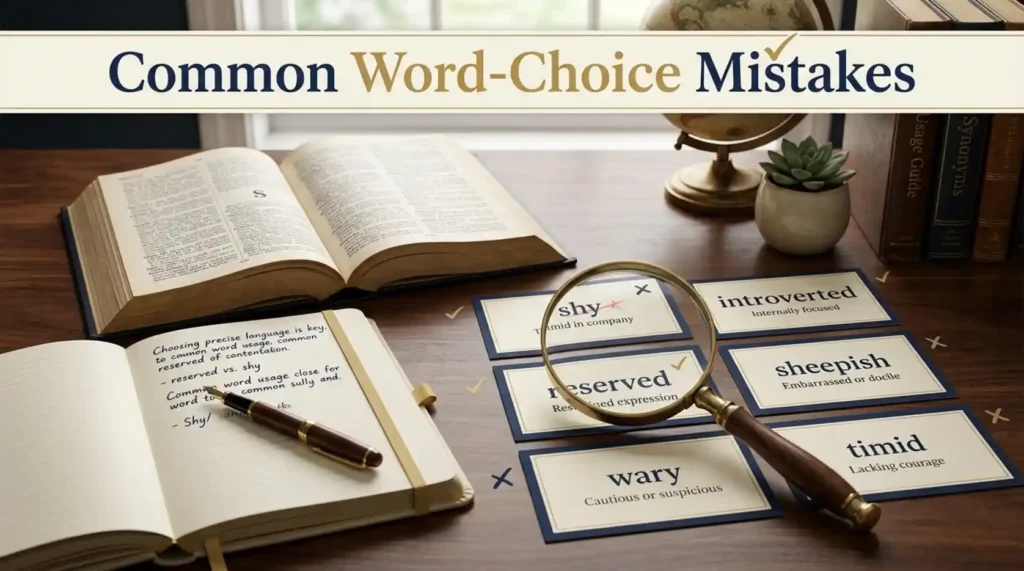
- “Reserved” always means scared: reserved means private, and a reserved person may feel confident.
- “Introverted” and “shy” are the same: introverted is a preference for quiet, while shy is discomfort around people.
- “She was sheepish by nature”: sheepish describes a moment of embarrassment, so use “shy” or “bashful” for personality.
- “He is coy because he is afraid”: coy usually suggests playful or deliberate shyness, not fear.
- “Two dollars shy to the price”: use “shy of,” as in “two dollars shy of the price.”
- “Shy” for a person who doesn’t trust others: use “wary” or “leery,” not “shy.”
- “Meek” as a compliment for politeness: meek suggests submissive, so use “polite” or “gentle” instead.
Frequently Asked Questions
What is the closest synonym for shy?
“Timid” and “bashful” are the closest everyday synonyms. “Bashful” is gentler, and “timid” leans toward fear.
What is a formal word for shy?
“Diffident” is a good formal choice. “Reticent” and “retiring” also work in formal writing.
What is a literary word for shy?
“Demure,” “timorous,” and “abashed” are common in literary writing. They suit stories and descriptions more than everyday talk.
Is shy the same as introverted?
No. An introverted person prefers quiet and time alone. A shy person feels nervous or awkward around others and may still want company.
What is the difference between shy and timid?
“Shy” is mostly about social discomfort. “Timid” is broader and means lacking courage in many situations.
What is the opposite of shy?
“Outgoing” is the most common opposite for people. “Bold” and “confident” also work.
Can “shy” be used for animals?
Yes. This is the oldest sense of the word. A shy deer or a shy horse is easily frightened.
What does “shy of” mean?
It means “short of” or “lacking.” For example, “ten dollars shy of the price” means ten dollars less than needed.
What is a word for being shy after doing something wrong?
“Sheepish” fits best. It describes embarrassment after a mistake.
What does “gun-shy” mean?
It means afraid of something because of a bad earlier experience. It began with hunting dogs scared by gunfire.
Conclusion
The closest alternatives to “shy” are “timid,” “bashful,” and “reserved.” For formal writing, “diffident” and “reticent” work well, while “demure” and “timorous” suit literary writing.
Context matters because “shy” has several senses. It can describe a nervous personality, a frightened animal, a cautious attitude, or a shortage of something. Words like “introverted,” “sheepish,” and “wary” are related but not exact matches.
To choose the right word, first decide which sense you mean. Then pick a word with the right level of fear, embarrassment, or caution, and check the tone against your audience.