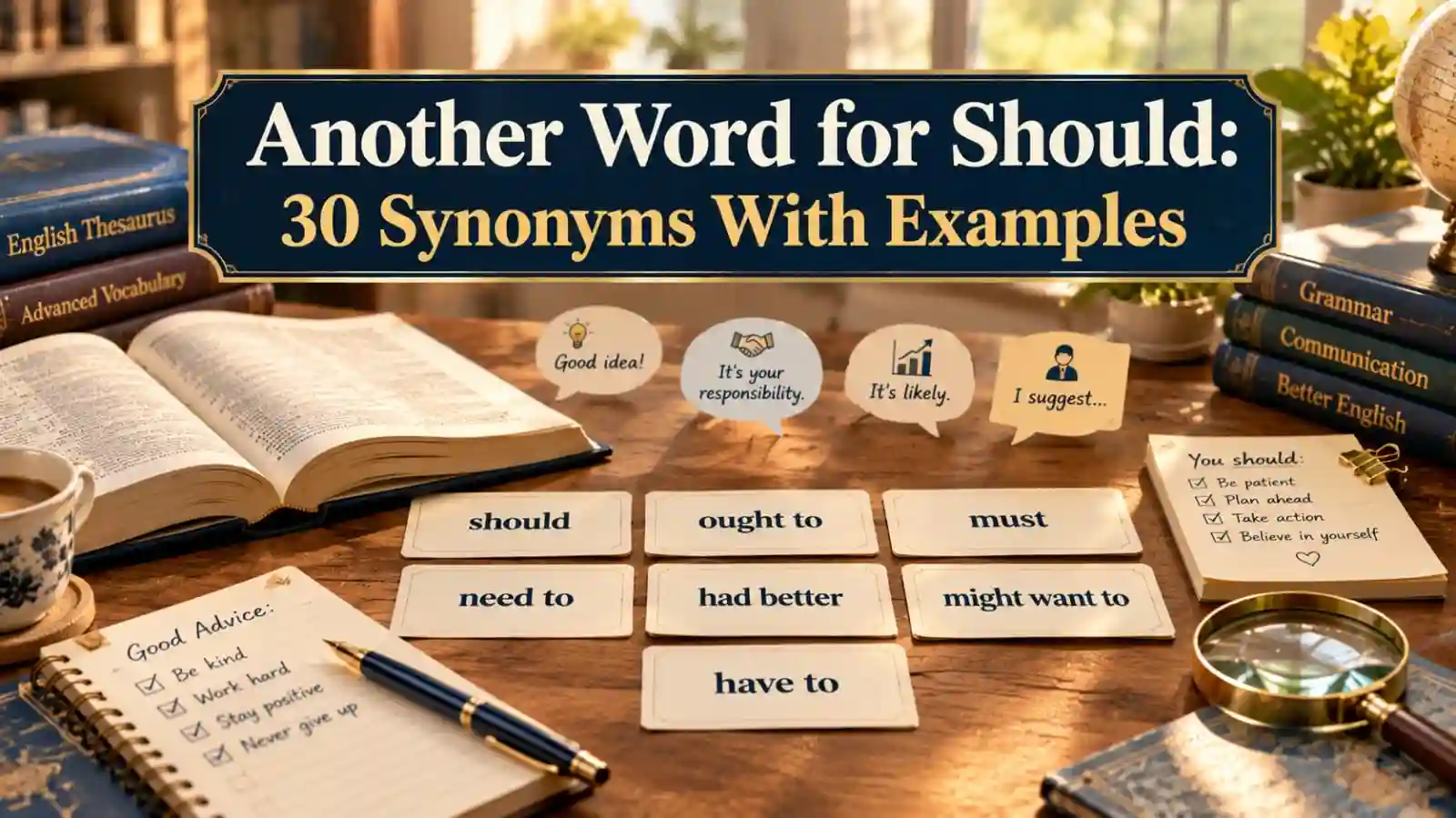
Another Word for Should: 30 Synonyms With Examples
The closest everyday alternatives to “should” are ought to, had better, need to, and be supposed to. “Should” is a modal verb, so many of its alternatives are short phrases rather than single words. Which one fits depends on what “should” is doing in your sentence: giving advice, stating a duty, predicting what is likely, or setting up a condition.
Strong versions of the idea include must and have to. Softer versions include might want to and would do well to. For expectations, likely and probably are common choices. For formal “if” meanings, such as “should you need help,” if and in the event that work well.
Quick list: ought to, had better, need to, be supposed to, must, have to, advisable, expected to, likely, might want to
This article looks at 30 alternatives with meanings, IPA, usage notes, examples, and context. Some are direct synonyms, and others are related alternatives that only match one sense of “should.”
At a Glance: Should Synonyms and Related Alternatives
| Alternative | Part of Speech | Meaning | Register / Tone | Ideal Context |
| ought to | modal phrase | is right or wise to do | neutral, slightly formal | moral duty, advice |
| must | modal verb | is required to | strong, direct | rules, strong necessity |
| had better | modal phrase | would be wise to, or else | informal, firm | warnings, urgent advice |
| need to | verb phrase | is necessary to | neutral | practical necessity |
| be supposed to | verb phrase | is expected or required to | informal to neutral | rules, plans, expectations |
| advisable | adjective | wise to do | formal | professional advice |
| have to | verb phrase | is obliged to | neutral, direct | outside requirements |
| expected to | verb phrase | is anticipated to | neutral | predictions, roles |
| likely | adjective/adverb | probable | neutral | probability |
| might want to | verb phrase | would be a good idea to | informal, polite | gentle suggestions |
Which Word Should You Use?

| If you want to… | Use | Why |
| Give mild advice | might want to | It sounds polite and soft. |
| Give moral advice | ought to | It suggests what is right. |
| Warn someone | had better | It implies a bad result if ignored. |
| State a rule | must | It leaves no choice. |
| Describe a duty set by others | have to | It points to an outside requirement. |
| Predict what is likely | probably | It shows expectation, not obligation. |
| Write a formal “if” clause | in the event that | It fits formal and legal writing. |
| Describe a plan or schedule | due to | It fits timetables and arrivals. |
Exploring the Multiple Meanings of “Should”
1. Duty or Obligation
- Meaning: Used to say what is right or required.
- Explanation: This sense is milder than “must.” It points to a duty or moral standard rather than a hard rule.
- Example: We should respect other people’s time.
2. Advice or Recommendation
- Meaning: Used to say what is wise or best to do.
- Explanation: This is the most common sense. The speaker gives an opinion, and the listener can choose to follow it.
- Example: You should drink more water.
3. Expectation or Probability
- Meaning: Used to say something is likely or expected.
- Explanation: Here “should” predicts, not instructs. It often describes plans, schedules, and results.
- Example: The package should arrive on Friday.
4. Condition (Formal “If”)
- Meaning: Used in formal conditional clauses, often with inverted word order.
- Explanation: “Should you need help” means “if you need help.” It is common in business and formal writing.
- Example: Should you have any questions, please contact us.
5. Surprise or Judgment
- Meaning: Used after certain words to show surprise, regret, or opinion.
- Explanation: This sense appears in clauses with words like “surprised” or “odd.” It is more common in British English.
- Example: It is odd that she should say that.
6. Polite Statement (Mainly British)
- Meaning: Used with “I” or “we” to make a polite wish or opinion.
- Explanation: Phrases like “I should like to” are formal and old-fashioned. Most speakers now use “would.”
- Example: I should like to thank everyone for coming.
Sources: Merriam-Webster, Collins Dictionary, Dictionary.com
Analyzing 30 Should Alternatives in Detail

Some alternatives below are direct synonyms for one sense of “should,” while others are related words that fit only certain contexts.
Core Modal Alternatives
1. Ought to
IPA: /ˈɔːt tuː/ (US and UK)
Definition: Used to say what is right, correct, or wise.
- Usage: The closest synonym for the advice and duty senses. It is slightly more formal than “should” and often stresses moral correctness.
- Example: You ought to apologize for being late.
2. Must
IPA: /mʌst/ (US and UK)
Definition: Used to say something is required or very important.
- Usage: Stronger than “should.” It fits the duty sense but not mild advice. It can also show strong certainty, which is a different meaning.
- Example: Drivers must stop at a red light.
3. Had better
IPA: US /hæd ˈbetər/ · UK /hæd ˈbetə/
Definition: Used to say something is the wise action, or bad results may follow.
- Usage: A strong, informal form of advice. It often carries a warning, so it is firmer than “should.”
- Example: You had better leave now, or you will miss the train.
4. Need to
IPA: /ˈniːd tuː/ (US and UK)
Definition: Be required or have a reason to do something.
- Usage: A related alternative that focuses on necessity. It is stronger than “should” and neutral in tone.
- Example: We need to finish this report today.
5. Be supposed to
IPA: US /bi səˈpoʊzd tuː/ · UK /bi səˈpəʊzd tuː/
Definition: Be expected or required to do something, often by rule or plan.
- Usage: Close to “should” for duty and expectation. It often hints that the thing is not being done.
- Example: You are supposed to wear a helmet here.
Advice and Recommendation
6. Advisable
IPA: /ədˈvaɪzəbəl/ (US and UK)
Definition: Wise and sensible to do.
- Usage: A formal adjective used in the pattern “it is advisable to.” It matches the advice sense only.
- Example: It is advisable to book your flight early.
7. Recommended
IPA: /ˌrekəˈmendɪd/ (US and UK)
Definition: Suggested as good or suitable.
- Usage: A related alternative common in guides, labels, and instructions. It is neutral and less personal than “should.”
- Example: Two coats of paint are recommended.
8. Wise
IPA: /waɪz/ (US and UK)
Definition: Showing good judgment.
- Usage: Used in phrases like “it would be wise to.” It is a related alternative that adds a sense of good judgment.
- Example: It would be wise to save some money first.
9. Recommend
IPA: /ˌrekəˈmend/ (US and UK)
Definition: To suggest that something is good or should be done.
- Usage: A verb that expresses advice from a speaker. It changes the sentence structure, as in “I recommend that you wait.”
- Example: I recommend that you read the instructions first.
10. Advise
IPA: /ədˈvaɪz/ (US and UK)
Definition: To tell someone what you think they should do.
- Usage: More formal than “recommend.” It is often used by professionals such as doctors and lawyers.
- Example: The doctor advised him to rest for a week.
Duty and Obligation
11. Have to
IPA: /ˈhæv tuː/ (US and UK)
Definition: Be forced or required to do something.
- Usage: Stronger than “should.” It usually points to an outside requirement, such as a rule or a boss.
- Example: Students have to wear uniforms at this school.
12. Required
IPA: US /rɪˈkwaɪərd/ · UK /rɪˈkwaɪəd/
Definition: Officially needed or demanded.
- Usage: A related alternative for rules and formal needs. It is much stronger than “should.”
- Example: A photo ID is required to enter the building.
13. Obliged
IPA: /əˈblaɪdʒd/ (US and UK)
Definition: Forced to do something by law, duty, or a promise.
- Usage: Formal. It is used in the pattern “obliged to” and fits legal or moral duty.
- Example: Employers are obliged to provide a safe workplace.
14. Bound to
IPA: /ˈbaʊnd tuː/ (US and UK)
Definition: Having a legal or moral duty to do something.
- Usage: Formal in the duty sense. “Bound to” can also mean “certain to happen,” which is a different meaning.
- Example: He is bound to keep the company’s secrets.
15. Duty-bound
IPA: US /ˌduːti ˈbaʊnd/ · UK /ˌdjuːti ˈbaʊnd/
Definition: Having a moral or legal duty.
- Usage: A formal, strong alternative for serious obligation. It is too heavy for everyday advice.
- Example: Officers are duty-bound to report crimes.
Expectation and Probability
16. Expected to
IPA: /ɪkˈspektɪd tuː/ (US and UK)
Definition: Thought likely or required to happen or be done.
- Usage: Works for both prediction and duty. It is common in news and workplace writing.
- Example: The meeting is expected to end at noon.
17. Likely
IPA: /ˈlaɪkli/ (US and UK)
Definition: Probable or having a good chance of happening.
- Usage: Matches only the probability sense. It does not work for advice or duty.
- Example: The weather is likely to improve tomorrow.
18. Probably
IPA: US /ˈprɑːbəbli/ · UK /ˈprɒbəbli/
Definition: Almost certainly, or more likely than not.
- Usage: A related alternative for the expectation sense. It replaces the whole verb pattern, as in “She will probably be late.”
- Example: The store is probably closed by now.
19. Due to
IPA: US /ˈduː tuː/ · UK /ˈdjuː tuː/
Definition: Expected or planned to happen at a certain time.
- Usage: Used for schedules, deadlines, and arrivals. It does not work for advice or duty.
- Example: The train is due to arrive at six.
20. Presumably
IPA: US /prɪˈzuːməbli/ · UK /prɪˈzjuːməbli/
Definition: Used to say something is believed to be true without proof.
- Usage: A related alternative that shows an assumption. It is weaker than “probably” and often used in guesses.
- Example: Presumably, he got the message by now.
Conditional and Formal Alternatives
21. If
IPA: /ɪf/ (US and UK)
Definition: Used to introduce a condition.
- Usage: The simplest alternative for the formal condition sense. “Should you need help” becomes “If you need help.”
- Example: If you need more time, just let us know.
22. In case
IPA: /ɪn ˈkeɪs/ (US and UK)
Definition: As a precaution because something might happen.
- Usage: A related alternative that focuses on preparation rather than a plain condition.
- Example: Take an umbrella in case it rains.
23. Were to
IPA: US /wɝː tuː/ · UK /wɜː tuː/
Definition: Used for imagined or unlikely future situations.
- Usage: Close to the conditional “should.” It suggests the event is unlikely or only imagined.
- Example: If the price were to rise, we would cancel.
24. In the event that
IPA: /ɪn ði ɪˈvent ðæt/ (US and UK)
Definition: If a particular thing happens.
- Usage: Formal and common in contracts and notices. It is wordier than “should” but very clear.
- Example: In the event that it rains, the game will be moved indoors.
25. Supposing
IPA: US /səˈpoʊzɪŋ/ · UK /səˈpəʊzɪŋ/
Definition: Used to introduce an imagined situation.
- Usage: More casual than “in the event that.” It suits spoken questions about possibilities.
- Example: Supposing you miss the bus, how will you get home?
Strength and Softness
26. Shall
IPA: /ʃæl/ (US and UK)
Definition: Used in formal rules, offers, and promises.
- Usage: A related word, since “should” comes from it. It is formal in rules (“the tenant shall pay”) and is strong, unlike “should.”
- Example: The tenant shall pay the rent on the first of each month.
27. Might want to
IPA: US /maɪt ˈwɑːnt tuː/ · UK /maɪt ˈwɒnt tuː/
Definition: Used to make a gentle suggestion.
- Usage: Softer than “should.” It is informal and polite, and good for suggestions you do not want to sound like orders.
- Example: You might want to check your email before the call.
28. Would do well to
IPA: /wʊd ˈduː wel tuː/ (US and UK)
Definition: Would be wise to do something.
- Usage: A polished, slightly formal way to give advice. It carries a hint of warning.
- Example: You would do well to read the contract carefully.
29. Meant to
IPA: /ˈment tuː/ (US and UK)
Definition: Intended or expected to do something.
- Usage: Informal. It often describes a plan or duty that has not been carried out.
- Example: I was meant to call her yesterday.
30. Mandatory
IPA: US /ˈmændəˌtɔːri/ · UK /ˈmændətri/
Definition: Required by a rule or law.
- Usage: A related alternative at the strongest end. It leaves no choice, so it replaces “must,” not mild “should.”
- Example: Safety training is mandatory for all new staff.
Sources: Merriam-Webster, Collins Dictionary, Dictionary.com
Should vs. Must vs. Ought To vs. Had Better

These four are often confused. The main difference is strength.
| Word | Strength | Typical Use | Example |
| should | medium | advice, expectation | You should rest. |
| ought to | medium | moral duty, advice | You ought to help him. |
| had better | strong | warning, urgent advice | You had better hurry. |
| must | very strong | rules, necessity | You must wear a seatbelt. |
“Should” and “ought to” are almost interchangeable. “Had better” suggests a bad result if ignored. “Must” leaves no choice. In questions and negatives, “should” is much more common than “ought to.”
Sources: Merriam-Webster, Collins Dictionary
Should and Opposite/Paired Word Pairs
| Word | Paired Word | Note |
| should | should not (shouldn’t) | The direct negative, used for advice against something. |
| should | must | A contrast in strength, from advice to rule. |
| should | could | Advice versus possibility. |
| should | would | Advice versus a result or habit. |
| should | need not (needn’t) | Advice versus no requirement. |
| should | may | Advice versus permission. |
“Should” has no true one-word antonym. Its direct opposite is “should not,” while other pairs show contrasts of strength or meaning. Learners often mix these modals up, so it helps to learn them as pairs.
Sources: Merriam-Webster, Collins Dictionary
Common Word Partners of “Should”

| Pattern | Common Partners | Example |
| should + have + past participle | should have known, should have gone | I should have called earlier. |
| really/probably + should | really should, probably should | You really should see a doctor. |
| should + be able to | should be able to | We should be able to finish by five. |
| should know better | should know better | He should know better than to lie. |
| Should + subject (question) | Should I, Should we | Should I bring anything? |
| should + anything/the need | should anything happen, should the need arise | Should anything change, I will tell you. |
Sources: Collins Dictionary, Merriam-Webster
Idiomatic Phrases Featuring “Should”
Few true idioms use “should.” The items below are fixed or well-established expressions.
1. Should have known better
- Meaning: An expression used to say someone made a mistake they were able to avoid.
- Example: I should have known better than to trust him with money.
2. You should be so lucky
- Meaning: An informal expression, mainly British, telling someone that what they hope for is very unlikely.
- Example: “Do you think she’ll lend you her car?” “You should be so lucky.”
3. Should the need arise
- Meaning: A formal expression meaning “if it becomes necessary.”
- Example: We have a backup plan should the need arise.
4. Shoulda, coulda, woulda
- Meaning: An informal expression used to talk about regrets over things not done.
- Example: There is no point in saying shoulda, coulda, woulda now.
Sources: Collins Dictionary, Merriam-Webster
Word Formation of “Should”
Etymology & Structure
“Should” began as the past tense of “shall.” It comes from Old English sceolde, the past form of sculan, a verb linked to owing and obligation. Today it works as a modal verb that carries meanings of duty, advice, and expectation, no longer just a past tense.
Date and History
The word goes back to Old English. Over time it moved from simple past-tense use to its present role in giving advice and describing expectation.
Word Class Variations
- Modal verb: should
- Negative contraction: shouldn’t
- Informal contraction: should’ve
- Informal spoken form: shoulda
- Related word: shall
“Should” has no standard noun, adjective, or adverb form, and it does not add -s or -ing.
Sources: Etymonline, Merriam-Webster
Common Word-Choice Mistakes
- Wrong: “I should to go.” Correct: “I should go.” (No “to” after “should.”)
- Wrong: “He shoulds study more.” Correct: “He should study more.” (No -s.)
- Wrong: “You should of called.” Correct: “You should have called.” (Say “have” or “should’ve.”)
- Wrong: “She should went home.” Correct: “She should have gone home.” (Use the past participle.)
- Wrong: “You should have a visa to enter.” (for a legal rule) Correct: “You must have a visa to enter.”
- Wrong: “Did he should come?” Correct: “Should he come?”
- Wrong: “You should better leave.” Correct: “You had better leave.” (Do not mix “should” with “better.”)
Frequently Asked Questions
What is the closest synonym for “should”?
“Ought to” is the closest. It carries the same advice and duty meanings and is slightly more formal.
What is a stronger word than “should”?
“Must” and “have to” are stronger. “Had better” is also firmer because it implies a bad result if ignored.
What is a softer alternative?
“Might want to” and “would do well to” are softer. They sound like suggestions, not orders.
What is the difference between “should” and “must”?
“Should” gives advice or expresses expectation. “Must” states a rule or strong necessity.
What is a formal alternative to “should”?
“Ought to,” “advisable,” and “in the event that” are formal. “Shall” appears in legal rules.
Can “should” talk about the future?
Yes. In “The bus should arrive soon,” it expresses expectation about a future event.
What does “should” mean in “Should you need help”?
It means “if you need help.” This formal structure is common in emails and business writing.
What is the opposite of “should”?
“Should not” is the direct opposite. “Need not” and “may” also contrast with it in meaning.
Is “should” the same as “shall”?
No. “Should” began as the past tense of “shall,” but they now have separate uses. “Shall” is formal and stronger.
Can I say “should of”?
No. The correct forms are “should have” and “should’ve.”
Conclusion
The closest alternatives to “should” are “ought to,” “had better,” “need to,” and “be supposed to.” Stronger choices include “must” and “have to,” while “might want to” and “would do well to” soften advice. For expectations, “likely,” “probably,” and “expected to” work well.
Context matters because “should” has several meanings. It can give advice, state a duty, predict an outcome, or begin a formal “if” clause. A word that fits one of these meanings may not fit the others.
To choose the right alternative, first decide what “should” means in your sentence. Then match the strength you want, If that is a gentle suggestion, firm advice, or a rule.