Searching for a Word Like Article? Discover 30 Natural Alternatives
The closest everyday alternatives to article are piece, story, essay, report, and item. The best choice depends on If you mean a written work, a legal clause, an object, or a grammar word.
Quick list: piece, story, essay, report, feature, item, write-up, paper, clause, provision.
This guide explains 30 useful alternatives with meanings, IPA, usage notes, and natural examples. It also covers the different meanings of article, common collocations, word history, and frequent word-choice mistakes.
At a Glance: Article Synonyms and Related Alternatives

| Alternative | Part of Speech | Meaning | Register / Tone | Ideal Context |
| Piece | Noun | A written work, especially in a newspaper or magazine | Neutral, common | Journalism, blogging, general writing |
| Story | Noun | A news report or account of events | Neutral | Newspapers, news broadcasts |
| Essay | Noun | A short piece of writing giving the writer’s view | Neutral to formal | School, magazines, opinion writing |
| Report | Noun | A factual account or official document | Neutral to formal | News, research, business |
| Feature | Noun | A longer, in-depth newspaper or magazine article | Professional | Journalism, magazines |
| Item | Noun | A short news item or a single object | Neutral | News briefs, lists, shopping |
| Write-up | Noun | A short article or review | Informal | Reviews, local news, blogs |
| Paper | Noun | An academic essay or formal written study | Formal | Universities, research |
| Clause | Noun | A distinct section of a legal document or contract | Formal, legal | Contracts, laws, agreements |
| Provision | Noun | A condition or requirement in a document | Formal, legal | Contracts, laws, policies |
Which Word Should You Use?

| If you want to… | Use | Why |
| Refer to a magazine or newspaper piece informally | Piece | It is natural and widely understood: “She wrote a piece about city housing.” |
| Describe a news account | Story | It is the standard word for a news report: “The story appeared on the front page.” |
| Write about a personal viewpoint | Essay | An essay usually develops an argument or reflection. |
| Refer to factual research or official information | Report | A report emphasizes facts, findings, or results. |
| Describe a long, detailed magazine article | Feature | A feature explores a subject in depth. |
| Mention a short news notice | Item | An item is brief and often appears in a list or news roundup. |
| Refer to part of a contract or law | Clause or provision | These are the normal legal alternatives to article. |
| Refer to an object, especially clothing or goods | Item or object | Article can mean a thing, but item is more common in everyday English. |
Exploring the Multiple Meanings of “Article”
1. A Written Work in a Publication
- Meaning: A nonfiction piece of writing, usually published in a newspaper, magazine, journal, or website.
- Explanation: This is the most common meaning. An article usually reports information, explains a topic, or presents an opinion.
- Example: She wrote an article about renewable energy for the local newspaper.
2. A Section of a Legal or Formal Document
- Meaning: A numbered or separate part of a document, such as a constitution, contract, or agreement.
- Explanation: In legal and formal writing, an article is a major division. Smaller parts are often called clauses, sections, or provisions.
- Example: Article 12 of the agreement explains how disputes will be resolved.
3. An Object or Item
- Meaning: A particular thing, especially one that is sold, owned, or listed.
- Explanation: This use is common in shops, inventories, and formal descriptions of goods. Item is usually more natural in everyday speech.
- Example: The store sells articles of clothing from several countries.
4. A Grammar Word
- Meaning: A word such as a, an, or the used before a noun.
- Explanation: A and an are indefinite articles; the is the definite article. This meaning is specific to grammar.
- Example: In “the book,” the is the definite article.
5. A Particular Kind of Person or Thing
- Meaning: A person or thing of a recognizable type.
- Explanation: This use is less common and often appears in the expression the genuine article, meaning the real thing rather than an imitation.
- Example: After testing several products, this one proved to be the genuine article.
Sources: Merriam-Webster; Collins English Thesaurus; Cambridge English Thesaurus; Etymonline.
Analyzing 30 Article Alternatives in Detail

Some alternatives below are direct synonyms, while others fit only particular senses of article, such as legal documents, objects, or grammar.
Written Works and Journalism
1. Piece
IPA: /piːs/ (US and UK)
Definition: A work of writing, art, music, or journalism.
- Usage: A very common, neutral alternative for a newspaper or magazine article. It sounds slightly less formal than article.
- Example: The magazine published a piece on remote work.
2. Story
IPA: /ˈstɔːri/ (US and UK)
Definition: An account of events, especially one reported in the news.
- Usage: Best for journalism and news reporting. It can also mean fiction, so context matters.
- Example: The reporter filed a story about the flood.
3. Report
IPA: /rɪˈpɔːrt/ (US and UK)
Definition: An account giving information about something that happened or was studied.
- Usage: Use it when facts, events, or research findings are central. It is more factual than essay.
- Example: The newspaper published a report on school attendance.
4. Feature
IPA: /ˈfiːtʃər/ (US and UK)
Definition: A long, detailed article in a newspaper or magazine.
- Usage: A professional journalism term for an in-depth story, often with interviews or background research.
- Example: The paper ran a feature on the city’s oldest bookstore.
5. Write-up
IPA: /ˈraɪt ʌp/ (US and UK)
Definition: A short written report, review, or account.
- Usage: Informal and common for reviews or brief coverage. It is related to article, but usually suggests something shorter.
- Example: The restaurant received a glowing write-up in the local paper.
6. News story
IPA: /nuːz ˈstɔːri/ (US and UK)
Definition: A report about a recent event or issue.
- Usage: A clear compound alternative when you specifically mean journalism rather than fiction.
- Example: The editor chose the housing story as the lead news story.
7. Column
IPA: /ˈkɒləm/ (US and UK)
Definition: A regular article by the same writer, often expressing personal opinions.
- Usage: Use it only for a recurring opinion or commentary piece, not every article.
- Example: Her weekly column examines local politics.
8. Editorial
IPA: /ˌedɪˈtɔːriəl/ (US and UK)
Definition: An article expressing the official opinion of a newspaper or magazine.
- Usage: A specific type of article. Do not use it for ordinary reporting.
- Example: The newspaper’s editorial called for better public transportation.
9. Commentary
IPA: /ˈkɒmənteri/ (US and UK)
Definition: A written explanation or opinion about an event, issue, or work.
- Usage: More formal than piece. It emphasizes interpretation or opinion.
- Example: The journal published a commentary on the new education policy.
10. Review
IPA: /rɪˈvjuː/ (US and UK)
Definition: An article that evaluates a book, film, product, performance, or service.
- Usage: A context-specific alternative. A review is an article, but not every article is a review.
- Example: Her review of the new museum exhibition appeared on Friday.
11. Blog post
IPA: /blɒɡ poʊst/ (US and UK)
Definition: A piece of writing published on a blog or website.
- Usage: Use it for online writing when article sounds too formal or traditional.
- Example: She published a blog post about starting a small garden.
12. Essay
IPA: /ˈeseɪ/ (US and UK)
Definition: A short piece of writing that develops a writer’s ideas or argument.
- Usage: Often more personal, reflective, or argument-driven than a news article.
- Example: He wrote an essay about the value of public libraries.
13. Paper
IPA: /ˈpeɪpər/ (US and UK)
Definition: A formal academic essay or research document.
- Usage: Use it for schoolwork or scholarship. It is not a natural substitute for a newspaper article.
- Example: The student presented a paper on climate policy.
14. Study
IPA: /ˈstʌdi/ (US and UK)
Definition: A detailed examination or research project, often published as a report.
- Usage: Related rather than exact: a study is research, while an article may simply describe or discuss it.
- Example: The researchers published a study on sleep and memory.
15. Treatise
IPA: /ˈtriːtɪs/ (US and UK)
Definition: A long, formal written work about a particular subject.
- Usage: Formal and academic. It suggests a much longer and more systematic work than an ordinary article.
- Example: The philosopher wrote a treatise on justice.
16. Composition
IPA: /ˌkɒmpəˈzɪʃən/ (US and UK)
Definition: A piece of writing, music, or art created by someone.
- Usage: A broad related term. In school contexts, it can mean a written essay.
- Example: The teacher asked each student to write a short composition.
17. Exposé
IPA: /ˌekspoʊˈzeɪ/ (US and UK)
Definition: A report that reveals shocking or hidden information.
- Usage: A specialized journalism alternative. It implies investigation and disclosure.
- Example: The newspaper published an exposé on unsafe housing conditions.
Legal and Formal Document Parts
18. Clause
IPA: /klɔːz/ (US and UK)
Definition: A distinct part of a legal document, contract, or agreement.
- Usage: The closest legal alternative when article means a section of a contract. A clause is often smaller or more specific than an article.
- Example: The contract includes a clause about late payments.
19. Provision
IPA: /prəˈvɪʒən/ (US and UK)
Definition: A condition or requirement in a law, contract, or agreement.
- Usage: Formal and legal. It emphasizes what the document requires or allows.
- Example: The lease contains a provision limiting pets.
20. Section
IPA: /ˈsekʃən/ (US and UK)
Definition: A separate part of a document, law, book, or text.
- Usage: A neutral alternative for a numbered division of a document. It is broader than clause.
- Example: See section 4 of the employee handbook.
21. Stipulation
IPA: /ˌstɪpjəˈleɪʃən/ (US and UK)
Definition: A condition that must be followed in an agreement.
- Usage: Formal and legal. It is related to article only when the article states a requirement.
- Example: One stipulation requires tenants to insure their belongings.
22. Term
IPA: /tɜːrm/ (US and UK)
Definition: A condition or requirement in an agreement.
- Usage: Usually plural: terms of an agreement. It is broader than a single article or clause.
- Example: Read the terms before signing the contract.
Objects, Goods, and Things
23. Item
IPA: /ˈaɪtəm/ (US and UK)
Definition: A single thing in a group, list, or collection.
- Usage: The most natural everyday alternative when article means an object, product, or listed thing.
- Example: Each item in the box was carefully wrapped.
24. Object
IPA: /ˈɒbdʒɪkt/ (US and UK)
Definition: A material thing that can be seen or touched.
- Usage: Use it for a physical thing, especially in descriptions or museums. It does not fit the writing or legal senses.
- Example: The museum displayed objects from ancient Rome.
25. Product
IPA: /ˈprɒdʌkt/ (US and UK)
Definition: Something made to be sold.
- Usage: A business-oriented alternative when article refers to merchandise.
- Example: The company recalled one product from its stores.
26. Commodity
IPA: /kəˈmɒdəti/ (US and UK)
Definition: A product that can be bought and sold, especially in trade.
- Usage: Formal or economic. It is related to article in the sense of goods, but sounds commercial.
- Example: Coffee is an important commodity in global trade.
27. Utensil
IPA: /juːˈtensəl/ (US and UK)
Definition: A tool used in the home, especially for cooking or eating.
- Usage: A narrow alternative for household articles. Use it only for tools such as spoons, knives, or pans.
- Example: The recipe requires only basic kitchen utensils.
Grammar and Related Terms
28. Determiner
IPA: /dɪˈtɜːrmɪnər/ (US and UK)
Definition: A word placed before a noun to show which person or thing is meant.
- Usage: A broader grammar term. Articles such as a, an, and the are one type of determiner.
- Example: In “this apple,” this is a determiner.
29. Definite article
IPA: /ˈdefɪnɪt ˈɑːrtɪkəl/ (US and UK)
Definition: The word the, used before a particular noun.
- Usage: A precise grammar alternative when discussing the. It is not a general substitute for article.
- Example: Use the definite article before “sun” in “the sun rises.”
30. Indefinite article
IPA: /ɪnˈdefɪnɪt ˈɑːrtɪkəl/ (US and UK)
Definition: The words a or an, used before a noun that is not specific.
- Usage: A precise grammar alternative for a or an. It is not a general substitute for article.
- Example: Use an indefinite article before “idea” in “an idea.”
Sources: Merriam-Webster; Merriam-Webster Thesaurus; Collins English Thesaurus; Cambridge English Thesaurus; Etymonline]
Article in Different Contexts
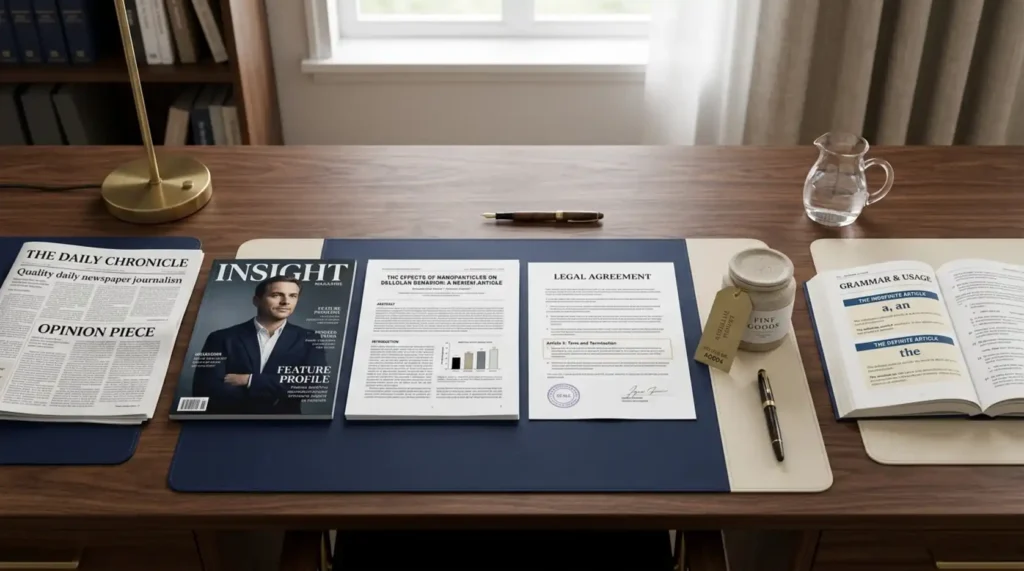
| Context | Natural alternative | Example |
| Newspaper journalism | Story, piece, report | “The story appeared online this morning.” |
| Magazine writing | Feature, piece, essay | “The feature explored the history of the building.” |
| Academic writing | Paper, essay, study | “Her paper examined bilingual education.” |
| Contracts and law | Clause, provision, section | “The clause limits liability.” |
| Shopping and goods | Item, product, object | “The item was out of stock.” |
| Grammar lessons | Determiner, definite article, indefinite article | “The is the definite article.” |
The word article is useful because it can cover all these areas, but precise alternatives make writing clearer. Choose the word that matches the subject: writing, law, goods, or grammar.
Sources: Merriam-Webster; Collins English Thesaurus; Cambridge English Thesaurus.
Article and Opposite/Paired Word Pairs
| Word | Paired Word | Note |
| Article | Whole document | An article is one part; the document is the complete text. |
| Article | Chapter | A chapter is a larger division of a book; an article is usually shorter and standalone. |
| Article | Clause | A clause is often a smaller legal provision within an article or section. |
| Article | Item | Both can mean a thing, but item is more common for objects and lists. |
| Definite article | Indefinite article | The is definite; a and an are indefinite. |
| Article | Advertisement | Both may appear in a publication, but an advertisement promotes something; an article informs or discusses. |
| Genuine article | Fake or imitation | The genuine article means the real thing, not a copy. |
These pairings show why context matters. Article can describe a small part of a text, a complete written work, or a physical object.
Sources: Merriam-Webster; Etymonline.
Common Word Partners of “Article”
| Pattern | Common Partners | Example |
| Write + article | write, publish, read | “She wrote an article for the school newspaper.” |
| Article + publication | newspaper, magazine, journal, website | “The article appeared in a science journal.” |
| Article + topic | about, on, concerning | “He read an article on electric cars.” |
| Legal article | constitution, treaty, agreement, contract | “Article 3 of the treaty sets out the main rules.” |
| Articles of clothing | clothing, clothing, clothing, clothing | “The shop sells articles of clothing.” |
| Grammar article | definite, indefinite, missing | “The sentence is missing an article.” |
| Genuine article | the genuine article | “This leather bag is the genuine article.” |
These combinations reflect the word’s main senses: written work, legal section, object, and grammar term.
Sources: Merriam-Webster; Collins English Thesaurus; Cambridge English Thesaurus.
Idiomatic Phrases Featuring “Article”
1. The genuine article
- Meaning: The real thing; a person or thing that is truly what it claims to be.
- Example: After meeting him, I realized he was the genuine article.
2. Articles of agreement
- Meaning: A formal document that records the terms of an agreement.
- Example: The two companies signed articles of agreement before starting the project.
3. Articles of incorporation
- Meaning: Official documents used to create a corporation.
- Example: The founders filed articles of incorporation with the state.
4. Article of faith
- Meaning: A belief that someone accepts firmly, often without needing proof.
- Example: For the team, customer service is an article of faith.
Sources: Merriam-Webster; Etymonline.
Word Formation of “Article”
Etymology & Structure
Article came into English through Old French article from Latin articulus, meaning “a part” or “a member.” Latin articulus was a diminutive of artus, meaning “a joint,” which helps explain the idea of a small connected part of a larger whole
Date and History
English use of article is recorded from about 1200 in the sense of separate parts of written texts, such as clauses of laws or statements of belief. The meaning “a literary composition in a journal” is recorded by 1712, while the sense of a piece of property or commodity is recorded by 1796. The grammar sense dates from the 1530s.
Word Class Variations
- Noun: article, articles
- Verb: article, articled, articling — mainly in the formal sense of binding someone by articles, such as an apprenticeship
- Related adjective: articled — used in phrases such as “an articled clerk”
- Related grammar terms: definite article, indefinite article
Sources: Merriam-Webster; Etymonline.
Common Word-Choice Mistakes

- Wrong: “She wrote a legal article about payment.” Better: “The contract contains a clause about payment.”
- Wrong: “I bought three articles of fruit.” Better: “I bought three items of fruit.”
- Wrong: “The newspaper printed an editorial about the fire.” Better: “The newspaper printed a report about the fire,” if it was factual reporting rather than an opinion piece.
- Wrong: “He published a paper in the local newspaper.” Better: “He published an article in the local newspaper,” unless it was an academic paper.
- Wrong: “This is a long article of law.” Better: “This is a long article of the law” or “This is a long legal provision.”
- Wrong: “Use the article before a vowel sound.” Better: “Use an before a vowel sound.”
- Wrong: “The review was an article about the movie’s plot.” Better: “The review evaluated the movie,” if you mean an evaluation rather than a plot summary.
Frequently Asked Questions
What is the closest synonym for article?
For a newspaper or magazine article, piece is probably the closest everyday alternative. Story is also very common in journalism.
What is another word for a news article?
Use news story, report, piece, or item. Story is especially common in newsrooms.
What is a formal alternative to article?
For academic writing, use paper, essay, study, or treatise. For legal writing, use clause, provision, or section.
What is the difference between an article and an essay?
An article often informs readers about a topic or reports news. An essay more often develops the writer’s personal argument or reflection.
What is the difference between an article and a feature?
A feature is a type of article: usually longer, more detailed, and more focused on human interest or background.
Can article mean an object?
Yes. It can mean an item or thing, especially in formal language or phrases such as “articles of clothing.” In everyday speech, item is usually more natural.
What is the legal meaning of article?
It means a distinct part of a document such as a constitution, treaty, or contract. A smaller requirement may be called a clause or provision.
What are the articles in grammar?
They are a, an, and the. A and an are indefinite articles; the is the definite article.
What does “the genuine article” mean?
It means the real thing, rather than an imitation or lesser version.
Is a blog post an article?
Often, yes. A blog post is an article published online, though blog post is more specific and modern.
Conclusion
The most common alternatives to article are piece, story, essay, report, and item. For legal documents, clause, provision, and section are usually better choices.
Because article has several meanings, context is essential. A feature is a type of article, a clause is part of a contract, and an item is a physical thing.
To choose well, first decide what kind of article you mean: a written work, a legal section, an object, or a grammar word. Then select the alternative that matches that exact sense.