Another Word for Directly: 30 Synonyms With Examples
The closest everyday alternatives to directly are straight, immediately, right away, and exactly. The best choice depends on If you mean a straight path, no delay, a clear manner of speaking, or an exact position.
Directly can describe movement without turning, something happening without delay, communication without hiding anything, or a position with nothing in between. Because these senses differ, no single synonym works in every sentence.
Quick list: straight, immediately, right away, at once, instantly, promptly, exactly, precisely, openly, frankly, in person, face-to-face.
This article explains 30 useful alternatives with meanings, IPA, usage notes, examples, and the contexts in which each one fits best.
At a Glance: Directly Synonyms and Related Alternatives
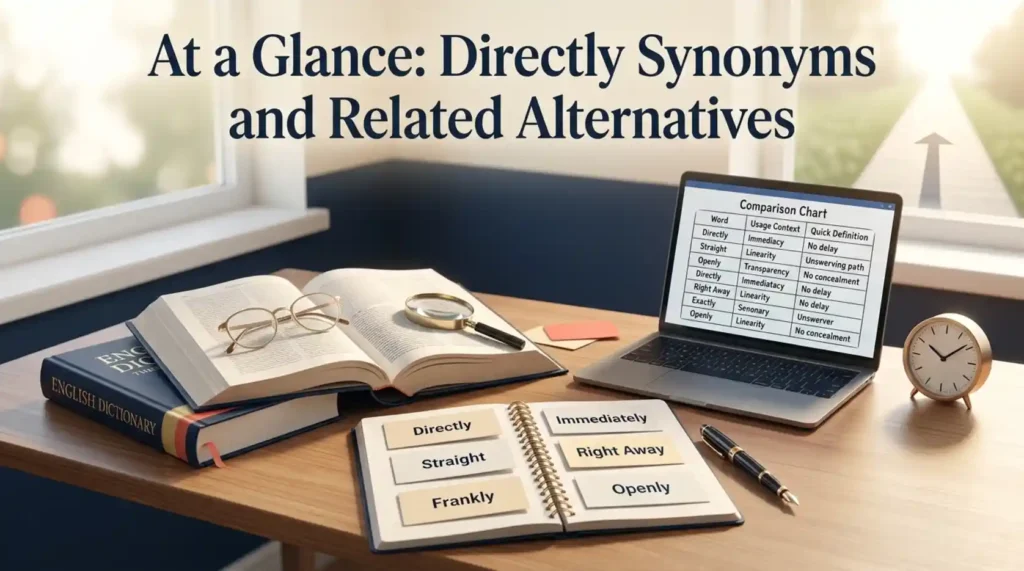
| Alternative | Part of Speech | Meaning | Register / Tone | Ideal Context |
| Straight | Adverb | In a direct line or course | Neutral | Movement or direction |
| Immediately | Adverb | Without delay | Neutral | Urgent or formal instructions |
| Right away | Adverbial phrase | Now; without waiting | Neutral, conversational | Everyday requests |
| At once | Adverbial phrase | Immediately | Slightly formal | Instructions, warnings |
| Instantly | Adverb | In an instant; at once | Neutral | Fast reactions or results |
| Promptly | Adverb | Without delay; on time | Formal | Business, schedules, service |
| Exactly | Adverb | Precisely; with no difference | Neutral | Position, agreement, measurement |
| Openly | Adverb | In an honest, unrestricted way | Neutral | Communication and feelings |
| Frankly | Adverb | In a direct, honest way | Neutral to blunt | Opinions and feedback |
| In person | Adverbial phrase | Physically present; not by phone or online | Neutral | Meetings and contact |
Which Word Should You Use?

| If you want to… | Use | Why |
| Describe movement without turning | Straight | It is the simplest word for a direct route or line. |
| Say something must happen now | Immediately or right away | Both mean without delay; right away sounds more conversational. |
| Use formal written English | Promptly or forthwith | These suit business, legal, and official contexts. |
| Describe an exact place | Exactly, precisely, or squarely | These emphasize accuracy or central position. |
| Say someone speaks honestly | Frankly, openly, or plainly | These focus on clear, honest communication. |
| Describe contact without an intermediary | In person or face-to-face | These mean people meet physically rather than remotely. |
| Describe a direct route in distance | As the crow flies | This established expression means in a straight line, ignoring roads. |
| Emphasize a very fast action | Instantly | It suggests something happens in an instant. |
Exploring the Multiple Meanings of “Directly”
1. In a Straight Line or Course
- Meaning: Without stopping, bending, or changing direction.
- Explanation: This sense describes physical movement or position. Straight is often the closest everyday substitute.
- Example: The bus goes directly to the airport.
2. Without Delay
- Meaning: Immediately; very soon.
- Explanation: In this sense, directly means “at once” or “shortly.” In American English, it often means “soon,” while in British English it can mean “immediately.”
- Example: I will call you directly after the meeting.
3. In a Direct Manner
- Meaning: Clearly, honestly, and without avoiding the point.
- Explanation: This sense is common with verbs such as speak, ask, answer, and explain. It does not necessarily mean “immediately.”
- Example: She directly told him that the plan would not work.
4. With Nothing in Between
- Meaning: With no person, object, or intermediate step involved.
- Explanation: This can describe physical closeness, a connection, or a source. Directly above, directly from, and directly involved are common patterns.
- Example: The lamp hangs directly over the table.
5. In Person
- Meaning: Face-to-face, rather than through another person or by remote communication.
- Explanation: This use often appears with verbs such as meet, speak, deal, and contact.
- Example: You can speak directly with the manager.
Sources: Merriam-Webster; Collins English Thesaurus; Cambridge English Thesaurus; Oxford Learner’s Dictionaries.
Analyzing 30 Directly Alternatives in Detail

Some alternatives are direct synonyms, while others work only in particular senses of directly, such as direction, timing, honesty, or position.
Time and Speed
1. Immediately
IPA: /ɪˈmiːdiətli/ (US and UK)
Definition: Without delay; at once.
- Usage: This is one of the closest alternatives when directly means “without waiting.” It is suitable for both everyday and formal English.
- Example: Please reply immediately if you can attend.
2. Right away
IPA: /ˌraɪt əˈweɪ/ (US and UK)
Definition: Now; without delay.
- Usage: This is a natural conversational alternative to directly in the time sense. It is slightly less formal than immediately.
- Example: We need to leave right away.
3. At once
IPA: /ət ˈwʌns/ (US and UK)
Definition: Immediately; without delay.
- Usage: This phrase is a little more formal than right away and is common in instructions or warnings.
- Example: Stop using the machine at once.
4. Instantly
IPA: /ˈɪnstəntli/ (US and UK)
Definition: In an instant; immediately.
- Usage: Use this when you want to stress that something happens extremely quickly. It is not always interchangeable with directly in the spatial sense.
- Example: The app instantly shows the results.
5. Promptly
IPA: US /ˈprɑːmptli/ · UK /ˈprɒmptli/
Definition: Without delay; at the expected time.
- Usage: This is a formal alternative, especially in business, scheduling, and service contexts. It can also imply doing something on time.
- Example: The hotel responded promptly to our request.
6. Straightaway
IPA: /ˌstreɪtəˈweɪ/ (US and UK)
Definition: Immediately; without delay.
- Usage: This is common in British English and is a useful alternative when directly means “at once.”
- Example: She got straightaway to work on the report.
7. Presently
IPA: /ˈprezntli/ (US and UK)
Definition: Soon; after a short time.
- Usage: This is a related alternative, not an exact synonym. In modern American English, presently usually means “soon,” while directly can mean “immediately.”
- Example: The doctor will see you presently.
8. Shortly
IPA: /ˈʃɔːrtli/ US · UK /ˈʃɔːtli/
Definition: In a short time; soon.
- Usage: Use this when directly means “in a little while,” rather than “this second.” It is common in announcements and formal updates.
- Example: The train will arrive shortly.
9. Forthwith
IPA: US /fɔːrθˈwɪθ/ · UK /fɔːθˈwɪθ/
Definition: At once; without delay.
- Usage: This is a formal, legal-sounding alternative. It is too stiff for ordinary conversation.
- Example: The committee must submit its findings forthwith.
10. Now
IPA: /naʊ/ (US and UK)
Definition: At the present time; immediately.
- Usage: This works when directly means “without delay,” but it is broader and can simply mean “at this moment.”
- Example: You need to decide now.
Direction and Route
11. Straight
IPA: /streɪt/ (US and UK)
Definition: In a direct line or course; without bending or stopping.
- Usage: This is the closest common alternative for physical direction. It works for roads, movement, lines, and routes.
- Example: Go straight to the end of the hall.
12. Right
IPA: /raɪt/ (US and UK)
Definition: Exactly; directly in a specified position or direction.
- Usage: Right is a close alternative in phrases such as right ahead, right above, and right there. It is more informal and emphatic than directly.
- Example: The keys are right under the newspaper.
13. Due
IPA: US /duː/ · UK /djuː/
Definition: Exactly; straight in a stated direction.
- Usage: This is mainly used with compass directions, such as due north, due south, due east, and due west. It is a specialized alternative.
- Example: The town lies due east of the river.
14. As the crow flies
IPA: US /əz ðə ˈkroʊ flaɪz/ · UK /əz ðə ˈkrəʊ flaɪz/
Definition: In a straight line, without following roads or other routes.
- Usage: This established expression is related to directly in the distance sense. It is used for measuring straight-line distance.
- Example: The village is ten miles away as the crow flies.
15. In a beeline
IPA: /ɪn ə ˈbiːlaɪn/ (US and UK)
Definition: By the shortest and most direct route.
- Usage: This is usually used with make or head: make a beeline for. It is more vivid and informal than directly.
- Example: After school, he made a beeline for the kitchen.
16. Unswervingly
IPA: US /ʌnˈswɜːrvɪŋli/ · UK /ʌnˈswɜːvɪŋli/
Definition: Without changing direction or purpose.
- Usage: This is a formal, literary alternative. It often describes determination or loyalty rather than a literal route.
- Example: She followed the plan unswervingly.
Exact Position
17. Exactly
IPA: /ɪɡˈzæktli/ (US and UK)
Definition: Precisely; with complete accuracy.
- Usage: This is a strong alternative when directly identifies an exact place, time, or amount.
- Example: The office is exactly across from the bank.
18. Precisely
IPA: /prɪˈsaɪsli/ (US and UK)
Definition: Exactly; accurately.
- Usage: This is slightly more formal than exactly and emphasizes accuracy. It fits measurements, locations, and detailed descriptions.
- Example: The marker is precisely halfway down the page.
19. Squarely
IPA: US /ˈskwerli/ · UK /ˈskweəli/
Definition: Directly and firmly in a position; exactly.
- Usage: This emphasizes that something is centered on or aimed at a target. It is common with in the middle, on, and at.
- Example: The ball hit him squarely on the shoulder.
20. Bang
IPA: /bæŋ/ (US and UK)
Definition: Exactly; directly.
- Usage: This informal intensifier appears in phrases such as bang in the middle and bang on time. It is chiefly British English.
- Example: The hotel is bang in the middle of town.
21. Smack
IPA: /smæk/ (US and UK)
Definition: Exactly; squarely.
- Usage: This informal word is used in phrases such as smack in the middle or smack dab in the middle. It is emphatic rather than neutral.
- Example: The house sits smack in the middle of the forest.
Honest or Clear Communication
22. Openly
IPA: US /ˈoʊpənli/ · UK /ˈəʊpənli/
Definition: In an honest way; without hiding feelings or information.
- Usage: This is a close alternative when directly describes honest communication. It often suggests willingness to discuss something publicly.
- Example: They talked openly about their concerns.
23. Frankly
IPA: /ˈfræŋkli/ (US and UK)
Definition: In an honest and direct way.
- Usage: This word can sound blunt, especially at the start of a sentence. Use it when the speaker intends to be candid.
- Example: Frankly, I do not think the idea will succeed.
24. Plainly
IPA: /ˈpleɪnli/ (US and UK)
Definition: Clearly; in simple and direct language.
- Usage: This emphasizes clarity as well as honesty. It is useful for instructions, explanations, and formal statements.
- Example: She plainly explained the rules to the new employees.
25. Candidly
IPA: /ˈkændɪdli/ (US and UK)
Definition: Honestly and openly.
- Usage: This is a formal alternative to directly in the communication sense. It often introduces a sincere opinion.
- Example: Candidly, the project needs more time.
26. Straightforwardly
IPA: US /ˌstreɪtˈfɔːrwərdli/ · UK /ˌstreɪtˈfɔːwədli/
Definition: In a clear, simple, and direct way.
- Usage: This is a precise alternative when directly means “without complication or evasion.” It is less common in casual speech.
- Example: He answered the question straightforwardly.
27. Explicitly
IPA: /ɪkˈsplɪsɪtli/ (US and UK)
Definition: Clearly and fully expressed; leaving no doubt.
- Usage: This is related rather than identical. It emphasizes that something was stated clearly, not merely that the speaker was honest.
- Example: The contract explicitly states the payment date.
28. Unequivocally
IPA: /ˌʌnɪˈkwɪvəkli/ (US and UK)
Definition: In a way that leaves no doubt; clearly and firmly.
- Usage: This formal word strengthens directly when someone gives an unambiguous answer or denial.
- Example: She unequivocally denied the accusation.
Personal Contact
29. In person
IPA: US /ɪn ˈpɜːrsn/ · UK /ɪn ˈpɜːsn/
Definition: Physically present rather than by phone, email, or another remote method.
- Usage: This is a related alternative for directly when it means “face-to-face.” It is common in workplace and customer-service language.
- Example: You must apply for the permit in person.
30. Face-to-face
IPA: /ˌfeɪs tə ˈfeɪs/ (US and UK)
Definition: Involving direct personal contact between people who are physically present.
- Usage: This phrase is related to directly in the sense of personal interaction. It can be an adverb or adjective.
- Example: The two leaders met face-to-face for the first time.
Sources: Merriam-Webster; Collins English Thesaurus; Cambridge English Thesaurus; Oxford Learner’s Dictionaries.
Directly vs. Immediately vs. Straight
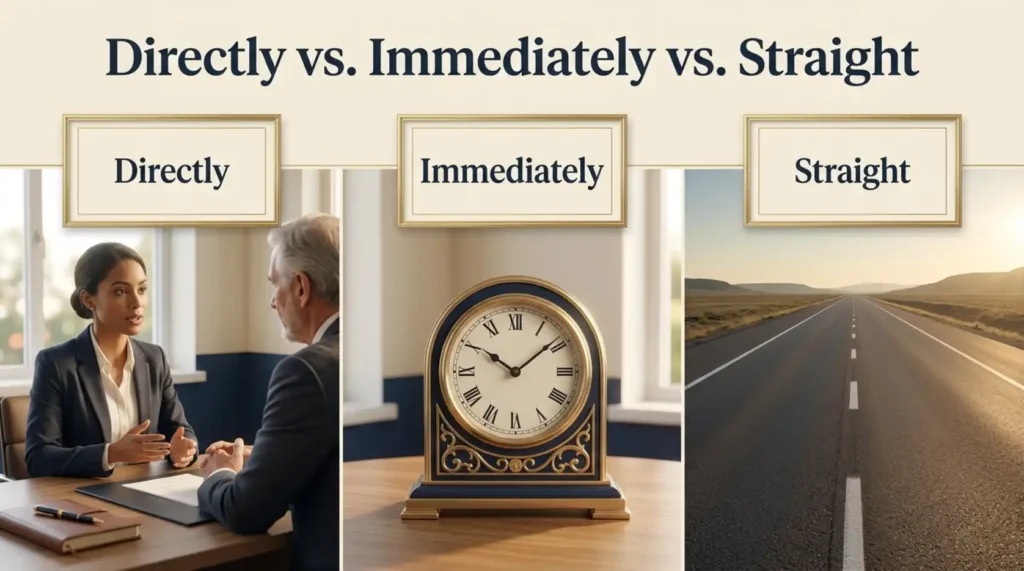
| Word | Main focus | Example |
| Directly | No intermediate step, person, delay, or change of direction | She spoke directly to the manager. |
| Immediately | Time; no delay | Call me immediately after the test. |
| Straight | Physical route or line; no bending or turning | Walk straight down this street. |
Directly is broader than the other two. Use immediately for time, straight for direction, and directly when you want to cover direction, contact, position, or clear communication in one word.
Sources: Merriam-Webster; Cambridge English Thesaurus; Oxford Learner’s Dictionaries.
Directly and Opposite/Paired Word Pairs
| Word | Paired Word | Note |
| Directly | Indirectly | The main opposite: not straight, not immediate, or not straightforward |
| Directly | Circuitously | Describes a route that is not direct |
| Directly | Delay | Contrasts with the time meaning “without delay” |
| Directly | Vaguely | Contrasts with clear, direct communication |
| Directly | In person | Often paired with remote contact, such as by phone or email |
| Straight | Crooked | Contrasts physical direction or shape |
| Openly | Secretly | Contrasts honest communication with concealment |
The most useful opposite is indirectly, because it can oppose directly in movement, communication, causation, and contact.
Sources: Merriam-Webster; Collins English Thesaurus.
Common Word Partners of “Directly”

| Pattern | Common Partners | Example |
| Directly + place/direction | above, below, ahead, opposite, across from | The café is directly across from the station. |
| Directly + movement verb | go, head, travel, fly, walk | We flew directly to Chicago. |
| Directly + communication verb | speak, ask, tell, contact, address | Please contact me directly. |
| Directly + source | from, at, with | I heard the news directly from her. |
| Directly + involvement | involved, affected, responsible, linked | He was directly involved in the project. |
| Directly + time expression | after, before, following | Call me directly after the interview. |
These patterns show why context matters: directly after concerns time, while directly above concerns position.
Sources: Merriam-Webster; Oxford Learner’s Dictionaries; Cambridge English Thesaurus.
Idiomatic Phrases Featuring “Directly”
1. Directly opposite
- Meaning: Exactly across from something.
- Example: The pharmacy is directly opposite the library.
2. Directly involved
- Meaning: Personally and importantly involved in something.
- Example: Only employees directly involved in the launch may attend.
3. Directly responsible
- Meaning: Having the main duty or blame for something.
- Example: The supervisor is directly responsible for staff training.
4. Speak directly to someone
- Meaning: Communicate with someone yourself, without an intermediary.
- Example: If you have a complaint, speak directly to the customer-service manager.
Sources: Merriam-Webster; Oxford Learner’s Dictionaries.
Word Formation of “Directly”
Etymology & Structure
Directly comes from direct plus the adverb-forming suffix -ly. Direct developed through Old French from Latin directus, meaning “straight,” based on dirigere, “to set straight” or “to guide.”
Date and History
Directly appeared in English in the late 1300s, first meaning “completely.” By the early 1400s, it could mean “in a straight line” and, figuratively, “clearly” or “expressly.” The meaning “at once” or “immediately” developed around 1600 from the earlier idea of “without intermediate steps.”
Word Class Variations
- Verb: direct, directs, directed, directing
- Noun: direction, directive, director, directness
- Adjective: direct, indirect
- Adverb: directly, indirectly
- Related derivative: directive
Sources: Online Etymology Dictionary; Merriam-Webster.
Common Word-Choice Mistakes
- Wrong: “Please come to my office straight.” Better: “Please come to my office directly” or “right away,” depending on If you mean route or time.
- Wrong: “The answer was directly no.” Better: “The answer was a clear no” or “She directly said no.”
- Wrong: “He directly replied to my email yesterday.” Better: “He replied to my email yesterday” if you mean timing; use directly only if you mean without an intermediary.
- Wrong: “The shop is directly near the station.” Better: “The shop is right near the station” or “directly opposite the station.”
- Wrong: “I will meet you directly at 6 p.m.” Better: “I will meet you at 6 p.m.” Directly is unnecessary with a precise time.
- Wrong: “She told me directly honest feedback.” Better: “She gave me direct, honest feedback.”
- Wrong: “The hotel is directly in the middle.” Better: “The hotel is right in the middle” or “smack in the middle.”
Frequently Asked Questions
What is the closest synonym for directly?
Straight is closest for direction, immediately for time, and exactly for position. There is no single synonym that replaces directly in every sense.
What is a formal alternative for directly?
Use promptly or forthwith for the time sense. For clear communication, use explicitly, candidly, or unequivocally.
What is the difference between directly and immediately?
Directly can mean “without an intermediate step,” while immediately always focuses on time. In “Call me directly after class,” both can work; in “The picture hangs directly above the sofa,” immediately does not.
Can directly mean soon?
Yes. In sentences such as “I will be there directly,” it can mean “soon” or “in a short time,” especially in British English.
What is the opposite of directly?
The main opposite is indirectly. Other opposites depend on context: circuitously for routes, vaguely for communication, and later for timing.
Can directly describe people?
Yes, but it usually describes their communication or involvement, as in “She spoke directly to the students” or “He was directly involved.”
Is directly the same as in person?
Not exactly. In person means physically present, while directly can also mean “without an intermediary.” “Speak directly with the manager” may mean in person, by phone, or by email.
What is a simple alternative for directly above?
Use right above in everyday English or exactly above when you want to emphasize precision.
What is a literary alternative for directly?
Unswervingly is a literary alternative for steady, unwavering direction or purpose. Forthwith is a formal literary-sounding alternative for “immediately.”
Can directly be used as a conjunction?
Yes, especially in British English. In “Directly I arrived, she left,” it means “as soon as I arrived.”
Conclusion
The most common alternatives to directly are straight, immediately, right away, exactly, openly, and in person. Each replaces only one part of the word’s meaning.
Because directly can refer to direction, timing, position, communication, and personal contact, always match the substitute to the sentence. A word that works for a direct route may sound wrong in a sentence about honest feedback.
Choose straight for routes, immediately or right away for timing, exactly for position, frankly or openly for communication, and in person or face-to-face for direct contact.