
Another Word for Partner: 30 Synonyms With Examples
The closest everyday alternatives to “partner” are associate, colleague, teammate, companion, spouse, and ally. The best choice depends on the kind of partnership. A business partner might be an associate or co-owner, a romantic partner might be a spouse or significant other, and a partner in an activity might be a teammate or collaborator.
“Partner” covers three main areas: love and marriage, business and work, and shared activities such as sports, dancing, or crime. Some alternatives are close synonyms, while others only fit one context. Tone matters too, since “spouse” is formal, “mate” is casual, and “counterpart” is neutral and professional.
Quick list: associate, colleague, teammate, companion, spouse, significant other, ally, collaborator, co-owner, buddy
This article looks at 30 alternatives, with meanings, IPA pronunciation, usage notes, and examples. It also covers common word pairs, collocations, expressions, word history, and frequent mistakes.
At a Glance: Partner Synonyms and Related Alternatives
| Alternative | Part of Speech | Meaning | Register / Tone | Ideal Context |
| Associate | noun | A person you work or deal with | Formal/neutral | Business, professional settings |
| Colleague | noun | A person you work with in a job or profession | Neutral | Workplaces, professions |
| Teammate | noun | A member of the same team | Neutral/casual | Sports, group projects |
| Companion | noun | A person who spends time with you | Neutral/warm | Travel, daily life, romance |
| Spouse | noun | A husband or wife | Formal | Legal, official, marriage |
| Significant other | noun | A person in a serious romantic relationship | Neutral/polite | Unmarried or unspecified couples |
| Ally | noun | A person or group that supports you | Neutral | Causes, conflicts, politics |
| Collaborator | noun | A person who works with others on a task | Neutral/professional | Creative, academic, project work |
| Co-owner | noun | A person who owns something jointly | Formal | Companies, property |
| Buddy | noun | A close friend or companion | Informal | Casual, friendly settings |
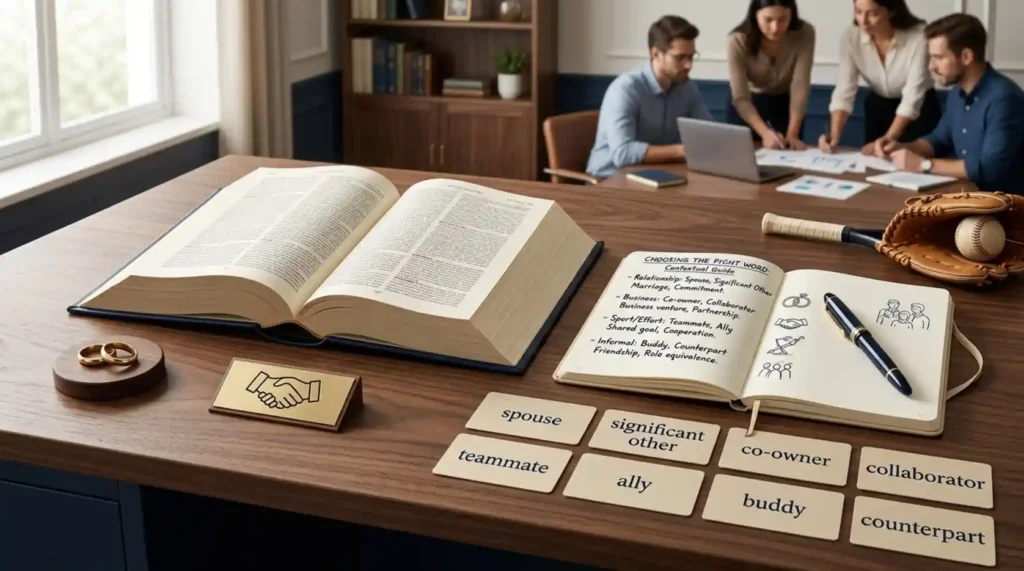
Which Word Should You Use?
| If you want to… | Use | Why |
| Refer to a husband or wife formally | spouse | It is precise, gender-neutral, and legal |
| Refer to a romantic partner without giving details | significant other | It does not state marriage or gender |
| Describe someone who owns a company with you | co-owner | It makes the shared ownership clear |
| Describe someone you work with on a project | collaborator | It stresses shared creative or intellectual effort |
| Describe a person on your sports side | teammate | It shows you belong to the same team |
| Describe a person who supports your cause | ally | It shows support rather than shared work |
| Sound friendly and relaxed | buddy | It is informal and warm |
| Describe your equivalent in another organization | counterpart | It points to someone in a matching role |
Exploring the Multiple Meanings of “Partner”
1. A Romantic or Life Companion
- Meaning: One of two people in a close or long-term relationship, often a spouse or live-in partner.
- Explanation: This sense is gender-neutral and does not say If the couple is married. It is common in everyday speech and in forms such as “domestic partner.”
- Example: She and her partner have lived together for six years.
2. A Co-Owner of a Business
- Meaning: A person who shares ownership, profits, and risks of a firm with others.
- Explanation: This is a specific business and legal sense, used in law firms, accounting firms, and similar companies. Titles such as “managing partner” belong here.
- Example: He became a partner at the law firm after ten years.
3. A Person Who Takes Part in an Activity With Another
- Meaning: One of two people who do something together, such as dancing, playing a game, or exercising.
- Explanation: Here the partnership lasts for the activity, not for life. Nothing is owned together.
- Example: My tennis partner and I play every Saturday morning.
4. An Associate, Ally, or Fellow Participant
- Meaning: A person, group, or country that cooperates with another for a shared goal.
- Explanation: This sense is broader and appears in politics, trade, and community work. It can describe organizations as well as people.
- Example: The school found a local company to be its partner in the reading program.
5. To Join or Work With Someone (Verb)
- Meaning: To act as a partner to someone, or to form a partnership with them.
- Explanation: As a verb, “partner” is usually followed by “with” or used with “up.” It is common in business and project writing.
- Example: The museum partnered with a university to create the exhibit.
Sources: Merriam-Webster; Collins English Dictionary; Dictionary.com; Etymonline.
Analyzing 30 Partner Alternatives in Detail

Some of these words are close synonyms of “partner,” while others are related alternatives that fit only a particular context. Each usage note says which is which.
Formal and Neutral Romantic Alternatives
1. Spouse
IPA: /spaʊs/ (US and UK)
Definition: A married person considered in relation to their husband or wife.
- Usage: This is a close synonym for “partner” only when the couple is married. It is formal and gender-neutral, so it is common in legal and official writing.
- Example: Please list your spouse as an emergency contact.
2. Significant other
IPA: US /sɪɡˈnɪfɪkənt ˈʌðər/ · UK /sɪɡˈnɪfɪkənt ˈʌðə/
Definition: A person with whom someone has a long-term romantic relationship.
- Usage: This is a close synonym for the romantic sense of “partner.” It is polite and does not reveal gender or marital status.
- Example: Employees may bring a significant other to the dinner.
Warm and Casual Romantic Alternatives
3. Companion
IPA: /kəmˈpænjən/ (US and UK)
Definition: A person who spends time or travels with another.
- Usage: This is a related alternative. It can mean a romantic partner, but it can also mean a friend or travel mate, so the context must make the meaning clear.
- Example: He traveled with a companion for most of the trip.
4. Mate
IPA: /meɪt/ (US and UK)
Definition: A sexual or life partner; in British and Australian English, also a friend.
- Usage: This is informal. In British English “mate” often means a friend, so use it for a romantic partner only when the meaning is clear. It is also the usual word for animal pairs.
- Example: The couple were mates for forty years.
5. Better half
IPA: US /ˌbetər ˈhæf/ · UK /ˌbetə ˈhɑːf/
Definition: A humorous term for one’s husband, wife, or partner.
- Usage: This is a playful, informal expression. It is a close synonym for the romantic sense but is not suitable for formal writing.
- Example: I need to check with my better half before we book anything.
Work Relationship Alternatives
6. Associate
IPA: US /əˈsoʊʃiət/ · UK /əˈsəʊʃiət/
Definition: A person connected with another in work or business.
- Usage: This is a close synonym for the business sense of “partner.” It is less formal than a legal partnership and may only mean a work contact.
- Example: She introduced me to an associate from her old firm.
7. Colleague
IPA: US /ˈkɑːliːɡ/ · UK /ˈkɒliːɡ/
Definition: A person who works in the same organization or profession.
- Usage: This is a related alternative. It describes people who work together but not necessarily co-owners.
- Example: My colleague will join the meeting at noon.
Ownership and Collaboration Alternatives
8. Co-owner
IPA: US /ˌkoʊ ˈoʊnər/ · UK /ˌkəʊ ˈəʊnə/
Definition: A person who owns something jointly with another.
- Usage: This is a precise alternative for a business or property partner. It does not suit other senses of “partner.”
- Example: The two sisters are co-owners of the bakery.
9. Co-founder
IPA: US /ˌkoʊ ˈfaʊndər/ · UK /ˌkəʊ ˈfaʊndə/
Definition: One of the people who start an organization together.
- Usage: This is a narrower alternative. It names a partner who helped start a company, not just one who joined later.
- Example: He is a co-founder of the software company.
10. Collaborator
IPA: US /kəˈlæbəreɪtər/ · UK /kəˈlæbəreɪtə/
Definition: A person who works with others on a project or piece of work.
- Usage: This is a close synonym for the “working together” sense. Note that in some contexts, such as wartime, “collaborator” can mean someone who helps an enemy.
- Example: The author thanked her research collaborators.
Team and Helper Alternatives
11. Teammate
IPA: /ˈtiːmmeɪt/ (US and UK)
Definition: A member of the same team.
- Usage: This is a close synonym when the partnership is part of a team. It does not suit romantic or ownership senses.
- Example: Her teammate passed her the ball.
12. Sidekick
IPA: /ˈsaɪdkɪk/ (US and UK)
Definition: A close companion or helper, often in a less important role.
- Usage: This is a related alternative and often suggests the other person is the main one. It can sound playful or slightly dismissive.
- Example: The detective and his sidekick solved the case.
Cause, Conflict, and Crime Alternatives
13. Accomplice
IPA: US /əˈkɑːmplɪs/ · UK /əˈkʌmplɪs/
Definition: A person who helps another commit a crime.
- Usage: This is a related alternative that fits only the idea of a partner in wrongdoing. It is negative and often legal in tone.
- Example: Police arrested the thief and his accomplice.
14. Ally
IPA: /ˈælaɪ/ (US and UK)
Definition: A person, group, or country that cooperates with or supports another.
- Usage: This is a close synonym for the “partner in a shared cause” sense. It suggests support and shared goals, not ownership.
- Example: The mayor found an ally in the city council.
15. Comrade
IPA: US /ˈkɑːmræd/ · UK /ˈkɒmreɪd/
Definition: A companion who shares one’s activities or struggles.
- Usage: This is a related alternative. It is somewhat old-fashioned and often suggests military or political companionship.
- Example: He wrote about the comrades who fought beside him.
Friendly and Informal Alternatives
16. Buddy
IPA: /ˈbʌdi/ (US and UK)
Definition: A close friend or companion.
- Usage: This is a casual related alternative. It fits shared activities, such as a “workout buddy,” but not formal partnerships.
- Example: I go hiking with my buddy every weekend.
17. Pal
IPA: /pæl/ (US and UK)
Definition: A friend.
- Usage: This is a casual, friendly related alternative. It describes friendship more than a formal partnership.
- Example: He and his pal opened a small repair shop.
18. Friend
IPA: /frend/ (US and UK)
Definition: A person you know well and like.
- Usage: This is a related alternative, not a direct synonym. A friend is not necessarily a partner, so use it only when the closeness is the main point.
- Example: She went to the concert with a friend.
19. Confidant
IPA: US /ˈkɑːnfɪdænt/ · UK /ˈkɒnfɪdænt/
Definition: A person you trust with private matters.
- Usage: This is a related alternative. It describes a partner or friend in terms of trust, not a shared activity.
- Example: Her sister was her closest confidant.
Formal and Organizational Alternatives
20. Counterpart
IPA: US /ˈkaʊntərpɑːrt/ · UK /ˈkaʊntəpɑːt/
Definition: A person or thing that has the same role as another in a different place or group.
- Usage: This is a related alternative. It points to a matching role, such as another country’s leader, and not to a shared effort.
- Example: The minister met her French counterpart.
21. Affiliate
IPA: /əˈfɪliət/ (US and UK)
Definition: An organization or person officially connected to a larger one.
- Usage: This is a related alternative for organizations. It suggests a looser link than a full partnership.
- Example: The clinic is an affiliate of the hospital.
22. Consort
IPA: US /ˈkɑːnsɔːrt/ · UK /ˈkɒnsɔːt/
Definition: The husband or wife of a ruler.
- Usage: This is a narrow alternative for royal or formal contexts. It is not a general word for a partner.
- Example: The queen’s consort attended the ceremony.
23. Party
IPA: US /ˈpɑːrti/ · UK /ˈpɑːti/
Definition: A person or group taking part in an agreement or legal matter.
- Usage: This is a legal-context alternative, as in “the parties to a contract.” It does not carry a personal meaning.
- Example: Both parties signed the agreement.
Social Event Alternatives
24. Escort
IPA: US /ˈeskɔːrt/ · UK /ˈeskɔːt/
Definition: A person who accompanies another, especially to a social event.
- Usage: This is a related alternative for event companions. Be careful, as “escort” can also suggest paid companionship.
- Example: He was her escort to the formal dinner.
25. Date
IPA: /deɪt/ (US and UK)
Definition: A person you go out with socially or romantically.
- Usage: This is a related alternative for a partner at an event or early relationship. It does not suggest a long-term bond.
- Example: She brought a date to the wedding.
Verb Alternatives for “To Partner”
26. Cooperate
IPA: US /koʊˈɑːpəreɪt/ · UK /kəʊˈɒpəreɪt/
Definition: To work together toward a shared goal.
- Usage: This is a close synonym for the verb “partner.” It is neutral and describes working together without formal ties.
- Example: The two schools agreed to cooperate on the project.
27. Team up
IPA: /ˌtiːm ˈʌp/ (US and UK)
Definition: To join with others to do something together.
- Usage: This is a close, informal synonym for “partner up.”
- Example: The two bakers teamed up to sell their bread.
28. Join forces
IPA: US /ˌdʒɔɪn ˈfɔːrsɪz/ · UK /ˌdʒɔɪn ˈfɔːsɪz/
Definition: To unite with others to reach a goal.
- Usage: This is a close alternative that sounds a little dramatic. It suits groups or companies facing a challenge.
- Example: Local farmers joined forces to open a market.
29. Pair up
IPA: /ˌpeər ˈʌp/ (US) · /ˌpeə ˈʌp/ (UK)
Definition: To form a pair with another person.
- Usage: This is a close alternative for two people only, such as students or dancers.
- Example: The students paired up for the experiment.
30. Unite
IPA: US /juˈnaɪt/ · UK /juːˈnaɪt/
Definition: To come together for a shared purpose.
- Usage: This is a related alternative. It suggests a stronger, more emotional joining than “partner.”
- Example: The neighbors united to save the park.
Sources: Merriam-Webster; Collins English Dictionary and Collins Thesaurus; Dictionary.com; Cambridge Dictionary.
Partner vs. Spouse vs. Significant Other
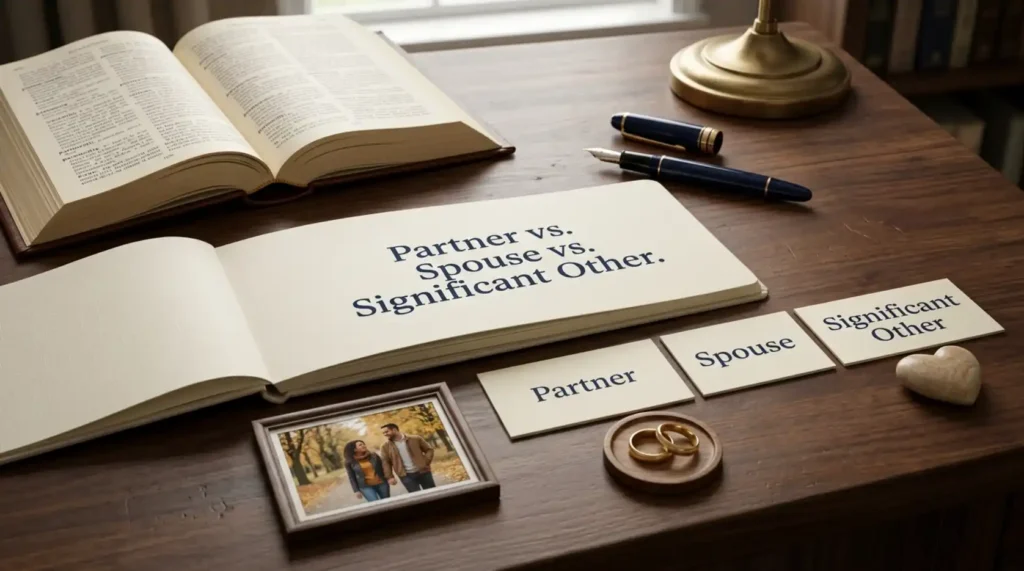
These three words are often confused when people talk about romantic relationships.
| Word | Marriage Required? | Tone | Best Use |
| Partner | No | Neutral | Any committed relationship |
| Spouse | Yes | Formal | Legal and official settings |
| Significant other | No | Polite, neutral | Invitations and forms where status is unknown |
“Partner” is the widest of the three. “Spouse” is correct only for married people. “Significant other” suits situations where you do not want to state the relationship type.
Sources: Merriam-Webster; Collins English Dictionary.
Partner and Opposite/Paired Word Pairs
| Word | Paired Word | Note |
| Partner | Rival | A rival competes with you; a partner works with you |
| Partner | Opponent | Used in games, sports, and debates |
| Partner | Competitor | Common in business |
| Partner | Stranger | Contrasts a close relationship with no relationship |
| Senior partner | Junior partner | Describes rank within a firm |
| Silent partner | Active partner | Describes involvement in running a business |
| Partnership | Rivalry | Noun forms of the same contrast |
“Partner” has no single perfect opposite. The best contrast depends on the sense: “rival” or “opponent” for competition, and “stranger” for personal closeness.
Sources: Merriam-Webster; Collins Thesaurus.
Common Word Partners of “Partner”
| Pattern | Common Partners | Example |
| adjective + partner | business, life, equal, senior, junior, silent | She is a senior partner at the firm. |
| noun + partner | dance, tennis, sparring, trading, domestic | He found a dance partner at class. |
| verb + partner | find, choose, become, make someone | They made her a partner last year. |
| partner + preposition | partner with, partner in | The charity partnered with a local bank. |
| title + partner | managing partner, general partner | The managing partner approved the plan. |
Sources: Merriam-Webster; Collins English Dictionary; Oxford Collocations Dictionary.
Idiomatic Phrases Featuring “Partner”

“Partner” appears in few true idioms, so this section includes established expressions. The first is a genuine idiom, and the others are fixed expressions.
1. Partners in crime
- Meaning: Two or more people who do something together, often something mischievous. It is often used humorously.
- Example: My brother and I were partners in crime as kids.
2. Silent partner
- Meaning: A partner who invests money in a business but does not take part in running it. In British English it is also called a “sleeping partner.”
- Example: She stayed a silent partner and let her cousin run the shop.
3. Junior partner / senior partner
- Meaning: A partner of lower or higher rank within a firm. Outside business, “junior partner” can describe the less powerful side in an arrangement.
- Example: He was a junior partner for five years before being promoted.
4. Partner up
- Meaning: To join with someone, usually informally, to do something together.
- Example: Please partner up with the person next to you.
Sources: Merriam-Webster; Cambridge Dictionary; Collins English Dictionary.
Word Formation of “Partner”
Etymology & Structure
“Partner” comes from Middle English partener, an alteration of parcener, meaning a joint heir or person who shares in something. Parcener came from Anglo-French and ultimately from Latin partitio, meaning “division.” The change in spelling was influenced by the word part, which fits the idea of sharing a part.
Date and History
Merriam-Webster dates the first known use of “partner” to the 14th century.
Word Class Variations
- Noun: partner
- Verb: partner, partnered, partnering
- Related nouns: partnership, copartner
- Related adjective: partnered (as in “partnered dancing”)
There is no standard adverb form.
Sources: Merriam-Webster; Etymonline.
Common Word-Choice Mistakes
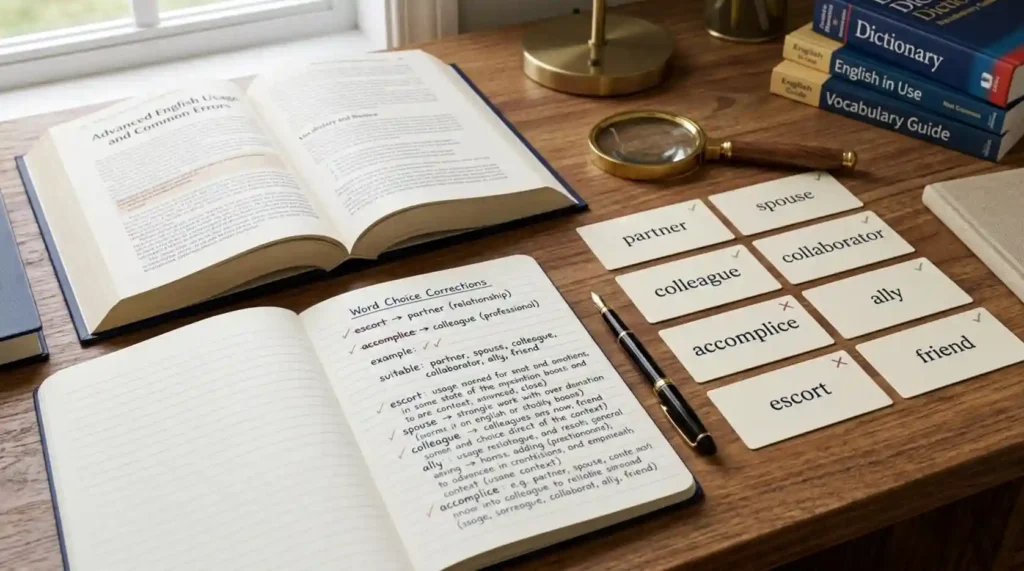
- “My partner and I are co-workers” for a romantic partner: say “colleague” for a work relationship and keep “partner” for a closer bond.
- “Spouse” for an unmarried partner: use “partner” or “significant other.”
- “Collaborator” in a wartime context: it can mean someone who helps an enemy, so check the setting.
- “Accomplice” for a friendly helper: it implies a crime, so use “ally” or “teammate.”
- “Escort” for a friendly event companion: it can suggest paid companionship, so “date” or “companion” is safer.
- “Partner” for any friend: a friend is not necessarily a partner, so use “friend” or “buddy.”
- “Partnered to” instead of “partnered with”: the correct preposition is “with.”
Frequently Asked Questions
Synonyms and Tone
What is the closest synonym for “partner”?
“Associate” is the closest in business, “spouse” or “significant other” in romance, and “teammate” in sports.
What is a formal word for partner?
“Spouse” is formal for marriage and “associate” is formal for business. “Counterpart” works for matching roles in formal writing.
What is an informal word for partner?
“Buddy,” “pal,” “mate,” and “better half” are informal, depending on the context.
Differences and Meanings
What is the difference between a partner and a colleague?
A partner usually shares ownership, responsibility, or a close bond. A colleague simply works in the same organization or field.
Can “partner” be used for a romantic relationship?
Yes. It is common, gender-neutral, and does not say If the couple is married.
What is the difference between a partner and an ally?
An ally supports you in a cause or conflict. A partner usually shares work, ownership, or a relationship.
Opposites, Verb Use, and Expressions
What is the opposite of partner?
There is no single opposite. “Rival” and “opponent” contrast with a working partner, and “stranger” contrasts with a close personal one.
Is “partner” also a verb?
Yes. People “partner with” a company or “partner up” for a project.
What is a silent partner?
It is a business partner who invests money but does not help run the company.
What is a good word for a partner in crime?
“Accomplice” is the formal word, while “sidekick” and “partner in crime” sound more playful.
Conclusion
The most common alternatives to “partner” are associate, colleague, teammate, companion, spouse, significant other, and ally. Each fits a different part of the word’s meaning, from business and work to romance and shared activities.
Context decides which word is correct. “Spouse” requires marriage, “co-owner” requires shared ownership, and “accomplice” suggests a crime. A word that fits one sense of “partner” may sound odd or wrong in another.
To choose well, first decide what kind of partnership you mean, then check the tone you want. Pick the word that matches both, and use “partner” itself when you need a flexible, neutral term.