Another Word for Sweet: 30 Synonyms With Examples
Sweet can mean different things. Food can be sugary or honeyed. A sweet person can be kind, gentle, or caring. A sweet sound can be melodious or soothing. The right word depends on what you are describing.
The word sweet also describes charming behavior, lovely memories, pleasant smells, and attractive experiences. Choosing the right synonym helps you express If something tastes sugary, feels comforting, sounds beautiful, or shows kindness.
Quick list: Sugary, sugary-sweet, saccharine, honeyed, sugary-tasting, pleasant, delightful, lovely, kind, gentle.
This guide explores 30 alternatives with definitions, pronunciation (IPA), usage notes, and natural examples. It also explains the different meanings of sweet, common word partnerships, established expressions, and frequent word-choice mistakes.
At a Glance: Sweet Synonyms and Related Alternatives
| Alternative | Part of Speech | Meaning | Register / Tone | Ideal Context |
| Sugary | Adjective | Containing or tasting like sugar | Everyday | Desserts and drinks |
| Sugared | Adjective | Covered or prepared with sugar | Neutral | Food and treats |
| Honeyed | Adjective | Sweet like honey; sometimes flattering | Descriptive or literary | Taste, voice, words |
| Saccharine | Adjective | Excessively sweet or sentimental | Often critical | Food, emotions, writing |
| Pleasant | Adjective | Giving enjoyment or comfort | Neutral | Experiences and smells |
| Delightful | Adjective | Causing great pleasure | Warm, positive | People, events, experiences |
| Lovely | Adjective | Attractive or pleasing | Informal, warm | People, moments, things |
| Kind | Adjective | Caring and considerate | Everyday | Behavior and character |
| Gentle | Adjective | Soft, calm, or mild | Neutral, warm | People, voices, actions |
| Melodious | Adjective | Pleasant and musical to hear | Descriptive | Voices, songs, sounds |
These alternatives are not interchangeable in every situation. For example, sugary usually describes taste, while kind describes behavior and melodious describes sound.
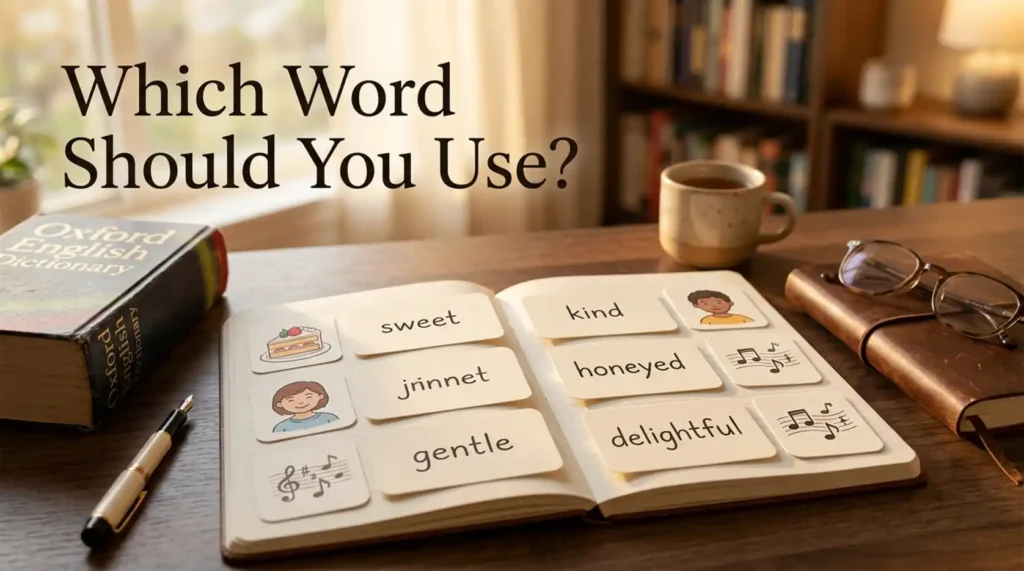
Which Word Should You Use?
| If you want to… | Use | Why |
| Describe food that tastes sweet | Sugary | It directly refers to a sugar-like taste. |
| Describe food coated with sugar | Sugared | It emphasizes the way the food is prepared. |
| Describe a voice that sounds sweet | Melodious | It highlights musical, pleasant sound. |
| Describe a caring person | Kind | It focuses on considerate behavior. |
| Describe a calm and soft manner | Gentle | It suggests mildness and tenderness. |
| Describe something that gives pleasure | Delightful | It expresses strong enjoyment. |
| Describe a pleasant smell or experience | Pleasant | It is broad and works in many contexts. |
| Describe excessive emotional sweetness | Saccharine | It suggests sentiment that feels unnatural or overdone. |
Exploring the Multiple Meanings of “Sweet”
1. Sweet in Taste
- Meaning: Having a taste like sugar or honey.
- Explanation: This is the most direct meaning of sweet. It describes foods and drinks that contain natural or added sugars, as well as some naturally sweet flavors.
- Example: The ripe mango was sweet and juicy.
2. Sweet in Personality
- Meaning: Kind, caring, or thoughtful.
- Explanation: When describing a person, sweet often refers to behavior that makes others feel appreciated. It can describe children, friends, partners, or strangers.
- Example: Our new neighbor was sweet enough to bring us homemade cookies.
3. Sweet in Sound
- Meaning: Pleasant, soft, or attractive to hear.
- Explanation: A sweet voice or melody sounds pleasing. Depending on the situation, melodious, harmonious, or soothing may express the intended quality more precisely.
- Example: Her sweet voice filled the room with warmth.
4. Sweet in Smell
- Meaning: Having a pleasant smell, often like flowers or fruit.
- Explanation: The word can describe the scent of roses, ripe fruit, perfume, or fresh blossoms. Fragrant is often a more precise alternative when describing a pleasant smell.
- Example: A sweet fragrance drifted through the open window.
5. Sweet as an Expression of Affection
- Meaning: Charming, thoughtful, or emotionally pleasing.
- Explanation: People often call a gesture, message, or memory sweet when it shows affection or creates a warm feeling.
- Example: It was sweet of him to remember my birthday.
6. Sweet as an Expression of Satisfaction
- Meaning: Enjoyable, rewarding, or especially satisfying.
- Explanation: In informal speech, sweet can express approval or excitement. In phrases such as sweet victory, it emphasizes the pleasure of a successful result.
- Example: Winning the final match after months of practice was sweet.
Sources: Merriam-Webster, Collins Dictionary, and Dictionary.com are suitable dictionary references for these meanings and usage distinctions.
Analyzing 30 Sweet Alternatives in Detail

Some of the following words are direct synonyms of sweet, while others work only in specific contexts, such as describing food, personality, sound, or emotional experiences.
Group 1: Sweet-Tasting Food and Drinks
1. Sugary
IPA: US /ˈʃʊɡəri/ · UK /ˈʃʊɡəri/
Definition: Containing or tasting like sugar.
- Usage: This is one of the closest everyday alternatives when describing food or drinks. It can also suggest that something contains too much sugar.
- Example: The sugary lemonade was popular with the children.
2. Sugared
IPA: US and UK /ˈʃʊɡərd/
Definition: Coated with or prepared using sugar.
- Usage: This is a context-specific alternative. It describes how food is prepared rather than simply how it tastes.
- Example: She decorated the cake with sugared strawberries.
3. Honeyed
IPA: US and UK /ˈhʌnid/
Definition: Having the taste, quality, or character of honey.
- Usage: It can describe a sweet flavor, but it also describes smooth voices and flattering speech. It is more descriptive than ordinary sweet.
- Example: The tea had a rich, honeyed flavor.
4. Saccharine
IPA: US and UK /ˈsækərɪn/
Definition: Excessively sweet or excessively sentimental.
- Usage: Use it when sweetness seems too strong or artificial. It often has a negative tone, especially when describing emotions, dialogue, or writing.
- Example: The movie’s saccharine ending felt unrealistic.
5. Syrupy
IPA: US and UK /ˈsɪrəpi/
Definition: Having the thick, sticky quality of syrup; excessively sweet in some contexts.
- Usage: It is useful for describing thick sweet liquids, rich flavors, or overly sentimental language. It is not a neutral substitute for every use of sweet.
- Example: The syrupy sauce made the dessert very rich.
Group 2: Pleasant and Enjoyable Experiences
6. Pleasant
IPA: US and UK /ˈplɛzənt/
Definition: Giving a feeling of enjoyment or satisfaction.
- Usage: This is a broad alternative when sweet means agreeable or enjoyable rather than sugary.
- Example: We spent a pleasant afternoon talking in the garden.
7. Delightful
IPA: US and UK /dɪˈlaɪtfəl/
Definition: Causing great pleasure or enjoyment.
- Usage: Use it for experiences, people, events, or things that bring strong enjoyment. It usually expresses more enthusiasm than pleasant.
- Example: The children had a delightful day at the beach.
8. Lovely
IPA: US and UK /ˈlʌvli/
Definition: Beautiful, attractive, or very pleasant.
- Usage: This warm, common word can describe people, gestures, weather, memories, and experiences. It often replaces sweet in casual conversation.
- Example: That was a lovely thing to do for your friend.
9. Charming
IPA: US and UK /ˈtʃɑːrmɪŋ/ (US) · /ˈtʃɑːmɪŋ/ (UK)
Definition: Pleasant or attractive in a way that wins affection.
- Usage: Use it when a person, manner, or place has an appealing quality. It overlaps with sweet in the sense of being likable, but it emphasizes attraction or appeal.
- Example: The little café had a charming atmosphere.
10. Appealing
IPA: US and UK /əˈpiːlɪŋ/
Definition: Attractive or interesting.
- Usage: This is a related alternative when sweet means attractive or pleasing. It is especially useful for choices, designs, offers, and ideas.
- Example: The garden’s simple design was appealing to visitors.
Group 3: Kindness, Care, and Affection
11. Kind
IPA: US and UK /kaɪnd/
Definition: Caring about others and treating them well.
- Usage: This is one of the best alternatives when sweet describes someone’s actions or character. It emphasizes consideration rather than charm.
- Example: It was kind of her to help the new student.
12. Gentle
IPA: US and UK /ˈdʒɛntəl/
Definition: Mild, calm, or careful in manner or action.
- Usage: Use it for a person, voice, touch, or approach that is soft and considerate. It is not always a synonym for sweet, because it can describe physical force or intensity.
- Example: He spoke in a gentle voice to calm the frightened child.
13. Caring
IPA: US and UK /ˈkɛrɪŋ/
Definition: Showing concern for other people’s needs and feelings.
- Usage: This word works well when sweet means thoughtful or affectionate. It highlights ongoing concern rather than a single charming act.
- Example: She is a caring teacher who listens to every student.
14. Thoughtful
IPA: US and UK /ˈθɔːtfəl/
Definition: Showing consideration for other people’s needs or feelings.
- Usage: Choose it for actions that show someone has paid attention to another person’s wishes. It is especially useful for gifts, messages, and small favors.
- Example: His thoughtful note made me feel much better.
15. Affectionate
IPA: US and UK /əˈfɛkʃənət/
Definition: Showing love or fondness.
- Usage: This is more specific than sweet when the intended meaning is loving behavior. It can describe words, gestures, relationships, or physical expressions of affection.
- Example: The affectionate message brought a smile to her face.
Group 4: Sound, Smell, and Sensory Qualities
16. Melodious
IPA: US and UK /məˈloʊdiəs/ (US) · /məˈləʊdiəs/ (UK)
Definition: Pleasant to hear because of its musical quality.
- Usage: This is a strong alternative for sweet when describing singing, voices, or music. It emphasizes melody rather than kindness or taste.
- Example: A melodious birdcall echoed through the trees.
17. Harmonious
IPA: US and UK /hɑːrˈmoʊniəs/ (US) · /hɑːˈməʊniəs/ (UK)
Definition: Forming a pleasing combination or agreement.
- Usage: Use it for sounds, colors, relationships, or arrangements that work well together. It is a related alternative when sweet means pleasing, not a direct synonym in every case.
- Example: The choir produced a harmonious blend of voices.
18. Soothing
IPA: US and UK /ˈsuːðɪŋ/
Definition: Making someone feel calmer or more comfortable.
- Usage: This works when a sweet sound, voice, or experience provides comfort. It emphasizes a calming effect rather than sweetness itself.
- Example: The soothing sound of rain helped me relax.
19. Fragrant
IPA: US and UK /ˈfreɪɡrənt/
Definition: Having a pleasant smell.
- Usage: This is more precise than sweet when describing flowers, perfume, herbs, or other pleasant scents. It does not necessarily mean the smell is sugary.
- Example: Fragrant jasmine flowers grew beside the path.
20. Perfumed
IPA: US and UK /ˈpɜːrfjuːmd/ (US) · /ˈpɜːfjuːmd/ (UK)
Definition: Having a scent added or being filled with perfume.
- Usage: This is a contextual alternative for sweet-smelling objects or spaces. Unlike fragrant, it can specifically suggest the use of perfume.
- Example: The perfumed candles filled the room with a floral scent.
Group 5: Attractive, Positive, and Emotionally Pleasing
21. Adorable
IPA: US and UK /əˈdɔːrəbəl/ (US) · /əˈdɔːrəbəl/ (UK)
Definition: Extremely lovable or appealing.
- Usage: This is useful when sweet means cute or lovable, especially when describing children, pets, or affectionate behavior.
- Example: The puppy looked adorable in its little sweater.
22. Endearing
IPA: US and UK /ɪnˈdɪrɪŋ/
Definition: Inspiring affection or liking.
- Usage: Use it for a quality or behavior that makes someone more lovable. It is particularly helpful when describing small habits or imperfections that people find charming.
- Example: His nervous laugh was strangely endearing.
23. Heartwarming
IPA: US and UK /ˈhɑːrtˌwɔːrmɪŋ/ (US) · /ˈhɑːtˌwɔːmɪŋ/ (UK)
Definition: Causing feelings of happiness, affection, or emotional warmth.
- Usage: This is a related alternative for a sweet story, moment, or gesture that creates a warm emotional response.
- Example: Their reunion was a heartwarming moment for the whole family.
24. Tender
IPA: US and UK /ˈtɛndər/ (US) · /ˈtendə/ (UK)
Definition: Showing gentleness, affection, or care.
- Usage: This word works when sweet describes loving feelings or delicate treatment. It can also describe soft food or sensitive emotions, depending on context.
- Example: She gave her baby a tender kiss on the forehead.
25. Winsome
IPA: US and UK /ˈwɪnsəm/
Definition: Attractive or pleasing in a way that inspires affection.
- Usage: This is a less common, somewhat literary alternative to sweet when describing a person’s expression, manner, or charm.
- Example: Her winsome smile made everyone feel welcome.
Group 6: Literary, Descriptive, and Context-Specific Alternatives
26. Sugary-sweet
IPA: US and UK /ˌʃʊɡəri ˈswiːt/
Definition: Very sweet in taste or manner.
- Usage: This compound expression is useful for emphasizing sweetness. When applied to behavior or language, it can sometimes suggest exaggerated sweetness.
- Example: The sugary-sweet frosting covered the entire cupcake.
27. Sacchariferous
IPA: US and UK /ˌsækəˈrɪfərəs/
Definition: Containing or producing sugar.
- Usage: This is a technical and uncommon term, not a natural everyday substitute for sweet. It can be useful in scientific or botanical descriptions of sugar-containing substances.
- Example: The researcher examined the sacchariferous plant material.
28. Luscious
IPA: US and UK /ˈlʌʃəs/
Definition: Rich, full, and highly pleasing to the senses.
- Usage: It often describes rich flavors, ripe fruit, or attractive sensory qualities. It can overlap with sweet, but it also suggests richness or luxurious appeal.
- Example: The ripe peaches had a luscious, juicy texture.
29. Delectable
IPA: US and UK /dɪˈlɛktəbəl/
Definition: Extremely pleasing, especially to taste.
- Usage: This is a good alternative when sweet describes delicious food. It emphasizes how enjoyable something is to eat rather than its sugar content.
- Example: The bakery served delectable pastries fresh from the oven.
30. Winsome-looking
IPA: US and UK /ˈwɪnsəm ˈlʊkɪŋ/
Definition: Having an appearance that is appealing or endearing.
- Usage: This descriptive phrase is a contextual alternative, not a direct synonym in all situations. It can describe an appealing expression or appearance, but winsome alone is more natural and concise in most writing.
- Example: The winsome-looking child waved happily at the camera.
Sources: Merriam-Webster, Collins Dictionary, and Dictionary.com are appropriate references for definitions and usage. Pronunciation transcriptions are provided in broad IPA form; regional accents may vary.
Sweet vs. Sugar, Sweetness, and Sweeter: Choosing the Right Form
The word sweet has several related forms, but they serve different purposes. Understanding these forms helps you choose the correct word for food, people, and experiences.
| Word | Part of Speech | Meaning | Example |
| Sweet | Adjective | Having a sugary taste or a pleasant quality | This tea is sweet. |
| Sweetness | Noun | The quality or state of being sweet | I enjoy the natural sweetness of berries. |
| Sweeten | Verb | To make something sweet or sweeter | Add honey to sweeten the tea. |
| Sweetly | Adverb | In a sweet, kind, or gentle way | She smiled sweetly. |
| Sweeter | Comparative adjective | More sweet than something else | This apple is sweeter than that one. |
| Sweetest | Superlative adjective | The most sweet among a group | These are the sweetest grapes. |
| Unsweetened | Adjective | Not having added sugar or sweetener | I prefer unsweetened yogurt. |
| Sweetener | Noun | A substance used to make food or drinks taste sweet | The recipe uses a natural sweetener. |
Sources: Merriam-Webster and Collins Dictionary.
Sweet and Opposite/Paired Word Pairs
The opposite of sweet depends on its meaning. A word that contrasts with sweet-tasting food may not be the right opposite when describing someone’s personality.
| Word | Paired Word | Note |
| Sweet | Sour | Contrasting tastes |
| Sweet | Bitter | Contrasting flavors or emotional experiences |
| Sweet | Salty | Different basic taste qualities |
| Sweet | Unsweetened | Sweetened versus lacking added sweetener |
| Sweet | Unkind | Contrasting behavior |
| Sweet | Harsh | Contrasting manner, tone, or treatment |
| Sweet | Unpleasant | Contrasting experiences or sensations |
| Sweet | Sour-tempered | Pleasant versus bad-tempered character |
The words sour, bitter, and salty describe different tastes, rather than exact opposites in every scientific or culinary sense. Similarly, unkind is a more natural opposite when sweet describes a caring person. Choose a contrast based on the meaning you intend.
Sources: Merriam-Webster and Collins Dictionary.
Common Word Partners of “Sweet”

Collocations are words that naturally appear together. Learning these combinations can help you use sweet more naturally in speaking and writing.
| Pattern | Common Partners | Example |
| Sweet + food | Tea, cake, fruit, chocolate | The sweet fruit tasted delicious. |
| Sweet + drink | Juice, coffee, lemonade | I ordered a sweet lemonade. |
| Sweet + person | Child, girl, boy, person | He is a sweet child. |
| Sweet + gesture | Message, gesture, surprise | That was a sweet gesture. |
| Sweet + sound | Voice, melody, music | Her sweet voice was easy to recognize. |
| Sweet + smell | Scent, fragrance, perfume | A sweet scent came from the flowers. |
| Sweet + memory | Memory, moment, childhood | We shared a sweet memory from school. |
| Sweet + result | Victory, success, revenge | The team’s victory was especially sweet. |
| Sweet + expression | Smile, look, face | She gave him a sweet smile. |
| Sweet + emotion | Love, affection, feeling | Their reunion was a sweet moment. |
These combinations illustrate the different ways sweet can describe taste, personality, the senses, emotions, and satisfying outcomes.
Sources: Collins Dictionary, Merriam-Webster, and Dictionary.com.
Idiomatic Phrases Featuring “Sweet”
The following are established expressions. Some have figurative meanings, while others are common fixed phrases rather than strict idioms.
1. Sweet tooth
- Meaning: A strong liking for sweet foods, such as cakes, sweets, and chocolate.
- Example: My brother has a sweet tooth and always orders dessert.
2. Sweet dreams
- Meaning: A common expression used to wish someone a pleasant night’s sleep.
- Example: She tucked her daughter into bed and said, “Sweet dreams.”
3. Sweet nothings
- Meaning: Romantic or affectionate words, often spoken softly to someone.
- Example: The couple whispered sweet nothings during their walk.
4. Sweet success
- Meaning: A satisfying or rewarding achievement, especially after effort or difficulty.
- Example: After months of practice, winning the competition felt like sweet success.
Sources: Merriam-Webster, Collins Dictionary, and Dictionary.com.
Word Formation of “Sweet”

Etymology & Structure
Sweet is an old English adjective with Germanic roots. It comes from Old English swēte, meaning sweet or pleasant. The word is related to forms found in other Germanic languages, including Dutch zoet and German süß.
The word can describe physical qualities, such as taste and smell, as well as figurative qualities, such as kindness, affection, or a satisfying outcome. Its broad meaning explains why its best synonym changes from one sentence to another.
Date and History
The adjective sweet has been used in English since the Old English period, before the Norman Conquest of 1066. Its meaning has expanded over time from sensory sweetness to pleasant feelings, affectionate behavior, and figurative expressions of satisfaction.
Exact first-use dates can vary by dictionary and by the particular sense being recorded, so a single precise date should not be assigned to every meaning.
Word Class Variations
- Adjective: Sweet — having a sugary taste or a pleasant quality.
- Noun: Sweetness — the quality of being sweet.
- Verb: Sweeten — to make something sweet or more pleasant.
- Adverb: Sweetly — in a sweet, kind, or gentle manner.
- Comparative adjective: Sweeter — more sweet than another thing.
- Superlative adjective: Sweetest — the most sweet in a group.
- Negative form: Unsweetened — not sweetened, especially by adding sugar or another sweetener.
- Related noun: Sweetener — a substance used to give food or drink a sweet taste.
Sources: Merriam-Webster, Collins Dictionary, and Etymonline.
Common Word-Choice Mistakes

- Wrong: The soup tastes sugary when you mean it tastes good. Correction: The soup tastes delicious.
- Wrong: She is a sugary person when you mean she is caring. Correction: She is a sweet or kind person.
- Wrong: The perfume tastes fragrant. Correction: The perfume smells fragrant.
- Wrong: He gave me a melodious gift. Correction: He gave me a lovely gift. Use melodious for music or other pleasing sounds.
- Wrong: The singer has a fragrant voice. Correction: The singer has a melodious or soothing voice.
- Wrong: The cake is kind. Correction: The cake is sweet or delicious. Use kind for people and their actions.
- Wrong: The story was saccharine when you mean it was simply enjoyable. Correction: The story was delightful or heartwarming. Use saccharine when the sentiment feels excessive.
Frequently Asked Questions
1. What is the closest synonym for sweet?
Pleasant is a useful alternative when sweet means enjoyable, while sugary is closer when describing taste. For a kind person, lovely, gentle, or kind may be more suitable.
2. What is another word for sweet in food?
Common alternatives include sugary, honeyed, syrupy, and luscious. Choose sugary for a sugar-like taste and syrupy for a thick, syrup-like quality.
3. What is a formal word for sweet?
Pleasant, affectionate, delightful, and endearing can work in more formal writing, depending on the meaning. Saccharine is more specialized and often suggests excessive sweetness or sentimentality.
4. What is a poetic word for sweet?
Honeyed, winsome, and tender can add a descriptive or literary tone. For example, honeyed words may suggest smooth, flattering speech.
5. What is another word for a sweet person?
Kind, caring, gentle, thoughtful, and affectionate are useful alternatives. Each highlights a different quality, such as consideration, warmth, or love.
6. Can sweet mean attractive or cute?
Yes. In informal English, sweet can describe someone or something as lovable, charming, or cute. Adorable and endearing are good alternatives when this is the intended meaning.
7. What is the opposite of sweet?
For taste, common contrasts include sour and bitter. For personality, unkind is often the clearest opposite, while harsh may contrast with a sweet voice or manner.
8. What is the difference between sweet and sugary?
Sweet has a wide range of meanings, including kind, pleasant, and affectionate. Sugary mainly describes something that contains sugar or tastes like sugar, and it can suggest excessive sweetness.
9. Is sweet the same as delightful?
No. Sweet can describe taste, personality, or affection, while delightful usually describes something that gives great pleasure. A person can be sweet, and an experience can be delightful.
10. How can I use sweet in a sentence without repeating it?
Replace it with a word that matches the intended meaning. For example, write a kind friend, a honeyed flavor, a soothing voice, or a heartwarming moment instead of repeating sweet in every sentence.
Conclusion
The best alternatives to sweet include sugary, pleasant, lovely, kind, gentle, delightful, and honeyed. Each word expresses a different part of the meaning, from taste and scent to kindness and emotional warmth.
Context matters when choosing a synonym. A sweet dessert may be sugary, a sweet person may be caring, and a sweet memory may be heartwarming. Some words, such as saccharine, can also carry a negative meaning when sweetness becomes excessive.
To choose the right alternative, first identify what sweet describes. Then select a word that expresses the intended taste, feeling, sound, or personal quality. This approach makes your English clearer, more natural, and more expressive.