Another Word for Key: 30 Synonyms With Examples
The word key has different meanings depending on the context. For something very important, alternatives include important, main, essential, and crucial. When talking about solving a problem, answer, solution, or clue may fit better. For opening a lock, you might need a passkey or master key, depending on the type of key.
“Key” is a short word with several separate meanings. It can be an adjective, a noun, or a verb, and it can refer to locks, music, keyboards, maps, and code. This article covers the main areas: importance, access and solutions, lock-and-code terms, guides and legends, and music and typing.
Quick list: important, main, essential, crucial, vital, critical, major, central, answer, solution
Below are 30 alternatives with meanings, IPA, usage notes, examples, and context. Some are direct synonyms of “key.” Others fit only one sense, and the usage notes say which is which.
At a Glance: Key Synonyms and Related Alternatives

| Alternative | Part of Speech | Meaning | Register / Tone | Ideal Context |
| Important | Adjective | Having great value or effect | Neutral | Everyday writing and speech |
| Essential | Adjective | Absolutely necessary | Neutral to formal | Requirements, needs, basics |
| Crucial | Adjective | Decisive; very important to a result | Neutral to strong | Outcomes, turning points |
| Vital | Adjective | Necessary for life or success | Strong | Health, survival, major goals |
| Critical | Adjective | Extremely important to a result | Neutral to formal | Business, science, safety |
| Main | Adjective | Most important of several | Neutral, simple | Describing the biggest item or idea |
| Central | Adjective | At the core of something | Neutral to formal | Ideas, themes, roles |
| Answer | Noun | A response that solves a question | Neutral | “The key to a puzzle” |
| Solution | Noun | A way to solve a problem | Neutral to formal | Problems and puzzles |
| Passkey | Noun | A key or code that gives access | Neutral | Locks, buildings, digital access |
Which Word Should You Use?
| If you want to… | Use | Why |
| Say something matters, in plain language | important or main | Simple and safe in almost any context |
| Say something cannot be left out | essential | It stresses that something is required |
| Say a result depends on one thing | crucial or critical | Both point to a decisive factor |
| Talk about survival or strong need | vital | It carries a sense of life and energy |
| Name the biggest idea or person in a group | principal or chief | Both suggest rank or leading position |
| Describe the idea at the center of a story | central | It places the idea at the core |
| Talk about the way to solve a puzzle | answer or solution | They replace “key” in “the key to the riddle” |
| Name something that opens access | passkey, master key, or access code | Each fits a specific kind of access |
Exploring the Multiple Meanings of “Key”
1. A Device for a Lock
- Meaning: A small piece of metal, plastic, or similar material used to open or lock something.
- Explanation: This is the oldest and most literal sense. The word can also cover things that work like a key, such as a key card or a clock key.
- Example: She turned the key and opened the front door.
2. A Means of Getting or Understanding Something
- Meaning: Something that gives access to, or helps you reach or understand, something else.
- Explanation: This figurative sense is very common. It is nearly always followed by “to,” as in “the key to success.”
- Example: Regular practice is the key to learning a language.
3. Very Important
- Meaning: Of great importance; pivotal.
- Explanation: Here “key” is an adjective and comes before a noun, as in “a key idea.” This is the sense most people have in mind when they look for synonyms. Dictionaries record this use in the early 20th century.
- Example: The key question is If we can afford it.
4. A Musical Key
- Meaning: A group of related notes that a piece of music is built around, such as C major.
- Explanation: Musicians use “key” to name the main tonality of a piece. Outside music, “in a minor key” can describe a sad or quiet mood.
- Example: The song starts in the key of G major.
5. A Button or Lever You Press
- Meaning: One of the parts you press on a keyboard, piano, or similar device.
- Explanation: As a verb, “key” also means to type something in, as in “key in a password.”
- Example: Press the enter key when you finish typing.
6. A Guide, Code, or Legend
- Meaning: A list that explains symbols or gives answers, or a piece of data used to lock and unlock information.
- Explanation: This sense covers an answer key, a map key, and an encryption key. In all of them, the key helps you decode or check something.
- Example: The teacher used the answer key to grade the quiz.
Sources: Merriam-Webster, “key”; WordReference (Random House Learner’s Dictionary of American English), “key.”
Analyzing 30 Key Alternatives in Detail

Some of these alternatives are direct synonyms, mostly for the adjective sense of “key.” Others are related words that fit only one sense, and the usage notes say which is which.
Group 1: Everyday Alternatives for “Very Important”
1. Important
IPA: US /ɪmˈpɔːrtənt/ · UK /ɪmˈpɔːtənt/
Definition: Having great value, meaning, or effect.
- Usage: The most common direct synonym for the adjective “key.” It is neutral and works in any context, but it is milder than “crucial” or “vital.”
- Example: Sleep is important for good health.
2. Main
IPA: /meɪn/ (US and UK)
Definition: Greatest in size, importance, or rank among several things.
- Usage: A direct synonym for “key” when you rank one item above others. It is simple and common, as in “the main reason.”
- Example: The main reason for the delay was bad weather.
3. Major
IPA: US /ˈmeɪdʒər/ · UK /ˈmeɪdʒə/
Definition: Greater in size, importance, or effect than others of its kind.
- Usage: A direct synonym for “key” when you want to stress size or weight. It is also a musical term, but there it names a type of key, not a replacement for “key.”
- Example: Cost was a major factor in our decision.
4. Essential
IPA: /ɪˈsenʃəl/ (US and UK)
Definition: Absolutely necessary; impossible to leave out.
- Usage: A direct synonym for “key” when the thing cannot be missing. It is stronger than “important.”
- Example: Clear communication is essential in any team.
5. Crucial
IPA: /ˈkruːʃəl/ (US and UK)
Definition: Of decisive importance to the outcome of something.
- Usage: A direct synonym for “key” when the result depends on one thing. It is stronger than “important.”
- Example: The final test was crucial to her grade.
6. Vital
IPA: US /ˈvaɪtl/ · UK /ˈvaɪtəl/
Definition: Absolutely necessary to the existence or success of something.
- Usage: A strong direct synonym for “key.” It often suggests that survival or success is at stake, so it can sound dramatic for small matters.
- Example: Clean water is vital for every community.
7. Critical
IPA: /ˈkrɪtɪkəl/ (US and UK)
Definition: Extremely important to a result or to success.
- Usage: A direct synonym for “key,” common in business, science, and safety writing. It can also mean “finding fault” or “in serious condition,” so check the context.
- Example: The first week is critical for the new project.
Group 2: Formal and Rank-Based Alternatives
8. Principal
IPA: US /ˈprɪnsəpəl/ · UK /ˈprɪnsɪpəl/
Definition: First in rank, importance, or value.
- Usage: A formal synonym for “key” that stresses rank. It is spelled differently from “principle,” which means a rule or belief.
- Example: Farming is the town’s principal source of income.
9. Central
IPA: /ˈsentrəl/ (US and UK)
Definition: Most important; forming the core of something.
- Usage: A good synonym for “key” when you mean the core of an idea, story, or role.
- Example: Trust is the central theme of the book.
10. Fundamental
IPA: /ˌfʌndəˈmentl/ (US and UK)
Definition: Forming the base or foundation of something.
- Usage: A related alternative. It means “basic and foundational,” so it does not always match “key,” which can also describe a late, decisive step.
- Example: Honesty is fundamental to any friendship.
11. Pivotal
IPA: /ˈpɪvətl/ (US and UK)
Definition: Of great importance because other things depend on it or turn on it.
- Usage: A close synonym of “key” for a turning point or a person who changes the result.
- Example: Her pivotal goal won the match.
12. Chief
IPA: /tʃiːf/ (US and UK)
Definition: Highest in rank or importance.
- Usage: A direct synonym for “key” when you rank things, as in “the chief concern.” It also names a leader, which “key” does not.
- Example: Cost was our chief concern.
13. Paramount
IPA: /ˈpærəmaʊnt/ (US and UK)
Definition: More important than anything else.
- Usage: A formal and strong alternative. It is stronger than “key” because it ranks one thing above all others.
- Example: Safety is paramount on a building site.
14. Primary
IPA: US /ˈpraɪmeri/ · UK /ˈpraɪməri/
Definition: First in importance or order.
- Usage: A formal synonym for “key” in lists of goals, causes, or sources. It can also simply mean “first in time.”
- Example: Our primary goal is to reduce waste.
Group 3: Alternatives for “the Key to Something”
15. Answer
IPA: US /ˈænsər/ · UK /ˈɑːnsə/
Definition: A response, solution, or way to deal with a question or problem.
- Usage: A related alternative for “the key to a riddle or problem.” It fits only that sense.
- Example: Patience may be the answer to this problem.
16. Solution
IPA: /səˈluːʃn/ (US and UK)
Definition: A way of solving a problem or dealing with a difficulty.
- Usage: A good alternative for the “means of solving” sense. It is slightly more formal than “answer.”
- Example: The engineer found a solution to the leak.
17. Clue
IPA: /kluː/ (US and UK)
Definition: A sign or piece of information that helps solve a problem or mystery.
- Usage: A related alternative. A clue only points toward the answer, while a key opens it fully.
- Example: The torn letter was a clue to what had happened.
18. Secret
IPA: US /ˈsiːkrət/ · UK /ˈsiːkrɪt/
Definition: The hidden or little-known way to do or get something.
- Usage: A related alternative in phrases like “the secret to success.” It suggests hidden knowledge, which “key” does not always imply.
- Example: The secret to good bread is a long, slow rise.
19. Gateway
IPA: /ˈɡeɪtweɪ/ (US and UK)
Definition: A means of access or entry to something.
- Usage: A figurative related alternative. It suggests a doorway into a new area.
- Example: Reading is a gateway to new ideas.
20. Means
IPA: /miːnz/ (US and UK)
Definition: A method or tool used to reach a result.
- Usage: A formal related alternative. It describes how something is done, not what unlocks it. The word is usually plural in form.
- Example: Education is a means of improving your life.
Group 4: Lock and Access Terms
21. Passkey
IPA: /ˈpæskiː/ (US and UK)
Definition: A key, card, or code that gives access to a place or system.
- Usage: A related alternative for the literal sense. It names a specific kind of key and is also used for modern digital sign-in.
- Example: Guests receive a passkey for the hotel’s front door.
22. Master key
IPA: US /ˈmæstər kiː/ · UK /ˈmɑːstə kiː/
Definition: A key that opens many different locks.
- Usage: A related alternative. It is a type of key, not a general replacement for the word.
- Example: The caretaker has a master key for every classroom.
23. Skeleton key
IPA: US /ˈskelətn kiː/ · UK /ˈskelɪtən kiː/
Definition: A key with the center cut away so that it can open many simple locks.
- Usage: A related alternative for a specific kind of key. It is also used figuratively for something that solves many problems.
- Example: The old skeleton key still opened the attic door.
24. Password
IPA: US /ˈpæswɜːrd/ · UK /ˈpɑːswɜːd/
Definition: A secret word or string of characters used to gain access.
- Usage: A related alternative for the “access” sense. It works like a key for digital accounts, but it is not a physical key.
- Example: Choose a password that is long and hard to guess.
25. Access code
IPA: US /ˈækses koʊd/ · UK /ˈækses kəʊd/
Definition: A number or series of characters used to enter a place or system.
- Usage: A related alternative for locks that use buttons or a keypad.
- Example: The gate opens when you enter the access code.
Group 5: Guides and Legends
26. Legend
IPA: /ˈledʒənd/ (US and UK)
Definition: An explanation of the symbols used on a map or chart.
- Usage: A direct synonym for “map key.” The word also means an old story, so add “map” if the meaning could be unclear.
- Example: Check the map legend to see what the blue lines mean.
27. Guide
IPA: /ɡaɪd/ (US and UK)
Definition: Something that helps you understand, use, or find your way.
- Usage: A related alternative for the “explanatory list” sense. It does not fit the lock or importance senses.
- Example: The guide at the back of the book explains each symbol.
Group 6: Music, Tone, and Typing
28. Tonality
IPA: US /toʊˈnæləti/ · UK /təʊˈnæləti/
Definition: The key or set of related tones that a piece of music is based on.
- Usage: A technical related alternative for the music sense. In everyday writing, “key” is more common.
- Example: The piece shifts from a bright to a darker tonality.
29. Tone
IPA: US /toʊn/ · UK /təʊn/
Definition: The general character, mood, or pitch of a voice, sound, or piece of writing.
- Usage: A loose related alternative. Dictionaries list “mood or style” as one meaning of “key,” as in “a melancholy key,” but “tone” is far more common in modern writing.
- Example: The speech had a calm, serious tone.
30. Enter
IPA: US /ˈentər/ · UK /ˈentə/
Definition: To put data into a computer or other device.
- Usage: A good alternative for the verb phrase “key in.” It is plainer and more general.
- Example: Please enter your password to continue.
Sources: Merriam-Webster, “key”; WordReference (Random House Learner’s Dictionary of American English), “key.”
Key vs. Crucial vs. Essential vs. Critical vs. Vital
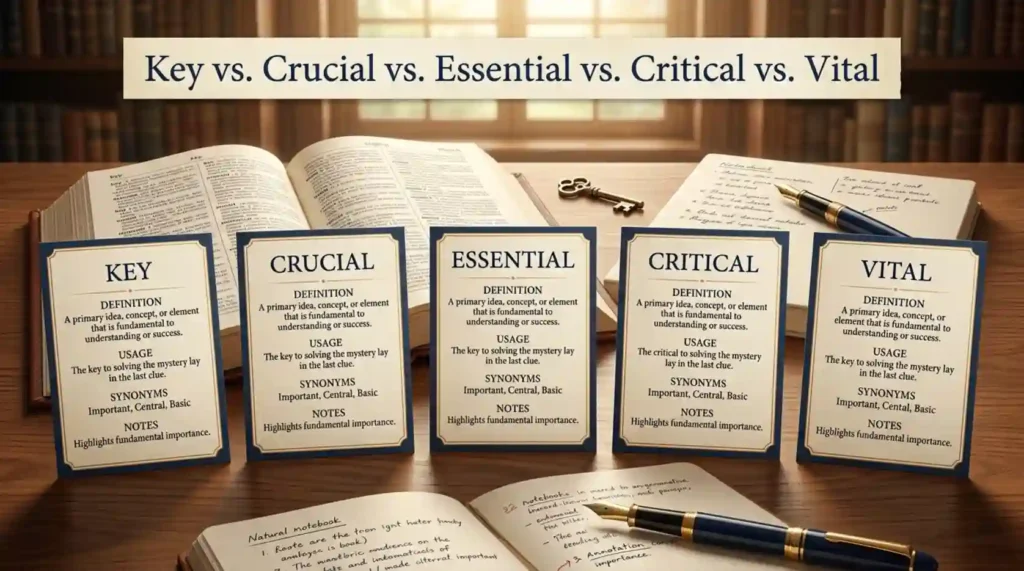
These five words are often used for each other, but each stresses something a little different.
| Word | What it stresses | Typical pairing |
| Key | Something that unlocks or decides the matter | key factor, key player |
| Crucial | The outcome depends on it | crucial moment, crucial decision |
| Essential | You cannot do without it | essential skill, essential tool |
| Critical | The result is at stake, often with risk | critical error, critical step |
| Vital | Life or survival depends on it | vital organ, vital supply |
In short, “key” is the broadest and mildest of the five. Use “essential” when something is required, “crucial” or “critical” when a result depends on it, and “vital” when the need is strong.
Sources: Merriam-Webster, “key”; WordReference (Random House Learner’s Dictionary of American English), “key.”
Key and Opposite/Paired Word Pairs
| Word | Paired Word | Note |
| Key (important) | Minor | Natural opposite for the adjective sense: a minor detail |
| Key (important) | Unimportant | Plain opposite: an unimportant fact |
| Key (lock) | Lock | The two work together as a pair |
| Major key | Minor key | Two basic types of musical key |
| Public key | Private key | A pair used in encryption |
| In key | Off-key | In tune, or not in tune |
| High-key | Low-key | Bright with little shadow, or dark and subtle (photography); “low-key” also means quiet and relaxed |
The adjective “key” has clear opposites such as “minor” and “unimportant.” The noun senses work better as pairs than as opposites. A key needs a lock, and a public key goes with a private key. Not every sense has a neat opposite, so the table lists contrasts only where they are natural.
Sources: Merriam-Webster, “key”; Wiktionary, “key.”
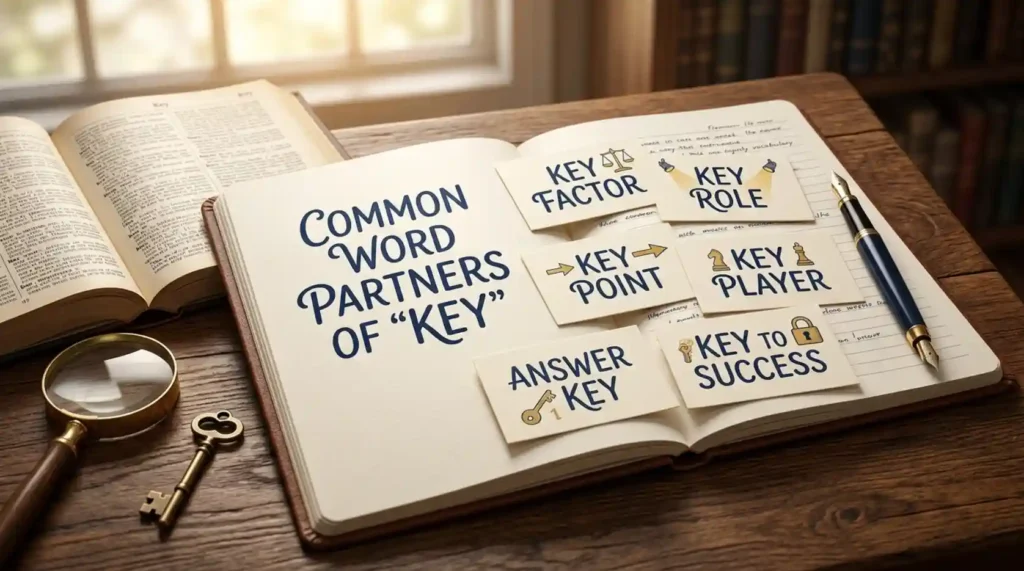
Common Word Partners of “Key”
| Pattern | Common Partners | Example |
| key + noun (importance) | key factor, key role, key player, key point, key issue, key question | Price is a key factor for most buyers. |
| key + noun (device) | key card, key fob, key ring | He left his key card on the desk. |
| adjective + key | master key, spare key, car key, house key, ignition key | Keep a spare key somewhere safe. |
| key + to + noun | key to success, key to a riddle, key to understanding | Sleep is the key to better focus. |
| verb + key | turn the key, press a key, hold down a key | Turn the key slowly. |
| key + in | key in a password, key in a number | Key in your password and press enter. |
| noun + key | answer key, map key, piano key, shift key | The answer key is at the back. |
Sources: Merriam-Webster, “key”; Wiktionary, “key.”
Idiomatic Phrases Featuring “Key”
Few fixed idioms use “key” in its own right, so this list includes a mix of true idioms and well-established expressions.
1. Key to the city
- Meaning: A symbolic honor that a city gives to a guest or citizen, usually in a public ceremony.
- Example: The mayor gave the astronaut the key to the city.
2. Under lock and key
- Meaning: Safely locked away.
- Example: The old photos are kept under lock and key.
3. Low-key
- Meaning: Quiet, relaxed, and not showy. This is an established compound adjective rather than a classic idiom.
- Example: They planned a low-key birthday at home.
4. Keyed up
- Meaning: Tense, excited, or full of nervous energy.
- Example: She was keyed up before her big interview.
Sources: Merriam-Webster, “key”; WordReference (Random House Learner’s Dictionary of American English), “key.”
Word Formation of “Key”
Etymology & Structure
“Key” comes from Old English cǣg, meaning an instrument for opening a lock. Its deeper origin is uncertain, and the word has few sure relatives outside Old Frisian kei. Etymologist Anatoly Liberman has suggested that the word first named a pin or peg with a twisted end. This is a proposal and not a settled fact.
The modern pronunciation (rhyming with “see” and not “say”) is itself unusual. Liberman notes it may be of northern origin.
The “key” in place names such as Key West is a different word. It comes from Spanish cayo, meaning a small island, and its spelling was influenced by an older English word for a quay.
Date and History
Merriam-Webster dates the first known use of “key” to before the 12th century. The adjective sense “crucially important” is much later; the Online Etymology Dictionary dates it to 1913. The verb is older: it appears in the mid-14th century with the sense of fastening with a wedge or key.
Word Class Variations
- Noun: key, keys
- Verb: key, keys, keyed, keying (to key in data; to lock; to scratch with a key)
- Adjective: key (a key idea)
- Related forms: keyed, keyless, keyboard, keyhole, keynote, keystone, keystroke, low-key, off-key
Sources: Merriam-Webster, “key”; Online Etymology Dictionary, “key”; Anatoly Liberman, Oxford University Press blog, “The Etymology of Key” (2015); Wiktionary, “key.”
Common Word-Choice Mistakes
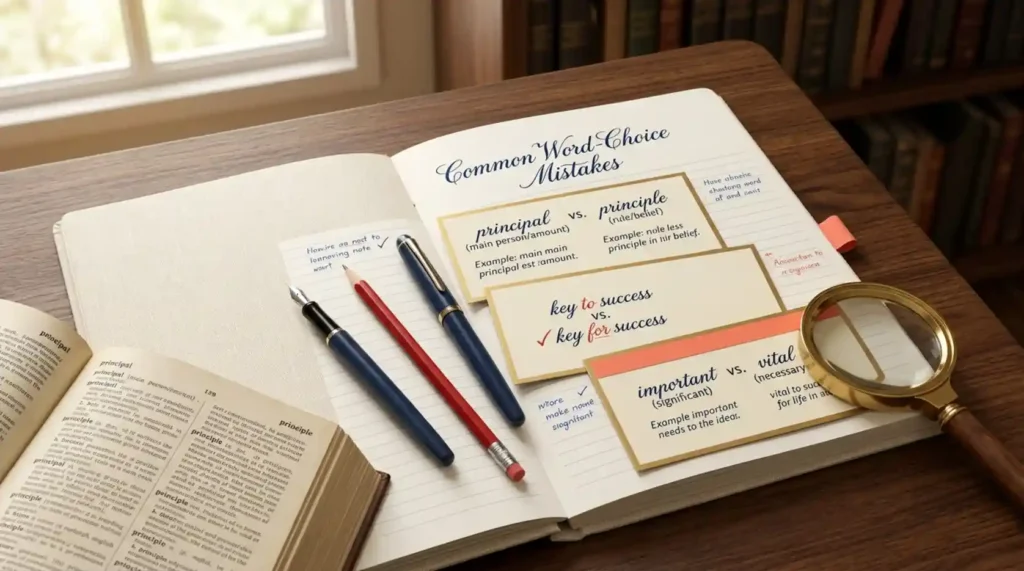
- “The principle reason” → “the principal reason” (“principle” means a rule or belief).
- “The key of success” → “the key to success” (use “to,” not “of”).
- “A keys factor” or “key points are” → “a key factor”; “key” stays singular when it acts as an adjective.
- “The main solution” for “the key to the puzzle” → “the answer” or “the solution” (keep “main” for rank, not for solving).
- “Vital” for a small matter, as in “a vital change of font” → “an important change” (“vital” is much stronger).
- “Key in” for plain “enter” in formal writing → “enter” is plainer when the context is not about typing.
- “Legend” alone on a chart that has no map → “key” or “legend” are both fine, but name it clearly so readers do not think of the old-story meaning.
Frequently Asked Questions
What is the closest synonym for “key”?
For the adjective, the closest everyday synonyms are “important,” “main,” and “crucial.” For the noun, it depends on the sense: “answer” or “solution” for the “key to a problem,” and “passkey” for a literal key.
What is a formal alternative to “key”?
“Principal,” “paramount,” and “fundamental” are more formal than “key.” “Pivotal” also suits careful or professional writing.
What is the difference between “key” and “essential”?
“Key” means very important or decisive. “Essential” means you cannot do without something. A key idea may still be only one of several important ones.
What is the difference between “crucial” and “critical”?
Both mean extremely important. “Crucial” stresses that an outcome depends on something, and “critical” often adds a sense of risk or a decisive point.
What is the opposite of “key”?
For the adjective, “minor” and “unimportant” are the plainest opposites. For the music sense, a minor key contrasts with a major key.
Can “key” describe people?
Yes. “A key player” or “a key member of the staff” is a common use, and “key worker” names someone in an essential job.
Can “key” mean an answer?
Yes. An “answer key” is a list of correct answers, and “the key to a riddle” means its solution.
Is “key” the same as “quay”?
No. They sound the same, but a quay is a landing place for boats. The two words are linked only in the spelling of place names like Key West.
What word replaces “key” in “key in a password”?
“Enter,” “type,” or “input” all work. “Enter” is the most neutral.
Is “key” a noun, a verb, or an adjective?
It is all three. As a noun it names a device or a guide, as a verb it means to type or lock, and as an adjective it means very important.
Conclusion
The closest common alternatives for “key” are “important,” “main,” “essential,” and “crucial” when you mean “very important.” When you mean something that unlocks a problem, “answer,” “solution,” and “clue” fit best. For locks and access, specific words like “passkey,” “master key,” and “password” are clearer.
Context decides the right choice because “key” has several unrelated senses. Many of the 30 alternatives work for only one of them, and some are stronger than “key” or more formal.
To choose well, first decide which sense you mean: importance, solving, access, a guide, or music and typing. Then pick the word that matches that sense and the tone you want.