Another Word for Conflict: 30 Synonyms With Examples
The closest everyday alternatives to “conflict” are dispute, clash, disagreement, fight, and struggle. Which one fits best depends on what kind of conflict you mean. A small argument between friends is not the same as a war between countries, and a clash of ideas is not the same as a feeling of being torn inside.
“Conflict” can describe a quarrel, an armed struggle, a clash of interests, or an inner struggle. A schedule can even “conflict” with another one. Each meaning has its own set of better-fitting words, which this article sorts out.
Quick list: dispute, clash, disagreement, argument, fight, battle, strife, discord, friction, controversy
This article looks at 30 alternatives to “conflict.” For each one, you will find a meaning, US and UK pronunciation, a usage note, and an example sentence.
At a Glance: Conflict Synonyms and Related Alternatives
| Alternative | Part of Speech | Meaning | Register / Tone | Ideal Context |
| Dispute | noun | A disagreement, often about a specific issue | Neutral to formal | Legal, workplace, business |
| Clash | noun | A sharp, direct meeting of opposing people or ideas | Neutral | News, politics, personalities |
| Disagreement | noun | A difference of opinion | Neutral | Everyday talk, meetings |
| Argument | noun | An angry or heated exchange of views | Neutral | Personal, everyday |
| Fight | noun | A physical or verbal struggle | Informal to neutral | Everyday, sports, news |
| Battle | noun | A fight between groups, or a long struggle | Neutral | Military, figurative use |
| War | noun | Armed conflict between nations or groups | Neutral, serious | Politics, history |
| Strife | noun | Bitter, ongoing conflict | Formal, literary | History, writing, news |
| Discord | noun | Lack of agreement or harmony | Formal | Groups, families, teams |
| Tension | noun | Strained feeling between people or groups | Neutral | Relationships, politics |
Which Word Should You Use?
| If you want to… | Use | Why |
| Describe a serious disagreement over a specific issue | dispute | It points to a clear matter in question, such as pay or land. |
| Describe a sudden, sharp meeting of opposing sides | clash | It suggests direct contact and strong feeling. |
| Describe a small, light disagreement | spat, tiff, squabble | These words show the problem is minor. |
| Describe armed fighting between countries or groups | war, combat, hostilities | They are used for organized violence. |
| Describe a long period of bitter conflict | strife, feud | They suggest conflict that lasts and does damage. |
| Describe an uneasy mood without open fighting | tension, friction | They show conflict that is building or hidden. |
| Describe a public disagreement that many people talk about | controversy | It stresses public debate. |
| Describe two sides refusing to give way | standoff | It suggests neither side moves. |
Exploring the Multiple Meanings of “Conflict”
1. A Serious Disagreement
- Meaning: A strong disagreement between people, groups, or ideas.
- Explanation: This is the most common sense. It can be personal, as between family members, or public, as between a company and its workers.
- Example: The two neighbors have been in conflict over the fence for years.
2. Armed or Physical Fighting
- Meaning: A war or a prolonged struggle involving force.
- Explanation: News reports often use “conflict” for fighting between nations or groups. It can sound more neutral and less direct than “war.”
- Example: The conflict has forced thousands of families to leave their homes.
3. A Clash of Interests or Ideas
- Meaning: A situation where two things cannot both be satisfied or both be true.
- Explanation: No fight is needed here. The problem is that two goals, duties, or beliefs pull in different directions.
- Example: There is a conflict between her need for sleep and her work schedule.
4. An Inner Struggle
- Meaning: A mental struggle caused by opposing wishes, needs, or feelings.
- Explanation: People use this sense for tough choices and mixed feelings. It is common in psychology and everyday talk.
- Example: He felt a deep conflict between loyalty to his friend and doing the right thing.
5. The Struggle in a Story
- Meaning: The central problem or opposing force in a story, play, or film.
- Explanation: Writers and teachers use “conflict” for the struggle that drives the plot. It may be between characters, or between a character and nature, society, or themselves.
- Example: The main conflict in the novel is a young man’s fight against his family’s wishes.
6. To Be Incompatible (verb)
- Meaning: To disagree with or be unable to exist alongside something else.
- Explanation: As a verb, “conflict” often describes facts, times, rules, or accounts that do not match.
- Example: The two witnesses’ stories conflict with each other.
Sources: Merriam-Webster; Collins English Dictionary; Dictionary.com; Cambridge Dictionary.
Analyzing 30 Conflict Alternatives in Detail
Some of these words are direct synonyms of “conflict,” while others are related words that fit only certain situations, and the usage notes say which is which.
Core Everyday Alternatives
1. Clash
IPA: /klæʃ/ (US and UK)
Definition: A sharp disagreement or fight between people or groups, or a direct opposition of ideas or interests.
- Usage: A close synonym. It suggests sudden, direct contact and strong feeling, and is common in news writing.
- Example: There was a clash between protesters and police outside the building.
2. Dispute
IPA: /dɪˈspjuːt/ (US and UK)
Definition: A disagreement or argument, especially a formal or official one.
- Usage: A close synonym. It usually refers to a specific issue, such as money, rights, or property, and is neutral to formal.
- Example: The workers are in a dispute with the company over pay.
3. Disagreement
IPA: /ˌdɪsəˈɡriːmənt/ (US and UK)
Definition: A situation in which people have different opinions about something.
- Usage: A direct but milder alternative. It does not need any anger or fighting, so it is weaker than “conflict.”
- Example: They had a disagreement about where to spend the holidays.
4. Argument
IPA: US /ˈɑːrɡjəmənt/ · UK /ˈɑːɡjʊmənt/
Definition: An angry exchange of words between people who disagree.
- Usage: A related alternative for personal conflict. It focuses on the spoken exchange, not the larger situation.
- Example: The two brothers had a loud argument at dinner.
5. Quarrel
IPA: US /ˈkwɔːrəl/ · UK /ˈkwɒrəl/
Definition: An angry argument or disagreement between people, often about something personal.
- Usage: A close alternative for personal conflict. It sounds a little older and more serious than “argument.”
- Example: A quarrel over money ended their friendship.
Fighting and Warfare
6. Fight
IPA: /faɪt/ (US and UK)
Definition: A physical or verbal struggle between people or groups.
- Usage: A common, informal alternative. It can describe real violence or a heated argument, and it is stronger than “disagreement.”
- Example: The fight started over a small mistake.
7. Battle
IPA: /ˈbætl/ (US and UK)
Definition: A fight between armed forces, or a long, hard struggle.
- Usage: A related alternative. It is literal in warfare and figurative for any hard struggle. It names one fight, not the whole conflict.
- Example: The two companies are locked in a battle for customers.
8. War
IPA: US /wɔːr/ · UK /wɔː/
Definition: A state of armed conflict between countries or groups.
- Usage: A related alternative for armed conflict only. It is narrower than “conflict,” which can also be non-violent.
- Example: The war lasted for six years.
9. Combat
IPA: US /ˈkɑːmbæt/ · UK /ˈkɒmbæt/
Definition: Fighting, especially between armed forces.
- Usage: A related alternative in military settings. It is a formal word and is not used for everyday arguments.
- Example: The soldiers had never been in combat before.
10. Skirmish
IPA: US /ˈskɜːrmɪʃ/ · UK /ˈskɜːmɪʃ/
Definition: A small or short fight, often one part of a larger conflict.
- Usage: A related alternative. It suggests a limited clash and can also be used lightly for a brief argument.
- Example: A brief skirmish broke out near the border.
Formal and Serious Alternatives
11. Discord
IPA: US /ˈdɪskɔːrd/ · UK /ˈdɪskɔːd/
Definition: Disagreement and lack of harmony between people.
- Usage: A formal alternative. It describes a state of unrest in a family, team, or group, not a single event.
- Example: Money problems caused discord in the family.
12. Strife
IPA: /straɪf/ (US and UK)
Definition: Angry or bitter disagreement over something important.
- Usage: A close, formal or literary synonym. It suggests ongoing, serious conflict and is rarely used for small arguments.
- Example: The country was torn by years of political strife.
13. Friction
IPA: /ˈfrɪkʃn/ (US and UK)
Definition: Disagreement or bad feeling caused by differences between people.
- Usage: A figurative alternative. It describes low-level, ongoing conflict rather than open fighting.
- Example: There was friction between the two managers.
14. Contention
IPA: /kənˈtenʃn/ (US and UK)
Definition: Angry disagreement, or a point that people argue about.
- Usage: A formal alternative. It also means “a claim made in an argument,” which “conflict” does not.
- Example: The land has long been a source of contention.
15. Hostility
IPA: US /hɑːˈstɪləti/ · UK /hɒˈstɪləti/
Definition: Unfriendly or angry feeling toward someone, or acts of war.
- Usage: A related alternative. It describes the feeling behind conflict. In the plural, “hostilities” means acts of war.
- Example: Open hostility between the two groups made talks impossible.
Long-Running and Personal Conflict
16. Feud
IPA: /fjuːd/ (US and UK)
Definition: A long and bitter quarrel, especially between families or groups.
- Usage: A close synonym for lasting, personal conflict. It suggests a long history.
- Example: The two families have had a feud for generations.
17. Rivalry
IPA: /ˈraɪvlri/ (US and UK)
Definition: A state of competing with someone for the same goal.
- Usage: A related alternative. It is about competition, not necessarily anger, and can be friendly.
- Example: The rivalry between the two teams is famous.
18. Tension
IPA: /ˈtenʃn/ (US and UK)
Definition: A strained feeling between people or groups.
- Usage: A related alternative. It describes unspoken unease before or between open disputes.
- Example: Tension rose between the two countries.
19. Enmity
IPA: /ˈenməti/ (US and UK)
Definition: A deep and lasting feeling of hatred toward someone.
- Usage: A formal, literary alternative. It names the feeling of being enemies, not the fighting itself.
- Example: Years of enmity kept the two leaders apart.
20. Confrontation
IPA: US /ˌkɑːnfrʌnˈteɪʃn/ · UK /ˌkɒnfrʌnˈteɪʃn/
Definition: A face-to-face meeting in which opposing sides argue or fight.
- Usage: A close alternative for direct, open conflict. It suggests the two sides meet head-on.
- Example: He wanted to avoid a confrontation with his boss.
Minor and Heated Arguments
21. Spat
IPA: /spæt/ (US and UK)
Definition: A short, minor argument.
- Usage: An informal alternative for small conflicts. It is much lighter than “conflict.”
- Example: The couple had a spat over the dishes.
22. Squabble
IPA: US /ˈskwɑːbl/ · UK /ˈskwɒbl/
Definition: A noisy quarrel about something unimportant.
- Usage: An informal alternative. It suggests a silly or petty argument.
- Example: The children had a squabble over a toy.
23. Tiff
IPA: /tɪf/ (US and UK)
Definition: A minor disagreement, especially between friends or partners.
- Usage: An informal, light alternative. It suggests a short disagreement that will soon pass.
- Example: They had a tiff but made up quickly.
24. Row
IPA: /raʊ/ (US and UK)
Definition: A noisy argument, or a serious public disagreement.
- Usage: A related alternative, mostly British. It can describe a loud personal quarrel or a public dispute. This sense of “row” is not the same as a “row” of seats.
- Example: A row over taxes split the party.
25. Altercation
IPA: US /ˌɔːltərˈkeɪʃn/ · UK /ˌɒltəˈkeɪʃn/
Definition: A noisy argument or short fight.
- Usage: A formal word, common in police and news reports. It suggests a sudden, heated incident, not a long conflict.
- Example: Police were called after an altercation outside the bar.
Opposing Ideas, Interests and Stalemates
26. Controversy
IPA: US /ˈkɑːntrəvɜːrsi/ · UK /ˈkɒntrəvɜːsi/
Definition: Public disagreement or debate about something many people care about.
- Usage: A related alternative. It is about public argument over a topic, not a fight between two people.
- Example: The new law caused a lot of controversy.
27. Opposition
IPA: US /ˌɑːpəˈzɪʃn/ · UK /ˌɒpəˈzɪʃn/
Definition: Strong disagreement with or resistance to something.
- Usage: A related alternative. It describes one side’s resistance to a plan or idea, so it is less balanced than “conflict.”
- Example: There was strong opposition to the new road.
28. Collision
IPA: /kəˈlɪʒn/ (US and UK)
Definition: A violent meeting of two things, or a sharp clash of ideas or interests.
- Usage: A figurative alternative. It stresses the moment of impact between opposing forces.
- Example: The meeting was a collision of two very different views.
29. Struggle
IPA: /ˈstrʌɡl/ (US and UK)
Definition: A long, hard effort to overcome something or to defeat an opponent.
- Usage: A related alternative. It fits both outer conflict and inner conflict, and it focuses on the effort involved.
- Example: Her struggle with the decision lasted weeks.
30. Standoff
IPA: US /ˈstændɔːf/ · UK /ˈstændɒf/
Definition: A situation in which neither side will give way, so nothing can move forward.
- Usage: A related alternative. It describes a stalemate within a conflict, not the conflict itself.
- Example: The standoff between the two parties lasted all week.
Sources: Merriam-Webster; Collins English Dictionary and Collins Thesaurus; Dictionary.com; Cambridge Dictionary.
Conflict vs. Dispute vs. Clash vs. Controversy
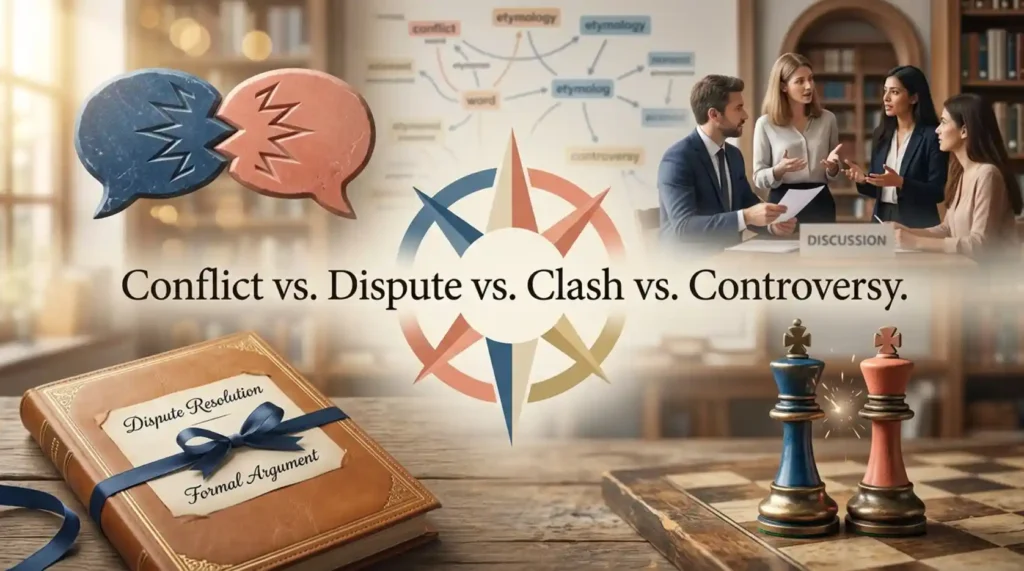
These four words are often mixed up. The table shows how they differ.
| Word | Main Idea | Typical Use |
| Conflict | Broad word for any struggle, from personal to armed | “The conflict between the two countries” |
| Dispute | Disagreement over a specific issue | “A pay dispute” |
| Clash | Sharp, direct meeting of opposing sides | “A clash of opinions” |
| Controversy | Public debate about a topic | “The decision caused controversy” |
“Conflict” is the widest of the four. A dispute is usually about one clear matter, a clash is a single sharp moment, and a controversy is a topic that many people argue about.
Sources: Merriam-Webster; Collins English Dictionary; Cambridge Dictionary.
Conflict and Opposite/Paired Word Pairs
| Word | Paired Word | Note |
| Conflict | Peace | The most common opposite, especially for war |
| Conflict | Harmony | Opposite for relationships and groups |
| Conflict | Agreement | Opposite for disagreements |
| Conflict | Cooperation | Opposite when people work together |
| War | Peace | A natural pair for armed conflict |
| Dispute | Settlement | Pair for formal or legal disputes |
| Discord | Accord | A formal pair for groups and agreements |
| Tension | Calm | Pair for an uneasy mood |
There is no single perfect opposite of “conflict.” The best one depends on the kind of conflict. “Peace” suits war, “agreement” suits an argument, and “harmony” suits relationships.
Sources: Merriam-Webster; Collins Thesaurus; Dictionary.com.
Common Word Partners of “Conflict”
| Pattern | Common Partners | Example |
| Adjective + conflict | armed, violent, bitter, ongoing, internal | The armed conflict lasted for years. |
| Verb + conflict | resolve, avoid, escalate, end | The leaders worked to resolve the conflict. |
| Conflict + preposition | between, with, over | The conflict between the two groups grew. |
| Conflict + noun | conflict zone, conflict management | Aid workers entered the conflict zone. |
| Conflict + resolution | conflict resolution skills | The school teaches conflict resolution. |
Sources: Collins English Dictionary; Cambridge Dictionary; Oxford Collocations Dictionary.
Idiomatic Phrases Featuring “Conflict”
“Conflict” has few true idioms. The phrases below are established fixed expressions, not figurative idioms.
1. Conflict of interest
- Meaning: A situation in which a person’s own interests could affect their duty to act fairly for others.
- Example: The judge left the case because of a conflict of interest.
2. In conflict with
- Meaning: Opposed to or not matching something else.
- Example: Her plans were in conflict with the company’s rules.
3. Conflict resolution
- Meaning: The process of ending a disagreement peacefully.
- Example: Good conflict resolution can save a team.
4. Conflict of laws
- Meaning: A legal term for a case in which the laws of different places could apply.
- Example: The lawyer studied conflict of laws before the trial.
Sources: Merriam-Webster; Collins English Dictionary; Cambridge Dictionary.
Word Formation of “Conflict”
Etymology & Structure
“Conflict” comes from the Latin conflictus, meaning “a striking together,” from confligere, “to strike together.” The Latin word combines con- (“together”) and fligere (“to strike”). The original idea was of two things hitting each other.
Date and History
Dictionaries trace “conflict” in English to the 15th century, first in the sense of a fight or battle. The wider sense of opposing ideas or interests developed later.
Word Class Variations
- Noun: conflict, conflicts
- Verb: conflict, conflicts, conflicted, conflicting
- Adjective: conflicting (conflicting reports), conflicted (feeling torn), conflictual (involving conflict)
- Adverb: no common adverb form
Sources: Etymonline; Merriam-Webster; Collins English Dictionary.
Common Word-Choice Mistakes
- A “conflict of interests” is common, but the fixed legal phrase is “conflict of interest” (singular).
- “I conflicted with the plan” is unclear: say “I disagreed with the plan,” or “the plan conflicted with my schedule.”
- “They had a war over the dishes” is too strong: use “spat” or “argument.”
- “A conflicted schedule” is wrong: use “conflicting schedules.”
- “Conflicted” and “conflicting” are not the same: a person feels conflicted, but reports are conflicting.
- “A conflict zone of opinions” is odd: use “clash of opinions.”
- “A feud about the bill” sounds off: “feud” suggests a long, bitter history, so use “dispute” for a single issue.
Frequently Asked Questions
What is the closest synonym for conflict?
“Dispute” and “clash” are the closest everyday synonyms. “Strife” is a close, more formal choice.
What is a formal alternative to conflict?
“Discord,” “strife,” and “contention” are formal alternatives.
What is a softer word for conflict?
“Disagreement,” “difference of opinion,” and “friction” are softer.
What is the difference between conflict and dispute?
A conflict can be any kind of struggle. A dispute usually concerns a specific issue and is often formal.
What is the opposite of conflict?
The opposite depends on context: “peace,” “harmony,” “agreement,” and “cooperation” are the most common.
Can conflict be used as a verb?
Yes. It means to be incompatible, as in “The two dates conflict.”
What is the difference between conflicting and conflicted?
“Conflicting” describes things that do not agree, such as stories. “Conflicted” describes a person who feels torn.
What is a word for a small conflict?
“Spat,” “tiff,” “squabble,” and “skirmish” all describe minor conflicts.
Is conflict the same as war?
No. War is armed conflict between groups or countries. Conflict is a broader word that includes non-violent disagreements.
What is a figurative word for conflict?
“Collision,” “friction,” and “battle” are common figurative alternatives.
Conclusion
The closest alternatives to “conflict” are “dispute,” “clash,” “disagreement,” and “struggle.” For armed fighting, words like “war,” “combat,” and “battle” fit better. For lasting bitterness, “strife,” “feud,” and “enmity” are stronger choices.
Context matters because these words differ in size, tone, and meaning. A tiff is tiny, a controversy is public, a standoff is stuck, and a war is armed. Some words describe the fight itself, and others describe the feeling behind it.
To choose well, ask three questions: How serious is it? Is it physical, verbal, or inner? Is it one moment or a long-running situation? The answers will point you to the right word.