
Another Word for Pressure: 30 Synonyms With Examples
Another word for pressure is stress when you mean mental strain, force when you mean a physical push, and coercion when someone is made to act against their will. Other everyday choices include strain, tension, burden, urgency, and demands. The best word depends on If you mean a physical force, a feeling, or a push from other people.
Pressure also has some narrower uses. In science, it means force spread over an area, as in tire pressure or air pressure. In daily life, it often means the weight of expectations, deadlines, or other people’s demands. This guide separates those meanings so you can choose the right word.
Quick list: stress, strain, force, tension, burden, coercion, urgency, demands, influence, push
This article looks at 30 alternatives to pressure. Each has a definition, IPA, usage note, and example sentence. Some are direct synonyms, and others only fit certain contexts. The usage notes say which is which.
At a Glance: Pressure Synonyms and Related Alternatives
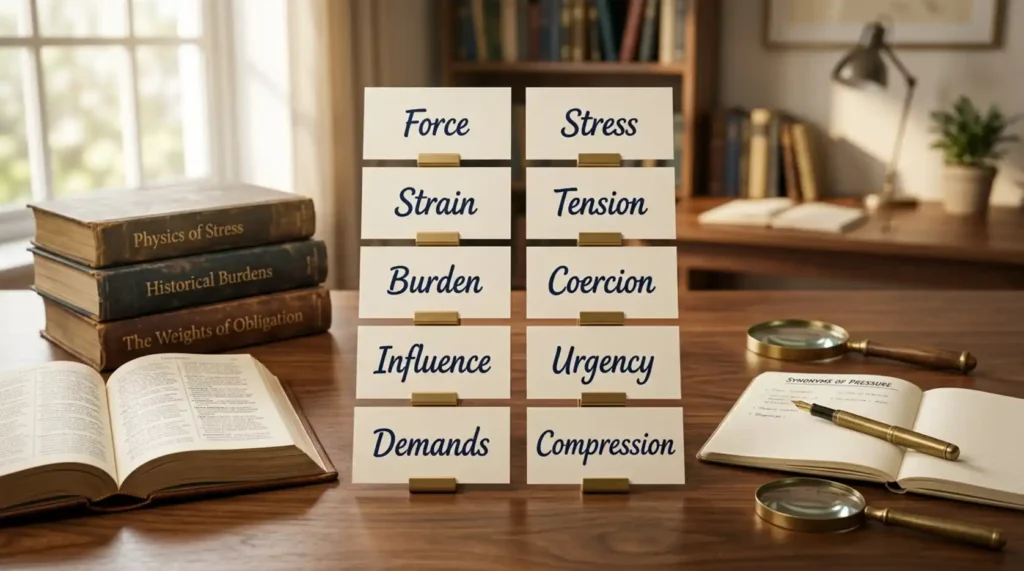
| Alternative | Part of Speech | Meaning | Register / Tone | Ideal Context |
| Force | noun | A push or pull that moves something | Neutral | Physical or social push |
| Stress | noun | Mental or emotional strain | Neutral | Work, school, health |
| Strain | noun | Heavy tension from too much demand | Neutral, slightly serious | Long-term effort or worry |
| Tension | noun | Mental strain or tightness between people | Neutral | Nervous or tense situations |
| Burden | noun | A heavy load, duty, or worry | Neutral to formal | Responsibility that weighs on you |
| Coercion | noun | Forcing someone by threats or power | Formal, strong | Legal and ethical discussions |
| Influence | noun | Power to affect what someone thinks or does | Neutral, mild | Gentle or indirect persuasion |
| Urgency | noun | The need to act quickly | Neutral | Deadlines and emergencies |
| Demands | plural noun | Things that must be done or provided | Neutral | Jobs, studies, caring duties |
| Compression | noun | The act of pressing something into less space | Technical | Science, engineering, medicine |
Which Word Should You Use?
| If you want to… | Use | Why |
| Describe worry from work or school | stress | It is the most common word for mental pressure. |
| Describe a long, tiring effort | strain | It suggests something is being pushed near its limit. |
| Describe a physical push | force | It fits a push or pull on an object. |
| Describe a tense mood between people | tension | It points to nervous or unfriendly feelings. |
| Describe being made to do something | coercion | It fits threats or unfair power. |
| Describe a deadline problem | urgency | It focuses on the need to act fast. |
| Describe the heavy side of a job or duty | burden | It shows the weight of responsibility. |
| Say a person is pushing someone gently | urge | It is milder than pressure. |
Exploring the Multiple Meanings of “Pressure”
1. Physical Force on a Surface
- Meaning: The force pressing on a surface, usually measured per unit of area.
- Explanation: This is the scientific sense. It covers air pressure, water pressure, and tire pressure. Here, pressure is not the same as stress or force alone, because it describes force spread over an area.
- Example: Check the tire pressure before a long drive.
2. The Act of Pressing
- Meaning: The act of pushing steadily against something.
- Explanation: This is the everyday physical sense. It is about touch and pushing, not about force measured by science.
- Example: Apply gentle pressure to the cut to stop the bleeding.
3. Social or Personal Pressure to Act
- Meaning: Influence or urging that pushes someone to do something.
- Explanation: The pressure can come from friends, family, bosses, or society. It may be mild or strong, but it is usually less extreme than coercion.
- Example: She felt pressure from her friends to join the team.
4. Stress From Demands
- Meaning: The burden of mental or emotional strain, often from deadlines or high expectations.
- Explanation: This sense is about how a situation feels inside, not about a person pushing you. It often appears in phrases like “under pressure.”
- Example: He works well under pressure.
5. Pressure in Weather and Medicine
- Meaning: The measured force of air in the atmosphere or of blood in the body.
- Explanation: In these fields, pressure is a measurement, so words like stress or strain do not replace it.
- Example: The nurse checked her blood pressure.
Sources: Merriam-Webster, Collins Dictionary, Dictionary.com
Analyzing 30 Pressure Alternatives in Detail

Some alternatives below are close synonyms, while others only match one sense of pressure. The usage notes show which is which.
How to Choose the Right Synonym for Pressure
The best alternative depends on the context. For example, stress describes mental or emotional strain, while force refers to a physical push or pull. Similarly, coercion suggests threats or force used to make someone act, whereas urgency describes a situation that requires quick action.
Understanding these differences helps you choose a word that expresses your intended meaning accurately.
Physical Force and Weight

1. Force
IPA: US /fɔːrs/ · UK /fɔːs/
Definition: A push or pull that makes something move or change.
Usage: This is a close match for the physical sense, but it is not exact. In science, pressure is force spread over an area. In social settings, force can also mean coercion.
Example: The force of the wind pushed the door shut.
2. Weight
IPA: /weɪt/ (US and UK)
Definition: How heavy something is, or the downward force of an object.
Usage: This is a related alternative, not an exact synonym. It fits the pressing-down sense, as in “the weight of the snow,” and also works figuratively for heavy expectations.
Example: The shelf bent under the weight of the books.
3. Load
IPA: US /loʊd/ · UK /ləʊd/
Definition: Something carried or supported, or the force a structure must bear.
Usage: This is a related alternative used in engineering and in everyday talk about work. It describes what presses down, not the pressure itself.
Example: The bridge can carry a heavy load.
4. Compression
IPA: /kəmˈpreʃən/ (US and UK)
Definition: The act of pressing something into a smaller space.
Usage: This is a technical alternative. It fits science, engineering, and medicine, but it is too specific for most talk about stress or social pressure.
Example: Compression made the gas take up less space.
5. Squeeze
IPA: /skwiːz/ (US and UK)
Definition: The act of pressing firmly from two or more sides, or a tight shortage of money or time.
Usage: As a noun it is informal, and it often means financial pressure, as in “a credit squeeze.” It is a context-specific alternative.
Example: Rising prices put a squeeze on many families.
Mental and Emotional Strain
6. Stress
IPA: /stres/ (US and UK)
Definition: Mental or emotional strain caused by hard or demanding situations.
Usage: This is the closest everyday synonym for the mental sense of pressure. In engineering, stress also means force inside a material.
Example: Work stress kept her awake at night.
7. Strain
IPA: /streɪn/ (US and UK)
Definition: Heavy tension or damage caused by too much effort or demand.
Usage: This is a close synonym when the pressure lasts a long time. It sounds a little more serious than stress.
Example: Caring for two jobs put a strain on him.
8. Tension
IPA: /ˈtenʃən/ (US and UK)
Definition: A state of mental strain, or a nervous feeling between people.
Usage: This is a related alternative. It fits worry or conflict, but it does not mean being pushed to act.
Example: Tension filled the room before the results came in.
9. Burden
IPA: US /ˈbɜːrdn/ · UK /ˈbɜːdn/
Definition: A heavy duty, load, or worry that is hard to carry.
Usage: This is a related alternative. It stresses the weight of responsibility, not the push from others.
Example: The loan was a heavy burden for the family.
10. Anxiety
IPA: /æŋˈzaɪəti/ (US and UK)
Definition: A feeling of worry or nervousness about what might happen.
Usage: This is related, not a synonym. Pressure can cause anxiety, but the words are not interchangeable. Anxiety is also a medical term, so use it with care.
Example: The pressure of the exam filled him with anxiety.
Pushing People to Act
11. Coercion
IPA: US /koʊˈɜːrʒən/ · UK /kəʊˈɜːʃən/
Definition: The use of force or threats to make someone act against their will.
Usage: This is much stronger than ordinary pressure. It is formal and common in legal and ethical contexts.
Example: The contract was invalid because it was signed under coercion.
12. Duress
IPA: US /dʊˈres/ · UK /djʊˈres/
Definition: Threats or force used to make someone do something.
Usage: This is a formal, strong alternative, most often found in legal writing and in the phrase “under duress.” It does not fit ordinary stress.
Example: He said he signed the paper under duress.
13. Compulsion
IPA: /kəmˈpʌlʃən/ (US and UK)
Definition: A strong force that makes someone do something, or a strong inner urge.
Usage: This is a related alternative and formal in tone. It can mean forced action or an urge from within, which pressure does not usually mean.
Example: She felt a compulsion to check her phone.
14. Influence
IPA: /ˈɪnfluəns/ (US and UK)
Definition: The power to affect what someone thinks or does.
Usage: This is a milder alternative. It fits indirect pressure, such as from friends or media, but it does not suggest force.
Example: Her friends had a strong influence on her choices.
15. Leverage
IPA: US /ˈlevərɪdʒ/ · UK /ˈliːvərɪdʒ/
Definition: Power or advantage that helps you get what you want.
Usage: This is a context-specific alternative used in business and politics. It points to the advantage used to push someone, not the push itself.
Example: The union used its leverage to win a better deal.
16. Arm-twisting
IPA: US /ˈɑːrm ˌtwɪstɪŋ/ · UK /ˈɑːm ˌtwɪstɪŋ/
Definition: Strong, often unfair persuasion used to make someone agree.
Usage: This is informal. It fits political and business talk, usually with a slightly negative tone.
Example: After some arm-twisting, the committee agreed.
Time and Demand Pressure
17. Urgency
IPA: US /ˈɜːrdʒənsi/ · UK /ˈɜːdʒənsi/
Definition: The need to act quickly.
Usage: This is a close alternative for time pressure. It describes the situation, not a person’s push.
Example: There was a sense of urgency in the office.
18. Demands
IPA: US /dɪˈmændz/ · UK /dɪˈmɑːndz/
Definition: Things that must be done, given, or dealt with.
Usage: This is a close alternative when it is plural. It names the sources of pressure, as in “the demands of the job.”
Example: The demands of a new baby left them tired.
19. Exigency
IPA: /ˈeksɪdʒənsi/ (US and UK)
Definition: An urgent need or demand created by a situation.
Usage: This is a formal and rather rare alternative. It is mostly used in the plural, as in “the exigencies of war.”
Example: The exigencies of the crisis forced quick decisions.
20. Haste
IPA: /heɪst/ (US and UK)
Definition: Speed or hurry in doing something.
Usage: This is a related alternative. It fits time pressure but describes how fast someone acts, not the force behind it.
Example: In his haste, he forgot his keys.
21. Heat
IPA: /hiːt/ (US and UK)
Definition: Intense pressure or criticism, in a figurative sense.
Usage: This is informal and figurative. It appears in phrases such as “feel the heat” and “take the heat.”
Example: The coach is feeling the heat after three losses.
22. Crunch
IPA: /krʌntʃ/ (US and UK)
Definition: A critical shortage, or a moment of great pressure.
Usage: This is an informal, context-specific noun, as in “a time crunch.” It names a tight moment, not pressure in general.
Example: The team is in a time crunch before the launch.
Hardship and Heavy Burdens (Formal and Literary)
23. Oppression
IPA: /əˈpreʃən/ (US and UK)
Definition: Cruel or unfair use of power, or a feeling of heavy weight on the mind.
Usage: This is a strong, formal alternative. It shares a Latin root with pressure, but it is too heavy for ordinary workplace stress.
Example: The people lived for years under oppression.
24. Hardship
IPA: US /ˈhɑːrdʃɪp/ · UK /ˈhɑːdʃɪp/
Definition: Something that causes suffering or difficulty, such as a lack of money.
Usage: This is a related alternative for the money-pressure sense. It names the hard conditions, not the force.
Example: The family faced financial hardship.
25. Affliction
IPA: /əˈflɪkʃən/ (US and UK)
Definition: Something that causes pain, suffering, or distress.
Usage: This is a literary, related alternative. It fits the older sense of distress but is uncommon in daily speech.
Example: He bore his affliction with patience.
26. Adversity
IPA: US /ædˈvɜːrsəti/ · UK /ədˈvɜːsəti/
Definition: A difficult or unlucky situation.
Usage: This is a related alternative. It describes hard times in general, not the push of a specific demand.
Example: She showed courage in the face of adversity.
Verb Alternatives for “To Pressure Someone”
27. Press
IPA: /pres/ (US and UK)
Definition: To push firmly, or to urge someone strongly to do something.
Usage: This is a close verb alternative and comes from the same Latin root as pressure. It often takes “for” or “to,” as in “press for an answer.”
Example: Reporters pressed the mayor for an answer.
28. Push
IPA: /pʊʃ/ (US and UK)
Definition: To try hard to make someone do something.
Usage: This is an informal verb alternative. It is milder than coerce and fits parents, coaches, and bosses.
Example: His parents pushed him to study harder.
29. Urge
IPA: US /ɜːrdʒ/ · UK /ɜːdʒ/
Definition: To strongly encourage someone to do something.
Usage: This is a milder verb alternative. It shows encouragement more than force.
Example: Doctors urged him to rest.
30. Lean on
IPA: US /ˈliːn ɑːn/ · UK /ˈliːn ɒn/
Definition: To try to influence or force someone by using pressure.
Usage: This is an informal phrasal verb. It sounds firm and can suggest mild threats.
Example: The investors leaned on the manager to cut costs.
Sources
Merriam-Webster, Collins Dictionary, Dictionary.com
Pressure vs. Stress vs. Strain vs. Tension

These four words overlap, but they point to different things.
| Word | Main Idea | Typical Use | Example |
| Pressure | Force or demand pushing on you | Cause of stress, or a measurement | I feel pressure to finish today. |
| Stress | The mental or physical reaction to demands | Feelings and health | Stress made her tired. |
| Strain | Heavy effort that wears something down | Long-term load on people or things | The long trip put a strain on them. |
| Tension | Tightness in a mood or between people | Nervous or tense situations | There was tension in the meeting. |
In short, pressure is often the cause, and stress is often the result. Strain suggests long wear, and tension suggests tightness. In science, stress and pressure also have separate meanings, so they are not interchangeable there.
Sources: Merriam-Webster, Collins Dictionary
Pressure and Opposite/Paired Word Pairs
| Word | Paired Word | Note |
| pressure | relief | The most natural opposite for the stress sense. |
| pressure | calm | Fits the emotional sense of pressure. |
| pressure | ease | Used when something becomes less demanding. |
| pressure | freedom | Fits social or forced pressure. |
| high pressure | low pressure | A common weather and science pair. |
| pressure | vacuum | A vacuum is a space with very low pressure. |
| pressure | temperature | Often paired in science and cooking. |
Pressure has no single perfect opposite, because it has several senses. For emotional or social pressure, relief and freedom work best. In science, high and low pressure are the usual pair. Pressure and temperature often appear together, but they are partners, not opposites.
Sources: Merriam-Webster, Collins Dictionary
Common Word Partners of “Pressure”
| Pattern | Common Partners | Example |
| Type + pressure | blood, air, tire, water | Her blood pressure was normal. |
| Source + pressure | peer, social, financial, time | Peer pressure can be hard to resist. |
| Adjective + pressure | mounting, growing, intense, constant | Mounting pressure pushed him to resign. |
| Verb + pressure | apply, exert, put, relieve | Apply pressure to the wound. |
| Preposition + pressure | under, without | He stays calm under pressure. |
| Pressure + noun | point, cooker, gauge, group | The gauge showed low pressure. |
Sources: Merriam-Webster, Collins Dictionary
Idiomatic Phrases Featuring “Pressure”
1. Under pressure
- Meaning: Facing stress or strong demands, or being forced to act.
- Example: She makes good choices even under pressure.
2. Put pressure on someone
- Meaning: To try to make someone do something.
- Example: The fans put pressure on the club to sign a new striker.
3. Pressure cooker
- Meaning: A situation with very high stress.
- Example: The newsroom was a pressure cooker on election night.
4. Pressure point
- Meaning: A place on the body that is sensitive to touch, or a weak spot where pressure works well.
- Example: Rising rent is a pressure point for many voters.
“Under pressure” and “put pressure on” are strongly established expressions rather than true idioms, because their meanings are clear from the words.
Sources: Merriam-Webster, Collins Dictionary, Etymonline
Word Formation of “Pressure”
Etymology & Structure
Merriam-Webster traces pressure to Middle English, from Anglo-French, from Late Latin pressura, from Latin for “action of pressing.” That Latin word comes from pressus, the past participle of premere, “to press.” The English noun is built from the Latin stem press- plus the ending -ure, which forms nouns of action or result.
Date and History
The first known use of pressure in English was in the 14th century. Later developments include these:
- “Pressure cooker” is attested from 1915, and the figurative use dates from 1958.
- “Pressure point” of the skin is attested from 1876.
- As a verb, pressure meant “to pressurize” in 1886, and “to exert pressure on” a person is attested by 1922.
Word Class Variations
- Noun: pressure, pressures
- Verb: pressure, pressures, pressured, pressuring (to pressure someone)
- Related verb: pressurize (mostly used for gases, containers, and cabins)
- Adjective: pressured (as in “I felt pressured”), pressurized, high-pressure
- Related nouns: pressurization, pressure group
- Adverb: none in standard use
Sources: Merriam-Webster, Etymonline
Common Word-Choice Mistakes

- Wrong: “My blood stress is high.” Correct: “My blood pressure is high.”
- Wrong: “I am pressure at work.” Correct: “I am under pressure at work.”
- Wrong: “She pressured on me to sign.” Correct: “She pressured me to sign” or “She put pressure on me to sign.”
- Wrong: “The tire has high stress.” Correct: “The tire has high pressure.”
- Wrong: “They used coercion to ask for a small favor.” Correct: “They pushed me to do a small favor.” Coercion suggests threats.
- Wrong: “They pressurized me to sign.” Better: “They pressured me to sign.” Pressurize mostly applies to gases, containers, and cabins.
- Wrong: “The haste of the job is heavy.” Correct: “The demands of the job are heavy.”
Frequently Asked Questions
What is the closest synonym for pressure?
Stress is the closest everyday synonym for the mental sense. For the physical sense, force is the nearest word, though it is not exact.
What is a formal alternative to pressure?
Duress, coercion, and exigency are formal choices. Which one fits depends on If you mean threats, force, or urgent need.
What is the difference between pressure and stress?
Pressure is often the cause, such as a deadline. Stress is the reaction to it, such as worry or tiredness.
Is pressure the same as force?
Not exactly. In science, pressure is force spread over an area. In everyday talk, the words sometimes overlap.
Can pressure be used as a verb?
Yes. “To pressure someone” means to try to make them do something. It is common in modern English.
What is a figurative alternative for pressure?
Heat, weight, and crunch are figurative choices. “Feel the heat” is a common example.
What is a literary alternative for pressure?
Affliction and oppression suit literary writing. Both link to the older sense of pressure as distress or heavy weight.
What is the opposite of pressure?
Relief, ease, and calm fit the emotional sense. In weather and science, the paired opposite is high or low pressure.
Is coercion the same as pressure?
No. Coercion means forcing someone with threats or power. Pressure can be mild, such as a friend’s encouragement.
Can pressure be good?
Yes. Some people do their best work under pressure, and many everyday uses of pressure are neutral.
Conclusion
The closest everyday alternatives to pressure are stress, strain, tension, and force. Burden, urgency, and demands also work well when you mean the weight of duties or deadlines. For physical settings, compression and force are more exact.
Context decides the best word. Some alternatives describe a feeling, others describe a push from people, and others describe a measurement. Words like coercion and duress are much stronger than ordinary pressure, while influence and urge are milder.
To choose, start by asking what kind of pressure you mean. Use stress or strain for feelings, urgency or demands for time and duties, and coercion or leverage for pushing people. Use force or compression for physical situations.