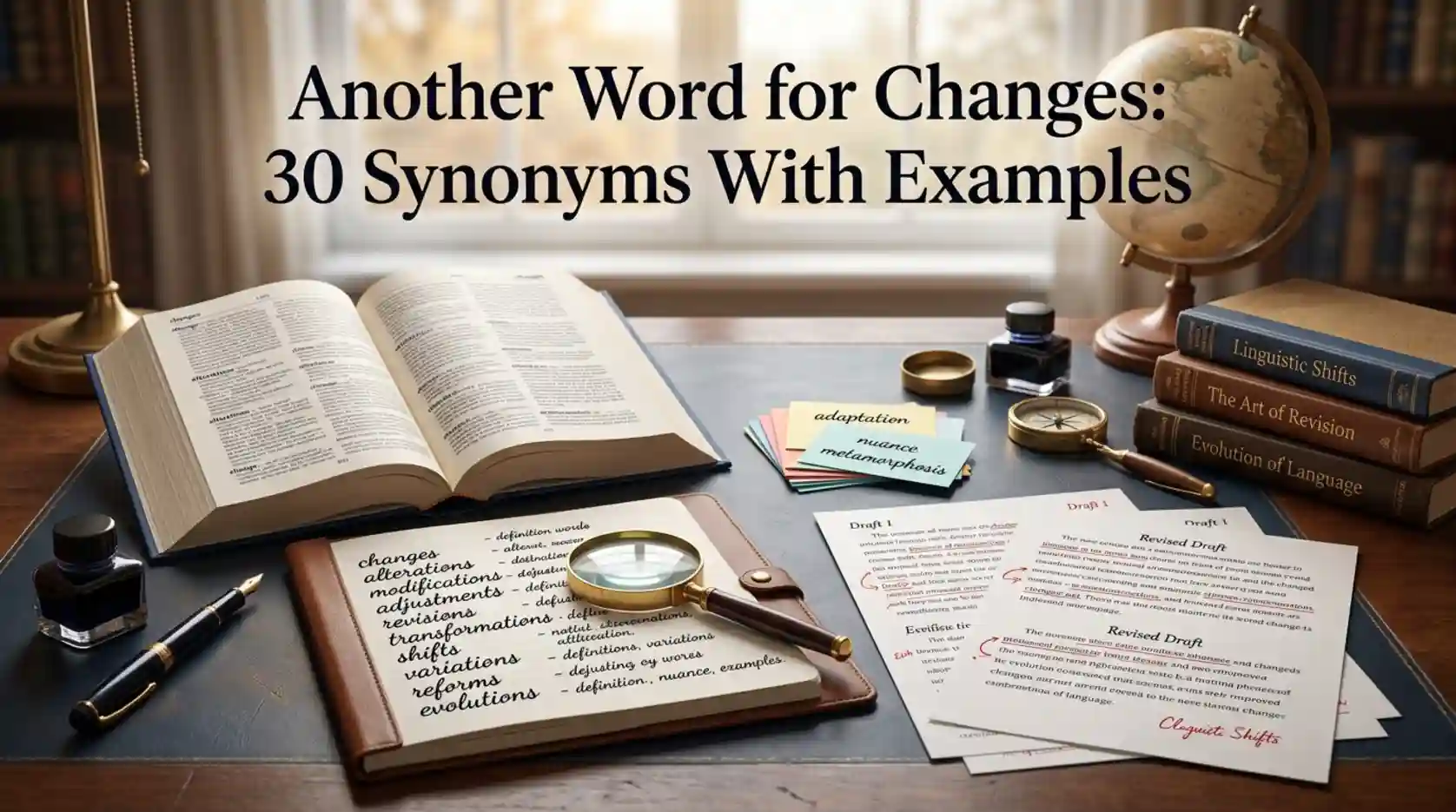
Another Word for Changes: 30 Synonyms With Examples
The closest everyday alternatives to “changes” are alterations, modifications, adjustments, and shifts. Which one fits depends on what changed. “Adjustments” suggests small fixes, “amendments” suits formal documents, and “transformations” describes deep change. “Changes” can also be a verb, as in “She changes jobs often,” so some alternatives are verbs such as “alters” and “transforms.”
The main meanings are differences made to something, big or complete change, replacement, and exchange. Each area has its own better words.
Quick list: alterations, modifications, adjustments, shifts, revisions, amendments, transformations, tweaks, replacements, swaps
Below are 30 alternatives with meanings, IPA, usage notes, and examples. Some are direct synonyms and some are related words that fit only certain contexts.
At a Glance: Changes Synonyms and Related Alternatives
| Alternative | Part of Speech | Meaning | Register / Tone | Ideal Context |
| Alterations | Noun | Changes made to something, often to fit or improve it | Neutral | Clothing, buildings, plans |
| Modifications | Noun | Changes made to adapt or improve something | Neutral to formal | Technical, design, rules |
| Adjustments | Noun | Small changes to get a better fit or result | Neutral | Settings, schedules, budgets |
| Shifts | Noun | Changes in position, direction, or attitude | Neutral | Trends, opinions, strategy |
| Revisions | Noun | Changes made after re-reading or reviewing | Neutral to formal | Writing, plans, estimates |
| Amendments | Noun | Formal changes to a text or law | Formal | Laws, contracts, documents |
| Transformations | Noun | Complete or deep changes in form | Neutral to dramatic | People, cities, industries |
| Tweaks | Noun | Small, minor changes | Informal | Quick improvements |
| Replacements | Noun | New things put in place of old ones | Neutral | Parts, staff, equipment |
| Swaps | Noun | Informal exchanges of one thing for another | Informal | Casual trades, small switches |
Which Word Should You Use?

| If you want to… | Use | Why |
| Describe small improvements | tweaks, adjustments | Both suggest minor, careful changes. |
| Describe changes to a law or contract | amendments | It is the standard formal term for legal text. |
| Describe edits to writing or plans | revisions | It implies reviewing and correcting. |
| Describe a complete change in form | transformations | It stresses a deep, visible difference. |
| Describe changes in opinion or direction | shifts | It suggests movement from one position to another. |
| Describe changes in numbers that rise and fall | fluctuations | It fits prices, temperatures, and rates. |
| Describe parts or people put in place of others | replacements, substitutions | Both focus on new items taking the old ones’ place. |
| Describe sudden, disruptive change | upheavals | It suggests turmoil. |
Exploring the Multiple Meanings of “Changes”

1. Alterations or Differences
- Meaning: Differences made to something so it is not the same as before.
- Explanation: This is the most common sense. The changes can be small or large and planned or unplanned.
- Example: The company made several changes to the website last week.
2. Transformations
- Meaning: A deep or complete change in form, nature, or condition.
- Explanation: Here “changes” means the thing becomes noticeably different, not just slightly edited.
- Example: The changes in the town over twenty years are amazing.
3. Replacements or Substitutions
- Meaning: One thing taken away and another put in its place.
- Explanation: This sense appears in phrases like “changes of clothes” and “oil changes.”
- Example: She packed two changes of clothes for the trip.
4. Makes Different (Verb)
- Meaning: Third-person singular of “change,” meaning to make or become different.
- Explanation: In this sense “changes” is a verb, not a plural noun, and the alternatives are verbs.
- Example: The weather changes quickly in the mountains.
5. Exchanges or Switches (Verb)
- Meaning: To move from one thing to another, or to swap one thing for another.
- Explanation: This sense is common with transport, places, and equipment.
- Example: He changes trains at the next station.
Sources: Merriam-Webster, Collins Dictionary, Dictionary.com (entries for change)
Analyzing 30 Changes Alternatives in Detail
Some alternatives below are direct synonyms for “changes,” while others are related words that fit only specific contexts, and the Usage notes say which is which.
Group 1: Core Synonyms
1. Alterations
IPA: US /ˌɔːltəˈreɪʃnz/ · UK /ˌɒltəˈreɪʃnz/
Definition: Changes made to something, especially to make it fit or work better.
- Usage: A direct synonym. It is common for clothes, buildings, and plans.
- Example: The tailor made some alterations to the jacket.
2. Modifications
IPA: US /ˌmɑːdɪfɪˈkeɪʃnz/ · UK /ˌmɒdɪfɪˈkeɪʃnz/
Definition: Changes made to improve, adapt, or limit something.
- Usage: A direct synonym, slightly more technical than “changes.” It suggests purposeful adjustment.
- Example: The engineers made modifications to the engine design.
3. Adjustments
IPA: /əˈdʒʌstmənts/ (US and UK)
Definition: Small changes made to improve fit, accuracy, or performance.
- Usage: A close synonym for minor changes. It does not suit dramatic change.
- Example: We made a few adjustments to the schedule.
4. Shifts
IPA: /ʃɪfts/ (US and UK)
Definition: Changes in position, direction, emphasis, or attitude.
- Usage: A close synonym, especially for trends and opinions. It suggests movement from one state to another.
- Example: There have been major shifts in how people shop.
5. Variations
IPA: US /ˌveriˈeɪʃnz/ · UK /ˌveəriˈeɪʃnz/
Definition: Differences or changes in amount, level, or form.
- Usage: A related alternative. It fits differences between versions or over time, not a deliberate act of changing.
- Example: There are slight variations in price from store to store.
Group 2: Formal and Official Alternatives
6. Amendments
IPA: /əˈmendmənts/ (US and UK)
Definition: Formal changes or corrections to a law, contract, or document.
- Usage: A formal, context-specific alternative. Use it for official texts, not everyday changes.
- Example: The committee approved two amendments to the bill.
7. Revisions
IPA: /rɪˈvɪʒnz/ (US and UK)
Definition: Changes made to correct or improve something after reviewing it.
- Usage: A close synonym for edited text, plans, and figures. It suggests careful review.
- Example: The author submitted her revisions on Monday.
8. Reforms
IPA: US /rɪˈfɔːrmz/ · UK /rɪˈfɔːmz/
Definition: Changes made to improve a system, law, or institution.
- Usage: A related alternative. It is used for public systems and organizations, and it implies improvement.
- Example: The government announced reforms to the tax system.
9. Adaptations
IPA: /ˌædæpˈteɪʃnz/ (US and UK)
Definition: Changes made so something suits a new use or situation.
- Usage: A related alternative. It stresses fitting a new purpose or environment.
- Example: Farmers made adaptations to cope with the dry climate.
10. Transitions
IPA: /trænˈzɪʃnz/ (US and UK)
Definition: The process of changing from one state or condition to another.
- Usage: A related alternative. It refers to the passage between states, not the changes themselves.
- Example: The company is managing several transitions at once.
Group 3: Big or Deep Changes
11. Transformations
IPA: US /ˌtrænsfərˈmeɪʃnz/ · UK /ˌtrænsfəˈmeɪʃnz/
Definition: Complete changes in form, appearance, or nature.
- Usage: A strong alternative for major change. Do not use it for minor edits.
- Example: The city has seen remarkable transformations since 2000.
12. Overhauls
IPA: US /ˈoʊvərhɔːlz/ · UK /ˈəʊvəhɔːlz/
Definition: Thorough changes or repairs to a system or process.
- Usage: A related alternative for sweeping changes. It suggests rebuilding or improving a system.
- Example: The school announced overhauls of its grading system.
13. Upheavals
IPA: /ʌpˈhiːvlz/ (US and UK)
Definition: Sudden, violent, or disruptive changes.
- Usage: A related alternative with a negative, disruptive tone.
- Example: The war caused great social upheavals.
14. Revolutions
IPA: /ˌrevəˈluːʃnz/ (US and UK)
Definition: Complete or dramatic changes in ideas, methods, or systems.
- Usage: A figurative alternative for sweeping change. It can also mean political uprisings.
- Example: Digital tools led to revolutions in how people work.
15. Metamorphoses
IPA: US /ˌmetəˈmɔːrfəsiːz/ · UK /ˌmetəˈmɔːfəsiːz/
Definition: Complete changes in form or character, as when an insect develops into an adult.
- Usage: A literary or scientific alternative. It is rare in everyday speech.
- Example: The artist’s style went through several metamorphoses.
Group 4: Small, Gradual, or Fluctuating Changes
16. Tweaks
IPA: /twiːks/ (US and UK)
Definition: Small changes made to improve something.
- Usage: An informal alternative for minor changes only.
- Example: The recipe needed a few tweaks.
17. Refinements
IPA: /rɪˈfaɪnmənts/ (US and UK)
Definition: Small improvements that make something more exact or polished.
- Usage: A related alternative. It always suggests improvement.
- Example: The designers added refinements to the final model.
18. Fluctuations
IPA: /ˌflʌktʃuˈeɪʃnz/ (US and UK)
Definition: Repeated rises and falls in amount or level.
- Usage: A related alternative for numbers that move up and down, such as prices or temperatures.
- Example: Fluctuations in the stock market worried investors.
19. Developments
IPA: /dɪˈveləpmənts/ (US and UK)
Definition: New events or stages in a situation.
- Usage: A related alternative common in news. It describes new events, not necessarily changes made on purpose.
- Example: There have been several developments in the case.
20. Swings
IPA: /swɪŋz/ (US and UK)
Definition: Sudden or noticeable changes from one condition to another.
- Usage: A related alternative for sharp changes in moods, opinions, or numbers.
- Example: The weather brought wild swings in temperature.
Group 5: Replacement and Exchange Terms
21. Replacements
IPA: /rɪˈpleɪsmənts/ (US and UK)
Definition: Things or people put in the place of others.
- Usage: A context-specific alternative. Use it when something new takes the old one’s place.
- Example: The team needs replacements for two injured players.
22. Substitutions
IPA: US /ˌsʌbstɪˈtuːʃnz/ · UK /ˌsʌbstɪˈtjuːʃnz/
Definition: Acts of using one thing or person in place of another.
- Usage: A context-specific alternative, common in cooking, sports, and chemistry.
- Example: The recipe allows substitutions for butter.
23. Swaps
IPA: US /swɑːps/ · UK /swɒps/
Definition: Informal exchanges of one thing for another.
- Usage: An informal, context-specific alternative.
- Example: The students made swaps between their seats.
24. Exchanges
IPA: /ɪksˈtʃeɪndʒɪz/ (US and UK)
Definition: Acts of giving one thing and receiving another.
- Usage: A related alternative. It fits trades and shared interactions, not edits.
- Example: The two schools arranged exchanges between students.
25. Switches
IPA: /ˈswɪtʃɪz/ (US and UK)
Definition: Changes from one thing to another, often sudden.
- Usage: A close alternative for a complete move from one option to another.
- Example: Several switches in the lineup surprised fans.
Group 6: Verb Alternatives for “Changes”
26. Alters
IPA: US /ˈɔːltərz/ · UK /ˈɒltəz/
Definition: Makes something different, usually in a small or partial way.
- Usage: A direct verb synonym. Use it when “changes” is a verb, not a plural noun.
- Example: He alters his plans depending on the weather.
27. Transforms
IPA: US /trænsˈfɔːrmz/ · UK /trænsˈfɔːmz/
Definition: Changes something completely in form or character.
- Usage: A strong verb alternative. It implies complete change.
- Example: Good teaching transforms how students see themselves.
28. Converts
IPA: US /kənˈvɜːrts/ · UK /kənˈvɜːts/
Definition: Changes something into a different form, use, or system.
- Usage: A related verb alternative. It needs a clear “into” or “to,” as in “converts into.”
- Example: The device converts sunlight into electricity.
29. Varies
IPA: US /ˈveriz/ · UK /ˈveəriz/
Definition: Is different or changes from one case or time to another.
- Usage: A related verb alternative. It describes difference from one case to another, not a deliberate act.
- Example: The price varies from store to store.
30. Reshapes
IPA: /ˌriːˈʃeɪps/ (US and UK)
Definition: Gives something a new form or character.
- Usage: A related verb alternative. It stresses a new form or structure.
- Example: New technology reshapes how people communicate.
Sources: Merriam-Webster, Collins Dictionary and Thesaurus, Dictionary.com
“Changes” vs. “Alterations” vs. “Modifications”
These three are often treated as the same. They overlap, but each has a typical use.
| Word | Typical Feel | Typical Use |
| Changes | Neutral, general | Any difference, large or small |
| Alterations | Practical, physical | Clothing, buildings, plans |
| Modifications | Technical, purposeful | Machines, designs, rules |
“Changes” is the safest everyday choice. “Alterations” fits things that are fitted or reshaped. “Modifications” suggests changes made on purpose to improve performance or suitability.
Sources: Merriam-Webster, Collins Dictionary
Changes and Opposite/Paired Word Pairs

| Word | Paired Word | Note |
| Changes | Stability | Stability describes a state without change. |
| Changes | Continuity | Continuity stresses that something carries on. |
| Changes | Constants | A constant stays the same while other things change. |
| Changes | Status quo | The status quo is the existing state of things. |
| Additions | Deletions | Common pairing in editing and documents. |
| Improvements | Setbacks | Contrasts good and bad changes. |
“Changes” has no single perfect opposite. Words like “stability” and “continuity” work in different situations, and which one fits depends on If you mean something staying the same or something carrying on over time. Pairs like “additions and deletions” describe types of change instead.
Sources: Merriam-Webster, Collins Thesaurus
Common Word Partners of “Changes”
| Pattern | Common Partners | Example |
| Verb + changes | make, undergo, bring about, accept, save, undo | You can undo changes with one click. |
| Adjective + changes | major, significant, minor, sweeping, recent | The company announced sweeping changes. |
| Noun + changes | policy, lifestyle, price, mood, weather | Lifestyle changes can improve health. |
| Changes + preposition | in, to, of | There were changes to the schedule. |
| Changes + verb | take effect, occur, happen, follow | The changes take effect on Monday. |
Sources: Collins Dictionary, Merriam-Webster, Cambridge Dictionary
Idiomatic Phrases Featuring “Changes”

Most idioms use the singular “change.” Only the first expression below uses the plural, and the others are included because they are established fixed phrases built on the same word.
1. Ring the changes
- Meaning: To try different ways of doing something to avoid repetition. This is mainly a British expression.
- Example: The restaurant rings the changes with a new menu every month.
2. A change of heart
- Meaning: A new decision or feeling that is different from an earlier one.
- Example: She had a change of heart and stayed.
3. A change of pace
- Meaning: Something different from what you usually do.
- Example: A weekend in the country was a nice change of pace.
4. A change of scenery
- Meaning: A move to a different place for variety or a fresh start.
- Example: After a hard year, he wanted a change of scenery.
Sources: Merriam-Webster, Cambridge Dictionary, Oxford Learner’s Dictionaries
Word Formation of “Changes”
Etymology & Structure
“Change” comes into English from Old French changer, which traces back to Late Latin cambiare (“to exchange”). “Changes” is the plural noun or the third-person singular verb form, made by adding -s to “change.”
Date and History
The word entered English in the Middle English period, around the 13th century. Check the Etymonline and Oxford English Dictionary entries for change for precise earliest dates before citing a specific year.
Word Class Variations
- Verb: change, changes, changed, changing
- Noun: change, changes
- Adjective: changeable, changing, unchanged
- Adverb: changeably (rare), unchangingly
- Related forms: changer, changeover, changeless
Sources: Etymonline, Merriam-Webster, Oxford English Dictionary
Common Word-Choice Mistakes
- “Do changes”: use “make changes.”
- “Changes on the plan”: use “changes to the plan.”
- “Many change”: use “many changes,” because the plural noun is needed.
- “Modification of mind”: use “change of mind.”
- “Transformations” for a tiny edit: use “tweaks” or “adjustments.”
- “Amendments” for casual updates: use “changes” or “updates.”
- “Alter” confused with “altar”: “alter” means to change, while “altar” is a table used in religious ceremonies.
Frequently Asked Questions
What is the closest synonym for changes?
“Alterations” and “modifications” are the closest everyday synonyms. “Adjustments” works for small changes.
What is a formal alternative to changes?
“Amendments” is the formal choice for laws and contracts, and “revisions” suits edited documents.
What is a casual alternative to changes?
“Tweaks” and “swaps” are informal. “Tweaks” means small changes, and “swaps” means exchanges.
What is the difference between changes and alterations?
“Changes” is general. “Alterations” is most common for physical things such as clothes or buildings.
What is a good alternative for big changes?
“Transformations,” “overhauls,” and “upheavals” describe large changes. “Upheavals” is negative.
Can “changes” be a verb?
Yes. In “She changes jobs often,” it is the third-person singular verb form. Alternatives include “alters” and “transforms.”
What is the opposite of changes?
There is no single opposite. “Stability” and “continuity” work in different contexts.
What is a figurative alternative to changes?
“Revolutions” and “metamorphoses” are figurative alternatives for big, striking change.
What word fits numbers that rise and fall?
Use “fluctuations.” It suits prices, temperatures, and rates.
Is “changes” the same as “developments”?
Not exactly. “Developments” are new events or stages in a situation, while “changes” are differences made to something.
Conclusion
The closest alternatives to “changes” are alterations, modifications, adjustments, and shifts. These work in most everyday situations. For specific needs, there are formal words such as amendments and revisions, and strong words such as transformations and upheavals.
Context decides which word is best. Small changes call for “tweaks” or “adjustments,” official changes call for “amendments,” and complete changes call for “transformations.” Some words, such as “fluctuations” and “replacements,” fit only particular situations.
To choose the right word, ask three questions: How big is the change? How formal is the setting? Is something being altered, replaced, or just moving up and down? The answers will usually point to the right alternative.