Another Word for Analysis: 30 Synonyms With Examples
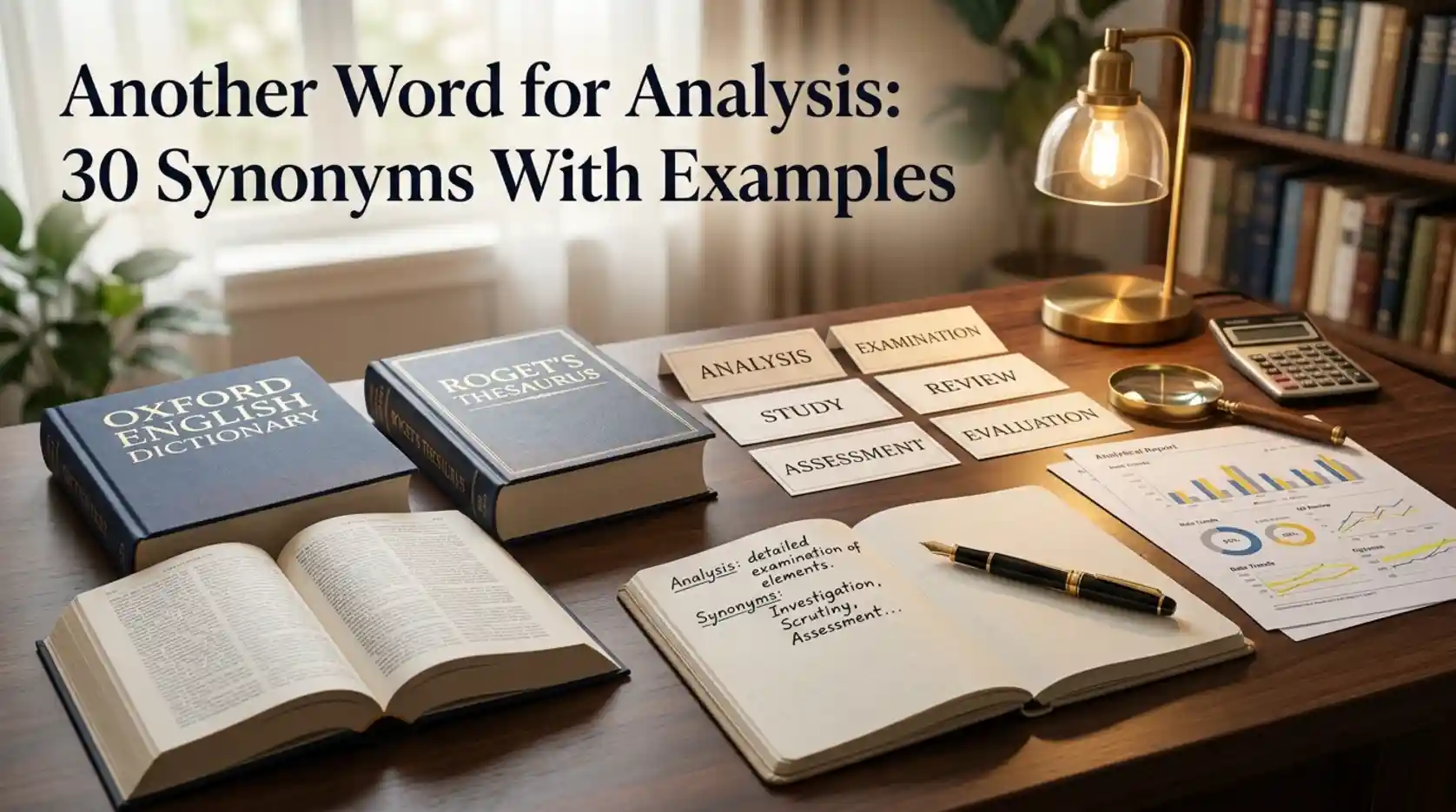
The closest everyday alternatives to “analysis” are examination, study, review, assessment, and evaluation. For a more formal tone, you can use scrutiny, appraisal, or investigation. Each word shifts the meaning a little, so the best choice depends on what you are doing. You might be breaking something into parts, judging its quality, testing it, or explaining what it means.
“Analysis” can describe a careful study of a complex thing, the written result of that study, a lab test of a substance, or a branch of mathematics. It also appears in grammar, logic, and psychology. Because of this range, some alternatives fit only one sense.
Quick list: examination, study, review, assessment, evaluation, investigation, scrutiny, breakdown, interpretation, audit
This article looks at 30 alternatives in detail, with meanings, IPA, usage notes, and examples. Some are close synonyms. Others are related words that work only in certain contexts, and the usage notes say which is which.
At a Glance: Analysis Synonyms and Related Alternatives
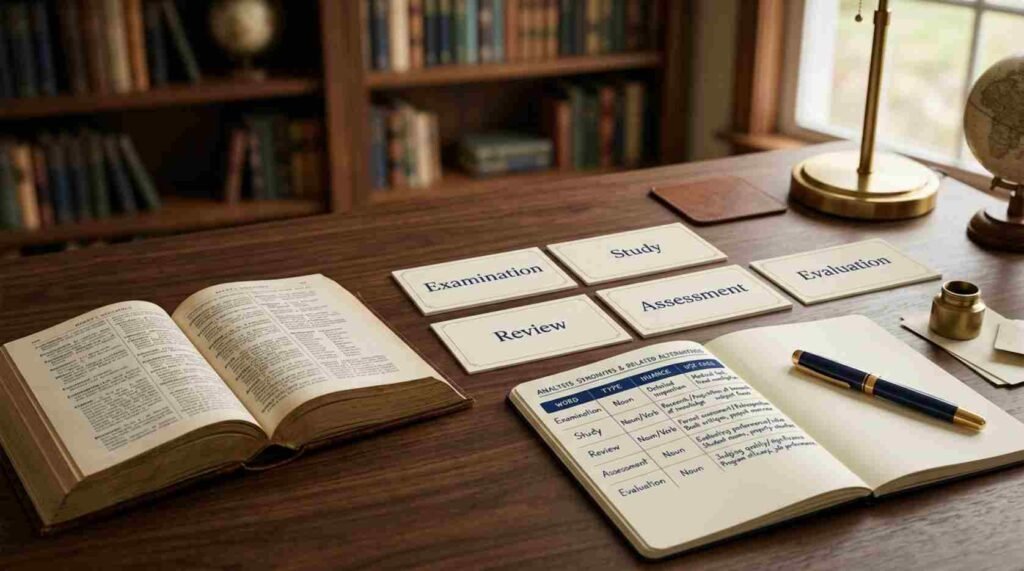
| Alternative | Part of Speech | Meaning | Register / Tone | Ideal Context |
| Examination | Noun | Close and careful looking at something | Formal | Science, medicine, law |
| Study | Noun | Detailed investigation of a subject | Neutral | Research, school, reports |
| Review | Noun | A careful look to judge or check | Neutral | Work, books, performance |
| Assessment | Noun | A judgment of quality, size, or value | Formal | Education, business, risk |
| Evaluation | Noun | A judgment of worth based on evidence | Formal | Programs, products, staff |
| Investigation | Noun | A thorough search for facts | Formal | Crime, science, journalism |
| Scrutiny | Noun | Very close, critical examination | Formal | Finance, politics, law |
| Breakdown | Noun | A division of something into parts | Neutral | Costs, data, statistics |
| Interpretation | Noun | An explanation of what something means | Formal | Texts, art, results |
| Audit | Noun | An official check of records or systems | Formal | Finance, quality, security |
Which Word Should You Use?
| If you want to… | Use | Why |
| Describe a careful study of a complex topic | study | It is simple and widely understood. |
| Judge how good or useful something is | evaluation | It focuses on worth, not just parts. |
| Show how a whole divides into parts | breakdown | It names the act of splitting something up. |
| Check financial or system records | audit | It means an official, rule-based check. |
| Explain what results or a text mean | interpretation | It focuses on meaning, not measurement. |
| Test the makeup of a substance | assay | It is the technical term in labs and mining. |
| Review a mistake after it happened | post-mortem | It means looking back to learn what went wrong. |
| Look at something very closely and critically | scrutiny | It suggests pressure and close attention. |
Exploring the Multiple Meanings of “Analysis”

1. A Detailed Examination of Something Complex
- Meaning: A careful study of something to understand its nature or main features.
- Explanation: This is the most common sense. The study usually looks at parts and how they connect. Words like study, examination, and investigation fit here.
- Example: The team began an analysis of last year’s sales.
2. The Written or Spoken Result of That Study
- Meaning: A report, statement, or explanation produced after studying something.
- Explanation: Here “analysis” names the finished product, not the process. Words like report, commentary, and assessment fit better.
- Example: Her analysis was only two pages long, but it was clear.
3. Separating a Substance Into Its Parts
- Meaning: The process of finding out what a substance contains.
- Explanation: This is the scientific sense, used in chemistry and medicine. It is more technical than the first sense. Assay and testing fit best.
- Example: A lab analysis showed lead in the water.
4. A Branch of Mathematics
- Meaning: The area of mathematics that deals with limits, functions, and calculus.
- Explanation: In this sense “analysis” has no good everyday synonym. It names a field, not an action.
- Example: He is taking a course in real analysis this semester.
5. Psychoanalysis
- Meaning: A short form of psychoanalysis, a method of treating mental and emotional problems.
- Explanation: This sense is common in phrases like “in analysis.” Do not replace it with ordinary synonyms such as review.
- Example: She has been in analysis for two years.
6. Breaking Language or Ideas Into Parts
- Meaning: Dividing a sentence, argument, or idea into its basic parts to see how it works.
- Explanation: This sense is used in grammar and logic. Parsing and breakdown are the closest alternatives.
- Example: The analysis of the sentence showed two clauses.
Sources: Merriam-Webster, Collins Dictionary, Dictionary.com
Analyzing 30 Analysis Alternatives in Detail
Some of the words below are direct synonyms of “analysis,” while others are related alternatives that fit only certain meanings or situations.
Core Everyday Alternatives
1. Examination
IPA: US /ɪɡˌzæməˈneɪʃən/ · UK /ɪɡˌzæmɪˈneɪʃn/
Definition: A careful look at something to learn about it or check its condition.
- Usage: A close synonym in the sense of detailed study. It is formal and often used in science, medicine, and law.
- Example: A careful examination of the data revealed an error.
2. Study
IPA: /ˈstʌdi/ (US and UK)
Definition: A detailed investigation of a subject or question.
- Usage: A common, neutral synonym for the process or the report. It is less focused on breaking things into parts than “analysis.”
- Example: The study looked at sleep habits in teenagers.
3. Review
IPA: /rɪˈvjuː/ (US and UK)
Definition: A formal look at something to check, judge, or improve it.
- Usage: A related alternative. It suggests checking or judging, not always a deep breakdown. It is lighter than “analysis.”
- Example: The manager ordered a review of the budget.
4. Assessment
IPA: /əˈsɛsmənt/ (US and UK)
Definition: A judgment about the quality, size, or value of something.
- Usage: A related alternative. It focuses on the final judgment, not the process of breaking things down.
- Example: The engineer gave an honest assessment of the bridge.
5. Evaluation
IPA: /ɪˌvæljuˈeɪʃən/ (US and UK)
Definition: A careful judgment of how good or valuable something is, based on evidence.
- Usage: A related alternative. Evaluation asks “how good is it?” while analysis asks “how does it work?”
- Example: The school completed an evaluation of the new reading program.
6. Investigation
IPA: /ɪnˌvɛstɪˈɡeɪʃən/ (US and UK)
Definition: A careful search for facts to learn the truth about something.
- Usage: A near synonym when the study aims to find facts or causes. It is also used for crime and official inquiries.
- Example: An investigation into the cause of the fire is under way.
Formal and Academic Alternatives
7. Scrutiny
IPA: US /ˈskruːtəni/ · UK /ˈskruːtɪni/
Definition: Very close and careful examination, often to find faults.
- Usage: A related alternative. It is stronger and more critical than “analysis” and often suggests pressure or doubt.
- Example: The company’s accounts came under public scrutiny.
8. Appraisal
IPA: /əˈpreɪzəl/ (US and UK)
Definition: A formal judgment of the value or quality of something.
- Usage: A related alternative. It is formal and focuses on value, as in property or job performance.
- Example: The manager gave a fair appraisal of her work.
9. Inquiry
IPA: US /ɪnˈkwaɪri/ · UK /ɪnˈkwaɪəri/
Definition: A formal process of asking questions to find facts.
- Usage: A related alternative. It suggests asking questions and gathering facts. It is not a direct synonym for breaking something into parts.
- Example: The council opened an inquiry into the delay.
10. Research
IPA: US /ˈriːsɝːtʃ/ · UK /rɪˈsɜːtʃ/
Definition: Careful study of a subject to find new facts or understand it better.
- Usage: A related alternative. Research includes gathering information, while analysis is often the step that makes sense of it.
- Example: Her research on coral reefs took five years.
11. Critique
IPA: /krɪˈtiːk/ (US and UK)
Definition: A detailed written or spoken judgment of a piece of work or an idea.
- Usage: A related alternative for analysis that includes strengths and weaknesses. It fits essays, art, and theories.
- Example: The professor wrote a short critique of the essay.
Breaking-Down Alternatives
12. Breakdown
IPA: /ˈbreɪkdaʊn/ (US and UK)
Definition: A division of something into parts, especially numbers or costs.
- Usage: A close synonym for the “separating into parts” idea. It is common with statistics, costs, and data.
- Example: The report includes a breakdown of costs by department.
13. Dissection
IPA: /dɪˈsɛkʃən/ (US and UK)
Definition: The careful cutting apart of something to study its structure, or very detailed analysis of an idea.
- Usage: A figurative alternative when the study is very detailed. In its literal sense, it refers to cutting apart a body or plant.
- Example: The article was a dissection of the senator’s speech.
14. Deconstruction
IPA: /ˌdiːkənˈstrʌkʃən/ (US and UK)
Definition: The act of breaking something down to show its hidden parts, assumptions, or meanings.
- Usage: A related alternative used mainly with texts, ideas, and art. It often suggests questioning hidden assumptions.
- Example: The class focused on the deconstruction of the poem.
15. Parsing
IPA: US /ˈpɑːrsɪŋ/ · UK /ˈpɑːzɪŋ/
Definition: Dividing a sentence into its parts to show grammar, or studying something closely to understand it.
- Usage: A related alternative. It fits grammar and computing best, and it works for close reading in general speech.
- Example: The parsing of the sentence took only a minute.
Testing, Checking, and Diagnosing Terms
16. Assay
IPA: /ˈæseɪ/ (US and UK)
Definition: A test of a metal, ore, or drug to find out what it contains and how pure it is.
- Usage: A technical alternative for the scientific sense of “analysis.” It is not used for general studies.
- Example: An assay of the rock found traces of gold.
17. Diagnosis
IPA: US /ˌdaɪəɡˈnoʊsɪs/ · UK /ˌdaɪəɡˈnəʊsɪs/
Definition: The act of finding the cause of a problem or illness.
- Usage: A related alternative. It focuses on identifying a problem, so it is narrower than “analysis.”
- Example: The mechanic’s diagnosis was a faulty battery.
18. Audit
IPA: /ˈɔːdɪt/ (US and UK)
Definition: An official check of accounts, records, or systems.
- Usage: A related alternative. It suggests checking against rules or standards, mostly in finance, quality, and security.
- Example: The auditors began an audit of the company’s records.
19. Survey
IPA: US /ˈsɜːrveɪ/ · UK /ˈsɜːveɪ/
Definition: A general look at or study of a subject, area, or group.
- Usage: A related alternative. It suggests a broad overview rather than a deep breakdown.
- Example: The survey of local housing covered ten years.
20. Testing
IPA: /ˈtɛstɪŋ/ (US and UK)
Definition: The process of trying something to see how it works or what it contains.
- Usage: A related alternative for scientific or technical analysis. It focuses on trying things out.
- Example: Testing of the soil showed high acid levels.
Explaining and Interpreting Terms
21. Commentary
IPA: US /ˈkɑːmənteri/ · UK /ˈkɒməntri/
Definition: A set of spoken or written remarks that explain or discuss something.
- Usage: A related alternative for the “written or spoken result” sense. It is common in news and sports.
- Example: The expert commentary helped viewers follow the debate.
22. Interpretation
IPA: US /ɪnˌtɜːrprɪˈteɪʃən/ · UK /ɪnˌtɜːprɪˈteɪʃn/
Definition: An explanation of what something means.
- Usage: A related alternative. It focuses on meaning, so it fits texts, art, and results.
- Example: Her interpretation of the results surprised the team.
23. Reading
IPA: /ˈriːdɪŋ/ (US and UK)
Definition: A particular way of understanding a text, event, or situation.
- Usage: A related alternative. It is informal and shows a personal view of something.
- Example: My reading of the contract is different from yours.
24. Explication
IPA: /ˌɛksplɪˈkeɪʃən/ (US and UK)
Definition: A detailed explanation, especially of a text or idea.
- Usage: A formal alternative used mostly in literature and philosophy. It is rare in everyday speech.
- Example: The book offers an explication of the poem’s main themes.
25. Insight
IPA: /ˈɪnsaɪt/ (US and UK)
Definition: A clear understanding of the true nature of something.
- Usage: A related alternative. It names what analysis often produces. It is not a synonym for the process.
- Example: The analysis gave us new insight into customer needs.
Close-Look and Informal Alternatives
26. Inspection
IPA: /ɪnˈspɛkʃən/ (US and UK)
Definition: A careful look at something to check its condition or quality.
- Usage: A related alternative. It suggests checking condition or safety, not explaining how something works.
- Example: The inspection found cracks in the wall.
27. Probe
IPA: US /proʊb/ · UK /prəʊb/
Definition: A detailed investigation into a matter, often by an official body.
- Usage: A related alternative common in news writing. It suggests digging for hidden facts.
- Example: A probe into the company’s finances is under way.
28. Post-Mortem
IPA: US /ˌpoʊstˈmɔːrtəm/ · UK /ˌpəʊstˈmɔːtəm/
Definition: An examination after an event to find out what went wrong, or a medical examination of a dead body.
- Usage: A figurative alternative used in business and sports. It means looking back at a failure or project to learn from it.
- Example: The team held a post-mortem after the failed launch.
29. Deep Dive
IPA: /ˌdiːp ˈdaɪv/ (US and UK)
Definition: A very thorough look at a subject.
- Usage: An informal alternative used in business and media. It suggests a long, detailed study.
- Example: The magazine ran a deep dive into city traffic.
30. Case Study
IPA: /ˈkeɪs ˌstʌdi/ (US and UK)
Definition: A detailed study of one person, group, or situation used as an example.
- Usage: A related alternative. It is narrower than “analysis” because it studies one example in depth.
- Example: The lesson included a case study of a small bakery.
Sources: Merriam-Webster, Collins Dictionary, Dictionary.com, Oxford Learner’s Dictionaries
Analysis vs. Evaluation vs. Assessment vs. Review

These four words are often treated as the same, but each answers a different question.
| Word | Main Focus | Typical Question | Example |
| Analysis | Breaking something into parts to understand it | How does this work? | The analysis showed three causes of the delay. |
| Evaluation | Judging worth or success | How good is this? | The evaluation rated the program as effective. |
| Assessment | Measuring or estimating quality, size, or risk | Where does this stand? | The assessment found moderate risk. |
| Review | Checking something again | Is this correct or acceptable? | The review found two small mistakes. |
In real writing, these tasks often overlap. A report may begin with analysis, move to evaluation, and end with a recommendation. The related forms also differ: analytics usually means the tools and methods used to study data, while analysis means the study itself.
Sources: Merriam-Webster, Collins Dictionary, Dictionary.com
Analysis and Opposite/Paired Word Pairs
| Word | Paired Word | Note |
| Analysis | Synthesis | Analysis breaks things apart, while synthesis puts parts together. |
| Analysis | Summary | A summary shortens something, while analysis explains how it works. |
| Analysis | Guesswork | Analysis relies on evidence, while guesswork does not. |
| Analysis | Intuition | Intuition is a quick feeling without step-by-step reasoning. |
| Quantitative analysis | Qualitative analysis | One uses numbers, while the other studies qualities, opinions, and meanings. |
“Analysis” has no single perfect opposite. The strongest contrast is synthesis, which is the traditional partner in philosophy and science. Other words such as guesswork show what analysis is not, but they are contrasts, not true antonyms.
Sources: Merriam-Webster, Collins Dictionary, Dictionary.com
Common Word Partners of “Analysis”

| Pattern | Common Partners | Example |
| Adjective + analysis | detailed, careful, statistical, critical, financial | The company ordered a detailed analysis of its costs. |
| Noun + analysis | data, market, risk, text, cost-benefit | Data analysis helped the team find the problem. |
| Verb + analysis | conduct, perform, carry out, require | Researchers carried out an analysis of 500 cases. |
| Analysis + verb | shows, suggests, reveals, indicates | The analysis suggests that prices will rise. |
| Analysis + of | analysis of results, analysis of the data | Her analysis of the results was clear. |
| Preposition + analysis | under analysis, through analysis, based on analysis | The plan is based on careful analysis. |
Sources: Collins Dictionary, Oxford Learner’s Dictionaries, Merriam-Webster
Idiomatic Phrases Featuring “Analysis”
1. In the final analysis
- Meaning: After everything has been considered; when all is said and done. “In the last analysis” is a common variant.
- Example: In the final analysis, the decision was his to make.
2. Analysis paralysis
- Meaning: A state where too much thinking or studying stops a person from making a decision.
- Example: The team had so many options that analysis paralysis set in.
3. Paralysis by analysis
- Meaning: Another form of analysis paralysis, with the same meaning.
- Example: Paralysis by analysis kept her from choosing a laptop.
4. On closer analysis
- Meaning: After a more careful look. This is an established expression, not a true idiom.
- Example: On closer analysis, the numbers did not add up.
Sources: Merriam-Webster, Collins Dictionary, Dictionary.com
Word Formation of “Analysis”
Etymology & Structure
“Analysis” came into English from Medieval Latin, which took it from Greek analysis, meaning a loosening or breaking up. The Greek word comes from analyein, “to unloose,” built from ana (“up, throughout”) and lysis (“a loosening”). The idea of “loosening” something into its parts is still at the heart of the word today.
Date and History
Etymonline places the first English use in the 1580s, when it meant breaking a complex thing into simple parts. Later senses developed in chemistry, mathematics, grammar, and psychology.
Word Class Variations
- Noun: analysis (plural: analyses)
- Verb: analyze (US), analyse (UK)
- Adjective: analytic, analytical
- Adverb: analytically
- Related nouns: analyst, analyzer, analytics, reanalysis, psychoanalysis
Sources: Etymonline, Merriam-Webster, Collins Dictionary
Common Word-Choice Mistakes

- “Do an analysis”: use conduct, perform, or carry out an analysis in formal writing.
- “Analysises”: the plural is analyses.
- “Analysis about the data”: use analysis of the data.
- “Paralysis of analysis”: the set phrases are analysis paralysis and paralysis by analysis.
- “The doctor gave an analysis of the illness”: diagnosis is the normal word. Use analysis for lab results, as in a blood analysis.
- “A quick review is the same as an analysis”: a review checks something, while an analysis breaks it into parts and explains it.
- “Analytics of the report”: use analysis. Analytics refers to tools and methods for studying data.
Frequently Asked Questions
What is the closest synonym for analysis?
Examination and study are the closest everyday synonyms. Investigation also works when the aim is to find facts.
What is a formal alternative to analysis?
Examination, appraisal, scrutiny, and evaluation are common formal choices. Explication is formal and mostly used for texts.
What is the difference between analysis and evaluation?
Analysis breaks something into parts to understand it. Evaluation judges how good or useful it is.
What is a casual alternative to analysis?
Breakdown, deep dive, and reading sound more relaxed. They fit business talk and everyday speech.
What is the opposite of analysis?
The usual contrast is synthesis, which combines parts into a whole. Guesswork is another contrast, but it is not a true antonym.
Is analysis the same as analytics?
No. Analysis is the act or result of studying something. Analytics usually refers to the tools and methods for studying data.
What is the plural of analysis?
The plural is analyses, pronounced /əˈnæləsiːz/. “Analysises” is not correct.
Can analysis mean a lab test?
Yes. In science, it can mean testing a substance to find what it contains. Assay and testing are close alternatives in that sense.
What does “in the final analysis” mean?
It means after everything has been considered. It introduces a conclusion, as in “In the final analysis, cost mattered most.”
Is “analyze” spelled differently in British English?
Yes. American English uses analyze, and British English uses analyse. The noun “analysis” is spelled the same in both.
Conclusion
The closest alternatives to “analysis” are examination, study, investigation, and breakdown. If you want to judge quality, words like evaluation, assessment, and appraisal are better. Words like assay, audit, and diagnosis fit specific fields.
Context matters because many alternatives change the meaning slightly. A review checks something, an evaluation judges it, and an interpretation explains it. A true analysis usually breaks something into parts to show how it works.