Another Word for Yet: 30 Synonyms With Examples
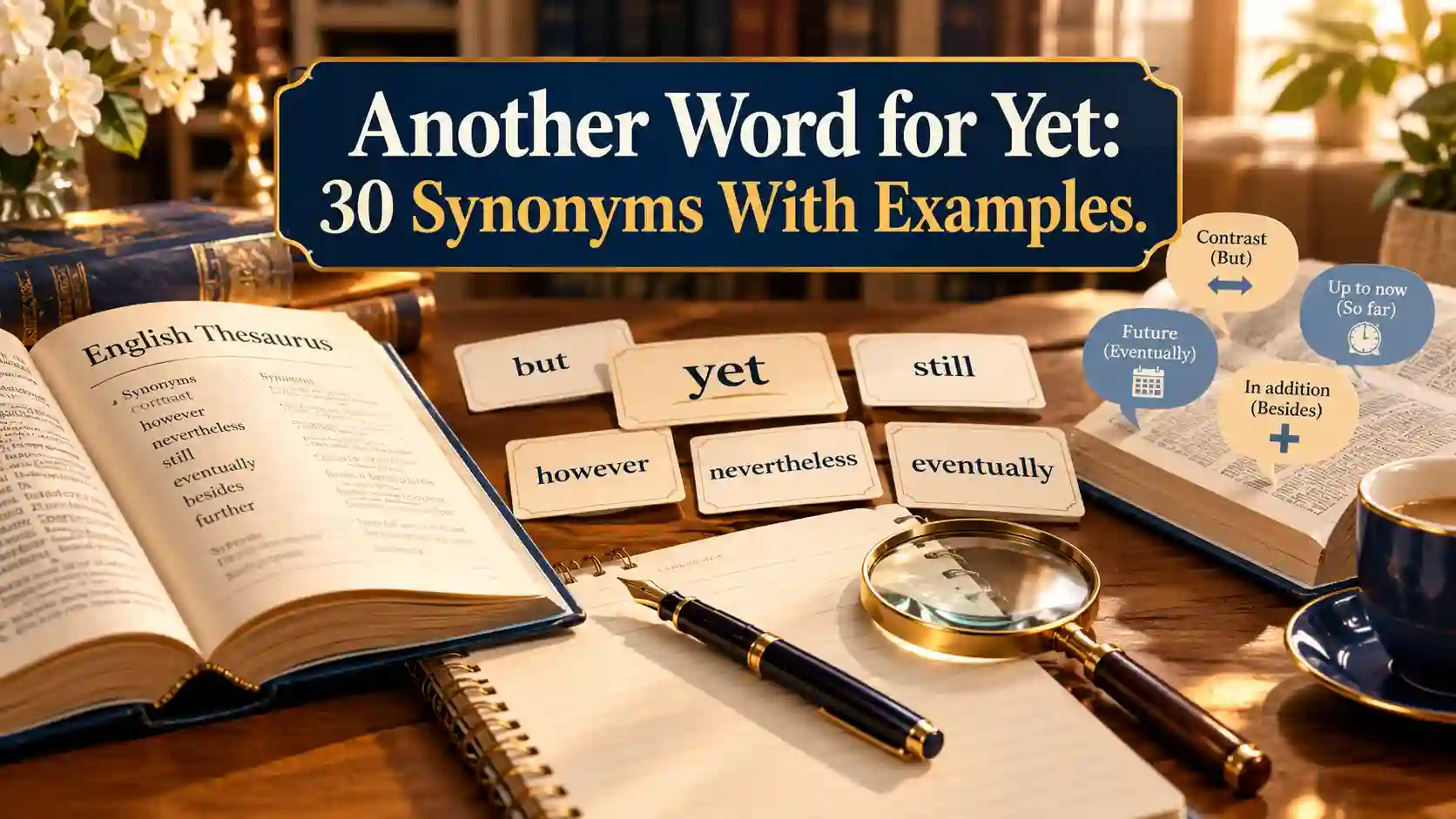
The closest everyday alternatives to yet are but, still, however, and so far. The best choice depends on the meaning: yet can show contrast (“but”), an action that has not happened up to now (“so far”), or something expected in the future (“eventually”).
Because yet has several different jobs in English, no single word replaces it in every sentence. It can mean “nevertheless,” “up to now,” “eventually,” “in addition,” or “even,” so the surrounding sentence decides which alternative fits.
Quick list: but, however, nevertheless, nonetheless, still, though, so far, thus far, as yet, eventually, in time, besides, even.
This article examines 30 alternatives with meanings, IPA, usage notes, examples, and context.
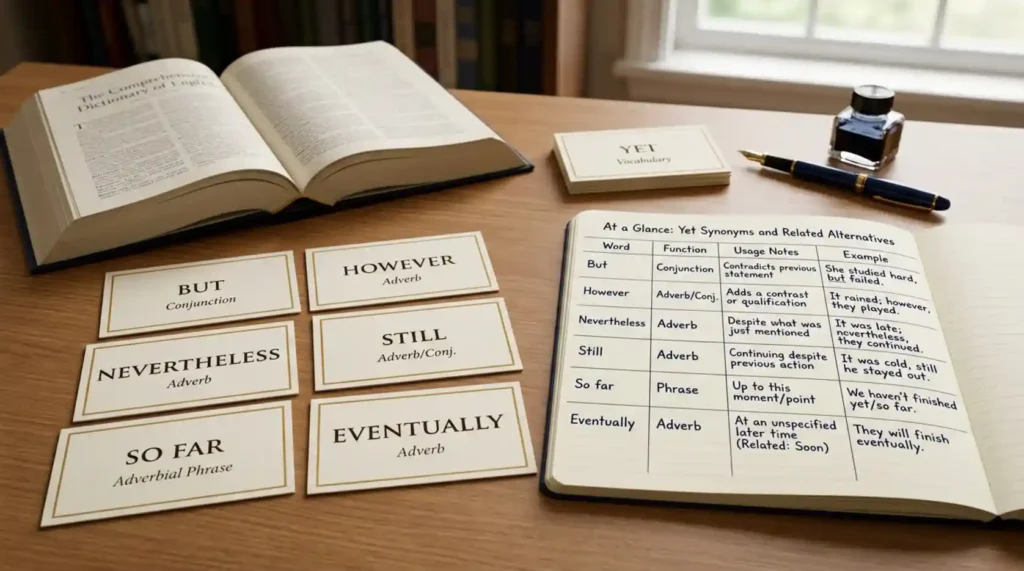
At a Glance: Yet Synonyms and Related Alternatives
| Alternative | Part of Speech | Meaning | Register / Tone | Ideal Context |
| But | Conjunction | However; despite that | Neutral | Everyday contrast: “Tired, but happy.” |
| However | Adverb | In spite of that | Formal to neutral | Writing, reports, careful speech |
| Nevertheless | Adverb | Despite what was said | Formal | Formal writing and argument |
| Still | Adverb | Despite that; even now | Neutral | Speech and writing |
| Though | Conjunction / adverb | But; however | Informal to neutral | Casual contrast, often at the end |
| So far | Adverbial phrase | Up to now | Neutral | Progress, experience, results |
| As yet | Adverbial phrase | Up to now | Formal | Formal reports and statements |
| Eventually | Adverb | In the end; after some time | Neutral | Future results and expectations |
| Besides | Adverb / preposition | In addition; apart from | Neutral | Adding a reason or point |
| Even | Adverb | Used to emphasize a surprise or extreme | Neutral | Emphasis: “even better” |
Which Word Should You Use?
| If you want to… | Use | Why |
| Show a simple contrast | But | It is the most common and natural replacement for yet as a conjunction. |
| Sound more formal | However or nevertheless | Both clearly signal contrast and suit professional writing. |
| Say something has not happened up to now | So far or up to now | These replace yet in sentences such as “I have not finished so far.” |
| Use formal language about the present situation | As yet, thus far, or to date | These are common in reports, news, and official writing. |
| Say something will happen after time passes | Eventually or in time | These replace yet in the sense of “at a future time.” |
| Add another point or reason | Besides, moreover, or in addition | These match yet in its “in addition” meaning. |
| Emphasize a surprising degree | Even | This matches “yet better,” “yet harder,” and similar uses. |
| Sound conversational | Still or though | Both are natural in everyday speech. |
Exploring the Multiple Meanings of “Yet”

1. But; Nevertheless
- Meaning: Used to introduce a contrast or an unexpected fact.
- Explanation: In this sense, yet works much like but, however, or nevertheless. It often follows a positive statement with a limiting or opposite idea.
- Example: The path was long, yet the view was worth it.
2. Up to Now; So Far
- Meaning: Until the present time.
- Explanation: This use often appears with negative verbs, especially in British English: “I haven’t seen it yet.” It describes something that has not happened by now.
- Example: She has not replied yet.
3. Still; Continuing Until Now
- Meaning: Continuously up to the present or another stated time.
- Explanation: Here, yet is close to still. It emphasizes that a state or action continues.
- Example: He is yet another talented player on the team.
4. At a Future Time; Eventually
- Meaning: At some later time; in the end.
- Explanation: This sense points forward rather than backward. It is common in phrases such as “yet to come” and “the best is yet to come.”
- Example: The team’s best performances are yet to come.
5. In Addition; Even
- Meaning: Besides; in addition; used to add emphasis.
- Explanation: Yet can strengthen a comparison or add another fact, as in “yet another problem” or “yet more evidence.”
- Example: The company faced yet another delay.
Sources: Merriam-Webster; Cambridge Dictionary; Collins Dictionary.
Analyzing 30 Yet Alternatives in Detail
Some alternatives below are direct synonyms in one meaning of yet, while others work only in particular contexts.
Contrast and Concession
1. But
IPA: /bʌt/ (US and UK)
Definition: Used to introduce something that contrasts with what came before.
- Usage: This is the closest everyday replacement for yet when it means “nevertheless.” It is neutral and works in almost any context.
- Example: The task was difficult, but she finished it.
2. However
IPA: /haʊˈɛvər/ (US and UK)
Definition: In spite of that; nevertheless.
- Usage: A formal alternative to contrastive yet. It usually begins a clause and is often followed by a comma.
- Example: The plan was expensive. However, it saved time.
3. Nevertheless
IPA: /ˌnɛvərðəˈlɛs/ (US and UK)
Definition: In spite of that; however.
- Usage: More formal than but or still. It emphasizes that the second statement remains true despite the first.
- Example: The evidence was limited; nevertheless, the conclusion was reasonable.
4. Nonetheless
IPA: /ˌnʌnðəˈlɛs/ (US and UK)
Definition: In spite of that; nevertheless.
- Usage: Very close to nevertheless, but slightly more common in formal writing. It replaces contrastive yet, not yet meaning “so far.”
- Example: The results were mixed; nonetheless, the project continued.
5. Still
IPA: /stɪl/ (US and UK)
Definition: Despite that; nevertheless.
- Usage: A natural, conversational alternative to yet as a contrast word. It can also mean “continuing up to now,” which overlaps with another sense of yet.
- Example: The road was icy; still, they drove carefully.
6. Though
IPA: US /ðoʊ/ · UK /ðəʊ/
Definition: However; but.
- Usage: Informal to neutral. Unlike yet, it often appears at the end of a sentence in everyday speech.
- Example: The apartment is small. It’s convenient, though.
7. Even so
IPA: US /ˈiːvən soʊ/ · UK /ˈiːvən səʊ/
Definition: Despite that; nevertheless.
- Usage: A phrase rather than a single word. It emphasizes contrast and fits both speech and writing.
- Example: The weather was poor. Even so, the event went ahead.
8. Notwithstanding
IPA: US /ˌnɑːtwɪθˈstændɪŋ/ · UK /ˌnɒtwɪðˈstændɪŋ/
Definition: In spite of that; nevertheless.
- Usage: Formal and somewhat legal or official in tone. Use it when you want a strong, formal contrast.
- Example: The costs were high; notwithstanding, the council approved the project.
9. All the same
IPA: /ɔːl ðə seɪm/ (US and UK)
Definition: Despite what has been said; nevertheless.
- Usage: Conversational and slightly emphatic. It replaces yet only in its contrast meaning.
- Example: I know it is risky. All the same, I want to try.
10. On the other hand
IPA: US /ɑn ði ˈʌðər hænd/ · UK /ɒn ði ˈʌðə hænd/
Definition: Used to present a different or contrasting point of view.
- Usage: A related alternative, not an exact synonym. It introduces a contrasting idea rather than simply meaning “but.”
- Example: The job pays well. On the other hand, it requires long hours.
Up to Now
11. So far
IPA: US /soʊ fɑːr/ · UK /səʊ fɑː/
Definition: Up to the present time.
- Usage: The most natural replacement for yet when describing progress, experience, or results up to now.
- Example: So far, no one has complained.
12. Thus far
IPA: US /ðʌs fɑːr/ · UK /ðʌs fɑː/
Definition: Up to this point in time.
- Usage: More formal than so far. It is common in reports, presentations, and formal explanations.
- Example: Thus far, the experiment has produced useful data.
13. Up to now
IPA: /ʌp tə naʊ/ (US and UK)
Definition: Until the present moment.
- Usage: Clear and neutral. It works well when you want to stress that a situation has continued until the present.
- Example: Up to now, the system has worked without problems.
14. Until now
IPA: /ənˈtɪl naʊ/ (US and UK)
Definition: Before the present time; up to the present.
- Usage: Similar to so far, but it often suggests that something is changing now.
- Example: Until now, the company had refused to comment.
15. To date
IPA: /tə deɪt/ (US and UK)
Definition: Up to the present time.
- Usage: Formal and common in business, research, and official updates. It is best for facts, totals, or progress.
- Example: To date, more than 500 people have applied.
16. As yet
IPA: /æz jɛt/ (US and UK)
Definition: Up to now; so far.
- Usage: A formal phrase that keeps much of the meaning of yet. It often appears with negatives: “as yet unknown.”
- Example: The cause of the fault is as yet unknown.
17. Hitherto
IPA: /ˌhɪðərˈtuː/ (US and UK)
Definition: Until now; up to this time.
- Usage: Formal, literary, and old-fashioned. Use it in careful writing, not everyday conversation.
- Example: The manuscript was hitherto unknown to scholars.
18. Heretofore
IPA: US /ˌhɪrtuːˈfɔːr/ · UK /ˌhɪətuːˈfɔː/
Definition: Until this time; before now.
- Usage: Very formal and mainly used in legal, academic, or official language. It is a related alternative to yet in the “up to now” sense.
- Example: The rule had heretofore applied only to new members.
Future and Expected Time
19. Eventually
IPA: /ɪˈvɛntʃuəli/ (US and UK)
Definition: In the end, especially after a long time.
- Usage: Replaces yet when it means “at a future time.” It suggests delay or a process leading to a result.
- Example: Eventually, the two sides reached an agreement.
20. In time
IPA: /ɪn taɪm/ (US and UK)
Definition: After a period of time; eventually.
- Usage: A softer alternative to eventually. It often suggests gradual change or improvement.
- Example: In time, she learned to trust her own judgment.
21. Sooner or later
IPA: US /ˈsuːnər ɔːr ˈleɪtər/ · UK /ˈsuːnə ɔː ˈleɪtə/
Definition: At some time in the future, If soon or after a delay.
- Usage: Conversational and emphatic. It replaces yet only in the forward-looking sense.
- Example: Sooner or later, the truth will come out.
22. One day
IPA: /wʌn deɪ/ (US and UK)
Definition: At some unspecified future time.
- Usage: Informal and hopeful in tone. It is suitable for dreams, plans, and predictions.
- Example: One day, they hope to open their own restaurant.
23. Before long
IPA: US /bɪˈfɔːr lɔːŋ/ · UK /bɪˈfɔː lɒŋ/
Definition: Soon; after a short time.
- Usage: Replaces yet when the expected event is likely to happen soon. It is more specific than eventually.
- Example: Before long, the train arrived.
24. Ultimately
IPA: /ˈʌltɪmətli/ (US and UK)
Definition: In the end; after everything has been considered.
- Usage: Formal and analytical. It emphasizes a final result or decision rather than simple future time.
- Example: Ultimately, the decision rests with the board.
25. Finally
IPA: /ˈfaɪnəli/ (US and UK)
Definition: After a long time or after other things have happened.
- Usage: Use it when something expected has now happened. It is related to yet in “the best is yet to come,” but it looks backward once the event occurs.
- Example: Finally, the results were published.
Addition and Emphasis
26. Besides
IPA: /bɪˈsaɪdz/ (US and UK)
Definition: In addition; also; apart from that.
- Usage: A useful alternative when yet means “in addition.” It often adds a reason or extra point in conversation.
- Example: The hotel is expensive. Besides, it is too far from the beach.
27. Moreover
IPA: US /mɔːrˈoʊvər/ · UK /mɔːˈrəʊvə/
Definition: In addition; what is more.
- Usage: Formal. It adds a supporting point, often in essays, reports, and formal arguments.
- Example: The drug is effective. Moreover, it has few side effects.
28. In addition
IPA: /ɪn əˈdɪʃən/ (US and UK)
Definition: As an extra point; also.
- Usage: Neutral to formal. It replaces the additive sense of yet but does not convey contrast.
- Example: In addition, the museum offers free tours.
29. Even
IPA: /ˈiːvən/ (US and UK)
Definition: Used to emphasize something surprising, extreme, or comparative.
- Usage: This matches yet in expressions such as “yet better” or “yet more difficult.” It is not a replacement for contrastive yet.
- Example: The second version was even better than the first.
30. Further
IPA: US /ˈfɜːrðər/ · UK /ˈfɜːðə/
Definition: To a greater degree or extent; additional.
- Usage: A related alternative for “yet more” or “yet another.” It is common in formal writing and announcements.
- Example: The committee requested further information.
Sources: Merriam-Webster; Cambridge Dictionary; Collins Dictionary; Dictionary.com.
Yet in Different Contexts

| Context | Common replacement | Example |
| Everyday contrast | But | “Simple, but effective.” |
| Formal contrast | However / nevertheless | “However, the results were inconclusive.” |
| Unfinished action | So far / up to now | “I have not received an answer so far.” |
| Formal status update | As yet / to date | “No decision has been made as yet.” |
| Future expectation | Eventually / in time | “Eventually, the service will expand.” |
| Adding a point | Besides / moreover | “Besides, the price includes delivery.” |
| Emphasis | Even | “The news made things even harder.” |
The same sentence can need different replacements depending on If yet points backward, forward, or adds emphasis. Checking the time reference is the fastest way to choose well.
Sources: Merriam-Webster; Cambridge Dictionary.
Yet and Opposite/Paired Word Pairs
| Word | Paired Word | Note |
| Yet | Already | Yet often appears in negatives and questions; already appears in affirmative statements. |
| Not yet | Now | “Not yet” means it has not happened; “now” means it is happening or has begun. |
| Yet | Still | Both can describe a continuing state, but yet is common in negatives and questions. |
| Yet | But | Both introduce contrast; but is more direct and common. |
| Yet to come | Already here | These phrases contrast future expectation with a present reality. |
| Yet again | Once | “Yet again” emphasizes repetition; “once” states that something happened one time. |
Yet frequently appears with negatives, questions, and comparative phrases. Its natural partners include not, already, still, another, again, and to come.
Sources: Merriam-Webster; Cambridge Dictionary.
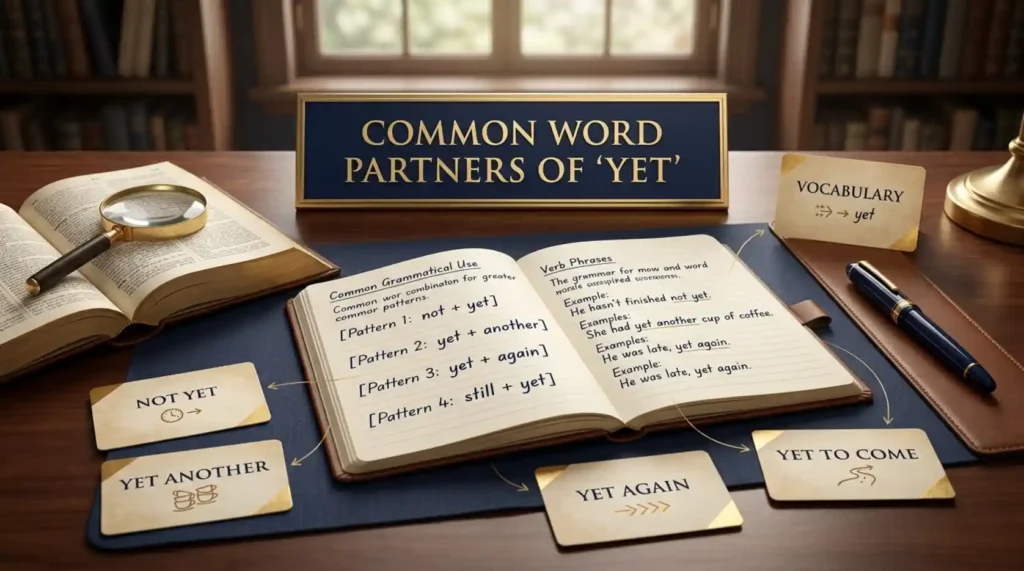
Common Word Partners of “Yet”
| Pattern | Common Partners | Example |
| Not + yet | arrived, finished, decided, known | “The results are not yet known.” |
| Have + not + yet | seen, heard, received, decided | “I have not yet received the invoice.” |
| Yet + another | problem, attempt, delay, example | “They faced yet another delay.” |
| Yet + again | failed, changed, repeated, asked | “The meeting was postponed yet again.” |
| Yet + comparative | better, harder, larger, more important | “The second draft was yet clearer.” |
| Be + yet + to + verb | come, be decided, be announced | “The winner is yet to be announced.” |
| As + yet | unknown, unclear, unproven, undecided | “The details remain as yet unclear.” |
These patterns are useful because yet changes meaning slightly with each one. “Not yet” looks at an unfinished situation, while “yet another” emphasizes repetition or addition.
Sources: Merriam-Webster; Cambridge Dictionary; Collins Dictionary.
Idiomatic Phrases Featuring “Yet”
1. Yet again
- Meaning: Once more, with emphasis that something has happened repeatedly.
- Example: The flight was delayed yet again.
2. Not yet
- Meaning: Not at this time, but possibly later.
- Example: “Are you ready?” “Not yet.”
3. As yet
- Meaning: Up to the present time; so far.
- Example: As yet, there has been no official response.
4. The best is yet to come
- Meaning: Better things are expected in the future.
- Example: Don’t worry about this setback—the best is yet to come.
Sources: Merriam-Webster; Etymonline; Cambridge Dictionary.
Word Formation of “Yet”
Etymology & Structure
Yet is a short adverb and conjunction. It came into English through Middle English from Old English gīet(a) or get, an Anglo-Frisian word with related forms in other Germanic languages. Its earlier senses included “till now,” “thus far,” “at last,” and “in addition.
Date and History
Dictionary sources record yet in English before 900. It was used as both an adverb and a conjunction in Middle English, and the conjunction use dates from around 1200. The phrase yet again, meaning “once more,” is recorded from the mid-15th century.
Word Class Variations
- Adverb: “She has not arrived yet.”
- Conjunction: “The work was hard, yet rewarding.”
- Related phrase: “as yet,” “not yet,” “yet again,” “yet to come.”
Yet does not have common verb, noun, or adjective forms in modern English. Its main grammatical roles are adverb and conjunction.
Sources: Etymonline; Merriam-Webster; Dictionary.com.
Common Word-Choice Mistakes

- Wrong: “I have finished yet.” Correct: “I have not finished yet.”
- Wrong: “Yet, I like it, it is expensive.” Correct: “I like it, yet it is expensive.”
- Wrong: “The best is yet came.” Correct: “The best is yet to come.”
- Wrong: “He is yet working here.” Correct: “He is still working here.”
- Wrong: “Yet far, we have raised $1,000.” Correct: “So far, we have raised $1,000.”
- Wrong: “It was yet a good movie, but too long.” Correct: “It was a good movie, but too long.”
- Wrong: “She is yet another late.” Correct: “She is late yet again.”
Frequently Asked Questions
What is the closest synonym for yet?
For contrast, but is the closest everyday synonym. For “up to now,” so far is usually the closest.
What is a formal alternative to yet?
Use however, nevertheless, as yet, thus far, or to date, depending on If you mean contrast or time up to now.
What is the difference between yet and still?
Still often describes a continuing state: “He is still waiting.” Yet is common in negatives and questions: “He has not arrived yet.”
Can yet mean but?
Yes. As a conjunction, yet means “but” or “nevertheless”: “The exam was hard, yet fair.”
What is another word for yet another?
Use another, a further, or one more. For emphasis, even another can work in some contexts.
What is another word for not yet?
Use not so far, not up to now, or, more formally, not as yet.
What is another word for yet to come?
Use still to come, to follow, or expected in the future.
Is yet the same as already?
No. Yet is used mainly in negatives and questions, while already appears in affirmative statements: “I haven’t eaten yet” versus “I have already eaten.”
Can yet mean eventually?
Yes. In phrases such as “the best is yet to come,” yet refers to something expected at a future time.
What is a literary alternative to yet?
Hitherto and heretofore are formal, literary alternatives for yet meaning “until now.”
Conclusion
The most common alternatives to yet are but, still, however, so far, and eventually. Each replaces only one of the word’s main meanings.
Context matters because yet can express contrast, unfinished time, future expectation, addition, or emphasis. A word such as nevertheless fits contrast, while as yet fits a formal statement about the present situation.
To choose well, identify what yet is doing in the sentence. If it contrasts ideas, choose but or however; if it refers to time up to now, choose so far or as yet; if it points to the future, choose eventually or in time.