
Struggling to Find the Right Word for Manipulate? Try These 30
The closest everyday alternatives to manipulate are control, handle, influence, and manage. The best word depends on If you mean skillful handling, careful management, or unfair control of a person or situation.
“Manipulate” can be neutral, as in handling a tool or editing data, but it often suggests deception or unfair influence. Related meanings include operating equipment, managing information, steering events, and exploiting someone’s emotions.
Quick list: control, handle, manage, influence, operate, steer, exploit, deceive, maneuver, engineer.
This article explains 30 useful alternatives with meanings, IPA, usage notes, examples, and context.
At a Glance: Manipulate Synonyms and Related Alternatives
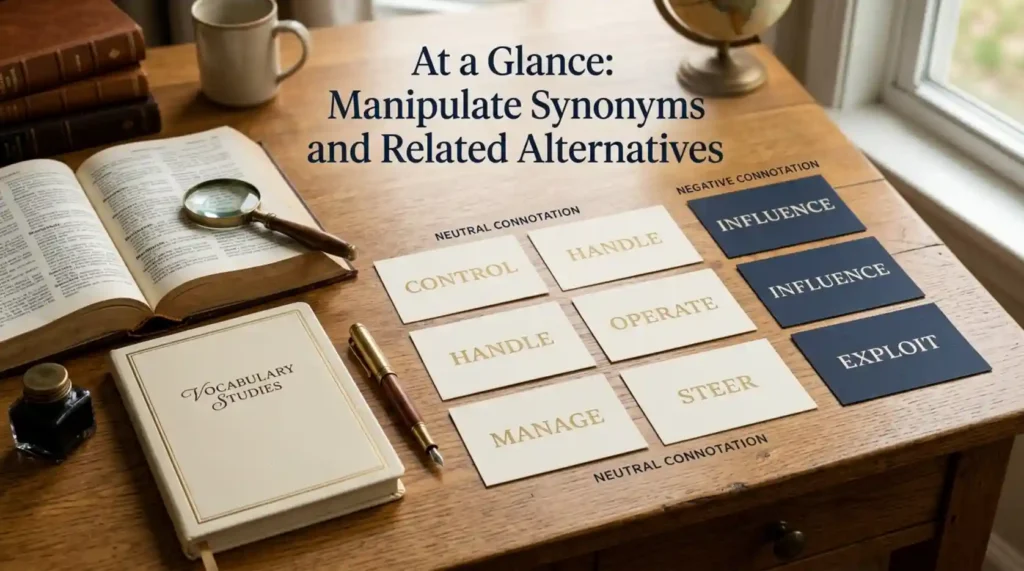
| Alternative | Part of Speech | Meaning | Register / Tone | Ideal Context |
| Control | Verb | Direct or limit something or someone | Neutral | Machines, systems, people, situations |
| Handle | Verb | Deal with or use something | Neutral, everyday | Objects, problems, tools, tasks |
| Manage | Verb | Organize or direct successfully | Neutral, professional | People, projects, money, time |
| Influence | Verb | Affect someone’s choices or opinions | Neutral to negative | People, decisions, public opinion |
| Operate | Verb | Make a machine or system work | Neutral, technical | Equipment, software, machinery |
| Steer | Verb | Guide the direction of something | Neutral, figurative common | Vehicles, projects, conversations |
| Exploit | Verb | Use unfairly for personal benefit | Negative | People, weaknesses, situations |
| Deceive | Verb | Make someone believe something false | Negative | People, facts, appearances |
| Maneuver | Verb | Move or arrange with skill | Neutral to strategic | Physical movement, plans, politics |
| Engineer | Verb | Arrange or cause something carefully | Formal, strategic | Events, outcomes, systems |
Which Word Should You Use?
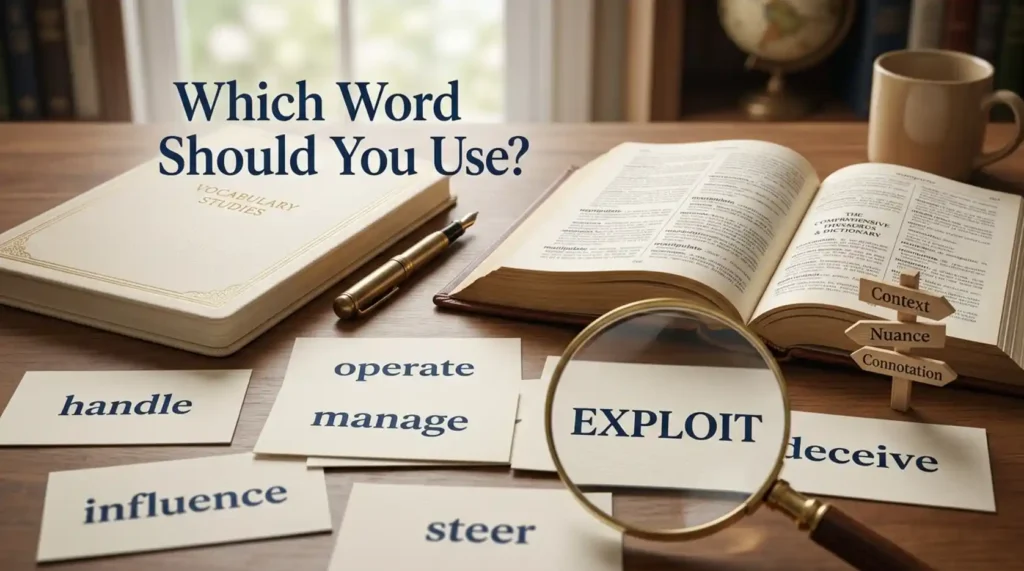
| If you want to… | Use | Why |
| Describe using a tool or object skillfully | Handle | It is natural and neutral for physical control. |
| Talk about running a machine or device | Operate | It focuses on making equipment work. |
| Describe organizing people or work | Manage | It suggests responsibility and organization. |
| Say someone affects another person’s decision | Influence | It is broader and less accusatory than manipulate. |
| Emphasize unfair use of someone | Exploit | It clearly signals taking advantage. |
| Describe dishonest persuasion | Deceive | It focuses on making someone believe something untrue. |
| Talk about guiding a situation or plan | Steer or maneuver | Both suggest direction and strategic movement. |
| Describe secretly arranging an outcome | Engineer | It is formal and often implies careful planning. |
Exploring the Multiple Meanings of “Manipulate”
1. Handle or Control Something Skillfully
- Meaning: To move, use, or control something with the hands or by mechanical means.
- Explanation: This is the oldest and most neutral sense. It can describe using tools, objects, body parts, or equipment.
- Example: The surgeon carefully manipulated the tiny instrument during the operation.
2. Manage or Use Something Skillfully
- Meaning: To deal with a situation, system, or resource in a skilled or effective way.
- Explanation: Here, “manipulate” does not have to be dishonest. It can mean handling data, software, schedules, or materials competently.
- Example: She learned how to manipulate the spreadsheet to organize the sales data.
3. Influence Someone Unfairly
- Meaning: To control or affect a person through artful, unfair, or hidden methods.
- Explanation: This sense usually carries a negative judgment. The person may be pressured, deceived, or emotionally influenced for someone else’s benefit.
- Example: He tried to manipulate his friend by making her feel guilty.
4. Change Information or Results Dishonestly
- Meaning: To alter facts, figures, evidence, or results to serve a purpose.
- Explanation: This use is common with words such as “data,” “results,” “evidence,” and “the truth.” It implies distortion rather than simple editing.
- Example: The company was accused of manipulating its financial results.
5. Plan or Arrange Events Cleverly
- Meaning: To arrange circumstances or events with subtle skill.
- Explanation: This sense can be strategic rather than dishonest, though it often suggests behind-the-scenes control.
- Example: The campaign carefully manipulated the timing of its announcements.
Sources: Merriam-Webster; Cambridge Dictionary; Oxford Learner’s Dictionaries; Collins English Dictionary.
Analyzing 30 Manipulate Alternatives in Detail
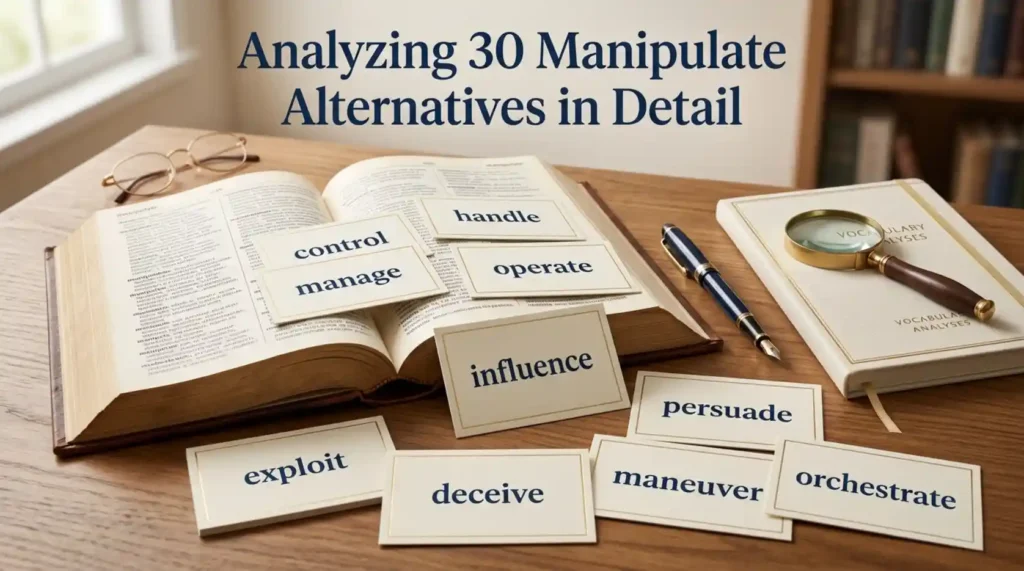
Some alternatives are direct synonyms, while others fit only particular senses of “manipulate.”
Core Synonyms
1. Control
IPA: /kənˈtroʊl/ (US and UK)
Definition: To direct, command, or limit the actions of someone or something.
- Usage: A strong, neutral alternative for controlling a machine, system, person, or situation. It does not automatically imply dishonesty.
- Example: The remote control lets you operate the television from across the room.
2. Handle
IPA: /ˈhændəl/ (US and UK)
Definition: To touch, hold, use, or deal with something.
- Usage: The most natural everyday replacement when “manipulate” means physically handling or dealing with an object or problem.
- Example: Please handle the glass vase carefully.
3. Manage
IPA: /ˈmænɪdʒ/ (US and UK)
Definition: To organize, direct, or succeed in dealing with something.
- Usage: Best for people, projects, money, time, or difficult situations. It emphasizes organization more than secret influence.
- Example: She manages the team’s daily schedule.
4. Operate
IPA: /ˈɒpəreɪt/ (US and UK)
Definition: To make a machine, system, or process work.
- Usage: A precise alternative for technical or mechanical manipulation. It is not a good substitute for emotional manipulation.
- Example: Only trained staff may operate the printing machine.
5. Direct
IPA: /dəˈrɛkt/ or /daɪˈrɛkt/ (US and UK)
Definition: To control or guide the actions, course, or development of something.
- Usage: Useful for guiding people, projects, films, organizations, or processes. It sounds more neutral and authoritative than “manipulate.”
- Example: The coach directed the players during practice.
6. Steer
IPA: /stɪr/ (US and UK)
Definition: To guide the movement or direction of something.
- Usage: Often figurative for steering a conversation, decision, or project. It suggests guidance rather than deception.
- Example: She steered the discussion back to the main topic.
7. Guide
IPA: /ɡaɪd/ (US and UK)
Definition: To show someone the way or help direct their actions.
- Usage: A gentler, more positive alternative. Use it when the person has some freedom and support, rather than being controlled.
- Example: The teacher guided the students through the experiment.
8. Regulate
IPA: /ˈrɛɡjəleɪt/ (US and UK)
Definition: To control or adjust something according to rules or a desired level.
- Usage: Best for systems, temperatures, markets, behavior, or processes. It is formal and institutional rather than personal.
- Example: The device regulates the temperature automatically.
Skillful Handling and Technical Use
9. Wield
IPA: /wild/ (US and UK)
Definition: To hold and use a tool, weapon, or form of power.
- Usage: Stronger and more vivid than “manipulate.” It often appears with power, influence, authority, or a physical object.
- Example: The lawyer wielded great influence in the negotiations.
10. Work
IPA: /wɜrk/ (US and UK)
Definition: To make something function or operate.
- Usage: Informal and broad. It can replace “manipulate” for machines, materials, or systems, but not for deceiving people.
- Example: He worked the controls until the engine started.
11. Use
IPA: /juz/ (US and UK)
Definition: To put something into action or service.
- Usage: The simplest neutral alternative. It lacks the skillful or strategic meaning of “manipulate,” so use it when you only mean employing something.
- Example: Use the mouse to select the file.
12. Employ
IPA: /ɪmˈplɔɪ/ (US and UK)
Definition: To use something for a particular purpose.
- Usage: More formal than “use.” It works well with methods, strategies, skills, and tools.
- Example: The researchers employed a new method to analyze the samples.
13. Utilize
IPA: /ˈjutəlaɪz/ (US and UK)
Definition: To make practical or effective use of something.
- Usage: Formal and sometimes businesslike. It is suitable for resources, data, or technology, but can sound stiff in casual writing.
- Example: The team utilized customer feedback to improve the app.
14. Apply
IPA: /əˈplaɪ/ (US and UK)
Definition: To put something into operation or use it for a purpose.
- Usage: Best for methods, rules, pressure, skills, or knowledge. It does not convey secret or unfair control.
- Example: Apply gentle pressure to close the lid.
15. Play
IPA: /pleɪ/ (US and UK)
Definition: To handle or deal with something in a particular way.
- Usage: Informal and context-dependent. In phrases such as “play the situation,” it can mean managing events skillfully.
- Example: He knew how to play the situation to his advantage.
Influence and Persuasion
16. Influence
IPA: /ˈɪnfluəns/ (US and UK)
Definition: To have an effect on someone’s actions, decisions, or opinions.
- Usage: The closest neutral alternative for affecting people. Unlike “manipulate,” it does not necessarily mean the influence is unfair.
- Example: Her experiences influenced her decision to study medicine.
17. Persuade
IPA: /pərˈsweɪd/ (US and UK)
Definition: To make someone agree to do something through reasoning or argument.
- Usage: A related alternative, not an exact synonym. “Persuade” usually suggests open argument, while “manipulate” suggests hidden or unfair pressure.
- Example: She persuaded her parents to let her go to the concert.
18. Sway
IPA: /sweɪ/ (US and UK)
Definition: To affect someone’s opinion or decision.
- Usage: Useful for opinions, voters, juries, and public feeling. It can be neutral or slightly negative depending on context.
- Example: The evidence swayed the jury’s opinion.
19. Pressure
IPA: /ˈprɛʃər/ (US and UK)
Definition: To try to force someone to do something by urging or persuading them strongly.
- Usage: A related alternative that emphasizes coercion. It is more direct than “manipulate” and does not necessarily involve deception.
- Example: Do not pressure customers into buying something they do not need.
20. Coerce
IPA: /koʊˈɜrs/ (US and UK)
Definition: To force someone to do something through threats or pressure.
- Usage: Stronger and more serious than “manipulate.” It implies a loss of free choice, often through threats or intimidation.
- Example: The suspect claimed the police coerced him into signing the statement.
Deception and Unfair Advantage
21. Exploit
IPA: /ɪkˈsplɔɪt/ (US and UK)
Definition: To use someone or something unfairly for one’s own benefit.
- Usage: A close negative alternative when “manipulate” means taking advantage of a person, weakness, or situation.
- Example: Some employers exploit workers by paying very low wages.
22. Deceive
IPA: /dɪˈsiv/ (US and UK)
Definition: To make someone believe something that is not true.
- Usage: Best when the manipulation depends on lying, hiding facts, or creating a false impression.
- Example: The advertisement deceived customers about the product’s benefits.
23. Trick
IPA: /trɪk/ (US and UK)
Definition: To make someone believe something untrue or do something through deception.
- Usage: Informal and direct. It is best for simple acts of deception rather than long-term emotional control.
- Example: They tricked him into revealing his password.
24. Mislead
IPA: /mɪsˈlid/ (US and UK)
Definition: To cause someone to have a wrong idea or belief.
- Usage: Softer than “deceive” and common with information, advertising, statements, and instructions.
- Example: The unclear label misled shoppers about the product’s size.
25. Dupe
IPA: /dup/ (US and UK)
Definition: To deceive someone, especially into believing something untrue.
- Usage: Informal and negative. It suggests the victim was fooled or taken advantage of.
- Example: The scammer duped older people, into sending money.
26. Con
IPA: /kɑn/ (US and UK)
Definition: To trick someone out of money or trust.
- Usage: Informal and strongly negative. It is most natural for fraud, scams, and dishonest persuasion.
- Example: He conned her into investing in a fake business.
Strategic Arrangement and Planning
27. Maneuver
IPA: /məˈnuvər/ (US and UK)
Definition: To move or guide something with skill, or to use clever methods to gain an advantage.
- Usage: A close alternative for strategic manipulation of people, events, or positions. It can be physical, political, or figurative.
- Example: She maneuvered the conversation toward her main point.
28. Engineer
IPA: /ˌɛndʒəˈnɪr/ (US and UK)
Definition: To arrange or cause something to happen through careful planning.
- Usage: Formal and strategic. It is common with outcomes, situations, agreements, and events; it does not always imply deception.
- Example: The two companies engineered a merger that benefited both sides.
29. Orchestrate
IPA: /ˈɔrkəstreɪt/ (US and UK)
Definition: To organize a complicated event or plan carefully.
- Usage: Often figurative. It suggests coordinated planning and can be neutral, admiring, or critical depending on the situation.
- Example: The organizers orchestrated a smooth product launch.
30. Stage-Manage
IPA: /ˈsteɪdʒ ˌmænɪdʒ/ (US and UK)
Definition: To control the details of an event or situation very carefully.
- Usage: A related, figurative alternative. It implies tight control of appearances or events and often suggests excessive planning.
- Example: The politician’s team stage-managed every detail of the interview.
Sources: Merriam-Webster Thesaurus; Cambridge Dictionary; Collins English Thesaurus; Oxford Learner’s Dictionaries.
Manipulate vs. Influence vs. Control
| Word | Main Focus | Typical Tone | Example |
| Manipulate | Skillful handling or unfair influence | Neutral or negative | He manipulated the data to hide the losses. |
| Influence | Affecting a decision or opinion | Usually neutral | Her advice influenced my choice. |
| Control | Having power over something | Neutral | The app controls the heating system. |
“Manipulate” is broader than “influence” because it can mean physical handling, technical operation, or deceptive control. Use “influence” for ordinary effects on people, “control” for direct power, and “manipulate” when skill, strategy, or unfairness is important.
Sources: Merriam-Webster; Cambridge Dictionary.
Manipulate and Opposite/Paired Word Pairs
| Word | Paired Word | Note |
| Manipulate | Empower | “Empower” suggests giving someone control or confidence. |
| Manipulate | Respect | Respectful communication contrasts with unfair manipulation. |
| Manipulate | Cooperate | Cooperation involves willing participation, not hidden control. |
| Manipulate | Inform | Honest information supports informed choices. |
| Manipulate | Protect | Protection can contrast with exploiting someone’s weakness. |
| Manipulate | Free choice | Manipulation reduces a person’s ability to choose freely. |
These pairs are useful for explaining ethical communication. “Manipulate” often appears in discussions of consent, advertising, relationships, politics, and workplace behavior because it implies control that limits another person’s freedom.
Sources: Merriam-Webster; Cambridge Dictionary.
Common Word Partners of “Manipulate”

| Pattern | Common Partners | Example |
| Manipulate + data | data, figures, results, statistics | The report manipulated the data to support its argument. |
| Manipulate + people | people, voters, customers, employees | The company manipulated customers with misleading offers. |
| Manipulate + emotions | emotions, feelings, fears, guilt | He manipulated her emotions to get what he wanted. |
| Manipulate + objects | objects, tools, materials, controls | Children manipulated the building blocks to make a tower. |
| Manipulate + systems | software, settings, images, systems | The designer manipulated the image settings. |
| Manipulate + situations | events, situations, outcomes, circumstances | They manipulated the situation to avoid a public debate. |
These collocations show the word’s main semantic areas: physical skill, technical use, information, people, emotions, and strategic planning.
Sources: Merriam-Webster; Cambridge Dictionary; Collins English Dictionary.
Idiomatic Phrases Featuring “Manipulate”
1. Pull the Strings
- Meaning: To secretly control a person, group, or situation.
- Example: Everyone knew the adviser was pulling the strings behind the scenes.
2. Play Someone Like a Fiddle
- Meaning: To control or deceive someone very easily.
- Example: The scammer played the older man like a fiddle.
3. Pull the Wool Over Someone’s Eyes
- Meaning: To deceive someone or prevent them from seeing the truth.
- Example: The salesperson tried to pull the wool over the customer’s eyes.
4. Twist Someone’s Arm
- Meaning: To pressure someone strongly into doing something.
- Example: She twisted his arm until he agreed to join the committee.
Sources: Merriam-Webster; Cambridge Dictionary.
Word Formation of “Manipulate”
Etymology & Structure
“Manipulate” comes from “manipulation,” which developed from French manipuler. The older source is Latin manipulus, meaning “handful,” “sheaf,” or “bundle.” It combines Latin manus, meaning “hand,” with a root related to plere, meaning “to fill.” This origin explains the word’s early connection with handling objects by hand.
Date and History
“Manipulate” entered English in 1827 with the meaning “to handle skillfully by hand.” By 1864, it was used for managing or influencing people, especially for one’s own purposes. A financial sense appeared by 1870.
Word Class Variations
- Verb: manipulate, manipulates, manipulated, manipulating
- Noun: manipulation, manipulator
- Adjective: manipulative
- Adverb: manipulatively
- Related noun: manipulability
Sources: Etymonline; Merriam-Webster; Collins English Dictionary; Oxford Learner’s Dictionaries.
Common Word-Choice Mistakes

- Wrong: “She manipulated him to help with the project.” Better: “She persuaded him to help with the project.”
- Wrong: “The machine was manipulated by pressing the button.” Better: “The machine was operated by pressing the button.”
- Wrong: “He manipulated the meeting very well.” Better: “He managed the meeting very well.”
- Wrong: “The teacher manipulated the students through clear instructions.” Better: “The teacher guided the students through clear instructions.”
- Wrong: “The company manipulated its employees by offering fair pay.” Better: “The company motivated its employees by offering fair pay.”
- Wrong: “She was manipulated by the evidence.” Better: “She was influenced by the evidence.”
- Wrong: “He manipulated the car into the parking space.” Better: “He maneuvered the car into the parking space.”
Frequently Asked Questions
What is the closest synonym for manipulate?
Control is the closest general synonym. For physical handling, handle is often more natural; for unfair influence, exploit or deceive may be better.
What is the difference between manipulate and influence?
“Influence” is usually neutral and means affecting someone’s thoughts or actions. “Manipulate” often suggests hidden, skillful, or unfair control.
What is a formal alternative to manipulate?
Engineer, orchestrate, utilize, and regulate are formal alternatives, depending on the context.
What is a negative synonym for manipulate?
Exploit, deceive, mislead, dupe, and coerce all carry negative meanings.
Can manipulate be neutral?
Yes. It can simply mean handling an object, operating a device, or using data skillfully.
What is the opposite of manipulate?
There is no single opposite. Empower, respect, cooperate with, and inform contrast with different manipulative behaviors.
Can manipulate be used for people?
Yes, but it often sounds critical. It suggests that someone is being unfairly influenced, pressured, or deceived.
Is manipulate the same as manage?
No. “Manage” means organizing or directing effectively. “Manipulate” can mean skillful handling, but it can also imply deception or unfair control.
What is a good alternative for manipulating data?
Use alter, distort, falsify, or misrepresent, depending on If the change is dishonest.
What is the difference between manipulate and coerce?
“Manipulate” often works through subtlety, emotional pressure, or deception. “Coerce” means forcing someone through threats or strong pressure.
Conclusion
The most common alternatives to manipulate are control, handle, manage, influence, operate, and steer. For negative contexts, consider exploit, deceive, mislead, or coerce.
The right choice depends on the object and the intention. “Handle” fits tools and objects, “manage” fits people and projects, “influence” fits decisions, and “exploit” or “deceive” fits unfair behavior.
Before choosing a synonym, ask If the action is skillful, neutral, strategic, or dishonest. That distinction will help you replace “manipulate” accurately and naturally.