Another Word for Representation: 30 Synonyms With Examples
The closest everyday alternatives to representation are depiction, portrayal, image, and picture. The best word depends on If you mean a visual likeness, a description, a performance, or someone acting for another person.
“Representation” can mean an image of something, a way of showing people or ideas, a formal statement, or the act of speaking and acting for someone else. Because these senses differ, words such as portrait, account, delegation, and performance may fit better in particular sentences.
Quick list: depiction, portrayal, image, picture, portrait, likeness, illustration, description, account, performance.
This article examines 30 alternatives with meanings, IPA, usage notes, examples, and context.
At a Glance: Representation Synonyms and Related Alternatives
| Alternative | Part of Speech | Meaning | Register / Tone | Ideal Context |
| Depiction | Noun | The act of showing or describing something | Neutral, often formal | Art, media, literature |
| Portrayal | Noun | A particular way of showing a person or subject | Neutral to formal | Film, biography, criticism |
| Image | Noun | A visual likeness or mental picture | Neutral | Photography, branding, art |
| Picture | Noun | A drawing, photograph, or visual image | Everyday | General use |
| Portrait | Noun | A picture or description of a person | Neutral, artistic | Painting, photography, writing |
| Likeness | Noun | A close visual resemblance | Slightly formal | Art, sculpture, description |
| Illustration | Noun | A picture or example that explains something | Neutral | Books, teaching, design |
| Description | Noun | An account in words of what something is like | Neutral | Writing, speech, reporting |
| Account | Noun | A report or explanation of events | Neutral to formal | News, history, testimony |
| Performance | Noun | A dramatic production or public show | Neutral | Theater, music, dance |
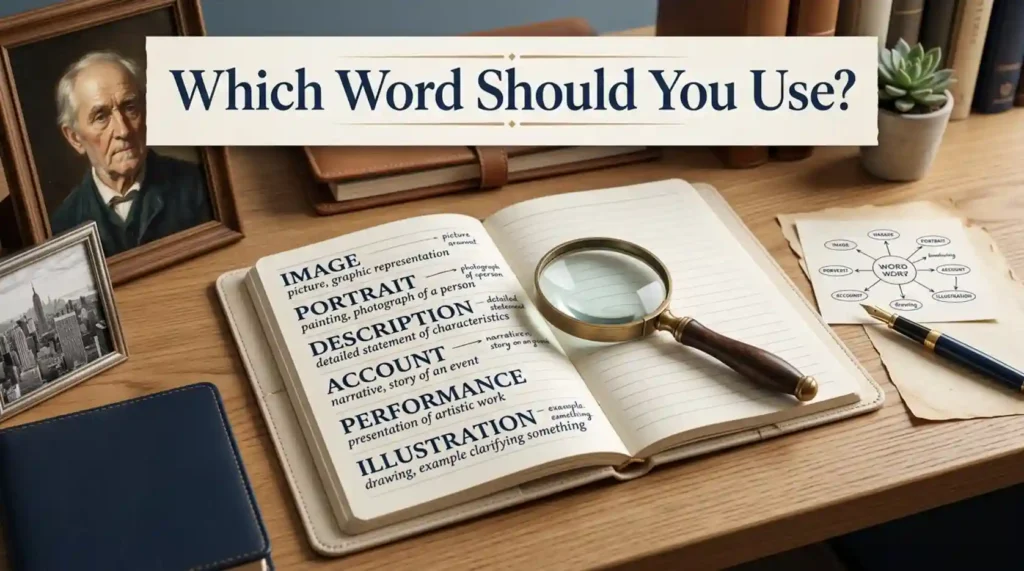
Which Word Should You Use?
| If you want to… | Use | Why |
| Describe how a person or group is shown in media | Portrayal | It emphasizes the way someone is presented. |
| Refer to a visual artwork or photograph | Image, picture, or depiction | These words focus on visual likeness. |
| Talk about a drawing in a book | Illustration | It usually means a picture that supports text. |
| Describe a person in words | Portrait or description | Both can mean a verbal picture of someone. |
| Report what happened | Account | It means a spoken or written report of events. |
| Refer to people acting for a country or group | Delegation or representation | These fit political and legal contexts. |
| Talk about a play, concert, or show | Performance | It refers to a dramatic or artistic production. |
| Discuss symbols or abstract ideas | Symbolization | It emphasizes standing for something else. |
Exploring the Multiple Meanings of “Representation”
1. A Visual Likeness
- Meaning: A picture, image, model, or other visual form that shows someone or something.
- Explanation: This is one of the most common senses. The representation may be realistic, symbolic, or stylized.
- Example: The cave paintings are early representations of animals.
2. A Description or Portrayal
- Meaning: A way of presenting a person, group, event, or idea in words, art, film, or another medium.
- Explanation: This sense often raises questions about fairness, accuracy, and perspective.
- Example: The film’s portrayal of rural life felt honest and detailed.
3. Acting or Speaking for Someone
- Meaning: The act of representing another person, group, or organization.
- Explanation: In law, politics, and business, it means having authority to act on someone’s behalf.
- Example: She has legal representation in the case.
4. A Formal Statement or Protest
- Meaning: A formal statement made to influence an official decision or express a complaint.
- Explanation: This use is more formal and common in legal, political, or administrative English.
- Example: The residents made representations to the city council.
5. A Dramatic Performance
- Meaning: A performance or production of a play, story, or scene.
- Explanation: This sense is older and less common in everyday speech, but it still appears in formal writing.
- Example: The school staged a representation of a classic folk tale.
Sources: Merriam-Webster; Collins English Thesaurus.
Analyzing 30 Representation Alternatives in Detail
Some alternatives are direct synonyms, while others are useful only in particular visual, descriptive, legal, political, or performance contexts.
Visual and Artistic Alternatives
1. Depiction
IPA: /ˌdɛpɪkˈʃən/ (US and UK)
Definition: The act of showing or describing someone or something in art, writing, or another medium.
- Usage: A strong, neutral substitute when representation means how a subject is shown. It is especially common in art, film, and media criticism.
- Example: The novel offers a vivid depiction of life in a small fishing town.
2. Portrayal
IPA: /pɔːrˈtreɪəl/ (US and UK)
Definition: The way a person, group, or subject is presented or described.
- Usage: Use it when the emphasis is on someone’s interpretation or treatment of a subject, especially in film, literature, or journalism.
- Example: Critics praised the actor’s portrayal of a struggling musician.
3. Image
IPA: /ˈɪmɪdʒ/ (US and UK)
Definition: A visual representation of a person or thing, or a mental picture.
- Usage: A common everyday alternative for a visual representation. It can also mean a public impression, so context matters.
- Example: The museum displayed an image of the ancient city.
4. Picture
IPA: /ˈpɪktʃər/ (US and UK)
Definition: A drawing, painting, photograph, or other visual image.
- Usage: The simplest everyday alternative, but it usually refers to a concrete visual image rather than an abstract idea.
- Example: She drew a picture of her family.
5. Portrait
IPA: /ˈpɔːrtrət/ (US and UK)
Definition: A picture, sculpture, or written description of a person.
- Usage: Best when the subject is a person. It can also mean a detailed verbal description.
- Example: The gallery has a portrait of the city’s founder.
6. Likeness
IPA: /ˈlaɪknəs/ (US and UK)
Definition: A picture or copy that resembles a person or thing.
- Usage: More formal than picture; it emphasizes visual similarity rather than artistic style.
- Example: The statue is a remarkable likeness of the poet.
7. Resemblance
IPA: /rɪˈzɛmbləns/ (US and UK)
Definition: The quality of being similar in appearance; a similar image or copy.
- Usage: A related rather than exact alternative. It stresses similarity, not the act of representing.
- Example: The sketch bears a strong resemblance to the missing person.
8. Illustration
IPA: /ˌɪləˈstreɪʃən/ (US and UK)
Definition: A picture, diagram, or example used to explain or decorate something.
- Usage: Use it for pictures in books, articles, or presentations. It can also mean an example that proves a point.
- Example: The science book includes an illustration of the water cycle.
9. Rendering
IPA: /ˈrɛndərɪŋ/ (US and UK)
Definition: A particular artistic interpretation or version of something.
- Usage: Common in art, architecture, music, and translation. It emphasizes the creator’s treatment of the subject.
- Example: The architect shared a rendering of the new library.
10. Model
IPA: /ˈmɑdəl/ US · UK /ˈmɒdəl/
Definition: A small copy or simplified version of something.
- Usage: A related alternative for a physical, three-dimensional representation, such as a building or vehicle.
- Example: The class built a model of the solar system.
11. Diagram
IPA: /ˈdaɪəɡræm/ (US and UK)
Definition: A simple drawing that explains how something works or how its parts relate.
- Usage: A context-specific alternative for technical or explanatory visual representations.
- Example: The manual includes a diagram of the engine.
12. Sketch
IPA: /skɛtʃ/ (US and UK)
Definition: A quick or rough drawing.
- Usage: Use it when the representation is unfinished, informal, or quickly made.
- Example: He made a sketch of the old bridge.
13. Silhouette
IPA: /ˌsɪləˈwɛt/ (US and UK)
Definition: A dark shape seen against a lighter background, or a picture showing only an outline.
- Usage: A specialized visual alternative, useful when the representation shows outline rather than detail.
- Example: The artist painted a silhouette of a dancer.
14. Icon
IPA: /ˈaɪkɑn/ (US and UK)
Definition: A symbolic image, especially a religious image or a small computer symbol.
- Usage: A related alternative when the representation has symbolic meaning or a standardized visual form.
- Example: Click the printer icon to print the document.
Descriptive and Verbal Alternatives
15. Description
IPA: /dɪˈskrɪpʃən/ (US and UK)
Definition: A statement in words that explains what someone or something is like.
- Usage: Use it when representation means a verbal account rather than an image.
- Example: The guide gave a clear description of the temple.
16. Account
IPA: /əˈkaʊnt/ (US and UK)
Definition: A report or description of an event or experience.
- Usage: Best for reports of events, especially in news, history, or personal writing.
- Example: She gave a detailed account of the accident.
17. Narrative
IPA: /ˈnɛrətɪv/ (US and UK)
Definition: A story or account of connected events.
- Usage: A related alternative when the representation presents events as a story or particular viewpoint.
- Example: The documentary presents a powerful narrative about migration.
18. Delineation
IPA: /dɪˌlɪniˈeɪʃən/ (US and UK)
Definition: A detailed description or portrayal of something.
- Usage: More formal and literary than description; it suggests careful outlining of details.
- Example: The writer’s delineation of village life is precise and warm.
19. Exposition
IPA: /ˌɛkspəˈzɪʃən/ (US and UK)
Definition: A clear and detailed explanation of an idea or subject.
- Usage: A related alternative for an explanatory representation of ideas, not a visual likeness.
- Example: The essay provides a clear exposition of the theory.
20. Characterization
IPA: /ˌkɛrəktərəˈzeɪʃən/ US · UK /ˌkærəktəraɪˈzeɪʃən/
Definition: The way a character’s personality is described or presented.
- Usage: Use it only for people in stories, plays, or films.
- Example: The novel’s characterization of the detective is memorable.
Symbolic and Conceptual Alternatives
21. Symbolization
IPA: /ˌsɪmbələˈzeɪʃən/ US · UK /ˌsɪmbəlaɪˈzeɪʃən/
Definition: The use of a symbol to stand for something else.
- Usage: A related alternative when the representation works through symbols rather than direct likeness.
- Example: The dove is a symbolization of peace.
22. Embodiment
IPA: /ɪmˈbɑdɪmənt/ (US and UK)
Definition: A person or thing that expresses an idea or quality in a concrete form.
- Usage: A related, more abstract alternative; it describes something that gives an idea a visible or human form.
- Example: She became an embodiment of courage for the community.
23. Interpretation
IPA: /ɪnˌtɜrprəˈteɪʃən/ (US and UK)
Definition: A particular way of understanding or presenting something.
- Usage: A related alternative that emphasizes the creator’s viewpoint rather than a neutral likeness.
- Example: Her interpretation of the song was slower and more emotional.
Representation by People or Groups
24. Delegation
IPA: /ˌdɛləˈɡeɪʃən/ (US and UK)
Definition: A group of people sent to represent a larger group, country, or organization.
- Usage: A context-specific alternative for political or organizational representation by a group.
- Example: The country sent a delegation to the climate conference.
25. Representative
IPA: /ˌrɛprɪˈzɛntətɪv/ (US and UK)
Definition: A person chosen or appointed to act or speak for others.
- Usage: Use it for a person, not the abstract act of representation.
- Example: Each department sent a representative to the meeting.
26. Proxy
IPA: /ˈprɑksi/ (US and UK)
Definition: A person authorized to act for someone else.
- Usage: A formal alternative in legal, business, or voting contexts; it does not mean an image or description.
- Example: She voted by proxy because she was traveling.
27. Advocacy
IPA: /ˈædvəkəsi/ (US and UK)
Definition: Public support for a person, group, or cause.
- Usage: A related alternative when representation involves speaking up for someone’s interests.
- Example: The organization provides advocacy for tenants facing eviction.
Performance and Presentation Alternatives
28. Performance
IPA: /pərˈfɔrməns/ US · UK /pəˈfɔːməns/
Definition: An act of presenting a play, concert, dance, or other entertainment.
- Usage: Use it when representation means a dramatic production or staged presentation.
- Example: The theater gave an evening performance of the play.
29. Presentation
IPA: /ˌprizənˈteɪʃən/ US · UK /ˌprɛzənˈteɪʃən/
Definition: The act of showing or offering something to an audience.
- Usage: A related alternative for how information, an idea, or a work is presented; it does not necessarily mean a likeness.
- Example: The team gave a presentation on the new project.
30. Exhibition
IPA: /ˌɛksəˈbɪʃən/ (US and UK)
Definition: A public display of works of art or other items.
- Usage: A context-specific alternative for a public showing of representations, rather than the representation itself.
- Example: The gallery opened an exhibition of local photography.
Sources: Merriam-Webster; Collins English Thesaurus; Etymonline.
Representation in Different Contexts
| Context | Better alternatives | Example |
| Art and photography | Image, picture, portrait, likeness | The photograph is a powerful image of the storm. |
| Film and literature | Portrayal, depiction, characterization | The film’s portrayal of the family is sympathetic. |
| News and history | Account, description, narrative | The book gives an account of the war. |
| Law and politics | Representation, representative, proxy, delegation | He sought legal representation before the hearing. |
| Science and design | Diagram, model, illustration, rendering | The engineer presented a model of the bridge. |
| Theater and music | Performance, interpretation, presentation | The orchestra’s interpretation was expressive. |
“Representation” is unusually broad because it covers both visual images and human agency. Choosing a narrower word makes writing clearer and more precise.
Sources: Merriam-Webster; Collins English Thesaurus.
Representation and Opposite/Paired Word Pairs
| Word | Paired Word | Note |
| Representation | Reality | A representation presents or interprets reality; it is not usually the thing itself. |
| Image | Original | An image is often a copy, likeness, or version of an original. |
| Portrayal | Subject | The subject is the person or thing being portrayed. |
| Description | Fact | A description presents facts, but may include interpretation. |
| Representative | Constituent | A representative acts for constituents in politics. |
| Delegation | Authority | A delegation receives authority to act for a larger group. |
| Symbol | Meaning | A symbol stands for an idea, object, or quality. |
| Performance | Audience | A performance is created for or experienced by an audience. |
These pairs show why context matters: a representation can be an image, an account, a symbol, or a person acting for others. The appropriate opposite or partner changes with the sense.
Sources: Merriam-Webster; Collins English Thesaurus.
Common Word Partners of “Representation”
| Pattern | Common Partners | Example |
| Representation of + person/group | women, workers, communities | The film improves the representation of rural communities. |
| Visual representation | image, diagram, chart, model | The report includes a visual representation of the data. |
| Accurate/fair representation | accurate, fair, realistic, balanced | Voters want fair representation in government. |
| Legal representation | legal, counsel, lawyer, attorney | She cannot afford legal representation. |
| Political representation | political, democratic, proportional | The system aims to provide political representation for all regions. |
| Make representations | make, submit, formal | Residents made formal representations to the council. |
These collocations are useful because representation often appears with a noun that identifies what is being represented or the field involved.
Sources: Merriam-Webster; Collins English Thesaurus.
Idiomatic Phrases Featuring “Representation”
1. Make representations
- Meaning: To make a formal statement or complaint to an authority.
- Example: The union made representations to the company about safety conditions.
2. Legal representation
- Meaning: A lawyer or legal team acting for someone in a legal matter.
- Example: Every defendant has the right to legal representation.
3. Proportional representation
- Meaning: An electoral system in which parties receive seats in proportion to the votes they win.
- Example: Some countries use proportional representation to elect lawmakers.
4. Visual representation
- Meaning: Information shown through a picture, chart, diagram, model, or other visual form.
- Example: The teacher used a visual representation to explain fractions.
Sources: Merriam-Webster; Collins English Thesaurus.
Word Formation of “Representation”
Etymology & Structure
Representation comes from Latin repraesentatio, meaning “a bringing before one” or “a showing or exhibiting.” It developed through Old French representacion and is related to the verb represent, from Latin repraesentare, “to show, exhibit, or display.”
The word contains the root present, connected to the idea of placing something before someone. The prefix re- may have functioned as an intensifier in Latin rather than meaning “again.”
Date and History
Etymonline dates representation in English to about 1400, when it meant “image, likeness, symbolic memorial.” The sense of presenting something to the mind or imagination is recorded from the 1640s, and the meaning “statement made in regard to some matter” from the 1670s.
Word Class Variations
- Verb: represent
- Noun: representation, representative, representativeness
- Adjective: representative, representational
- Related forms: representable, misrepresentation, misrepresent
Sources: Etymonline; Merriam-Webster.
Common Word-Choice Mistakes
- Wrong: “The movie gave a good representation of the actor.” Use portrayal when discussing how a person is presented.
- Wrong: “Please send a representation of the accident.” Use account or description for a report in words.
- Wrong: “The lawyer provides image for her client.” Use representation or legal representation for legal advocacy.
- Wrong: “The diagram is a portrait of the process.” Use diagram, illustration, or visual representation for technical explanations.
- Wrong: “The delegation gave a portrait at the meeting.” Use presentation or account for a formal report or talk.
- Wrong: “The statue is a description of the president.” Use likeness, portrait, or representation for a physical image.
- Wrong: “He was chosen as a portrayal of the workers.” Use representative for a person who acts for a group.
Frequently Asked Questions
What is the closest synonym for representation?
Depiction is often the closest general synonym when you mean how something is shown or described. For a visual object, image or picture is usually more natural.
What is the difference between representation and portrayal?
Representation is broader and more neutral. Portrayal emphasizes the particular way a person, group, or subject is presented, often with an implied viewpoint.
What is a formal alternative to representation?
Depiction, delineation, exposition, and representation itself are formal choices. For legal or political contexts, legal representation, delegation, or proxy may be more precise.
Can representation mean a person?
Not directly. Use representative, delegate, proxy, or advocate for a person who acts for someone else.
What is another word for visual representation?
Use image, picture, illustration, diagram, model, or rendering, depending on the type of visual.
What is the opposite of representation?
There is no single opposite. Depending on the sense, contrasts include reality versus representation, original versus image, or direct participation versus representation by another person.
Can representation mean a performance?
Yes. In a formal or older sense, it can mean a dramatic production or performance. In modern everyday English, performance is clearer.
Is depiction the same as description?
They overlap, but depiction can be visual or verbal, while description is normally verbal. A painting can be a depiction, but it is not usually called a description.
What does “make representations” mean?
It means to make a formal statement, request, or complaint, usually to an official body.
Is representation always accurate?
No. A representation can be accurate, simplified, symbolic, biased, or imaginative. Words such as interpretation and portrayal often signal a particular perspective.
Conclusion
The most useful alternatives to representation are depiction, portrayal, image, picture, portrait, and description. For legal or political contexts, representation, representative, delegation, and proxy remain especially important.
The right choice depends on If you mean a visual likeness, a verbal account, a symbolic form, or someone acting for others. A single word cannot cover all these meanings without losing precision.
Before choosing, ask what is being represented and how: visually, in words, through symbols, or through a person’s authority. That simple question will usually point to the clearest alternative.