
Another Word for Magical: 30 Synonyms With Examples
The closest everyday alternatives to magical are magic, enchanted, enchanting, mystical, and wondrous. The best word depends on whether you mean real or imagined magic, a mysterious supernatural quality, or something simply delightful and unforgettable.
Magical can describe spells and supernatural power, but it also describes experiences that feel special, beautiful, or almost impossible—such as a magical evening or a magical view. Related meanings include mystery, wonder, charm, enchantment, and the supernatural.
Quick list: magic, enchanted, enchanting, mystical, supernatural, wondrous, miraculous, otherworldly, dreamlike, spellbinding
This article explains 30 alternatives with meanings, IPA, usage notes, examples, and the contexts in which each word works best.
At a Glance: Magical Synonyms and Related Alternatives
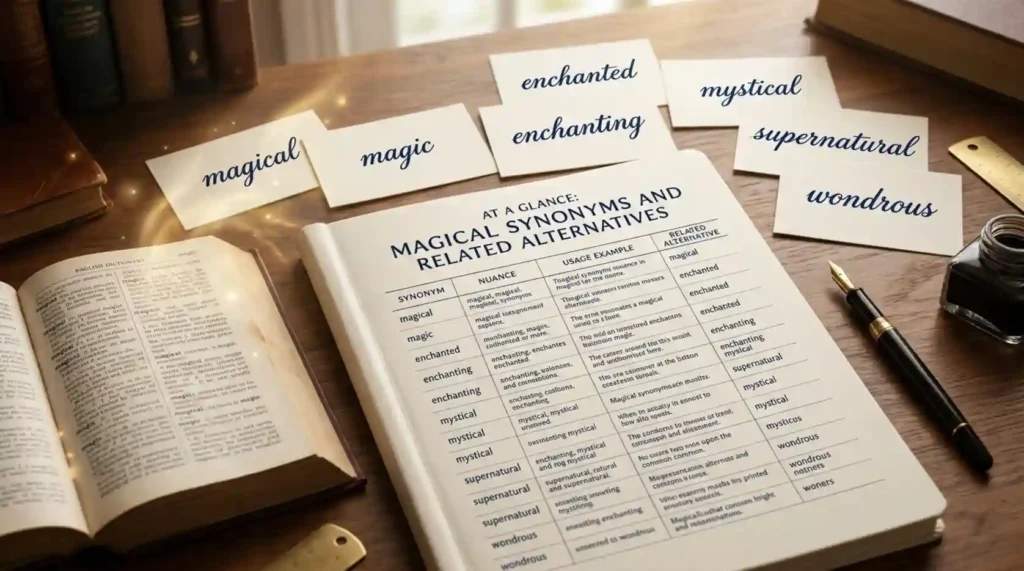
| Alternative | Part of Speech | Meaning | Register / Tone | Ideal Context |
| Magic | Adjective | Having or producing supernatural power | Neutral | Spells, fantasy, tricks |
| Enchanted | Adjective | Under a spell; filled with delight | Literary, warm | Fairy tales, places, moods |
| Enchanting | Adjective | Very charming or delightful | Warm, positive | People, places, performances |
| Mystical | Adjective | Connected with hidden spiritual power | Reflective, spiritual | Religion, meditation, symbols |
| Supernatural | Adjective | Beyond natural laws | Neutral, serious | Ghosts, powers, fiction |
| Wondrous | Adjective | Full of wonder; remarkable | Literary, elevated | Nature, discoveries, stories |
| Miraculous | Adjective | Like a miracle; amazingly good | Emotional, strong | Recoveries, escapes, results |
| Otherworldly | Adjective | Strange or beautiful in a way that seems not of this world | Literary | Landscapes, music, atmosphere |
| Dreamlike | Adjective | Like a dream; unreal or hazy | Descriptive, gentle | Memories, scenery, experiences |
| Spellbinding | Adjective | Holding attention completely | Enthusiastic | Stories, performances, speakers |
Which Word Should You Use?
| If you want to… | Use | Why |
| Describe something produced by a spell | Magic or enchanted | These directly connect to spells and supernatural power. |
| Praise a charming person or place | Enchanting or charming | They emphasize delight and appeal rather than actual magic. |
| Describe a spiritual or mysterious feeling | Mystical or numinous | They suggest hidden spiritual meaning or presence. |
| Describe ghosts, powers, or impossible events | Supernatural or paranormal | They refer to things beyond ordinary natural explanation. |
| Say something was amazingly good | Wondrous, miraculous, or phenomenal | These stress wonder, surprise, or exceptional quality. |
| Describe a strange, beautiful atmosphere | Otherworldly, ethereal, or unearthly | They suggest a quality that feels distant from ordinary life. |
| Describe a soft, unreal experience | Dreamlike or surreal | They compare the experience to a dream or something unreal. |
| Describe a story that holds attention | Spellbinding or mesmerizing | They emphasize fascination and strong attention. |
Exploring the Multiple Meanings of “Magical”
1. Connected With Magic or Spells
- Meaning: Of, relating to, or producing magic.
- Explanation: This is the literal sense. It can describe a spell, ritual, object, creature, or power in fantasy, folklore, or fiction.
- Example: The wizard used a magical spell to open the hidden door.
2. Produced by or as if by Magic
- Meaning: Seeming impossible to explain, or as though caused by magic.
- Explanation: This use does not require real magic. It often describes a surprising result, transformation, or effect.
- Example: The messy room looked magical after her quick cleanup.
3. Extremely Pleasant, Beautiful, or Exciting
- Meaning: Wonderful in a special or memorable way.
- Explanation: This is a common everyday sense. A magical evening, vacation, or performance is one that feels unusually enjoyable or special.
- Example: We had a magical evening watching the northern lights.
4. Having a Mysterious or Spiritual Quality
- Meaning: Suggesting hidden powers, mystery, or a connection with the supernatural.
- Explanation: Words such as mystical, occult, and supernatural fit this area, though they are not always interchangeable.
- Example: The old forest had a magical, mysterious atmosphere.
Sources: Merriam-Webster; Collins English Dictionary; Collins English Thesaurus.
Analyzing 30 Magical Alternatives in Detail
Some alternatives are direct synonyms, while others work only in particular contexts.
Enchantment and Charm
1. Magic
IPA: /ˈmædʒ.ɪk/ (US and UK)
Definition: Having special powers; produced by or involving magic.
- Usage: Magic is the closest direct alternative in most literal contexts. It works well for spells, tricks, fantasy, and figurative “magic moments.”
- Example: The magician performed a magic trick that amazed everyone.
2. Enchanted
IPA: /ɪnˈtʃæn.tɪd/ (US and UK)
Definition: Under a magic spell; filled with great delight or wonder.
- Usage: Use enchanted for fairy-tale settings, objects, forests, or people who feel delighted. It can imply either real enchantment or a strong emotional response.
- Example: The children wandered through an enchanted garden.
3. Enchanting
IPA: /ɪnˈtʃæn.tɪŋ/ (US and UK)
Definition: Very pleasing, charming, or delightful.
- Usage: Enchanting is a strong everyday alternative when magical means “delightful” or “charming.” It does not necessarily mean supernatural.
- Example: She gave an enchanting performance at the school concert.
4. Bewitching
IPA: /bɪˈwɪtʃ.ɪŋ/ (US and UK)
Definition: So attractive or interesting that it seems to cast a spell on someone.
- Usage: Bewitching is more literary and intense than enchanting. It often describes beauty, charm, or a powerful effect on attention.
- Example: The dancer had a bewitching stage presence.
5. Spellbinding
IPA: /ˈspelˌbaɪn.dɪŋ/ (US and UK)
Definition: Holding complete attention as if by a spell.
- Usage: Use spellbinding for stories, speeches, performances, or scenery that fascinate people. It emphasizes attention rather than supernatural power.
- Example: The guide told a spellbinding story about the castle.
6. Charming
IPA: /ˈtʃɑːr.mɪŋ/ US · /ˈtʃɑː.mɪŋ/ UK
Definition: Pleasant, attractive, and likable.
- Usage: Charming is a related, not exact, alternative. It fits when magical means “delightful,” but it does not suggest mystery or supernatural power.
- Example: They stayed in a charming little village by the sea.
7. Mesmerizing
IPA: /ˈmez.mə.raɪ.zɪŋ/ (US and UK)
Definition: So interesting or beautiful that you cannot stop watching or listening.
- Usage: Mesmerizing is a related alternative for experiences that hold attention. It suits performances, movement, light, and natural scenes.
- Example: The northern lights were mesmerizing.
8. Captivating
IPA: /ˈkæp.tɪ.veɪ.tɪŋ/ (US and UK)
Definition: Holding interest or attention completely.
- Usage: Captivating is a practical alternative for people, stories, and places. It stresses interest and appeal, not magic itself.
- Example: The museum has a captivating collection of ancient artifacts.
Mystery and the Supernatural
9. Mystical
IPA: /ˈmɪs.tɪ.kəl/ (US and UK)
Definition: Connected with spiritual powers, hidden knowledge, or experiences beyond ordinary understanding.
- Usage: Mystical is a close alternative when magical suggests mystery or spirituality. It is less suitable for a fun, exciting evening.
- Example: The temple had a mystical atmosphere at sunrise.
10. Mystic
IPA: /ˈmɪs.tɪk/ (US and UK)
Definition: Having a spiritual or mysterious meaning; relating to mysticism.
- Usage: Mystic is often more literary or traditional than mystical. It can describe symbols, experiences, writings, or places.
- Example: The painting had a mystic quality that invited quiet thought.
11. Supernatural
IPA: /ˌsuː.pərˈnætʃ.ər.əl/ US · /ˌsjuː.pəˈnætʃ.ər.əl/ UK
Definition: Not explainable by natural laws; related to forces beyond nature.
- Usage: Use supernatural for ghosts, spirits, powers, and fantasy. It is more literal and serious than magical in its “wonderful” sense.
- Example: The movie is about a family with supernatural abilities.
12. Otherworldly
IPA: /ˌʌð.əˈwɜːld.li/ US · /ˌʌð.əˈwɜː.ld.li/ UK
Definition: Strange, beautiful, or unusual in a way that seems not to belong to this world.
- Usage: Otherworldly is a related alternative for landscapes, sounds, or experiences with an unreal quality. It does not necessarily involve spells.
- Example: The salt flats looked otherworldly under the full moon.
13. Paranormal
IPA: /ˌpær.əˈnɔːr.məl/ (US and UK)
Definition: Beyond normal scientific explanation, especially involving ghosts, psychic powers, or unexplained events.
- Usage: Paranormal is a related alternative only in supernatural contexts. It is not a good substitute for a delightful or beautiful experience.
- Example: They investigated paranormal activity in the abandoned house.
14. Preternatural
IPA: /ˌpriː.təˈnætʃ.ər.əl/ (US and UK)
Definition: Beyond what is normal or natural; unusually great or strange.
- Usage: Preternatural is formal and literary. It can describe unusual ability, calmness, or phenomena that seem outside ordinary nature.
- Example: She showed preternatural calm during the emergency.
15. Occult
IPA: /əˈkʌlt/ (US and UK)
Definition: Connected with hidden or secret supernatural knowledge and practices.
- Usage: Occult is a related alternative, but it has a darker, more specialized tone. Use it for rituals, symbols, or hidden practices—not for a pleasant experience.
- Example: The shop sold books on occult history and symbolism.
16. Uncanny
IPA: /ʌnˈkæn.i/ (US and UK)
Definition: Strange in an unsettling or mysterious way; beyond what is normal.
- Usage: Uncanny is a related alternative when magical means “strangely impossible.” It often describes resemblance, timing, or intuition.
- Example: He has an uncanny ability to remember names.
17. Unearthly
IPA: /ʌnˈɜːθ.li/ US · /ʌnˈɜːθ.li/ UK
Definition: Not natural or ordinary; strange or frightening in a supernatural way.
- Usage: Unearthly is literary and often slightly eerie. It suits sounds, light, landscapes, or creatures that feel beyond the ordinary world.
- Example: An unearthly glow appeared above the trees.
18. Numinous
IPA: /ˈnuː.mɪ.nəs/ US · /ˈnjuː.mɪ.nəs/ UK
Definition: Having a strong spiritual or religious quality; suggesting a divine presence.
- Usage: Numinous is a formal, literary related alternative. Use it for sacred places, profound experiences, or a sense of spiritual awe.
- Example: The cathedral felt numinous in the early morning light.
19. Divine
IPA: /dɪˈvaɪn/ (US and UK)
Definition: Connected with a god or gods; extremely good or beautiful.
- Usage: Divine is a related alternative when magical suggests heavenly beauty or spiritual power. In informal speech, it can also simply mean “wonderful.”
- Example: The choir’s voices filled the divine old chapel.
Wonder and Awe
20. Miraculous
IPA: /mɪˈræk.jə.ləs/ (US and UK)
Definition: Like a miracle; very surprising and wonderful.
- Usage: Miraculous is a strong alternative when magical means “seemingly impossible” or “amazingly fortunate.” It often implies relief, survival, or an unexpected result.
- Example: Their miraculous escape from the flood surprised everyone.
21. Wondrous
IPA: /ˈwʌn.drəs/ (US and UK)
Definition: Causing wonder or amazement; remarkable.
- Usage: Wondrous is literary and positive. It works well for nature, discoveries, stories, and places that inspire awe.
- Example: They explored the wondrous caves beneath the mountain.
22. Marvelous
IPA: /ˈmɑːr.vəl.əs/ US · /ˈmɑː.vəl.əs/ UK
Definition: Extremely good, impressive, or wonderful.
- Usage: Marvelous is a useful alternative when magical means “wonderful.” It is warm and enthusiastic but does not imply mystery.
- Example: We had a marvelous time at the festival.
23. Extraordinary
IPA: /ɪkˈstrɔːr.dən.er.i/ US · /ɪkˈstrɔː.dən.ər.i/ UK
Definition: Very unusual, remarkable, or impressive.
- Usage: Extraordinary is a related alternative for exceptional talent, events, or results. It is broader than magical and does not suggest enchantment.
- Example: She has an extraordinary memory for details.
24. Phenomenal
IPA: /fəˈnɑː.mə.nəl/ (US and UK)
Definition: Extremely impressive or remarkable.
- Usage: Phenomenal is a modern, enthusiastic alternative for outstanding performance or results. It does not carry a supernatural meaning.
- Example: The young violinist gave a phenomenal concert.
25. Fabulous
IPA: /ˈfæb.jə.ləs/ (US and UK)
Definition: Extremely good; wonderful; also, existing only in stories or myths.
- Usage: Fabulous can mean “excellent” in everyday speech or “legendary and unreal” in literary use. Choose the meaning carefully.
- Example: The costume party had a fabulous, fairy-tale theme.
Dreamlike and Literary Alternatives
26. Ethereal
IPA: /ɪˈθɪr.i.əl/ (US and UK)
Definition: Light, delicate, and beautiful in a way that seems not part of the ordinary world.
- Usage: Ethereal is a related literary alternative for music, light, clothing, or landscapes. It emphasizes delicate beauty rather than power.
- Example: The singer’s ethereal voice filled the hall.
27. Dreamlike
IPA: /ˈdriːm.laɪk/ (US and UK)
Definition: Like a dream; strange, soft, or unreal.
- Usage: Dreamlike is a related alternative for experiences that feel hazy, beautiful, or unreal. It is especially useful for memories and scenery.
- Example: The lake at dawn had a dreamlike stillness.
28. Surreal
IPA: /səˈriː.əl/ (US and UK)
Definition: Very strange; like a dream or like something from an unreal world.
- Usage: Surreal is a related alternative when magical means “unreal” or “hard to believe.” It can be positive, strange, or unsettling.
- Example: Walking through the empty city at night felt surreal.
29. Whimsical
IPA: /ˈwɪm.zɪ.kəl/ (US and UK)
Definition: Playful, unusual, and fanciful in a charming way.
- Usage: Whimsical is a related alternative for lighthearted, imaginative things. It suits décor, stories, designs, and characters more than serious supernatural events.
- Example: The café had whimsical paintings on every wall.
30. Fairylike
IPA: /ˈfer.i.laɪk/ (US and UK)
Definition: Like a fairy; delicate, small, beautiful, or enchanting.
- Usage: Fairylike is a more specific literary alternative. It fits delicate appearances, tiny creatures, gardens, or fairy-tale settings.
- Example: The garden was full of fairylike lights and tiny flowers.
Sources: Merriam-Webster Dictionary and Thesaurus; Collins English Thesaurus; Cambridge English Thesaurus.
Magical vs. Enchanting vs. Mystical
| Word | Main Focus | Best Example |
| Magical | Wonder, spells, or a special unforgettable quality | “It was a magical wedding.” |
| Enchanting | Charm and delight | “She told an enchanting story.” |
| Mystical | Hidden spiritual meaning or mystery | “The ancient site felt mystical.” |
Magical is the broadest word. Use enchanting when charm is the main idea, and mystical when spiritual mystery is the main idea. For literal spells and supernatural power, magic, enchanted, or supernatural are usually clearer.
Sources: Merriam-Webster; Collins English Thesaurus.
Magical and Opposite/Paired Word Pairs
| Word | Paired Word | Note |
| Magical | Ordinary | Contrasts a special experience with an everyday one. |
| Magical | Realistic | Contrasts fantasy or wonder with practical reality. |
| Magical | Mundane | Contrasts wonder with dull, routine life. |
| Magical | Natural | Contrasts supernatural power with explainable nature. |
| Enchanted | Disenchanted | A common contrast: delighted or spellbound versus disappointed or freed from illusion. |
| Mystical | Practical | Contrasts spiritual mystery with everyday usefulness. |
| Supernatural | Natural | A direct conceptual pair in discussions of unexplained events. |
These pairs help show the main senses of magical: wonder and delight, supernatural power, and mystery. Enchanted/disenchanted is especially useful because both words are established English terms with related but different meanings.
Sources: Merriam-Webster; Collins English Thesaurus.
Common Word Partners of “Magical”
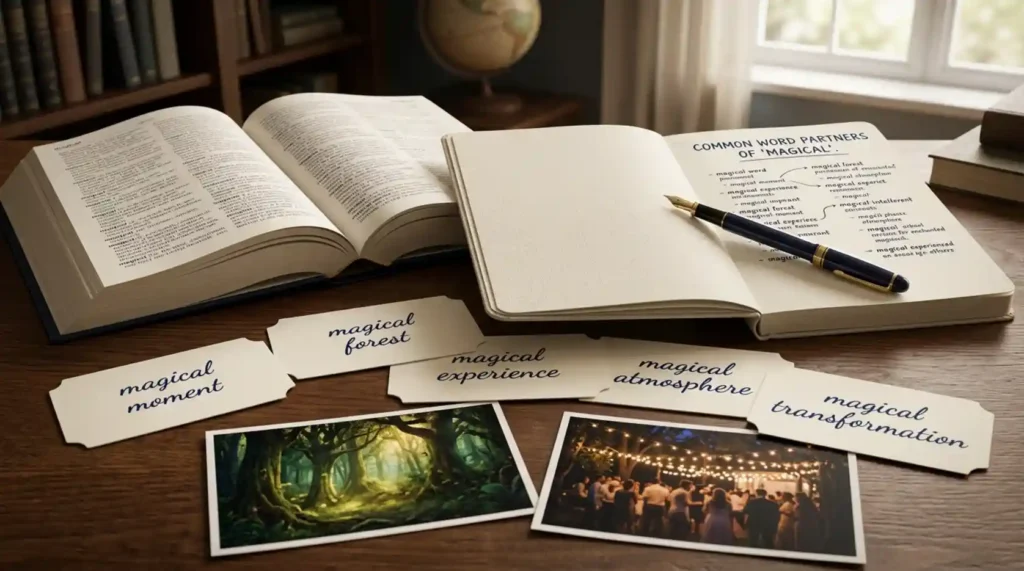
| Pattern | Common Partners | Example |
| Magical + place | forest, garden, world, kingdom, land | “They entered a magical forest.” |
| Magical + experience | evening, moment, trip, journey, night | “It was a magical evening by the sea.” |
| Magical + quality | power, touch, atmosphere, feeling | “The old theater had a magical atmosphere.” |
| Magical + event | transformation, escape, recovery, reunion | “Their reunion felt magical.” |
| Magical + object | spell, potion, creature, powers, dust | “The story features magical creatures.” |
| Feel/seem + magical | feel, seem, sound, look | “The music seemed magical.” |
These combinations reflect the word’s two main uses: literal fantasy and figurative wonder. Merriam-Webster lists magical as relating to magic and also as “extremely or extraordinarily pleasant, enjoyable, or exciting.”
Sources: Merriam-Webster; Collins English Dictionary.
Idiomatic Phrases Featuring “Magical”
1. A magical moment
- Meaning: A very special, memorable, or emotionally powerful moment.
- Example: Seeing my family at the airport was a magical moment.
2. Work like magic
- Meaning: To be extremely effective, often quickly or surprisingly.
- Example: A little rest and water worked like magic on her headache.
3. There is no magic
- Meaning: There is no simple secret or instant solution.
- Example: Learning a language takes practice; there is no magic.
4. Magic touch
- Meaning: A special ability to make things succeed or improve.
- Example: The coach has a magic touch with young players.
Sources: Merriam-Webster; Collins English Thesaurus.
Word Formation of “Magical”
Etymology & Structure
Magical is formed from magic plus the adjective-forming suffix -al. The noun magic came into English through Old French magique, from Late Latin magice, and ultimately from Greek magikē, related to magikos (“magical”) and magos (“magus” or sorcerer).
Date and History
Magical was first recorded in English in the 1550s in the sense “of or relating to magic.” By about 1600, it was also used to mean “resembling magic in action or effect.
Word Class Variations
- Noun: magic, magician, enchantment, mystery
- Adjective: magical, magic, mystic, mystical
- Adverb: magically
- Related derivatives: enchant, enchanting, enchanted, enchantment
Magic can function as both a noun and an adjective, while magical is normally an adjective. Etymonline notes that the difference between adjective magic and magical is largely poetic and depends on rhythm.
Sources: Etymonline; Merriam-Webster.
Common Word-Choice Mistakes
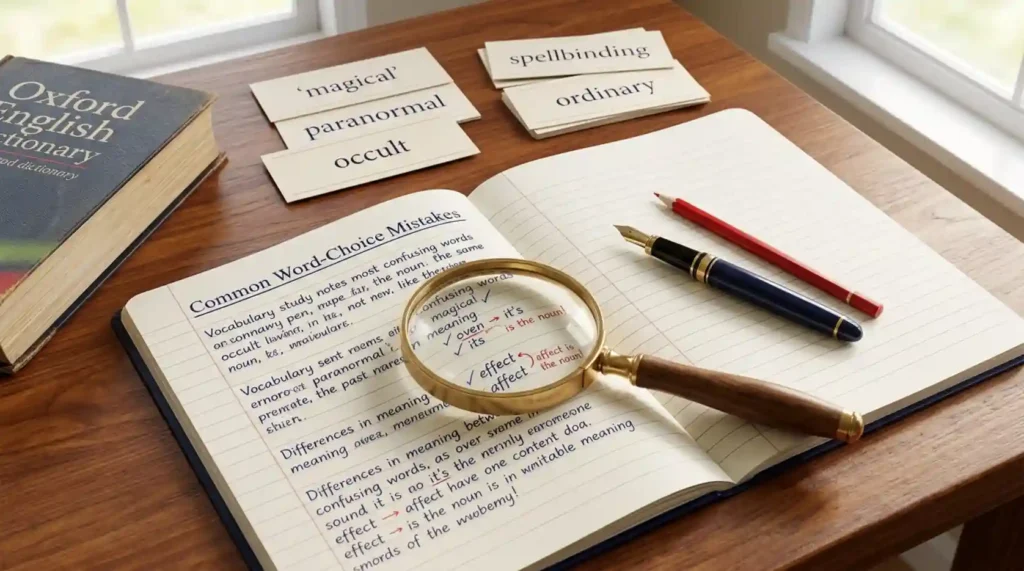
- Wrong: “The paranormal garden was beautiful.” Correct: “The magical garden was beautiful,” unless the garden involves ghosts or psychic phenomena.
- Wrong: “She has a magical solution to every problem.” Correct: “She has a practical solution to every problem,” if you mean sensible rather than wonderful.
- Wrong: “The speech was very occult.” Correct: “The speech was spellbinding,” if you mean fascinating.
- Wrong: “The medicine had a supernatural effect.” Correct: “The medicine had a remarkable effect,” if you mean impressive but explainable.
- Wrong: “He is a very mystical child.” Correct: “He is a very charming child,” if you mean likable and delightful.
- Wrong: “The view was very paranormal.” Correct: “The view was otherworldly,” if you mean strangely beautiful.
- Wrong: “The plan worked like magical.” Correct: “The plan worked like magic.”
Frequently Asked Questions
What is the closest synonym for magical?
Magic is usually the closest direct synonym, especially for spells, supernatural power, or fantasy. For a delightful experience, enchanting or wondrous may sound more natural.
What is a good everyday alternative to magical?
Wonderful, amazing, special, or unforgettable work when you mean an experience was extremely enjoyable.
What is the difference between magical and enchanting?
Magical can mean supernatural, mysterious, or wonderfully special. Enchanting mainly means charming and delightful.
What is a formal alternative to magical?
Preternatural, numinous, or extraordinary can work in formal writing, depending on whether you mean beyond nature, spiritually powerful, or exceptional.
What is a poetic alternative to magical?
Ethereal, otherworldly, wondrous, dreamlike, and fairylike are useful poetic choices.
What is the opposite of magical?
Ordinary, mundane, natural, or realistic are common opposites, depending on the sense.
Can magical describe a person?
Yes. A person can have a magical smile, voice, presence, or ability, meaning they seem unusually charming or impressive.
Can magical mean “very good”?
Yes. In everyday English, a magical vacation, evening, or moment is one that feels especially enjoyable or memorable.
Is mystical the same as magical?
No. Mystical emphasizes spiritual mystery or hidden meaning, while magical can also refer to spells, wonder, or delight.
Is paranormal a synonym for magical?
Only in supernatural contexts. Paranormal refers to events or abilities beyond normal scientific explanation, such as ghosts or psychic phenomena.
Conclusion
The most common alternatives to magical are magic, enchanted, enchanting, mystical, wondrous, and miraculous. For a delightful experience, choose enchanting or wonderful; for supernatural power, choose magic, enchanted, or supernatural.
Context matters because magical covers several related ideas: spells, mystery, beauty, wonder, and unforgettable experiences. A word such as occult, paranormal, or numinous may fit one sense but sound strange in another.
To choose the best alternative, decide what you want to emphasize: charm, awe, mystery, supernatural power, or unreal beauty. Then select the word whose main meaning matches that impression.