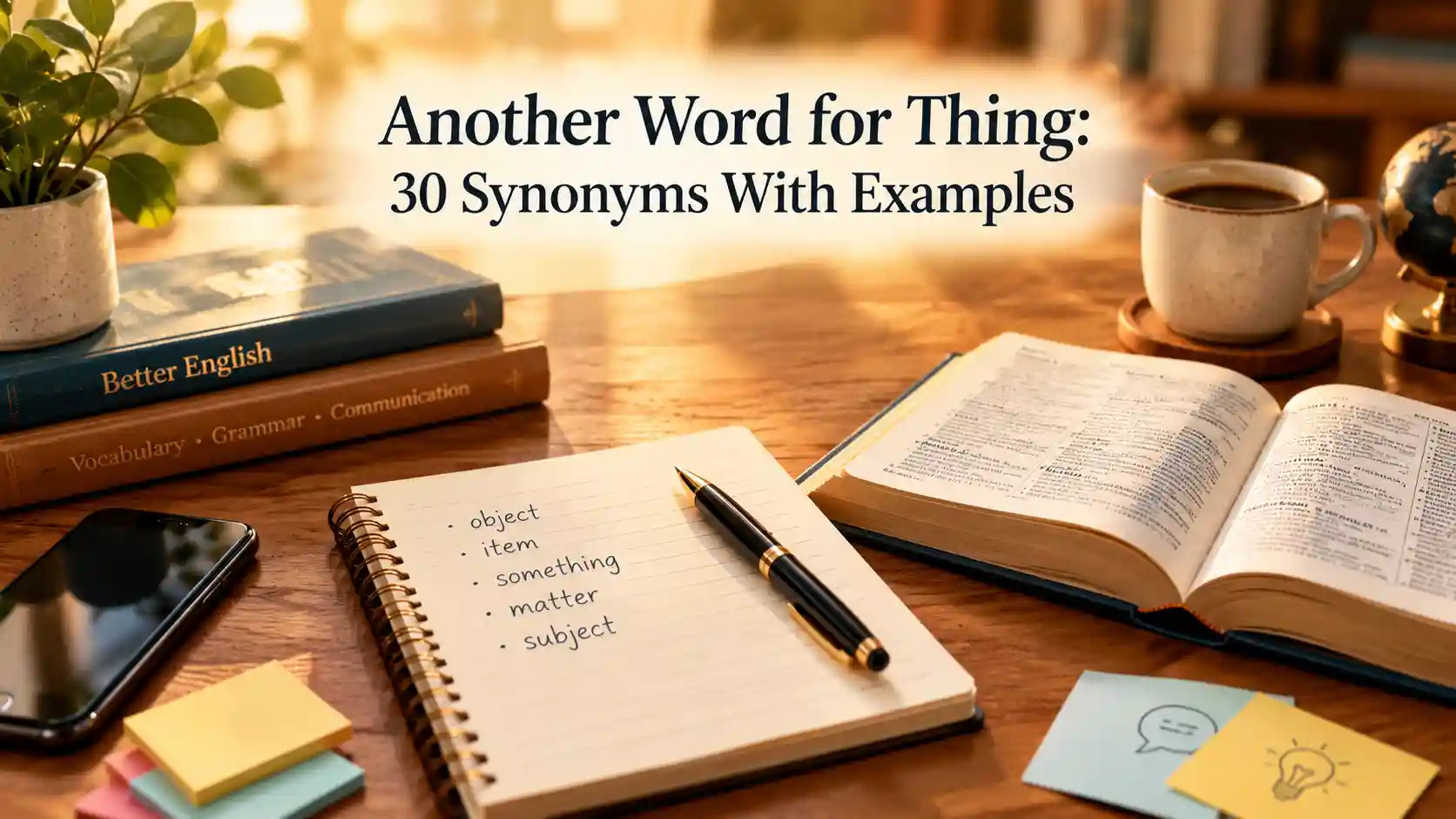
another word for thing: 30 Synonyms With Examples
“Another word for thing” depends on what thing means in your sentence. The closest everyday alternatives are object, item, something, matter, and stuff.
Use object or item for a physical thing, matter or subject for an idea or issue, event for something that happened, and stuff for a group of unnamed items. The right choice also depends on tone: some words are formal, while others are informal or literary.
Quick list: object, item, article, something, stuff, matter, subject, issue, affair, fact, idea, concept, event, occurrence, action, task, activity, device, tool, objectivity, entity, being, feature, element, detail, possession, belonging, property, gadget, whatsit.
This guide examines 30 alternatives with meanings, IPA pronunciations, usage notes, examples, context, collocations, expressions, and word history.
At a Glance: another word for thing Synonyms and Related Alternatives

| Alternative | Part of Speech | Meaning | Register / Tone | Ideal Context |
| object | Noun | A physical item | Neutral | Naming a physical thing |
| item | Noun | One thing in a group or list | Neutral | Lists, shopping, inventory |
| something | Pronoun / noun | An unspecified thing | Neutral | An unknown or unnamed thing |
| stuff | Noun | Unnamed material or objects | Informal | Everyday speech |
| matter | Noun | A subject, problem, or concern | Neutral/formal | Business, serious discussion |
| subject | Noun | A topic being discussed | Neutral/formal | School, writing, conversation |
| issue | Noun | A problem or important point | Neutral/formal | Work, politics, debate |
| affair | Noun | A situation or event | Formal | Public or serious matters |
| event | Noun | Something that happens | Neutral | Occurrences and occasions |
| entity | Noun | A distinct existing thing | Formal | Law, philosophy, science |
| device | Noun | A tool or piece of equipment | Neutral | Technology and machinery |
Which Word Should You Use?
| If you want to… | Use | Why |
| Name a physical thing | object | It clearly refers to a material item. |
| Refer to one thing in a group | item | It works well in lists, records, and collections. |
| Avoid naming an unknown thing | something | It is natural when the exact name is not known. |
| Refer to several unnamed physical things | stuff | It is common but informal and usually uncountable. |
| Discuss a topic or concern | matter | It can refer to a subject, situation, or problem. |
| Name a problem that needs attention | issue | It often suggests difficulty, disagreement, or debate. |
| Describe something that happened | event | It refers specifically to an occurrence. |
| Use a formal word for an existing thing | entity | It suits legal, academic, and technical writing. |
Exploring the Multiple Meanings of “thing”
1. A Physical Object
- Meaning: An inanimate item that can usually be seen or touched.
- Explanation: In this sense, thing is a general word for an object whose exact name is unknown, unimportant, or deliberately omitted. More precise alternatives include object, item, article, and device.
- Example: Please move that thing from the table.
2. An Idea, Topic, or Subject
- Meaning: A thought, topic, or area of discussion.
- Explanation: Thing can refer to something abstract rather than physical. In formal writing, idea, subject, matter, or concept is usually clearer.
- Example: The important thing is that everyone understands the plan.
3. An Action, Activity, or Task
- Meaning: Something that someone does or needs to do.
- Explanation: English often uses thing in phrases such as the best thing to do. Depending on the sentence, action, task, activity, or step may be more exact.
- Example: The first thing to do is check the address.
4. An Event or Occurrence
- Meaning: Something that happens.
- Explanation: In this sense, thing can describe an event, incident, experience, or occurrence. These alternatives provide more information about what happened.
- Example: Strange things happened during the journey.
5. A Person, Creature, or Being
- Meaning: An individual or living being viewed in a general or emotional way.
- Explanation: Thing can refer to a person or animal, but this use may sound affectionate, humorous, dismissive, or insulting depending on context. Person, creature, being, or individual may be more appropriate.
- Example: You poor thing—you must be exhausted.
6. A Possession or Group of Possessions
- Meaning: An object or group of objects that someone owns.
- Explanation: The plural things often means personal belongings. In this sense, possessions, belongings, property, or effects may be more precise.
- Example: I packed my things before leaving the apartment.
Analyzing 30 thing Alternatives in Detail
The alternatives below include direct synonyms and context-specific related words. Some can replace thing in many sentences; others work only for a particular meaning.
General Physical Alternatives
1. Object
IPA: /ˈɑːbdʒɪkt/ (US) · /ˈɒbdʒɪkt/ (UK)
Definition: A material thing that can be seen or touched.
- Usage: This is one of the closest alternatives when thing means a physical item. It sounds neutral and is common in academic, technical, and everyday English.
- Example: The museum displayed a small bronze object.
2. Item
IPA: /ˈaɪtəm/ (US and UK)
Definition: A single thing, especially one in a group, list, or collection.
- Usage: Use item for products, entries, possessions, or individual parts of a set. It is more organized and specific than the very general thing.
- Example: Each item on the menu has a calorie count.
3. Article
IPA: /ˈɑːrtɪkəl/ (US) · /ˈɑːtɪkəl/ (UK)
Definition: An individual object, especially one of a particular type.
- Usage: Article is a formal or commercial alternative for a physical object, piece of clothing, or piece of property. It is not usually the best choice for an abstract idea.
- Example: The customs officer inspected every article in the bag.
4. Piece
IPA: /piːs/ (US and UK)
Definition: A separate part or unit of something.
- Usage: Piece is useful when the thing is part of a larger whole, such as furniture, equipment, art, or information. It does not replace thing in every context.
- Example: That piece of furniture is over a hundred years old.
5. Element
IPA: /ˈeləmənt/ (US and UK)
Definition: A necessary or important part of something.
- Usage: Element is a related alternative, not a general synonym. It focuses on a component within a larger system, argument, design, or situation.
- Example: Trust is a key element of a strong friendship.
Unspecified or Informal Alternatives
6. Something
IPA: /ˈsʌmθɪŋ/ (US and UK)
Definition: An unspecified or unknown person, object, event, or idea.
- Usage: This is often the closest grammatical replacement for thing when the identity is unknown or not stated. It can refer to physical and abstract meanings.
- Example: There is something under the sofa.
7. Stuff
IPA: /stʌf/ (US and UK)
Definition: Unspecified material, objects, or matters.
- Usage: Stuff is informal and usually uncountable. It often means a collection of objects, while thing can refer to one countable object.
- Example: I need to clear some old stuff from the garage.
8. Whatsit
IPA: /ˈwɒtsɪt/ (US) · /ˈwɒtsɪt/ (UK)
Definition: An informal name for an object whose name is forgotten or unknown.
- Usage: Whatsit is a very informal substitute for thingamajig. It is suitable for casual speech, not formal writing.
- Example: Pass me that little whatsit beside the screwdriver.
9. Thingamajig
IPA: /ˈθɪŋəmədʒɪɡ/ (US and UK)
Definition: An informal word for an object whose name is unknown or forgotten.
- Usage: This is a playful, informal related alternative. It often suggests that the speaker expects the listener to know which object is meant.
- Example: Use the thingamajig to tighten the screw.
10. Gadget
IPA: /ˈɡædʒɪt/ (US and UK)
Definition: A small device or useful mechanical or electronic object.
- Usage: Gadget is not an exact synonym for every thing. It applies specifically to a clever, practical, or electronic device.
- Example: This kitchen gadget slices vegetables quickly.
Abstract Alternatives
11. Matter
IPA: /ˈmætər/ (US) · /ˈmætə/ (UK)
Definition: A subject, situation, or problem being considered.
- Usage: Use matter when thing means a concern or subject, especially in serious or formal contexts.
- Example: We need to discuss this matter before Friday.
12. Subject
IPA: /ˈsʌbdʒɪkt/ (US and UK)
Definition: A person, topic, or area being discussed or studied.
- Usage: Subject is a strong alternative when thing means a topic. It is common in education, journalism, research, and formal discussion.
- Example: Climate change was the main subject of the lecture.
13. Issue
IPA: /ˈɪʃuː/ (US) · /ˈɪʃuː/ or /ˈɪsjuː/ (UK)
Definition: An important problem, question, or topic.
- Usage: Issue is more specific than thing because it often suggests a problem, disagreement, or matter requiring attention.
- Example: We must solve this issue before launching the product.
14. Affair
IPA: /əˈfer/ (US) · /əˈfeə/ (UK)
Definition: An event, situation, or matter.
- Usage: Affair is a formal alternative, especially for public, political, personal, or complicated situations. It can also have the separate meaning of a romantic relationship.
- Example: The whole affair lasted several months.
15. Concern
IPA: /kənˈsɜːrn/ (US) · /kənˈsɜːn/ (UK)
Definition: A worry, interest, or matter that affects someone.
- Usage: Use concern when thing means something important or worrying. It is not a neutral replacement for every physical object.
- Example: Safety is our main concern.
Ideas, Facts, and Concepts
16. Idea
IPA: /aɪˈdiːə/ (US and UK)
Definition: A thought, plan, or suggestion.
- Usage: Idea replaces thing when the word refers to a thought or plan rather than an object.
- Example: That is an interesting idea.
17. Concept
IPA: /ˈkɑːnsept/ (US) · /ˈkɒnsept/ (UK)
Definition: An abstract idea or general notion.
- Usage: Concept is more formal and abstract than idea. It is useful in academic, technical, and philosophical writing.
- Example: The concept of fairness is difficult to define.
18. Fact
IPA: /fækt/ (US and UK)
Definition: A piece of information that is known or proved to be true.
- Usage: Fact is a related alternative when thing refers to true information. It should not replace thing when the information is uncertain or merely an opinion.
- Example: One important fact is that the bridge is unsafe.
19. Point
IPA: /pɔɪnt/ (US and UK)
Definition: An idea, detail, or purpose expressed in speech or writing.
- Usage: Point works when thing means a specific idea, argument, or detail. It can also mean purpose in expressions such as the point is.
- Example: You made a good point about the budget.
20. Detail
IPA: /ˈdiːteɪl/ (US) · /ˈdiːteɪl/ or /ˈdiːteɪl/ (UK)
Definition: A small fact or feature of something.
- Usage: Detail is narrower than thing. Use it for one small part of a description, plan, account, or design.
- Example: Check every detail before signing the contract.
Events, Actions, and Situations
21. Event
IPA: /ɪˈvent/ (US and UK)
Definition: Something that happens, especially an important occurrence.
- Usage: Use event when thing refers to something that happened or is planned to happen.
- Example: The charity event raised thousands of dollars.
22. Occurrence
IPA: /əˈkɜːrəns/ (US) · /əˈkʌrəns/ (UK)
Definition: Something that happens or takes place.
- Usage: Occurrence is formal and often appears in reports or academic writing. It is less natural than event in everyday speech.
- Example: The report recorded every unusual occurrence.
23. Action
IPA: /ˈækʃən/ (US and UK)
Definition: Something that someone does.
- Usage: Action replaces thing when the meaning is a deed or behavior. It emphasizes what a person does rather than an object.
- Example: Every action has consequences.
24. Task
IPA: /tæsk/ (US and UK)
Definition: A piece of work that must be done.
- Usage: Task is a precise alternative when thing means a duty, job, or step in a process.
- Example: My first task is to answer the customer emails.
25. Activity
IPA: /ækˈtɪvəti/ (US and UK)
Definition: Something that people do for work, learning, entertainment, or another purpose.
- Usage: Activity is useful for planned or repeated actions. It is not a general substitute for a physical thing.
- Example: Reading is a relaxing evening activity.
Formal and Technical Alternatives
26. Entity
IPA: /ˈentəti/ (US and UK)
Definition: A distinct person, organization, object, or thing that exists.
- Usage: Entity is formal and often technical. It can refer to something physical or abstract, especially in law, business, philosophy, and computing.
- Example: The company is a separate legal entity.
27. Being
IPA: /ˈbiːɪŋ/ (US and UK)
Definition: A living creature or an existent person or thing.
- Usage: Being is a related alternative when thing refers to a person, animal, or living creature. It may sound philosophical or formal.
- Example: Humans are social beings.
28. Substance
IPA: /ˈsʌbstəns/ (US and UK)
Definition: A particular kind of matter or material; the essential meaning of something.
- Usage: Substance can refer to physical material or the important content of an idea. It is not an ordinary substitute for every use of thing.
- Example: The speech had style but little substance.
29. Apparatus
IPA: /ˌæpəˈrætəs/ (US) · /ˌæpəˈrɑːtəs/ (UK)
Definition: A set of equipment used for a particular purpose.
- Usage: This formal, technical word applies to equipment or a system of tools, not to an unnamed object in general.
- Example: The laboratory apparatus must be cleaned after use.
30. Implement
IPA: /ˈɪmpləmənt/ (US and UK)
Definition: A tool or instrument used for a particular purpose.
- Usage: Implement is a formal or somewhat old-fashioned alternative for a useful tool. It is more specific than thing.
- Example: The farmer selected the right implement for the job.
Thing vs. Stuff vs. Object
These three words overlap, but they are not interchangeable in every sentence.
| Word | Main Meaning | Countable? | Typical Tone | Example |
| thing | One object, idea, action, event, or person | Yes | Neutral and very broad | What is that thing? |
| stuff | A group or amount of unnamed material or objects | Usually no | Informal | Put your stuff in the closet. |
| object | A physical item | Yes | Neutral or formal | The object was made of glass. |
Thing is the broadest word. Object is clearer for a physical item, while stuff usually describes an unnamed collection or amount. Cambridge notes that thing can refer not only to physical objects but also to ideas, actions, and events.
Thing and Opposite/Paired Word Pairs
| Word | Paired Word | Note |
| thing | person | Used to contrast an object with a human being. |
| something | nothing | A common contrast between existence and absence. |
| everything | nothing | Refers to all things versus no things. |
| anything | nothing | Common in questions and negative statements. |
| object | subject | A common grammar and philosophy contrast. |
| matter | mind | A philosophical contrast between physical substance and thought. |
| real thing | imitation | Contrasts an original with a copy. |
| important thing | unimportant thing | Contrasts significance, although matter is often more natural. |
Thing does not have one simple opposite. The natural opposite depends on the intended meaning: nothing for existence, person for an inanimate object, or imitation for an original.
Sources: Merriam-Webster Thesaurus, Cambridge Dictionary.
Common Word Partners of “thing”
| Pattern | Common Partners | Example |
| adjective + thing | important, strange, funny, little, same | The important thing is to stay calm. |
| thing + to-infinitive | thing to do, thing to remember, thing to say | The best thing to do is wait. |
| the thing is | the thing is that… | The thing is, we do not have enough time. |
| things + adjective | things are difficult, things are changing, things are improving | Things are getting better. |
| things like | things like that, things like computers | We discuss things like cost and safety. |
| possessive + things | my things, your things, personal things | Please collect your things. |
| all things + adjective | all things considered, all things being equal | All things considered, it was a good decision. |
| do + possessive + thing | do your own thing, do his thing | She prefers to do her own thing. |
Idiomatic Phrases Featuring “thing”
1. The thing is
- Meaning: Used to introduce an important fact, explanation, or problem.
- Example: I would come with you, but the thing is, I have to work.
2. Do your own thing
- Meaning: Do what you want or what interests you, independently of other people.
- Example: Maya likes to do her own thing on weekends.
3. Is that a thing?
- Meaning: Is that a real trend, practice, or accepted idea?
- Example: People are putting fruit on pizza again—is that a thing?
4. All things considered
- Meaning: After considering all the relevant facts.
- Example: All things considered, moving closer to work was a good choice.
These include established expressions rather than ordinary adjective-and-noun combinations. The thing is is especially common in conversation, while do your own thing expresses independent behavior.
Word Formation of “thing”
Etymology & Structure
Modern English thing comes from Old English þing, a word associated with a meeting, assembly, council, matter, or affair. Over time, its meaning expanded from a matter discussed or decided to an event, and then to a concrete object or entity. The word is related to forms in several Germanic languages, including Old Norse þing.
The word is a basic noun rather than a modern combination of smaller English word parts. Its plural form is things.
Date and History
Old English records show forms related to thing many centuries ago. Etymonline traces the word to Old English þing, while historical dictionary sources connect it with Germanic words for an assembly or meeting.
Word Class Variations
- Noun: thing, things.
- Pronoun-like use: something, anything, nothing, everything.
- Compound nouns: thingamajig, thingummy, thingy.
- Adjectival compounds: thing-like is possible but uncommon.
- Related expression: do your own thing.
Sources: Etymonline, Middle English Dictionary, Cambridge Dictionary.
Common Word-Choice Mistakes
- Wrong pairing: an information thing; correction: a piece of information or a fact.
- Wrong pairing: many stuff; correction: much stuff or many things.
- Wrong pairing: a stuff; correction: a thing, an object, or an item.
- Wrong pairing: discuss about this thing; correction: discuss this matter or talk about this issue.
- Wrong pairing: a thing of furniture; correction: a piece of furniture.
- Wrong pairing: thing happened yesterday; correction: something happened yesterday or an event happened yesterday.
- Wrong pairing: the thing is very important issue; correction: the issue is very important or the important thing is…
Frequently Asked Questions
1. What is the closest synonym for “thing”?
The closest choice depends on meaning. Object is best for a physical thing, item for one thing in a list, and something for an unnamed thing.
2. What is a formal word for “thing”?
Matter, entity, object, subject, and affair can be formal alternatives in different contexts. Entity is especially common in legal, technical, and academic writing.
3. Is “stuff” the same as “thing”?
No. Stuff usually refers to an uncountable group or amount of unnamed material or objects. Thing can refer to one countable object, idea, action, or event.
4. What is another word for a physical thing?
Use object, item, article, piece, or device. The best word depends on If the item is general, listed, technical, or part of a larger whole.
5. What is another word for “thing” meaning a topic?
Use subject, matter, issue, point, or concern. Issue often suggests a problem, while subject simply names a topic.
6. What is another word for “thing” meaning an event?
Use event, occurrence, incident, or affair. Occurrence is more formal, and incident often suggests an unusual or troubling event.
7. Can “thing” refer to a person?
Yes, but the tone changes with context. Expressions such as poor thing can sound affectionate, while calling someone merely a thing may sound insulting or dehumanizing.
8. What is the opposite of “thing”?
There is no single opposite in every context. Nothing is the usual opposite when thing means something that exists, while person may contrast with an inanimate thing.
9. Is “item” more formal than “thing”?
Usually, yes. Item sounds more precise and organized, especially in lists, records, shopping, and business writing.
10. What is a playful word for an unnamed thing?
Whatsit, thingamajig, and thingy are informal choices. They are useful when the speaker does not know or cannot remember the object’s name.
Conclusion
The most useful alternatives for thing are object, item, something, stuff, matter, and subject. Each one fits a different meaning or level of formality.
Because thing can refer to an object, idea, action, event, person, or possession, no single synonym works everywhere. Words such as event, issue, task, and entity are more precise in specific contexts.
Choose the alternative that tells readers exactly what you mean. Use common words in everyday speech, and use more formal or technical words when the context calls for greater precision.