
Another Word for Selfish: 30 Synonyms With Examples
The closest everyday alternatives to selfish are self-centered, self-absorbed, self-interested, and inconsiderate. The best word depends on If you mean someone who ignores other people, seeks personal gain, wants too much, or is overly focused on themselves.
Selfish usually describes a person or action that puts one’s own advantage, pleasure, or needs first without enough regard for others. Related words can emphasize greed, lack of thought for others, self-importance, or a strong focus on personal interests.
Quick list: self-centered, self-absorbed, self-interested, self-serving, inconsiderate, egocentric, egotistical, greedy, thoughtless, selfish.
This article explains 30 alternatives with meanings, IPA, usage notes, examples, and the contexts in which each word works best.
At a Glance: Selfish Synonyms and Related Alternatives

| Alternative | Part of Speech | Meaning | Register / Tone | Ideal Context |
| Self-centered | Adjective | Overly focused on your own needs and interests | Neutral to critical | Everyday speech |
| Self-absorbed | Adjective | So focused on yourself that you notice others little | Critical | Describing personality |
| Self-interested | Adjective | Motivated by personal benefit | More neutral or formal | Business, politics, ethics |
| Self-serving | Adjective | Done to help yourself, often at others’ expense | Critical | Work, public life |
| Inconsiderate | Adjective | Not thinking about other people’s feelings or needs | Critical but common | Everyday behavior |
| Egocentric | Adjective | Seeing everything mainly in relation to yourself | Formal, critical | Psychology, character description |
| Egotistical | Adjective | Excessively proud or full of yourself | Critical | Describing arrogance |
| Greedy | Adjective | Wanting more than you need, especially money or food | Strong, informal to formal | Money, possessions, food |
| Thoughtless | Adjective | Not considering how your actions affect others | Mild criticism | Everyday behavior |
| Egotistical | Adjective | Extremely self-focused and needing admiration | Strong, often clinical or critical | Personality, relationships |
Which Word Should You Use?

| If you want to… | Use | Why |
| Describe someone who thinks mainly of themselves | Self-centered | It is the most natural everyday alternative. |
| Say someone ignores other people’s needs | Inconsiderate | It focuses on the effect on others. |
| Describe someone who is always thinking about themselves | Self-absorbed | It suggests deep preoccupation with one’s own life. |
| Talk about a decision made for personal benefit | Self-interested | It is more neutral and works well in formal writing. |
| Criticize an action that helps the speaker | Self-serving | It implies the action benefits the person doing it. |
| Describe someone who wants more money or possessions | Greedy | It focuses on wanting too much. |
| Describe someone who acts without thinking of others | Thoughtless | It is milder than selfish. |
| Describe extreme self-focus or need for admiration | Egotistical | It is stronger and often used in psychology or serious criticism. |
Exploring the Multiple Meanings of “Selfish”
1. Caring Only About Yourself
- Meaning: Concerned mainly or only with your own advantage, pleasure, or well-being.
- Explanation: This is the core meaning. It often suggests that a person does not consider how their choices affect other people.
- Example: He was selfish and refused to share the food with anyone else.
2. Acting for Personal Advantage
- Meaning: Seeking your own benefit without regard for others.
- Explanation: This sense often appears in phrases such as selfish reasons or selfish motives. It can describe actions as well as people.
- Example: She supported the plan for selfish reasons, not because it would help the team.
3. Disregarding Other People’s Feelings
- Meaning: Not giving enough attention to other people’s wishes, needs, or feelings.
- Explanation: In everyday conversation, selfish is often used when someone feels ignored, used, or treated unfairly.
- Example: It was selfish of him to make everyone wait while he finished his game.
4. Wanting Too Much for Oneself
- Meaning: Keeping more than a fair share or being unwilling to share.
- Explanation: This sense overlaps with words such as greedy and stingy, though selfish is broader.
- Example: Don’t be selfish—there is enough cake for everyone.
5. Focused on Self-Preservation or Self-Interest
- Meaning: Guided by concern for one’s own welfare or interests.
- Explanation: This use can be less insulting. In biology, for example, a selfish gene means a gene that behaves as if it promotes its own replication; it does not mean the gene has feelings.
- Example: The company made a self-interested decision to protect its profits.
Sources: Merriam-Webster; Cambridge Dictionary; Collins English Dictionary.
Analyzing 30 Selfish Alternatives in Detail

Alternatives to “Selfish”: Nuances, Contexts, and Definitions
When choosing an alternative for “selfish,” selecting the right word depends heavily on context. Some alternatives are direct synonyms, while others are useful only in particular situations or carry specific emotional weights.
Core Synonyms for Everyday Selfishness
These core synonyms are the closest replacements for “selfish.” They describe individuals who prioritize their own needs, thoughts, or feelings over others, ranging from general personality traits to deeper psychological self-focus.
1. Self-centered
- IPA: US
/ˌsɛlfˈsɛntərd/· UK/ˌsɛlfˈsɛntəd/ - Definition: Overly concerned with your own desires, needs, or interests.
- Usage: This is one of the closest and most common alternatives to selfish. It is slightly less harsh and can describe a general personality trait.
- Example: He is kind, but he can be self-centered when he is under stress.
2. Self-absorbed
- IPA: US and UK
/ˌsɛlf əbˈzɔːrbd/ - Definition: Absorbed in your own thoughts, feelings, or interests.
- Usage: Use this for someone who is so focused on themselves that they pay little attention to others. It emphasizes preoccupation more than unfairness.
- Example: She became self-absorbed after her promotion and stopped asking how her friends were doing.
3. Egocentric
- IPA: US and UK
/iːɡoʊˈsɛntrɪk/· UK/iːɡəʊˈsɛntrɪk/ - Definition: Thinking only of yourself and viewing things mainly in relation to yourself.
- Usage: This is a more formal alternative. It can describe a person, attitude, or way of thinking.
- Example: His egocentric view of the project ignored the concerns of the whole team.
4. Egotistical
- IPA: US and UK
/iːɡəˈtɪstɪkəl/ - Definition: Excessively conceited or self-important.
- Usage: Use this when selfishness is connected with pride, boasting, or believing you are more important than others. It is not an exact synonym in every context.
- Example: His egotistical attitude made it difficult for anyone else to speak in meetings.
5. Egoistic
- IPA: US and UK
/iːɡoʊˈɪstɪk/· UK/iːɡəʊˈɪstɪk/ - Definition: Concerned chiefly with your own interests or welfare.
- Usage: This is a formal, somewhat philosophical alternative. It often describes a theory, motive, or general outlook rather than everyday rudeness.
- Example: The argument was based on an egoistic view of human behavior.
6. Self-involved
- IPA: US and UK
/ˌsɛlf ɪnˈvɑːlvd/ - Definition: Engrossed in your own concerns and not attentive to others.
- Usage: This is close to self-absorbed but often sounds slightly more descriptive than insulting.
- Example: Teenagers can sometimes seem self-involved as they work out who they are.
7. Self-obsessed
- IPA: US and UK
/ˌsɛlf əbˈsɛst/ - Definition: Excessively interested in or concerned with yourself.
- Usage: This is stronger than self-centered and suggests constant thinking about oneself. It is informal to neutral in tone.
- Example: He became self-obsessed with his online image.
8. Selfish
- IPA: US and UK
/ˌnɑːrsɪˈsɪstɪk/· UK/ˌnɑːsɪˈsɪstɪk/ - Definition: Having an excessive interest in yourself and your physical appearance, or needing admiration.
- Usage: This is a strong word. In psychology, it relates to narcissism; in everyday speech, it is often used critically for extreme self-focus.
Personal-Interest and Advantage Terms
These terms describe actions or attitudes aimed at personal gain, advancement, or unfair advantage, frequently used in political, business, or formal contexts.
9. Self-interested
- IPA: US and UK
/ˌsɛlf ˈɪntrəstɪd/· UK/ˌsɛlf ˈɪntrəstɪd/ - Definition: Motivated by concern for your own advantage.
- Usage: This is often more neutral than selfish. It is useful in discussions of politics, business, and human behavior.
- Example: Voters may support a policy because it is in their self-interest.
10. Self-serving
- IPA: US and UK
/ˌsɛlf ˈsɜːrvɪŋ/· UK/ˌsɛlf ˈsɜːvɪŋ/ - Definition: Serving your own interests, often at the expense of others.
- Usage: Use this for actions, explanations, or decisions that appear designed to benefit the person making them. It is usually critical.
- Example: His apology sounded self-serving rather than sincere.
11. Self-seeking
- IPA: US and UK
/ˌsɛlf ˈsiːkɪŋ/ - Definition: Trying to gain personal advantage, especially in a way that ignores others.
- Usage: This is more formal and literary than selfish. It often describes ambition or political behavior.
- Example: The report criticized the self-seeking behavior of several officials.
12. Opportunistic
- IPA: US and UK
/ˌɑːpərtuːˈnɪstɪk/· UK/ˌɒpətjuːˈnɪstɪk/ - Definition: Taking advantage of opportunities without considering principles or other people.
- Usage: This is a related rather than exact alternative. It emphasizes using a situation for personal gain.
- Example: His opportunistic support for the policy appeared only after it became popular.
13. Mercenary
- IPA: US and UK
/ˈmɜːrsəneri/· UK/ˈmɜːsənəri/ - Definition: Interested only in making money; willing to act for payment.
- Usage: This is a related alternative for selfishness connected with money. It is stronger and more judgmental.
- Example: Critics called the consultant’s advice mercenary because it served only the client who paid most.
14. Venal
- IPA: US and UK
/ˈviːnəl/ - Definition: Open to bribery or willing to use power for money.
- Usage: This is a formal word for corruption driven by personal gain. It is not a general synonym for selfish.
- Example: The venal official accepted payments in exchange for permits.
15. Exploitative
- IPA: US and UK
/ɪkˈsplɔɪtətɪv/ - Definition: Treating people unfairly in order to benefit from them.
- Usage: This is related to selfishness but focuses on unfair use of other people’s work, weakness, or trust.
- Example: The company faced criticism for its exploitative labor practices.
Lack of Consideration and Empathy
These words emphasize a failure to notice, care about, or sympathize with the feelings and needs of others.
16. Inconsiderate
- IPA: US and UK
/ˌɪnkənˈsɪdərət/ - Definition: Not carefully thinking about other people’s feelings or needs.
- Usage: This is a common, slightly milder alternative. It is ideal for everyday behavior such as being late, making noise, or ignoring someone.
- Example: It was inconsiderate to play loud music late at night.
17. Thoughtless
- IPA: US and UK
/ˈθɔːtləs/ - Definition: Not considering the possible effects of your words or actions on others.
- Usage: This is gentler than selfish. It can suggest carelessness rather than deliberate self-interest.
- Example: Her thoughtless comment hurt his feelings.
18. Uncaring
- IPA: US and UK
/ʌnˈkɛərɪŋ/· UK/ʌnˈkeərɪŋ/ - Definition: Not showing concern or sympathy for others.
- Usage: This related alternative emphasizes emotional coldness. A person can be uncaring without actively seeking personal gain.
- Example: His uncaring response shocked the family.
19. Callous
- IPA: US and UK
/ˈkæləs/ - Definition: Emotionally hardened; showing no concern for others’ suffering.
- Usage: This is a strong related alternative. It suggests cruelty or indifference, not merely wanting your own way.
- Example: The manager’s callous treatment of staff caused anger.
20. Heartless
- IPA: US and UK
/ˈhɑːrtləs/· UK/ˈhɑːtləs/ - Definition: Showing no kindness, pity, or sympathy.
- Usage: This is emotional and informal. It is related to selfishness when someone ignores another person’s suffering.
- Example: It seemed heartless to cancel the trip after she had already paid.
Greed, Possession, and Unwillingness to Share
These alternatives apply specifically when selfishness involves money, physical possessions, or a desire to hoard resources.
21. Greedy
- IPA: US and UK
/ˈɡriːdi/ - Definition: Having a strong desire for more food, money, or possessions than you need.
- Usage: Use this when selfishness involves wanting or taking too much. It is direct and commonly understood.
- Example: The greedy developer bought every available plot of land.
22. Grasping
- IPA: US and UK
/ˈɡræspɪŋ/ - Definition: Greedy, especially for money.
- Usage: This is a more formal or literary alternative to greedy. It often suggests an unpleasant eagerness to gain wealth.
- Example: The grasping landlord raised the rent again.
23. Acquisitive
- IPA: US and UK
/əˈkwɪzɪtɪv/ - Definition: Eager to acquire and keep money or possessions.
- Usage: This is a formal related alternative. It describes a desire to own things rather than a general lack of concern for others.
- Example: The acquisitive collector wanted every rare edition he could find.
24. Stingy
- IPA: US and UK
/ˈstɪndʒi/ - Definition: Unwilling to give, spend, or share.
- Usage: This is related to selfishness in situations involving money, gifts, or sharing. It is informal and critical.
- Example: He was too stingy to leave a tip.
25. Ungenerous
- IPA: US and UK
/ʌnˈdʒɛnərəs/ - Definition: Not willing to give or share freely.
- Usage: This is a more neutral alternative to stingy. It can describe money, praise, time, or spirit.
- Example: Her ungenerous review ignored the film’s strengths.
26. Possessive
- IPA: US and UK
/pəˈzɛsɪv/ - Definition: Wanting to own or keep things, or unwilling to share people or possessions.
- Usage: This is a context-specific related word. It often describes relationships, territory, or belongings rather than general selfishness.
- Example: He became possessive of his notes and refused to share them.
Self-Image, Pride, and Egocentrism
These terms link self-centeredness with personal vanity, arrogance, or an inflated sense of self-importance.
27. Vain
- IPA: US and UK
/veɪn/ - Definition: Too interested in your appearance or achievements.
- Usage: This is related to selfishness when self-focus involves appearance or admiration. It is not an exact synonym.
- Example: He was vain about his clothes and spent hours choosing them.
28. Conceited
- IPA: US and UK
/kənˈsiːtɪd/ - Definition: Having too high an opinion of yourself.
- Usage: Use this for arrogance and pride. It overlaps with egotistical more than with ordinary selfishness.
- Example: She was too conceited to admit she had made a mistake.
29. Self-important
- IPA: US and UK
/ˌsɛlf ɪmˈpɔːrtənt/ - Definition: Having an exaggerated sense of your own importance.
- Usage: This related alternative describes someone who acts as though they matter more than other people.
- Example: The self-important director ignored suggestions from the crew.
30. Solipsistic
- IPA: US and UK
/ˌsɑːlɪpˈsɪstɪk/· UK/ˌsɒlɪpˈsɪstɪk/ - Definition: Extremely self-centered; treating only your own mind or experience as truly important.
- Usage: This is a formal, intellectual, or literary alternative. In philosophy, solipsism is the view that only one’s own mind is sure to exist, so use it carefully.
- Example: The novel presents a solipsistic narrator who cannot see beyond his own experience.
Sources: Merriam-Webster; Collins English Dictionary and Collins Thesaurus; Cambridge Dictionary; Longman Dictionary of Contemporary English.
Selfish vs. Self-Centered vs. Self-Interested
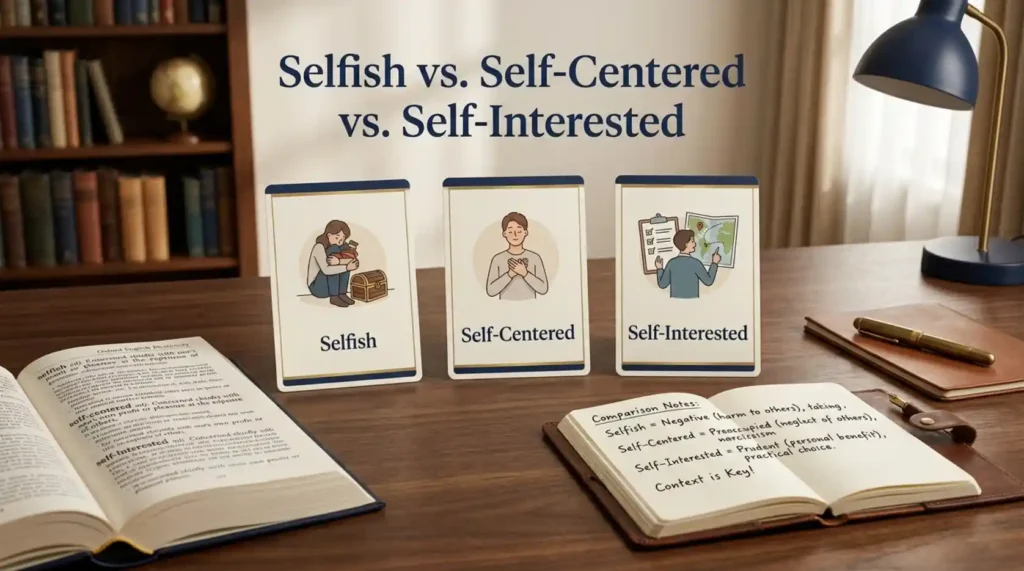
These three words overlap, but they do not mean exactly the same thing.
| Word | Main Focus | Typical Tone | Example |
| Selfish | Putting your own wishes first and disregarding others | Critical | “Don’t be selfish—let your sister have a turn.” |
| Self-centered | Being mentally focused on yourself | Critical but less harsh | “He is self-centered and rarely asks about anyone else.” |
| Self-interested | Acting for your own benefit | Neutral or formal | “It is a self-interested decision, but it is not illegal.” |
Use selfish for blame, self-centered for personality, and self-interested when you want a more neutral explanation of motivation.
Sources: Merriam-Webster; Cambridge Dictionary; Collins English Dictionary.
Selfish and Opposite/Paired Word Pairs
| Word | Paired Word | Note |
| Selfish | Selfless | Selfless means caring more about others than yourself. |
| Selfish | Unselfish | Unselfish is the direct opposite and means not selfish. |
| Self-centered | Other-centered | Other-centered describes attention to other people’s needs. |
| Self-interested | Altruistic | Altruistic means motivated by concern for others’ welfare. |
| Greedy | Generous | Generous means willing to give or share. |
| Inconsiderate | Considerate | Considerate means careful about other people’s feelings. |
| Self-absorbed | Attentive | Attentive means noticing and responding to others. |
These pairs are useful because many alternatives to selfish become clearer when compared with their opposites. For example, self-interested can be neutral, while altruistic clearly describes concern for others.
Sources: Merriam-Webster; Cambridge Dictionary.
Common Word Partners of “Selfish”

| Pattern | Common Partners | Example |
| Selfish + noun | behavior, motives, reasons, desires, interests | “He acted out of selfish motives.” |
| Be + selfish | be selfish, seem selfish, sound selfish | “That may sound selfish, but I need time alone.” |
| Adverb + selfish | very selfish, deeply selfish, incredibly selfish | “It was a deeply selfish decision.” |
| Selfish + preposition | selfish about, selfish with, selfish toward | “She was selfish with her time.” |
| Selfish + action noun | selfish act, selfish choice, selfish decision | “Choosing not to help was a selfish act.” |
These combinations are natural in everyday English and can make your writing more precise than repeating selfish person.
Sources: Collins English Dictionary; Longman Dictionary of Contemporary English.
Idiomatic Phrases Featuring “Selfish”
1. Selfish reasons
- Meaning: Personal motives that benefit oneself rather than other people.
- Example: He joined the committee for selfish reasons, hoping to make useful business contacts.
2. Selfish interests
- Meaning: Personal benefits or advantages, especially when they conflict with the interests of a group.
- Example: The law was changed to protect the selfish interests of a small group.
3. Selfish gene
- Meaning: A scientific expression describing a gene as behaving in a way that promotes its own replication; it does not mean a gene has human feelings.
- Example: The idea of the selfish gene helped explain why certain inherited traits spread through populations.
4. Selfish DNA
- Meaning: A scientific term for DNA sequences that replicate without a known benefit to the organism.
- Example: The researchers studied selfish DNA to understand how repetitive genetic sequences spread.
Sources: Merriam-Webster; Collins English Dictionary.
Word Formation of “Selfish”
Etymology & Structure
Selfish is formed from self plus the suffix -ish. The suffix can form adjectives that describe a quality or tendency. In this word, it means “having the qualities of concern for the self.”
Date and History
Collins dates the English adjective selfish to the period 1630–1640. The word developed from self and -ish, and its modern sense of caring mainly for oneself became established in English usage.
Word Class Variations
- Adjective: selfish — “That was a selfish decision.”
- Adverb: selfishly — “He selfishly took the last seat.”
- Noun: selfishness — “Her selfishness upset the whole family.”
- Related noun: self-interest — “The policy was driven by self-interest.”
- Related adjective: self-interested — “They made a self-interested choice.”
Sources: Collins English Dictionary; Merriam-Webster.
Common Word-Choice Mistakes
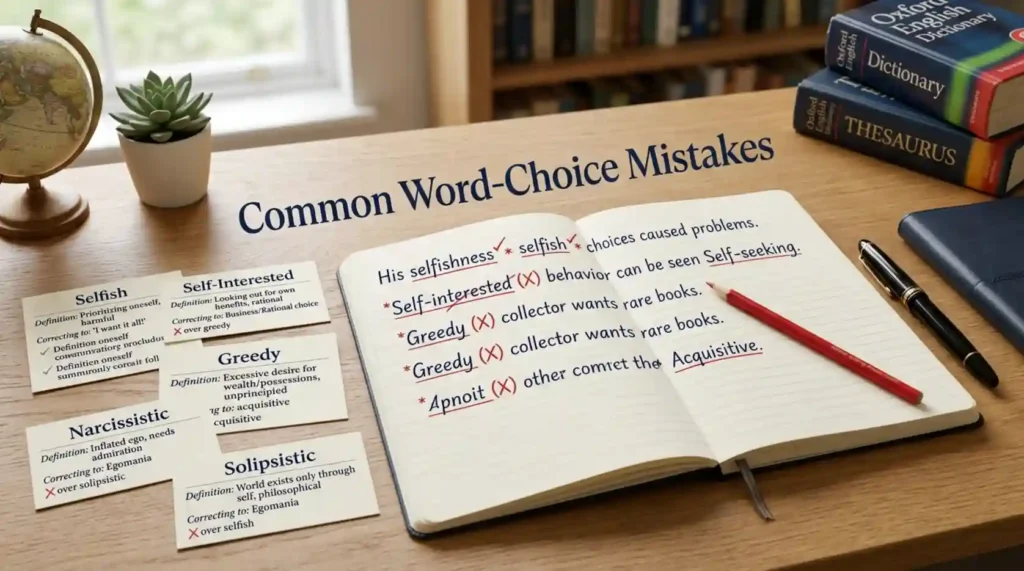
- Wrong: “He is very egoistic person.” Correction: “He is a very egoistic person.”
- Wrong: “She is selfish of her toys.” Correction: “She is selfish with her toys.”
- Wrong: “It was a selfishness decision.” Correction: “It was a selfish decision.”
- Wrong: “He is selfish because he likes attention.” Correction: Use vain, self-absorbed, or attention-seeking unless the self-focus is extreme.
- Wrong: “The greedy person is always selfish with people.” Correction: Use greedy for wanting money, food, or possessions; use selfish for disregarding others.
- Wrong: “He is self-interested, so he never helps anyone.” Correction: Self-interested does not always mean unkind; use selfish or inconsiderate for that meaning.
- Wrong: “She is a solipsistic friend.” Correction: Use self-absorbed or self-involved in everyday conversation; solipsistic is formal and philosophical.
Frequently Asked Questions
What is the closest synonym for selfish?
Self-centered is usually the closest everyday synonym. Self-absorbed and inconsiderate are also very close, depending on the situation.
What is the difference between selfish and self-centered?
Selfish stresses putting your own interests ahead of others. Self-centered stresses being mentally focused on yourself, often with less direct blame.
What is a formal alternative to selfish?
Self-interested, egoistic, egocentric, and self-serving are more formal options. Choose based on If you mean motivation, worldview, or benefit to oneself.
What is a polite way to call someone selfish?
Say inconsiderate, thoughtless, or self-focused. These words are less insulting while still making the concern clear.
What is a strong word for selfish?
selfish, callous, heartless, and exploitative are stronger, but they add meanings such as lack of sympathy, cruelty, or unfair treatment.
What is the opposite of selfish?
Selfless, unselfish, generous, and altruistic are common opposites. Selfless is the most direct opposite.
Can selfish describe an action?
Yes. You can say “a selfish decision,” “a selfish act,” or “a selfish reason.” The word describes both people and behavior.
Is greedy the same as selfish?
No. Greedy means wanting too much, especially money, food, or possessions. Selfish is broader and means putting yourself first without enough concern for others.
Is self-interested always negative?
No. Self-interested can be neutral. People often make reasonable choices based on their own needs, such as choosing a job that pays well.
Can selfish be used in science?
Yes. Selfish gene and selfish DNA are established scientific expressions. They describe genetic behavior, not human character or feelings.
Conclusion
The most useful alternatives to selfish are self-centered, self-absorbed, self-interested, self-serving, and inconsiderate. For greed, choose greedy or stingy; for arrogance, choose egotistical or conceited.
Context matters because these words highlight different ideas: disregard for others, personal benefit, excessive self-focus, or wanting too much. A word such as self-interested can be neutral, while selfish and self-serving usually sound critical.
To choose well, first decide what you want to criticize: the person’s focus on themselves, their lack of consideration, their desire for gain, or their unfair treatment of others. Then select the alternative that matches that exact meaning.