Another Word for Complexity: 30 Synonyms With Examples
Another word for complexity is intricacy when you mean many small, connected parts. Complication works when something makes a situation harder. Difficulty is the plain everyday choice when the point is that something is hard to understand or do. The best choice depends on If you mean many parts, hard to understand, or a problem that makes things worse.
Complexity can describe a system (the complexity of the human body), a feature (the complexities of tax law), or a technical measure (computational complexity). Some alternatives are close synonyms. Others only fit certain contexts.
Quick list: complication, intricacy, difficulty, sophistication, elaborateness, convolution, multiplicity, interconnectedness, entanglement, nuance
This article looks at 30 alternatives. Each one has a meaning, IPA, a usage note, and an example.
At a Glance: Complexity Synonyms and Related Alternatives
| Alternative | Part of Speech | Meaning | Register / Tone | Ideal Context |
| Complication | noun | a factor that makes something harder | neutral | plans, medicine, law |
| Intricacy | noun | the state of having many fine, connected details | neutral to formal | design, patterns, machines |
| Difficulty | noun | the quality of being hard to do or understand | neutral, everyday | tasks, problems, tests |
| Sophistication | noun | a high level of development or detail | neutral to formal | technology, methods, tastes |
| Elaborateness | noun | the quality of being detailed and carefully planned | neutral | plans, decorations, rituals |
| Convolution | noun | a twisted, confusing arrangement | formal, often critical | arguments, plots, rules |
| Multiplicity | noun | the state of being many and varied | formal | causes, factors, meanings |
| Interconnectedness | noun | the state of being linked in many ways | formal, academic | systems, economies, ecology |
| Nuance | noun | a small, subtle difference or shade of meaning | neutral to formal | ideas, language, art |
| Entanglement | noun | a confusing tangle of connections | neutral, figurative | relationships, legal matters |
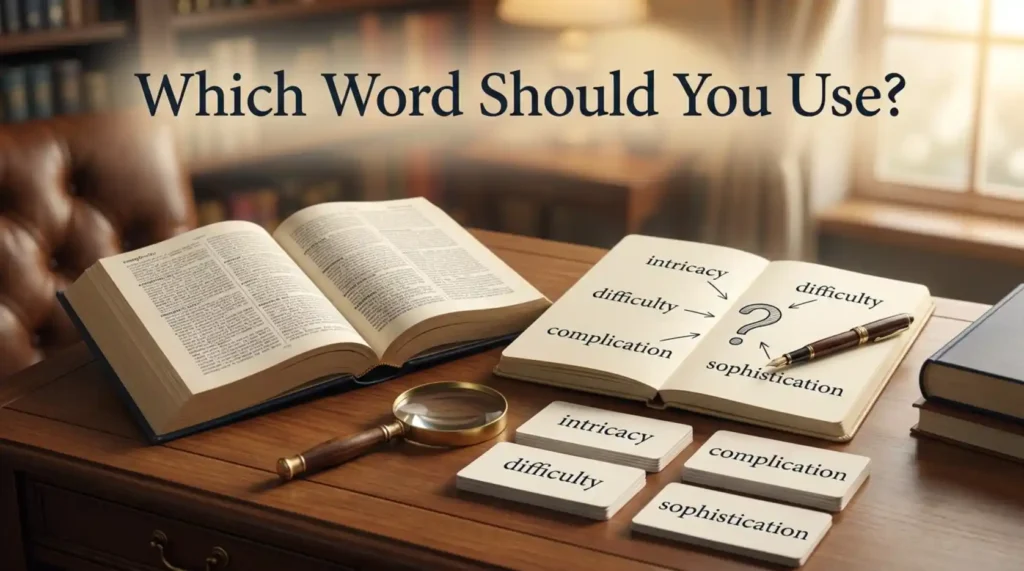
Which Word Should You Use?
| If you want to… | Use | Why |
| Describe many fine, connected parts | intricacy | It suggests careful, detailed structure. |
| Say something makes a plan harder | complication | It points to a specific extra problem. |
| Use a simple, everyday word | difficulty | It is short and widely understood. |
| Praise a well-built, advanced system | sophistication | It sounds positive and skilled. |
| Criticize a confusing argument or plot | convolution | It suggests twists that are hard to follow. |
| Describe a system with many linked parts | interconnectedness | It focuses on the links between parts. |
| Talk about many different causes or factors | multiplicity | It stresses number and variety. |
| Describe a confusing situation with no clear way out | morass | It suggests being stuck and slowed down. |
Exploring the Multiple Meanings of “Complexity”
1. The State of Having Many Connected Parts
- Meaning: The quality of being made up of many parts that connect to one another.
- Explanation: This is the core sense. The focus is on how many parts there are and how they relate, not on If anything is hard. A system can be complex and still work smoothly.
- Example: The complexity of a rainforest comes from millions of connected species.
2. A Complicated Feature or Detail
- Meaning: A particular part or aspect that makes something complicated.
- Explanation: In this sense the word is usually countable and plural. It means the specific tricky points inside a larger subject.
- Example: She explained the complexities of the new visa rules.
3. Difficulty in Understanding or Dealing With Something
- Meaning: The quality of being hard to understand, explain, or solve.
- Explanation: Here the focus moves from the structure to the reader or user. The same system may feel simple to an expert and complex to a beginner.
- Example: Many people avoid the topic because of its complexity.
4. A Technical Measure in Computing and Science
- Meaning: A measure of how much time, memory, or effort a process or problem needs.
- Explanation: In computer science, “complexity” is a precise term, as in time complexity or computational complexity. Everyday synonyms do not usually replace it in this sense.
- Example: The programmer reduced the algorithm’s time complexity.
Sources: Merriam-Webster (entries for complex and complexity); standard dictionary senses.
Analyzing 30 Complexity Alternatives in Detail
Some of these words are direct synonyms of complexity, while others are related alternatives that fit only certain contexts.
Group 1: Core Synonyms
1. Complication
IPA: US /ˌkɑːmplɪˈkeɪʃn/ · UK /ˌkɒmplɪˈkeɪʃn/
Definition: A factor or detail that makes something more complicated or harder to handle.
- Usage: A close synonym for sense 2 of complexity. It usually means a specific extra problem, not the overall condition.
- Example: The missing document was an unexpected complication.
2. Intricacy
IPA: (US and UK) /ˈɪntrɪkəsi/
Definition: The quality of having many small, carefully arranged parts or details.
- Usage: A close synonym for sense 1. It often sounds positive, because it suggests skill or beauty.
- Example: We admired the intricacy of the clock’s gears.
3. Elaborateness
IPA: (US and UK) /ɪˈlæbərətnəs/
Definition: The quality of being detailed, carefully worked out, and often complicated.
- Usage: A related alternative. It fits plans, designs, and ceremonies more than abstract systems.
- Example: The elaborateness of the wedding plan surprised everyone.
4. Sophistication
IPA: (US and UK) /səˌfɪstɪˈkeɪʃn/
Definition: The quality of being advanced, refined, or developed in a complex way.
- Usage: A related alternative, not an exact synonym. It describes complexity that shows skill or advanced design, usually in a positive way.
- Example: The sophistication of the software impressed the engineers.
5. Complexness
IPA: US /kɑːmˈplɛksnəs/ · UK /kəmˈplɛksnəs/
Definition: The state of being complex.
- Usage: A direct but less common variant of complexity. Most writers prefer complexity, so use complexness only if you want a plainer form.
- Example: The complexness of the task slowed the whole team.
Group 2: Difficulty and Confusion
6. Difficulty
IPA: (US and UK) /ˈdɪfɪkəlti/
Definition: The quality of being hard to do, understand, or deal with.
- Usage: A related alternative for sense 3. It focuses on effort, not on the number of parts. A simple task can still be difficult.
- Example: The difficulty of the exam worried the students.
7. Trickiness
IPA: (US and UK) /ˈtrɪkinəs/
Definition: The quality of being hard to handle because of hidden problems.
- Usage: An informal, related alternative. It suggests a situation that needs care, not many connected parts.
- Example: The trickiness of the contract made us hire a lawyer.
8. Convolution
IPA: US /ˌkɑːnvəˈluːʃn/ · UK /ˌkɒnvəˈluːʃn/
Definition: A twisted or very complicated form or arrangement.
- Usage: A formal, related alternative. It often has a negative tone, as if the twists are unnecessary.
- Example: Readers gave up because of the convolution of the plot.
9. Entanglement
IPA: (US and UK) /ɪnˈtæŋɡlmənt/
Definition: A confusing tangle of connections or involvements.
- Usage: A figurative, related alternative. It works for people, money, and law, where things are hard to separate.
- Example: Their financial entanglements took years to solve.
10. Labyrinth
IPA: (US and UK) /ˈlæbərɪnθ/
Definition: A confusing network of paths or details that is hard to find a way through.
- Usage: A literary, figurative alternative. It does not mean complexity in general, only a confusing maze of it.
- Example: She got lost in a labyrinth of rules and forms.
Group 3: Many Parts and Links
11. Multiplicity
IPA: (US and UK) /ˌmʌltɪˈplɪsəti/
Definition: The state of being many and varied.
- Usage: A related alternative. It stresses number and variety, not difficulty. Use it for causes, factors, or meanings.
- Example: The multiplicity of causes makes the problem hard to study.
12. Interconnectedness
IPA: US /ˌɪntərkəˈnɛktɪdnəs/ · UK /ˌɪntəkəˈnɛktɪdnəs/
Definition: The state of being linked together in many ways.
- Usage: A related alternative. It names one cause of complexity, the links between parts. It is common in science and economics.
- Example: The interconnectedness of the world’s banks spread the crisis quickly.
13. Interdependence
IPA: US /ˌɪntərdɪˈpɛndəns/ · UK /ˌɪntədɪˈpɛndəns/
Definition: The state of depending on one another.
- Usage: A related alternative. It describes parts that need each other, which often makes a system complex.
- Example: The interdependence of the teams made planning harder.
14. Heterogeneity
IPA: US /ˌhɛtəroʊdʒəˈniːəti/ · UK /ˌhɛtərəʊdʒəˈniːɪti/
Definition: The quality of being made up of different kinds of parts.
- Usage: A technical, related alternative. It does not mean complexity itself, but a mix of different parts often creates it.
- Example: The heterogeneity of the data made analysis difficult.
15. Nuance
IPA: US /ˈnuːɑːns/ · UK /ˈnjuːɑːns/
Definition: A small, subtle difference in meaning, tone, or feeling.
- Usage: A related alternative. It points to fine detail inside a complex subject, not to the whole.
- Example: The book captures the nuance of life in a small town.
Group 4: Hard-to-Understand Alternatives
16. Obscurity
IPA: US /əbˈskjʊrəti/ · UK /əbˈskjʊərəti/
Definition: The quality of being unclear or hard to understand.
- Usage: A related alternative for sense 3 only. It means unclear, not many-parted.
- Example: The obscurity of the legal language confused the readers.
17. Abstruseness
IPA: (US and UK) /æbˈstruːsnəs/
Definition: The quality of being hard to understand, especially because it is deep or technical.
- Usage: A formal, rare, related alternative. Use it for ideas, theories, or texts.
- Example: The abstruseness of the theory kept it from a wide audience.
18. Opacity
IPA: US /oʊˈpæsəti/ · UK /əʊˈpæsəti/
Definition: The quality of being hard to see through or understand clearly.
- Usage: A related alternative. In writing about systems, it describes complexity that hides how things work.
- Example: The opacity of the process made people distrust it.
19. Subtlety
IPA: (US and UK) /ˈsʌtlti/
Definition: The quality of being delicate and hard to notice or describe.
- Usage: A related alternative. It suggests fine detail, often in ideas, art, or behavior.
- Example: The film rewards viewers who notice its subtlety.
20. Inscrutability
IPA: US /ɪnˌskruːtəˈbɪləti/ · UK /ɪnˌskruːtəˈbɪlɪti/
Definition: The quality of being impossible or very hard to understand.
- Usage: A formal, literary, related alternative. It is stronger than difficulty and fits people, motives, or systems.
- Example: The inscrutability of the rules left him helpless.
Group 5: Problems and Burdens
21. Rigmarole
IPA: US /ˈrɪɡməroʊl/ · UK /ˈrɪɡmərəʊl/
Definition: A long, complicated, and often pointless procedure.
- Usage: An informal, related alternative. It describes complexity in a process and suggests annoyance.
- Example: Getting the permit meant going through a long rigmarole.
22. Morass
IPA: (US and UK) /məˈræs/
Definition: A confusing situation that is hard to escape.
- Usage: A figurative, related alternative. It suggests being stuck in complexity.
- Example: The company sank into a morass of debt and lawsuits.
23. Quagmire
IPA: US /ˈkwæɡmaɪr/ · UK /ˈkwæɡmaɪə/
Definition: A difficult situation that is hard to get out of.
- Usage: A figurative, related alternative, close to morass but often used for political or legal problems.
- Example: The talks turned into a quagmire.
24. Mess
IPA: (US and UK) /mɛs/
Definition: A confused or untidy situation.
- Usage: An informal, related alternative. It suggests disorder more than real complexity.
- Example: The schedule changes made the project a mess.
25. Headache
IPA: (US and UK) /ˈhɛdeɪk/
Definition: A cause of trouble or worry.
- Usage: An informal, figurative alternative. It describes complexity as seen from the person who has to deal with it.
- Example: The new tax rules are a headache for small businesses.
Group 6: Depth, Detail, and Design
26. Depth
IPA: (US and UK) /dɛpθ/
Definition: The quality of having many layers of meaning or detail.
- Usage: A related alternative with a positive tone. It suggests rich, serious thought, not confusion.
- Example: Readers praised the depth of the characters.
27. Richness
IPA: (US and UK) /ˈrɪtʃnəs/
Definition: The quality of having many interesting parts or details.
- Usage: A related alternative with a positive tone. Use it for culture, language, or art.
- Example: The richness of the language makes it hard to translate.
28. Detail
IPA: US /dɪˈteɪl/ · UK /ˈdiːteɪl/
Definition: The small parts that together make up a whole.
- Usage: A loose, related alternative. It names what makes something complex and works best with an adjective such as fine or intricate.
- Example: The map shows every street in fine detail.
29. Ornateness
IPA: US /ɔːrˈneɪtnəs/ · UK /ɔːˈneɪtnəs/
Definition: The quality of being heavily decorated or detailed.
- Usage: A related alternative. It suits designs, buildings, and writing styles, not abstract systems.
- Example: The ornateness of the palace amazed visitors.
30. Refinement
IPA: (US and UK) /rɪˈfaɪnmənt/
Definition: The quality of being improved and developed with fine detail.
- Usage: A related alternative. It suggests careful, polished complexity, not confusion.
- Example: The refinement of the design took years.
Sources: Merriam-Webster; standard dictionary senses.
Complexity vs. Complication vs. Difficulty
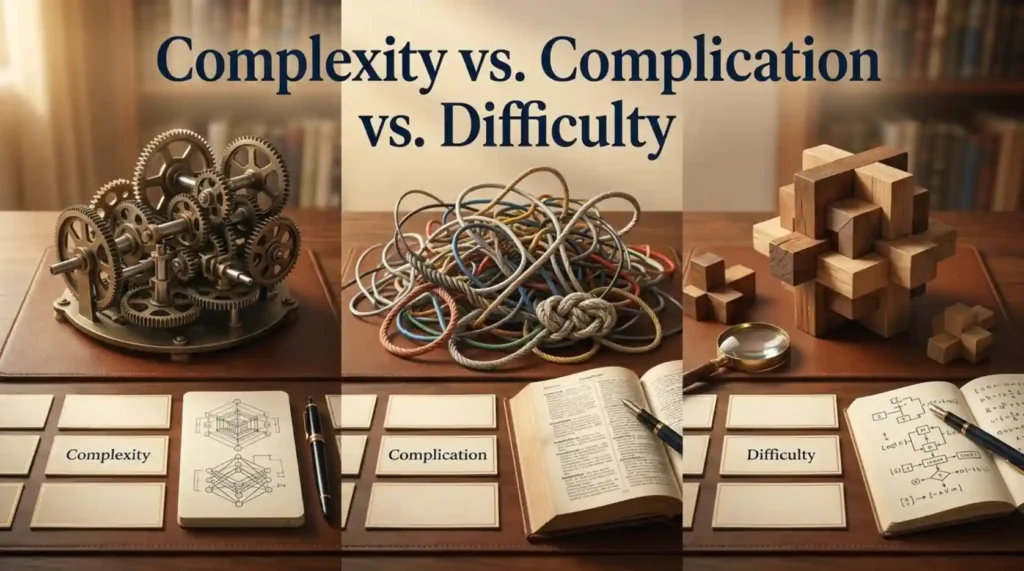
These three words overlap, but they are not interchangeable.
| Word | Focus | Typical Use | Example |
| Complexity | Many connected parts | Systems, structures, ideas | The complexity of the immune system |
| Complication | An extra problem | Plans, health, law | A complication in the plan |
| Difficulty | How hard something is | Tasks, tests, learning | The difficulty of the test |
A system can be complex without being difficult. A task can be difficult without being complex. A complication is one specific problem inside a larger situation.
Sources: Merriam-Webster.
Complexity and Opposite/Paired Word Pairs
| Word | Paired Word | Note |
| Complexity | Simplicity | The most direct opposite. |
| Complexity | Clarity | Used when complexity hides meaning. |
| Complexity | Ease | Contrasts difficulty with effortlessness. |
| Complexity | Uniformity | Contrasts many different parts with one kind. |
| Complexity | Straightforwardness | Describes direct, easy-to-follow things. |
| Complexity | Order | A loose pair, because a complex system can still be orderly. |
Simplicity is the true opposite. The other words are contrasts that fit particular senses, so choose the one that matches what you mean.
Sources: Merriam-Webster Thesaurus.
Common Word Partners of “Complexity”
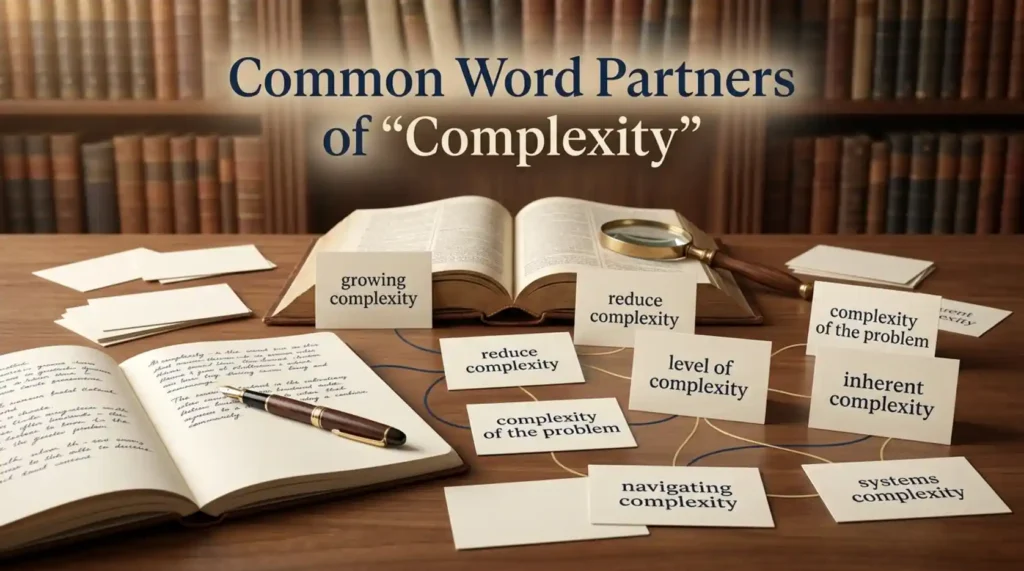
| Pattern | Common Partners | Example |
| adjective + complexity | growing, increasing, great, added, unnecessary | Unnecessary complexity slows teams down. |
| verb + complexity | reduce, manage, handle, understand, reflect | The report reflects the complexity of the issue. |
| complexity + of | the issue, the task, the system, the problem | We underestimated the complexity of the task. |
| level / degree of + complexity | high, low, varying | The level of complexity varies by project. |
| layer of + complexity | an extra, another | The new law adds a layer of complexity. |
| technical term + complexity | time, space, computational | Time complexity affects how fast code runs. |
Sources: Merriam-Webster; common usage.
Idiomatic Phrases Featuring “Complexity”
Complexity has no strong idioms of its own. The expressions below are established phrases, not true idioms.
1. Layers of complexity
- Meaning: Several levels of detail or difficulty inside one subject.
- Example: The case has layers of complexity that took months to sort out.
2. Computational complexity
- Meaning: A technical term for the amount of computing resources a problem needs.
- Example: The computational complexity of the problem makes it slow to solve.
3. Complexity theory
- Meaning: The study of how hard problems are to solve with computers.
- Example: She teaches a course on complexity theory.
Sources: Merriam-Webster; standard usage in computer science.
Word Formation of “Complexity”
Etymology & Structure
Complexity is built from complex plus the noun-forming ending -ity. Complex comes from the Latin complecti, meaning “to entwine around” or “to embrace,” a word based partly on plectere, “to braid.” The idea of things woven together is still visible in the modern meaning.
Date and History
Merriam-Webster gives circa 1652 as the first known use of complex. The noun complexity came later. A reliable first date for it should be checked in the OED or Etymonline before publishing.
Word Class Variations
- Noun: complexity, complexities, complexness
- Adjective: complex
- Adverb: complexly
- Verb: complexify (informal)
- Noun (from the same root): complex, as in an apartment complex
Sources: Merriam-Webster (entry for complex).
Common Word-Choice Mistakes
- The complexity of the problem is easy: use simplicity or ease when you mean the opposite.
- a complexity inside the plan: say a complication for one specific problem.
- the difficulty of the system’s parts: say the complexity or intricacy when you mean many parts.
- a morass of beauty: use intricacy or richness for positive detail, because morass sounds negative.
- the sophistication of the mess: use sophistication only for skillful, advanced design.
- very complexity: use the adjective very complex.
- a complexity of cases: use a variety of cases or a multiplicity of cases.
Frequently Asked Questions
What is the closest synonym for complexity?
Intricacy is the closest everyday synonym when you mean many connected parts. Complication is the closest when you mean something that makes a situation harder.
What is a simple word for complexity?
Difficulty is the simplest everyday word, though it focuses on effort and not on the number of parts.
What is the difference between complexity and complication?
Complexity describes the overall state of having many parts. A complication is one specific problem that makes something harder.
What is a formal alternative to complexity?
Multiplicity and interconnectedness are formal choices, especially in academic writing.
What is a literary alternative?
Labyrinth works well in literary writing for a confusing maze of detail.
What is the opposite of complexity?
Simplicity is the direct opposite. Clarity and ease are also common contrasts.
Can complexity be a positive word?
Yes. It can describe rich, skillful design. Sophistication, depth, and richness keep that positive tone.
Is complexity the same as difficulty?
No. Something can be complex but easy to use, or simple but hard to do.
Can I use complexity for people?
Yes, in a figurative way, such as “the complexity of her character.” Depth or nuance often sound more natural.
What does complexity mean in computer science?
It is a measure of how much time or memory an algorithm needs. Time complexity and computational complexity are the common terms.
Conclusion
The closest everyday alternatives to complexity are intricacy, complication, and difficulty. Words like sophistication and interconnectedness fit more specific meanings.
Context decides the best choice. Some words describe the structure (many connected parts), some describe the experience (hard to understand), and some describe the effect (a problem or burden). Words like morass and headache add a negative tone, while depth and richness add a positive one.
To choose well, ask what you want to stress: the number of parts, the difficulty, or the problem it causes. Then pick the word that matches that point.