What Does “Means” Really Mean? 30 Alternatives for Different Contexts
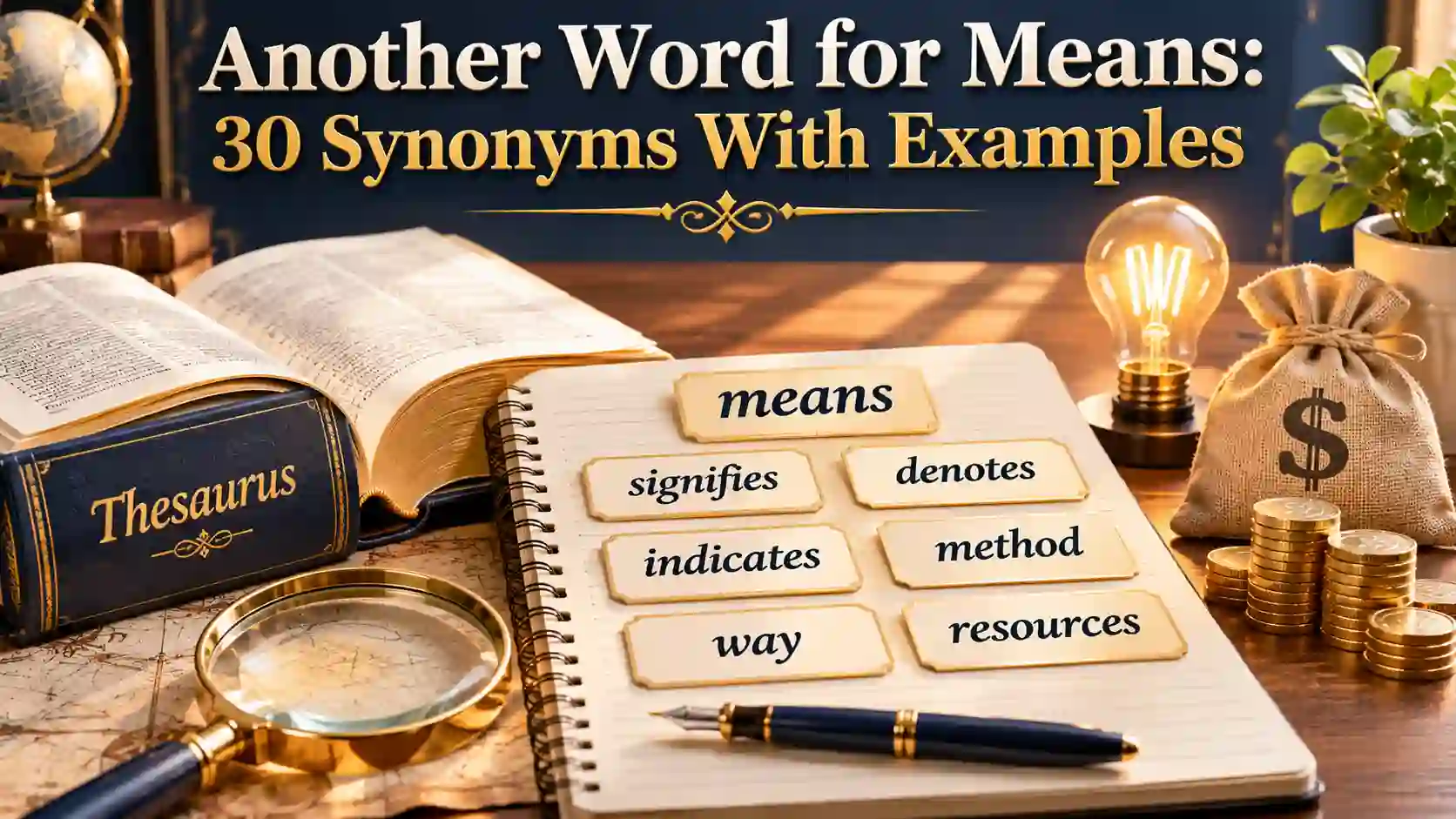
The closest everyday alternatives to “means” are signifies, denotes, indicates, and stands for when it explains what something says.When it means a way of doing something, use way, method, or medium. When it means money, use funds or resources. When it means a plan or purpose, use intends.
“Means” is both a verb and a noun, so the best word depends on the sense. The verb can show meaning (“A red light means stop”), intention (“She means to leave”), or result (“Winning means more work”). The noun can show a method (“a means of travel”) or money (“a person of means”). Pick the word that fits the sense you need.
Quick list: stands for, signifies, denotes, indicates, represents, implies, intends, method, way, resources
This article looks at 30 alternatives, with meanings, IPA, usage notes, examples, and context.
At a Glance: Means Synonyms and Related Alternatives
| Alternative | Part of Speech | Meaning | Register / Tone | Ideal Context |
| Signifies | Verb | Has a particular meaning | Neutral to formal | Explaining symbols or words |
| Denotes | Verb | Names or marks something exactly | Formal | Definitions, technical writing |
| Indicates | Verb | Points to or shows something | Neutral | Signs, data, evidence |
| Represents | Verb | Stands as a sign of something | Neutral | Symbols, colors, charts |
| Implies | Verb | Suggests without saying directly | Neutral | Hidden or unstated meaning |
| Intends | Verb | Plans or has in mind to do | Neutral | Plans and purposes |
| Entails | Verb | Makes necessary or brings with it | Formal | Costs, duties, consequences |
| Method | Noun | An organized way of doing something | Neutral | Processes and techniques |
| Way | Noun | A manner of doing something | Informal to neutral | Everyday explanations |
| Resources | Noun | Money or supplies one can use | Neutral to formal | Finance, planning |
Which Word Should You Use?

| If you want to… | Use | Why |
| Explain what a word or symbol means | stands for, signifies | Both are clear and natural for definitions |
| Be formal or technical about a definition | denotes | It suggests a precise, dictionary-style meaning |
| Say something points to a fact or trend | indicates | It fits evidence, signs, and data |
| Show an unstated message | implies, suggests | Both carry meaning that is not said openly |
| Say what someone plans to do | intends | It replaces “means to” without changing the sense |
| Show a result or cost | entails, involves | Both show what comes with an action |
| Describe how something is done | method, way | Both replace the noun “means” |
| Talk about money | resources, funds, assets | Each fits a different kind of financial talk |
Exploring the Multiple Meanings of “Means”
1. To Have a Particular Meaning
- Meaning: To be defined as something, or to express an idea.
- Explanation: This is the most common sense of the verb. It explains what a word, sign, or symbol says.
- Example: The word “gratis” means free of charge.
2. To Intend
- Meaning: To plan or have in mind to do something.
- Explanation: This sense is followed by “to” and a verb. It is about a person’s purpose, not about a word’s definition.
- Example: I mean to call her tomorrow.
3. To Result In or Involve
- Meaning: To bring about something or make it necessary.
- Explanation: The subject is often an action or a decision, and what follows is the result.
- Example: Moving abroad means leaving your friends behind.
4. A Method or Way of Doing Something
- Meaning: A way, tool, or system used to reach a goal.
- Explanation: As a noun, “means” is often followed by “of.” It looks plural but is used with “a” or “the” as a singular noun, and the singular and plural look the same.
- Example: Email is the fastest means of reaching our team.
5. Money or Resources
- Meaning: The money or property a person has.
- Explanation: This noun sense is usually plural in meaning and appears in phrases like “a man of means” and “live within your means.”
- Example: She had the means to pay for the trip.
Sources: Merriam-Webster, “mean” and “means”; Collins English Dictionary, “mean” and “means”; Dictionary.com, “means.”
Analyzing 30 Means Alternatives in Detail

Some alternatives below are direct synonyms of one sense of “means,” while others are related words that fit only certain contexts, and each Usage note says which is which.
Group 1: Core Alternatives for “Means” as “Signifies”
1. Signifies
IPA: /ˈsɪɡnɪfaɪz/ (US and UK)
Definition: To be a sign of something or to have a particular meaning.
- Usage: A direct synonym of “means” in its definition sense. It is slightly more formal and often used for symbols or signs.
- Example: A white flag signifies surrender.
2. Denotes
IPA: US /dɪˈnoʊts/ · UK /dɪˈnəʊts/
Definition: To be a sign of something, or to refer to it directly.
- Usage: A direct synonym in a formal or technical register. It usually points to the exact, literal meaning of a word.
- Example: The term “mammal” denotes an animal that feeds its young milk.
3. Indicates
IPA: /ˈɪndɪkeɪts/ (US and UK)
Definition: To point out or show that something is true or present.
- Usage: A close synonym when something points to a fact or trend. It is weaker than “means” in definitions of words.
- Example: A high fever often indicates an infection.
4. Represents
IPA: /ˌrɛprɪˈzɛnts/ (US and UK)
Definition: To stand as a symbol of something.
- Usage: A good synonym for symbols, colors, and charts. It focuses on one thing standing in for another.
- Example: On this map, each blue line represents a river.
5. Stands for
IPA: US /ˈstændz fɔr/ · UK /ˈstændz fɔː/
Definition: To be a short form of something, or to be a symbol of it.
- Usage: The most natural everyday synonym for abbreviations and symbols. It is informal to neutral.
- Example: NASA stands for National Aeronautics and Space Administration.
6. Refers to
IPA: US /rɪˈfɝz tu/ · UK /rɪˈfɜːz tuː/
Definition: To point to or name a particular thing.
- Usage: A related alternative. It shows what a word points to in a given situation, not the full definition.
- Example: In this report, “the company” refers to our parent group.
7. Implies
IPA: /ɪmˈplaɪz/ (US and UK)
Definition: To suggest something without stating it openly.
- Usage: A related alternative. It fits hidden or unstated meaning, not a definition.
- Example: His silence implies that he disagrees.
8. Suggests
IPA: US /səɡˈdʒɛsts/ · UK /səˈdʒɛsts/
Definition: To make you think that something is likely or true.
- Usage: A related alternative that is weaker and less certain than “means.” It is good when the evidence is not final.
- Example: The pattern suggests the data may be wrong.
Group 2: Formal and Interpretive Alternatives
9. Connotes
IPA: US /kəˈnoʊts/ · UK /kəˈnəʊts/
Definition: To suggest an additional feeling or idea beyond the literal meaning.
- Usage: A related alternative, not an exact synonym. It describes the emotional or cultural meaning of a word, not its dictionary meaning.
- Example: The word “home” connotes warmth and safety.
10. Conveys
IPA: /kənˈveɪz/ (US and UK)
Definition: To communicate an idea or feeling.
- Usage: A related alternative. It focuses on the message being passed on, not on a fixed definition.
- Example: Her smile conveys more than words could.
11. Designates
IPA: /ˈdɛzɪɡneɪts/ (US and UK)
Definition: To mark or name something officially for a particular purpose.
- Usage: A formal, related alternative. It fits official labels and codes.
- Example: A red circle on the plan designates a fire exit.
12. Signals
IPA: /ˈsɪɡnəlz/ (US and UK)
Definition: To show that something exists or is about to happen.
- Usage: A close alternative when an event or action points to something coming. It is more about warning or change than definition.
- Example: A rise in prices often signals a shortage.
Group 3: Alternatives for “Means” as “Intends”
13. Intends
IPA: /ɪnˈtɛndz/ (US and UK)
Definition: To have a plan or purpose in mind.
- Usage: A direct synonym of “means to.” It is slightly more formal.
- Example: She intends to apply for the job next month.
14. Aims
IPA: /eɪmz/ (US and UK)
Definition: To try or plan to achieve something.
- Usage: A close alternative. It stresses the goal and is usually followed by “to” or “at.”
- Example: The team aims to finish by Friday.
15. Plans
IPA: /plænz/ (US and UK)
Definition: To decide in advance to do something.
- Usage: A close alternative for a clear decision. It suggests more organization than “means.”
- Example: He plans to move in the spring.
Group 4: Alternatives for “Means” as “Result In or Involve”
16. Entails
IPA: /ɪnˈteɪlz/ (US and UK)
Definition: To make something necessary or to bring it as a result.
- Usage: A formal, close synonym when one thing requires another.
- Example: The job entails long hours and some travel.
17. Involves
IPA: US /ɪnˈvɑːlvz/ · UK /ɪnˈvɒlvz/
Definition: To include something as a necessary part.
- Usage: A neutral, close alternative. It is less strong than “entails” and does not stress a result.
- Example: Learning to swim involves practice and patience.
18. Amounts to
IPA: /əˈmaʊnts tuː/ (US and UK)
Definition: To be equal to or the same in effect as something.
- Usage: A related alternative. It fits when one thing is really the same as another.
- Example: Ignoring the warning amounts to taking a big risk.
Group 5: Alternatives for “Means” as a Method
19. Method
IPA: /ˈmɛθəd/ (US and UK)
Definition: An organized way of doing something.
- Usage: A direct synonym for the noun “means.” It suggests a planned or repeatable process.
- Example: Boiling is a simple method of cleaning water.
20. Way
IPA: /weɪ/ (US and UK)
Definition: A manner or style of doing something.
- Usage: The most common everyday synonym for the method sense. It is informal and flexible.
- Example: This is the easiest way to get there.
21. Medium
IPA: /ˈmiːdiəm/ (US and UK)
Definition: A tool or channel through which something is communicated or done.
- Usage: A related alternative for communication or art. It does not fit every use of “means.”
- Example: Radio is a powerful medium for reaching rural areas.
22. Instrument
IPA: /ˈɪnstrəmənt/ (US and UK)
Definition: A tool or thing used to achieve a purpose.
- Usage: A formal, close alternative. It can be a physical tool or a more abstract thing, like a law or policy.
- Example: Education is an instrument of social change.
23. Channel
IPA: /ˈtʃænəl/ (US and UK)
Definition: A path or system through which something is sent or done.
- Usage: A related alternative. It fits communication, information, and official routes.
- Example: Use the official channel to submit your complaint.
24. Vehicle
IPA: US /ˈviːəkəl/ · UK /ˈviːɪkəl/
Definition: A thing used to express, carry, or achieve something.
- Usage: A figurative, related alternative. It is not a direct synonym and works only in certain contexts.
- Example: The film became a vehicle for his political ideas.
Group 6: Alternatives for “Means” as Money
25. Resources
IPA: US /ˈriːsɔrsɪz/ · UK /rɪˈsɔːsɪz/
Definition: Money, supplies, or other things that can be used when needed.
- Usage: A close synonym for the money sense. It also covers non-money items like time and staff.
- Example: The charity has limited resources.
26. Funds
IPA: /fʌndz/ (US and UK)
Definition: Money that is available for a particular use.
- Usage: A close alternative. It stresses money set aside for a purpose, not general wealth.
- Example: We don’t have the funds to hire anyone new.
27. Wealth
IPA: /wɛlθ/ (US and UK)
Definition: A large amount of money or valuable property.
- Usage: A related alternative. “Means” can be modest, but “wealth” always suggests a lot.
- Example: The family’s wealth came from shipping.
28. Assets
IPA: /ˈæsɛts/ (US and UK)
Definition: Things of value that a person or company owns.
- Usage: A formal, related alternative used in finance and law. It covers property as well as cash.
- Example: The company sold several assets to pay its debts.
29. Capital
IPA: /ˈkæpɪtəl/ (US and UK)
Definition: Money or property used to start or grow a business.
- Usage: A related alternative. It does not mean general personal money and fits business and investing.
- Example: She needed more capital to open a second shop.
30. Finances
IPA: US /fəˈnænsɪz/ · UK /faɪˈnænsɪz/
Definition: The money a person, family, or organization has and how it is managed.
- Usage: A close alternative to the money sense when talking about how money is handled.
- Example: They checked their finances before buying a house.
Sources: Merriam-Webster, entries for the words above; Collins English Dictionary and Collins Thesaurus; Dictionary.com.
Means as a Verb vs. Means as a Noun: How to Tell the Difference
The same spelling can be a verb or a noun. The sentence shows which one it is.
| Form | Meaning | Example | Better Alternatives |
| Verb (“it means”) | Has a meaning | “Stop” means do not go on. | signifies, stands for, denotes |
| Verb (“means to”) | Intends | He means to help. | intends, plans, aims |
| Verb (“means that”) | Results in | Rain means we stay inside. | entails, involves |
| Verb (“means a lot”) | Matters to someone | Your support means a lot to me. | matters, counts |
| Noun (“a means of”) | Method | A bike is a means of travel. | method, way, instrument |
| Noun (“of means”) | Money | She is a woman of means. | resources, wealth, funds |
The verb has other forms: mean, means, meant, and meaning. The noun “means” never changes its spelling. It takes a singular verb when it refers to one method (“This is a means of escape”) and a plural verb when it refers to several (“These means are not enough”).
Sources: Merriam-Webster, “mean” (verb) and “means” (noun); Collins English Dictionary, “means.”
Means and Opposite/Paired Word Pairs
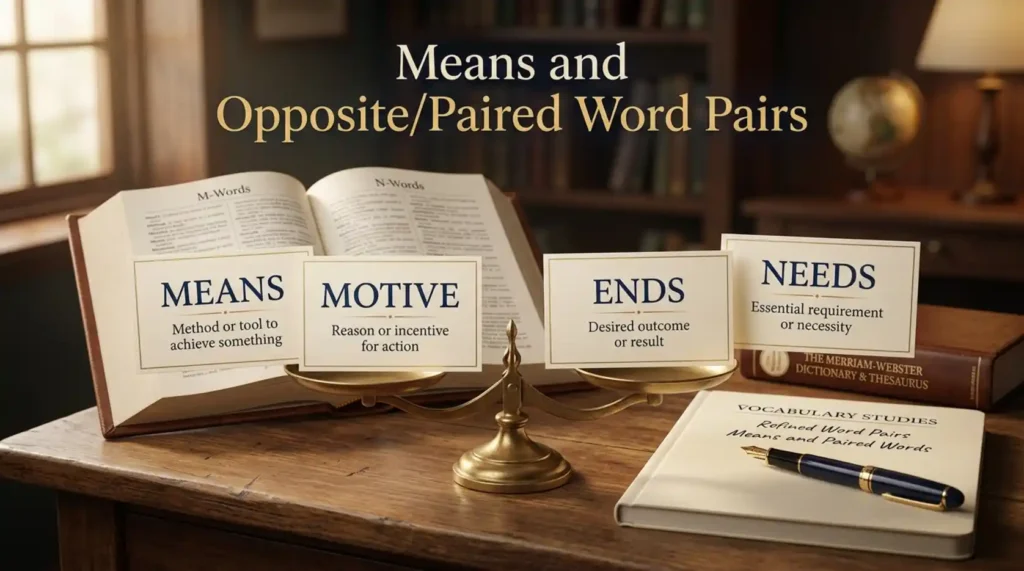
“Means” has no true opposite in its verb sense. The noun forms do have useful pairs.
| Word | Paired Word | Note |
| Means | Ends | Used for methods and goals in “means to an end.” |
| Means | Motive | Paired in the legal phrase “means, motive, and opportunity.” |
| Ways | Means | Joined in the set phrase “ways and means.” |
| Means (money) | Needs | Compares what a person has with what they must pay for. |
| Within one’s means | Beyond one’s means | Opposite phrases about spending. |
Most of these pairs show up together in real phrases. They are not strict opposites, so they are best learned as pairs.
Sources: Merriam-Webster, “means” and “by means of”; Collins English Dictionary, “ways and means.”
Common Word Partners of “Means”
| Pattern | Common Partners | Example |
| means of + noun | transport, communication, escape, payment, production | The ferry was their only means of transport. |
| adjective + means | financial, private, legal, effective, limited | She has private means. |
| means that + clause | this, it, that | This means that we must start again. |
| means + noun (verb) | a lot, nothing, everything, something | Your help means a lot to me. |
| by + means | by means of, by all means, by no means | He opened it by means of a key. |
| means test | a means test, means-tested benefits | The program uses a means test. |
Sources: Collins English Dictionary and Merriam-Webster entries for “means.”
Idiomatic Phrases Featuring “Means”
1. By all means
- Meaning: Yes, of course; used to give permission.
- Example: “May I borrow your pen?” “By all means.”
2. By no means
- Meaning: Not at all.
- Example: The task is by no means easy.
3. A means to an end
- Meaning: Something done only to get a result, not for its own sake.
- Example: For her, the job was only a means to an end.
4. Live beyond your means
- Meaning: To spend more money than you earn.
- Example: They lived beyond their means and ended up in debt.
Sources: Merriam-Webster, entries for the expressions above; Collins English Dictionary.
Word Formation of “Means”
Etymology & Structure
The verb “mean” comes from Old English mǣnan, which meant to tell, say, or intend. It is related to German meinen. The noun “means” has a different path. It comes from the adjective “mean” in the sense of “middle” or “in between,” through Old French and Latin. The idea is that a method stands between a person and a goal.
Date and History
The verb goes back to Old English. The noun “means” appears in Middle English. For precise first dates for each sense, check Etymonline and the Oxford English Dictionary, because the money and method senses developed at different times.
Word Class Variations
- Verb: mean, means, meant, meaning
- Noun: meaning, means, meanings
- Adjective: meaningful, meaningless
- Adverb: meaningfully
Sources: Etymonline, “mean” (verb) and “means”; Merriam-Webster; Collins English Dictionary.
Common Word-Choice Mistakes
- “A mean of transport”: correct form is “a means of transport.”
- “I denote to leave”: correct form is “I mean to leave.”
- “He lives beyond his mean”: correct form is “beyond his means.”
- “She suggests me to go”: correct form is “She suggests that I go.”
- “I infer you are upset” when you mean you are hinting it: use “imply.” You imply a message, but you infer it from someone else’s words.
- “By all means, I disagree”: “by all means” is a polite yes, so use “by no means” for a strong no.
- “The job means a high salary” when you want a formal tone: “entails” or “involves” better suits requirements, and “means” suits results.
Frequently Asked Questions
What is the closest synonym for “means”?
For the common sense, “signifies” and “stands for” are the closest. For intention, use “intends.”
What is a formal alternative to “means”?
“Denotes” and “signifies” are formal for meaning, and “entails” is formal for results.
What is the difference between “denotes” and “connotes”?
“Denotes” is the literal meaning of a word, while “connotes” is the feeling or idea that goes with it.
What is the difference between “imply” and “infer”?
A speaker implies something, and a listener infers it.
Can “means” be used for money?
Yes. In phrases like “a person of means,” it means money or wealth.
What is a good alternative to “means of”?
Use “way of,” “method of,” or “instrument of,” depending on the sentence.
Is “means” singular or plural?
It can be either. “A means” is singular and “these means” is plural, and the noun’s spelling does not change.
What is the opposite of “means” as a method?
There is no direct opposite, but “ends” is its natural pair in “means and ends.”
What does “by all means” mean?
It means “certainly” or “of course” and is used to give permission.
Is “means” the same as “intends”?
Only when followed by “to.” “She means to go” and “She intends to go” are very close.
Conclusion
The closest everyday alternatives to “means” are “signifies,” “stands for,” and “denotes” for meaning, “intends” for plans, “method” and “way” for how something is done, and “resources” or “funds” for money. Each one covers a different sense.
Context matters because “means” has several uses. A word that fits one sense may sound wrong in another, so “denotes” works for a definition but not for a plan.
To choose the right word, first decide which sense you need: meaning, intention, result, method, or money. Then pick the alternative that fits the tone, formal or casual, and test it in the sentence.