
Another Word for Productive: 30 Synonyms With Examples
The closest everyday alternatives to productive are effective, efficient, fruitful, and useful. If you mean someone creates a lot of work, prolific is often the best choice; if you mean something produces good results, effective or successful fits better.
The right word depends on If you are talking about work, results, land, creativity, or output. Productive can describe a hard-working person, a useful meeting, fertile soil, a successful discussion, or a writer who produces many books.
Quick list: effective, efficient, fruitful, useful, successful, prolific, constructive, valuable, worthwhile, profitable, creative, industrious, high-output, fertile, beneficial.
This article explains 30 alternatives with meanings, IPA, usage notes, examples, and the contexts in which each word works best.
At a Glance: Productive Synonyms and Related Alternatives
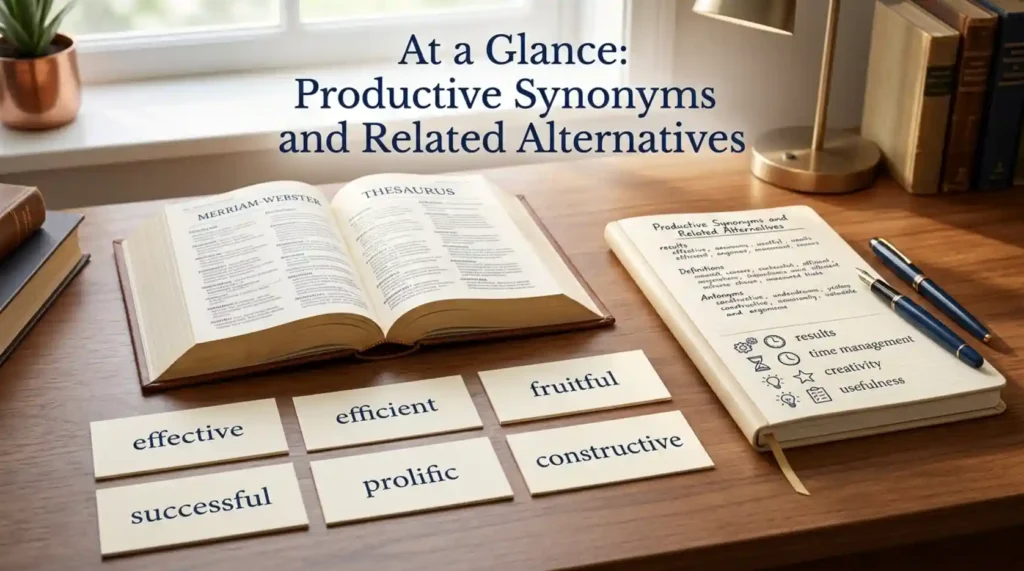
| Alternative | Part of Speech | Meaning | Register / Tone | Ideal Context |
| Effective | Adjective | Producing the intended result | Neutral | Work, plans, methods |
| Efficient | Adjective | Achieving results without wasting time, money, or effort | Neutral, professional | Business, systems, work habits |
| Fruitful | Adjective | Producing good or useful results | Slightly formal | Meetings, research, relationships |
| Useful | Adjective | Helpful or serving a purpose | Neutral, everyday | Advice, tools, information |
| Successful | Adjective | Achieving a desired aim | Neutral | Projects, people, outcomes |
| Prolific | Adjective | Producing a large amount of work or output | Formal to neutral | Writers, artists, inventors |
| Constructive | Adjective | Helping to improve or build something positive | Neutral, professional | Feedback, discussions, criticism |
| Valuable | Adjective | Worth a lot; helpful or important | Neutral | Experience, advice, contributions |
| Worthwhile | Adjective | Worth the time, effort, or money spent | Neutral | Activities, projects, discussions |
| Profitable | Adjective | Producing money or financial gain | Business, formal | Companies, investments, products |
Which Word Should You Use?

| If you want to… | Use | Why |
| Say a method gets results | Effective | It focuses on achieving the intended result. |
| Describe work done with little waste | Efficient | It emphasizes speed, organization, and resource use. |
| Describe a meeting with good outcomes | Fruitful | It suggests useful results or progress. |
| Praise a writer or artist who creates a lot | Prolific | It specifically means producing many works. |
| Describe helpful feedback | Constructive | It means feedback that helps someone improve. |
| Say an activity was worth doing | Worthwhile | It focuses on value compared with effort. |
| Describe a business that makes money | Profitable | It is the natural business and finance term. |
| Describe soil that grows crops well | Fertile | It is the standard word for land that supports growth. |
Exploring the Multiple Meanings of “Productive”
1. Producing a lot or in abundance
- Meaning: Producing a large amount of something.
- Explanation: This sense can describe people, animals, land, factories, or creative work. It focuses on quantity of output.
- Example: She has been very productive this month and finished three reports.
2. Achieving useful or desired results
- Meaning: Producing good, useful, or successful results.
- Explanation: Here, productive does not only mean “a lot”; it means the activity led somewhere useful.
- Example: The meeting was productive because the team agreed on a clear plan.
3. Making or creating something
- Meaning: Having the power to produce or create.
- Explanation: This sense is common in economics, science, and technical language. It describes something that creates goods, value, or other results.
- Example: Productive farmland helps the region grow more food.
4. Fertile or able to support growth
- Meaning: Producing abundant crops, plants, or life.
- Explanation: This use often applies to soil, fishing waters, or ecosystems. Fertile is often the closest alternative.
- Example: The river delta has productive fishing waters.
5. Used to form new words or structures
- Meaning: In grammar, able to create many new words or forms.
- Explanation: A productive suffix or pattern can be used freely to make new expressions. This is a specialized linguistic meaning.
- Example: The suffix “-ness” is productive in English because it forms many abstract nouns.
Sources: Merriam-Webster; Cambridge Dictionary; Collins English Dictionary.
Analyzing 30 Productive Alternatives in Detail

Some alternatives are direct synonyms, while others fit only particular senses of productive, such as work output, useful results, fertility, or financial gain.
Core Synonyms for Results and Usefulness
1. Effective
IPA: /ɪˈfɛktɪv/ (US and UK)
Definition: Successful in producing the result that you want.
- Usage: This is one of the closest general alternatives to productive when the focus is on results rather than the amount of work done.
- Example: Regular practice is an effective way to improve your English.
2. Efficient
IPA: /ɪˈfɪʃənt/ (US and UK)
Definition: Working well without wasting time, money, or energy.
- Usage: Use efficient when productivity involves using resources wisely. It does not necessarily mean the result is good in quality.
- Example: The new software made the billing process more efficient.
3. Fruitful
IPA: /ˈfruːtfəl/ (US and UK)
Definition: Producing good or useful results.
- Usage: Fruitful is slightly more formal than productive and often describes meetings, research, discussions, and relationships.
- Example: Their conversation was fruitful and led to a new partnership.
4. Useful
IPA: /ˈjuːsfəl/ (US and UK)
Definition: Able to help you do or achieve something.
- Usage: Useful is a simple, everyday alternative when productive means helpful or valuable.
- Example: The workshop gave us several useful ideas.
5. Successful
IPA: /səkˈsɛsfəl/ (US and UK)
Definition: Achieving what you wanted to achieve.
- Usage: Use successful when you want to emphasize that a goal was reached. It is broader than productive.
- Example: The campaign was successful in attracting new customers.
6. Constructive
IPA: /kənˈstrʌktɪv/ (US and UK)
Definition: Helping to improve something or make progress.
- Usage: Constructive is especially common with feedback, criticism, discussions, and relationships. It is related to productive, but it emphasizes positive improvement.
- Example: She gave constructive feedback that helped the team improve the design.
7. Beneficial
IPA: /ˌbɛnɪˈfɪʃəl/ (US and UK)
Definition: Producing good results or advantages.
- Usage: Beneficial focuses on benefits, often to health, society, or a group. It is related rather than an exact synonym.
- Example: Walking every day is beneficial for your health.
8. Worthwhile
IPA: /ˈwɜːrθwaɪl/ (US and UK)
Definition: Worth the time, effort, or money spent.
- Usage: Use worthwhile when judging whether an activity produced enough value. It is a contextual alternative to productive.
- Example: The training was worthwhile because everyone learned practical skills.
9. Valuable
IPA: /ˈvæljuəbəl/ (US and UK)
Definition: Very helpful, important, or worth a lot.
- Usage: Valuable describes the worth of a result, contribution, or experience rather than the act of producing it.
- Example: Her advice was valuable during the project.
10. Rewarding
IPA: /rɪˈwɔːrdɪŋ/ (US and UK)
Definition: Giving you satisfaction, benefit, or a good result.
- Usage: Rewarding emphasizes personal satisfaction as well as results. It is related to productive, not identical.
- Example: Volunteering at the shelter has been a rewarding experience.
High-Output and Creative Alternatives
11. Prolific
IPA: /prəˈlɪfɪk/ (US and UK)
Definition: Producing a large number of works, ideas, or results.
- Usage: Prolific is the best choice for writers, artists, musicians, inventors, and athletes who produce a great deal. It emphasizes quantity more than usefulness.
- Example: The author was prolific, publishing a novel nearly every year.
12. Creative
IPA: /kriˈeɪtɪv/ (US and UK)
Definition: Using imagination to make new or original things.
- Usage: Creative relates to productive when the output is artistic or original, but it does not necessarily mean a person produces a lot.
- Example: The team found a creative solution to the delivery problem.
13. Generative
IPA: /ˈdʒɛnərətɪv/ (US and UK)
Definition: Able to produce or create something.
- Usage: Generative is more technical or academic than productive. It is common in linguistics, biology, and technology.
- Example: The discussion was generative, producing several new project ideas.
14. Fecund
IPA: /ˈfiːkənd/ (US and UK)
Definition: Producing many offspring, ideas, or results; fertile.
- Usage: Fecund is formal and literary. It can describe soil, imagination, or creative ability, but it is less common in everyday speech.
- Example: The region’s fecund soil supports many small farms.
15. Fertile
IPA: /ˈfɜːrtaɪl/ (US and UK)
Definition: Able to produce crops, plants, young, or many ideas.
- Usage: Use fertile for land, imagination, or conditions that support growth. It is the closest alternative for the agricultural sense of productive.
- Example: The valley has fertile soil and a long growing season.
16. Abundant
IPA: /əˈbʌndənt/ (US and UK)
Definition: Existing or available in large amounts.
- Usage: Abundant describes supply or quantity, not the process of producing it. It is a related alternative for productive land or waters.
- Example: The forest provides an abundant supply of mushrooms in autumn.
17. Bountiful
IPA: /ˈbaʊntɪfəl/ (US and UK)
Definition: Large in amount; generous or plentiful.
- Usage: Bountiful is more descriptive and slightly literary. It often describes harvests, supplies, or gifts.
- Example: The farmers had a bountiful harvest this year.
18. Teeming
IPA: /ˈtiːmɪŋ/ (US and UK)
Definition: Full of people, animals, or things.
- Usage: Teeming emphasizes being full or crowded. It is related to the abundance sense of productive, but it does not mean effective.
- Example: The wetland is teeming with birds in spring.
Hard-Working and Active Alternatives
19. Industrious
IPA: /ɪnˈdʌstriəs/ (US and UK)
Definition: Hard-working and diligent.
- Usage: Industrious describes a person’s character and effort. A person can be industrious without being productive if their work does not produce results.
- Example: The industrious students finished their assignments early.
20. Diligent
IPA: /ˈdɪlɪdʒənt/ (US and UK)
Definition: Working carefully and with steady effort.
- Usage: Diligent highlights care and persistence. It is related to productivity but focuses on how someone works.
- Example: He is a diligent worker who checks every detail.
21. Busy
IPA: /ˈbɪzi/ (US and UK)
Definition: Occupied with work or activity.
- Usage: Busy does not mean productive. Someone can be busy without achieving much, so use it only when activity itself matters.
- Example: She was busy all morning preparing for the presentation.
22. Active
IPA: /ˈæktɪv/ (US and UK)
Definition: Doing things; involved in activity.
- Usage: Active is broader than productive. It can describe movement, participation, or energy rather than results.
- Example: He remains active in local community projects.
23. Dynamic
IPA: /daɪˈnæmɪk/ (US and UK)
Definition: Full of energy and new ideas; forceful.
- Usage: Dynamic often describes people, teams, or organizations. It suggests energy and change, not necessarily measurable output.
- Example: The company has a dynamic team of young designers.
Business and Financial Alternatives
24. Profitable
IPA: /ˈprɒfɪtəbəl/ (US and UK)
Definition: Producing money or financial gain.
- Usage: Use profitable in business contexts. A productive factory is not always profitable if costs are too high.
- Example: The online store became profitable after two years.
25. Gainful
IPA: /ˈɡeɪnfəl/ (US and UK)
Definition: Bringing in money, especially through work.
- Usage: Gainful is formal and usually appears in phrases such as “gainful employment.” It relates to earning, not general productivity.
- Example: She found gainful employment shortly after graduating.
26. Lucrative
IPA: /ˈluːkrətɪv/ (US and UK)
Definition: Producing a large amount of money.
- Usage: Lucrative emphasizes high financial reward. It is stronger and more specific than productive.
- Example: The company signed a lucrative contract with a major retailer.
Growth, Recovery, and Descriptive Alternatives
27. Thriving
IPA: /ˈθraɪvɪŋ/ (US and UK)
Definition: Growing, developing, or doing well.
- Usage: Thriving describes ongoing success and health. It is related to productive for businesses, communities, and ecosystems.
- Example: The neighborhood has a thriving market for local food.
28. Flourishing
IPA: /ˈflʌrɪʃɪŋ/ (US and UK)
Definition: Growing strongly or being successful.
- Usage: Flourishing is similar to thriving but often sounds slightly more literary. It describes healthy development over time.
- Example: The city’s flourishing arts scene attracts many visitors.
29. High-yielding
IPA: /ˌhaɪˈjiːldɪŋ/ (US and UK)
Definition: Producing a large amount of a crop, product, or return.
- Usage: High-yielding is technical and common in farming, science, and finance. It is a precise alternative for the abundance sense of productive.
- Example: The farm switched to a high-yielding variety of rice.
30. Resultful
IPA: /rɪˈzʌltfəl/ (US and UK)
Definition: Producing results.
- Usage: Resultful is much less common than productive or effective. Use it only when you specifically want to stress that results were produced.
- Example: The talks were resultful, ending with a signed agreement.
Sources: Merriam-Webster Thesaurus; Cambridge English Thesaurus; Collins English Thesaurus; Collins English Dictionary.
Productive vs. Effective vs. Efficient
These three words overlap, but they answer different questions.
| Word | Main question | Example |
| Productive | Did it produce a lot or produce something useful? | “It was a productive morning; I finished two reports.” |
| Effective | Did it achieve the intended result? | “The new policy was effective in reducing errors.” |
| Efficient | Did it achieve results without waste? | “The new system is efficient because it saves time.” |
A worker can be busy but not productive, productive but not efficient, or efficient but not effective if the wrong goal is being pursued. Choose the word based on If you care most about output, results, or resource use.
Sources: Merriam-Webster; Cambridge Dictionary.
Productive and Opposite/Paired Word Pairs
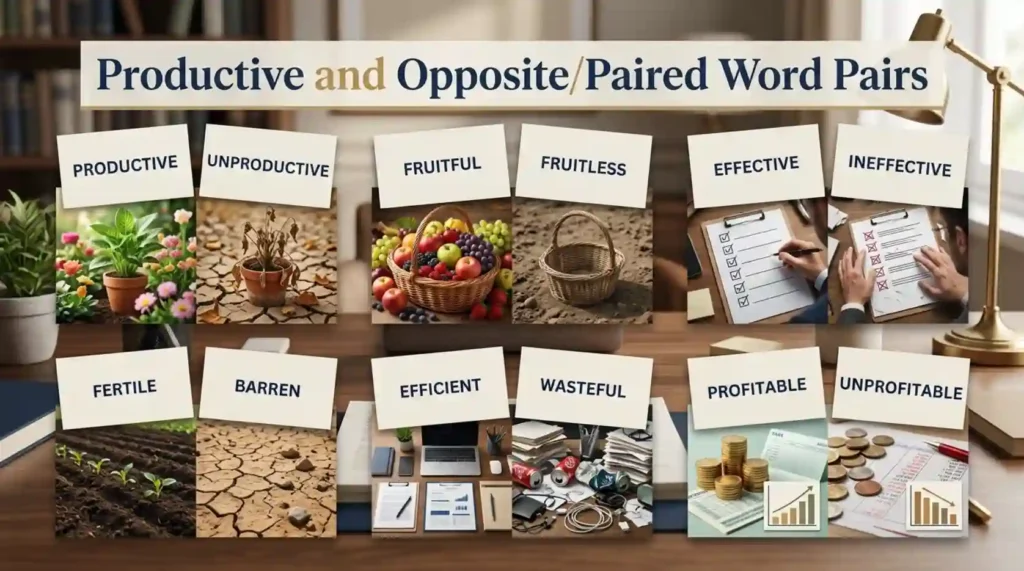
| Word | Paired Word | Note |
| Productive | Unproductive | The direct opposite; means not producing much or not producing useful results. |
| Productive | Counterproductive | Means having the opposite of the intended helpful effect. |
| Fertile | Barren | A natural contrast for land, soil, or imagination. |
| Fruitful | Fruitless | Fruitless means producing no useful result. |
| Effective | Ineffective | A direct contrast for methods and actions. |
| Efficient | Wasteful | Contrasts careful use of resources with poor use of resources. |
| Prolific | Sparse | Contrasts high output with very little output. |
| Profitable | Unprofitable | A direct business and finance contrast. |
These pairs are useful because many alternatives to productive have a matching negative form. For example, a fruitful meeting produces progress, while a fruitless meeting produces none.
Sources: Collins English Dictionary; Cambridge Dictionary.
Common Word Partners of “Productive”
| Pattern | Common Partners | Example |
| Productive + noun | day, meeting, discussion, conversation, relationship | “We had a productive meeting.” |
| Highly / very + productive | highly productive, very productive | “She is a highly productive writer.” |
| Productive + use of | use of time, use of resources | “The course encourages productive use of class time.” |
| Productive + member | member of society, member of the team | “He is a productive member of the team.” |
| Productive + capacity | capacity, capacity of the economy | “The factory increased its productive capacity.” |
| Become / remain + productive | become productive, remain productive | “The team remained productive during the busy season.” |
These combinations reflect the most common everyday and professional uses of productive. They are collocations rather than fixed idioms.
Sources: Cambridge Dictionary; Collins English Dictionary.
Idiomatic Phrases Featuring “Productive”
Productive does not appear in many true idioms, but several established expressions use its related ideas of output, results, and effort.
1. A productive day
- Meaning: A day in which you complete a good amount of useful work.
- Example: After answering emails, planning the project, and finishing the report, she called it a productive day.
2. Productive use of time
- Meaning: Time spent in a way that creates value or helps you reach a goal.
- Example: Reading on the train was a productive use of time.
3. Necessity is the mother of invention
- Meaning: When people really need something, they often find a creative way to get it or solve the problem.
- Example: With no delivery service nearby, the village started its own courier system; necessity is the mother of invention.
4. Put something to productive use
- Meaning: Use something in a way that creates value or useful results.
- Example: The city put the empty building to productive use as a community center.
Sources: BBC Learning English; Merriam-Webster.
Word Formation of “Productive”
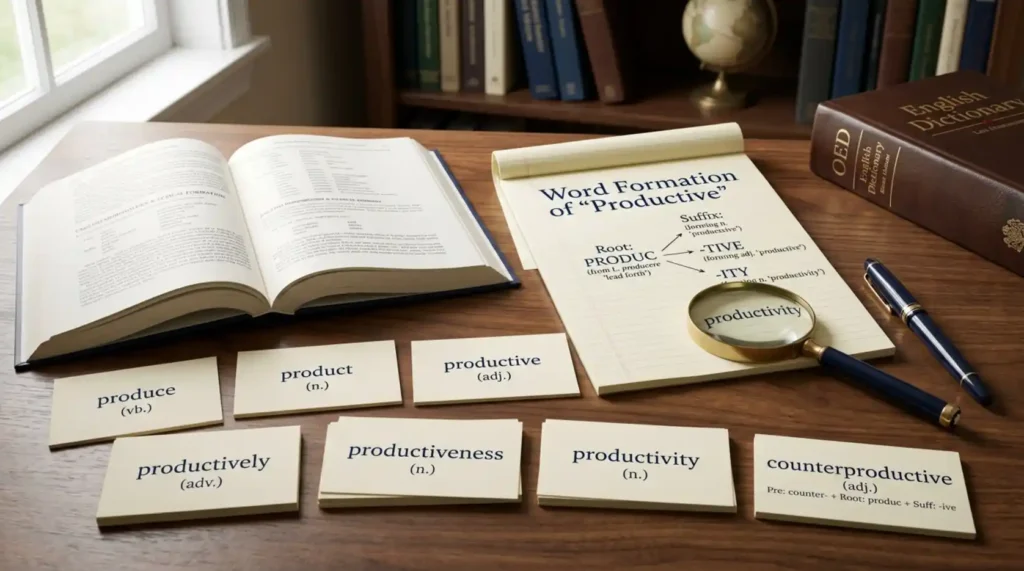
Etymology & Structure
Productive comes from Medieval Latin productivus, meaning “fit for production.” It entered English through French productif. The root is Latin producere, meaning “to bring forth” or “lead forward,” formed from pro- (“forward”) and ducere (“to lead”).
Date and History
Productive was first recorded in English in the 1610s with the meaning “serving to produce.” By 1706, it was also used to mean “fertile” or “producing abundantly.”
Word Class Variations
- Adjective: productive — “a productive meeting”
- Adverb: productively — “They worked productively.”
- Noun: productiveness — “the productiveness of the soil”
- Related noun: productivity — “Employee productivity increased.”
- Related verb: produce — “The factory produces cars.”
- Related noun: product — “The company launched a new product.”
- Related adjective: counterproductive — “The rule was counterproductive.”
Sources: Etymonline; Dictionary.com.
Common Word-Choice Mistakes
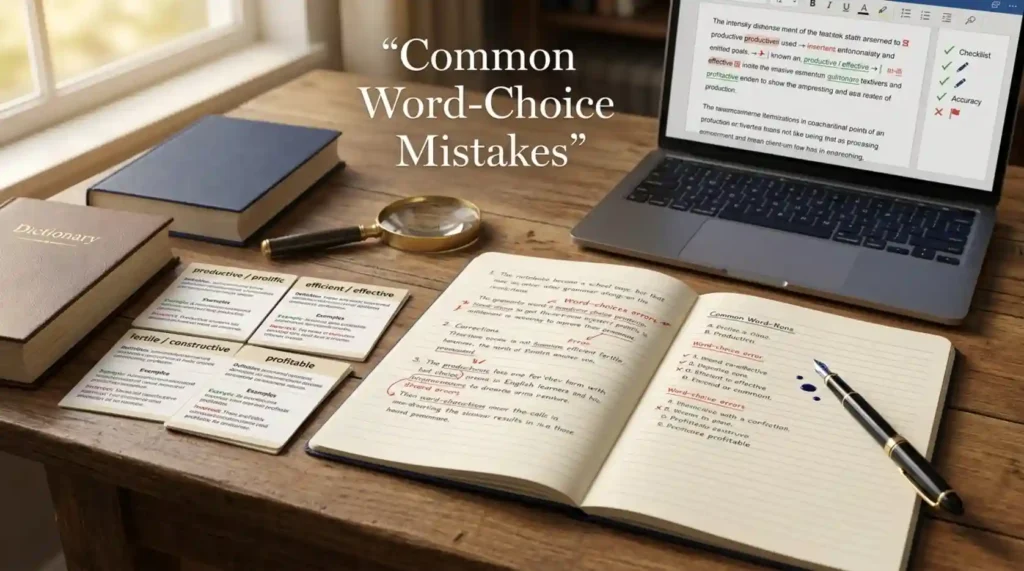
- Wrong: “She is a very prolific worker.” Better: “She is a very productive worker.” Prolific usually describes creators who make many works.
- Wrong: “The meeting was very efficient.” Better: “The meeting was productive.” Efficient emphasizes saving time or resources, not necessarily good outcomes.
- Wrong: “The soil is very effective.” Better: “The soil is very fertile.” Fertile is the natural word for land.
- Wrong: “He was busy, so he was productive.” Better: “He was busy, but he was not very productive.” Being busy does not prove output.
- Wrong: “The feedback was productive.” Better: “The feedback was constructive.” Constructive is the usual word for helpful feedback.
- Wrong: “The business is very fruitful.” Better: “The business is very profitable.” Profitable is the standard business term.
- Wrong: “This is a gainful idea.” Better: “This is a useful idea.” Gainful mainly refers to paid work or earnings.
Frequently Asked Questions
What is the closest synonym for productive?
Effective is often the closest general synonym when you mean “producing good results.” Fruitful is also close for meetings, discussions, and efforts.
What is the best word for a productive person?
Industrious, diligent, or hard-working describe effort. Use prolific for someone who creates many works, such as a writer or artist.
What is the difference between productive and efficient?
Productive means producing a lot or producing useful results. Efficient means producing results without wasting time, money, or energy.
What is a formal alternative to productive?
Fruitful, beneficial, constructive, and gainful are more formal in different contexts. Fruitful is especially common in professional writing.
What is the best alternative for fertile land?
Fertile is the best choice. Fecund is a more literary alternative, while high-yielding is technical.
Can productive describe a meeting?
Yes. A productive meeting is one that leads to decisions, progress, or useful outcomes. Fruitful is a common alternative.
Can productive mean profitable?
Not exactly. Productive means producing output or useful results; profitable specifically means producing financial gain.
What is the opposite of productive?
Unproductive is the direct opposite. Fruitless, ineffective, barren, and counterproductive are opposites in particular contexts.
Is prolific the same as productive?
No. Prolific means producing a large number of works or results. Productive can also mean effective, useful, fertile, or profitable.
What is a simple word for productive?
Useful is the simplest alternative when you mean helpful or valuable. Effective is simple when you mean successful.
Conclusion
The most common alternatives to productive are effective, efficient, fruitful, useful, successful, and prolific. Each highlights a different kind of output or result.
Context matters: use fertile for soil, prolific for creators, profitable for business, constructive for feedback, and efficient for saving time or resources. Some words are close synonyms, while others are only related alternatives.
To choose well, decide what you want to emphasize: the amount produced, the quality of the result, the effort involved, or the value created. Then select the word that matches that emphasis.