Another Word for Alot: 30 Synonyms With Examples
The closest everyday alternatives to “alot” are a lot, lots, plenty, many, and much. “Alot” is not a standard English word. Major dictionaries list the correct form as two words, “a lot,” so the search really asks for another way to say “a lot.” That phrase covers several ideas: a large number (a lot of people), a large amount (a lot of water), a high degree (I like it a lot), and high frequency (She travels a lot).
The best alternative depends on which idea you mean. “Many” suits countable things, “much” suits uncountable things, “greatly” suits degree, and “often” suits frequency. Tone matters too: “loads” and “heaps” are casual, while “numerous” and “a great deal” suit formal writing.
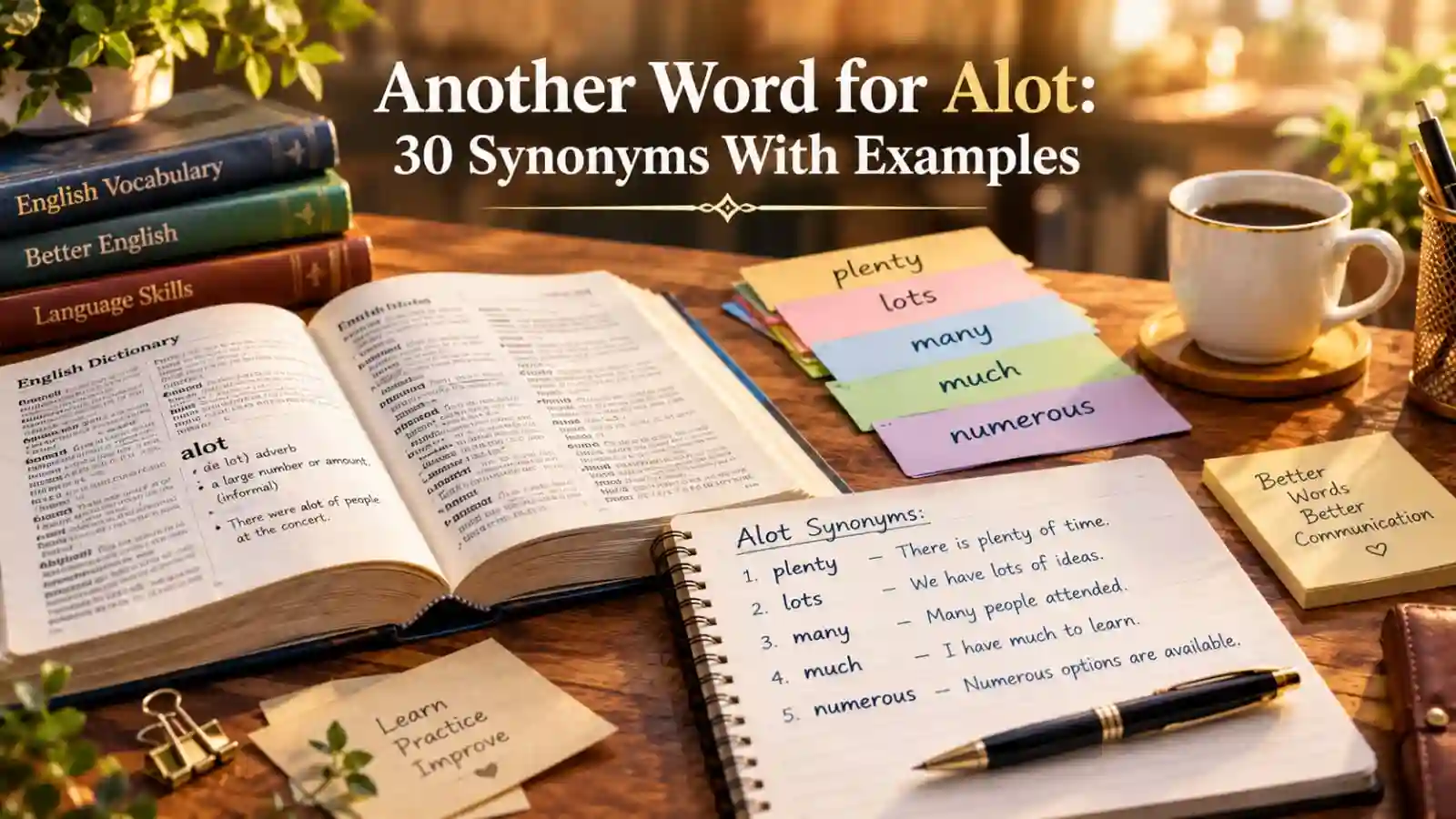
Quick list: a lot, lots, plenty, many, much, loads, a great deal, numerous, considerably, often
This article covers 30 alternatives, each with a meaning, IPA, usage note, and example. Some are direct synonyms and others are related words that fit only certain contexts. Where a word is only a related alternative, the usage note says so.
At a Glance: Alot Synonyms and Related Alternatives
| Alternative | Part of Speech | Meaning | Register / Tone | Ideal Context |
| plenty | pronoun, noun, adverb | a large or sufficient amount | neutral | food, time, space, reassurance |
| lots | pronoun, noun, adverb | a large number or amount | informal | everyday speech and casual writing |
| many | determiner, pronoun | a large number of countable things | neutral | people, items, reasons |
| loads | noun, pronoun | a large quantity | informal, mainly British | casual speech |
| a great deal | noun phrase, adverb | a large amount or degree | neutral to formal | essays, reports, polite speech |
| numerous | adjective | many in number | formal | reports, academic writing |
| substantial | adjective | large in amount or size | formal | money, evidence, change |
| greatly | adverb | to a high degree | formal | appreciation, difference, improvement |
| often | adverb | many times, frequently | neutral | habits and routines |
| countless | adjective | too many to count | neutral, expressive | emphasis and storytelling |
Which Word Should You Use?
| If you want to… | Use | Why |
| Sound casual and friendly | lots, loads | Both are common in everyday speech. |
| Count people or things formally | numerous, many | They work with countable nouns and sound professional. |
| Describe an uncountable amount | a great deal, much, plenty | They fit things like money, time, or information. |
| Say something is more than enough | plenty | It suggests there is enough, or extra. |
| Say you like or value something strongly | greatly, immensely, tremendously | They replace “a lot” as an adverb of degree. |
| Say something happens many times | often, frequently, regularly | They describe frequency. |
| Stress a very large number | countless, myriad | They suggest too many to count. |
| Describe a large and important amount | substantial, considerable | They suit money, evidence, or change. |
Exploring the Multiple Meanings of “Alot”
“Alot” is a common misspelling, so the meanings below belong to the standard phrase “a lot.”
1. A Large Number of Countable Things
- Meaning: A great many people or things.
- Explanation: Used before a plural noun with “of.” It is neutral to informal.
- Example: A lot of students stayed after class to ask questions.
2. A Large Amount of Something Uncountable
- Meaning: A great quantity of something that cannot be counted one by one.
- Explanation: It works with words like time, money, water, and noise.
- Example: We spent a lot of time planning the trip.
3. A Large Quantity Used on Its Own
- Meaning: Much, without a noun following it.
- Explanation: “A lot” can act as a pronoun when the noun is already clear.
- Example: I thought the test would be easy, but a lot has changed since last year.
4. To a Great Degree
- Meaning: Very much; to a high extent.
- Explanation: As an adverb, it often follows a verb or comes before a comparative like “better” or “faster.”
- Example: She likes her new school a lot, and her grades are a lot better.
5. Often or Frequently
- Meaning: Many times; on many occasions.
- Explanation: This sense is about frequency, not amount.
- Example: He travels a lot for work.
Sources: Merriam-Webster; Collins English Dictionary; Cambridge Dictionary; Dictionary.com.
Analyzing 30 Alot Alternatives in Detail
Some alternatives below are direct synonyms of “a lot,” while others fit only one of its senses, such as degree or frequency.
Everyday Quantity Words
1. Plenty
IPA: /ˈplɛnti/ (US and UK)
Definition: A full or generous amount; enough or more than enough.
- Usage: A close synonym for “a lot of,” but it adds the idea of enough. It is neutral in tone.
- Example: There is plenty of food for everyone.
2. Lots
IPA: US /lɑːts/ · UK /lɒts/
Definition: A large number or amount.
- Usage: A direct, informal synonym. It is usually followed by “of.”
- Example: We saw lots of birds at the lake.
3. Many
IPA: /ˈmɛni/ (US and UK)
Definition: A large number of.
- Usage: A direct synonym only for countable nouns. It sounds natural in questions, negatives, and formal writing.
- Example: Many people arrived early.
4. Much
IPA: /mʌtʃ/ (US and UK)
Definition: A large amount of.
- Usage: A direct synonym only for uncountable nouns. In positive statements, “a lot of” often sounds more natural than “much.”
- Example: We don’t have much time.
5. Loads
IPA: US /loʊdz/ · UK /ləʊdz/
Definition: A large quantity of something.
- Usage: Very informal and especially common in British English. It is used in speech, not formal writing.
- Example: I have loads of homework tonight.
6. Tons
IPA: /tʌnz/ (US and UK)
Definition: A very large amount (informal use).
- Usage: A figurative, informal synonym. It exaggerates the amount for emphasis.
- Example: She has tons of energy.
Formal Quantity Words
7. A great deal
IPA: /ə ɡreɪt ˈdiːl/ (US and UK)
Definition: A large amount or extent.
- Usage: A formal-leaning synonym that works with uncountable nouns. It also works as an adverb (“it helped a great deal”).
- Example: The team learned a great deal from the project.
8. Numerous
IPA: US /ˈnuːmərəs/ · UK /ˈnjuːmərəs/
Definition: Existing in large numbers.
- Usage: A formal replacement for “many” or “a lot of.” It works only with countable nouns.
- Example: The report lists numerous errors.
9. Considerable
IPA: /kənˈsɪdərəbəl/ (US and UK)
Definition: Fairly large in size, amount, or importance.
- Usage: A formal adjective that suggests a notable amount. It does not usually suggest an extreme amount.
- Example: The project took a considerable amount of time.
10. Substantial
IPA: /səbˈstænʃəl/ (US and UK)
Definition: Large in amount, value, or importance.
- Usage: A related formal alternative. It suggests size or importance, not just number.
- Example: They received a substantial donation.
11. Abundant
IPA: /əˈbʌndənt/ (US and UK)
Definition: Present in large quantities; more than enough.
- Usage: A related alternative that describes supply, such as food, water, or resources.
- Example: The valley has abundant water.
12. A wealth of
IPA: /ə ˈwɛlθ əv/ (US and UK)
Definition: A large supply of something useful or valuable.
- Usage: A related phrase that suits helpful things like information, experience, or talent. It would sound odd with negative things.
- Example: The museum offers a wealth of information.
Informal and Casual Alternatives
13. Heaps
IPA: /hiːps/ (US and UK)
Definition: A large amount or number (informal).
- Usage: A casual synonym, common in British, Australian, and New Zealand English.
- Example: We had heaps of fun at the beach.
14. Oodles
IPA: /ˈuːdəlz/ (US and UK)
Definition: A very large amount (informal).
- Usage: A playful, informal synonym. It is lighthearted and not used in serious writing.
- Example: She has oodles of talent.
15. Piles
IPA: /paɪlz/ (US and UK)
Definition: A large quantity (informal use).
- Usage: A figurative synonym based on the picture of things stacked up.
- Example: I have piles of laundry to fold.
16. Stacks
IPA: /stæks/ (US and UK)
Definition: A large number or amount (informal use).
- Usage: An informal, mostly British synonym, often used for things like work or paperwork.
- Example: He has stacks of books at home.
17. A bunch
IPA: /ə ˈbʌntʃ/ (US and UK)
Definition: A fairly large number or amount (informal use).
- Usage: A casual, mostly American alternative. It often suggests a moderate-to-large number, not an extreme one.
- Example: A bunch of us went to the game.
18. Masses
IPA: /ˈmæsɪz/ (US and UK)
Definition: A large quantity or number (informal use).
- Usage: A related informal alternative, common in British English. It sounds lively and is not suited to formal writing.
- Example: There are masses of tourists in July.
Alternatives for “To a Great Degree”
19. Greatly
IPA: /ˈɡreɪtli/ (US and UK)
Definition: To a large degree; very much.
- Usage: A formal replacement for “a lot” in the degree sense. It is usually placed before a verb.
- Example: We greatly appreciate your help.
20. Significantly
IPA: /sɪɡˈnɪfɪkəntli/ (US and UK)
Definition: To a noticeable or important degree.
- Usage: A related alternative used with changes and differences, often in reports.
- Example: Sales improved significantly this year.
21. Immensely
IPA: /ɪˈmɛnsli/ (US and UK)
Definition: To a very great degree.
- Usage: A stronger alternative to “a lot” in the degree sense, often used with feelings.
- Example: She enjoyed the trip immensely.
22. Enormously
IPA: US /ɪˈnɔːrməsli/ · UK /ɪˈnɔːməsli/
Definition: To a very large degree.
- Usage: A strong, slightly formal alternative that stresses size or scale.
- Example: The city has changed enormously.
23. Tremendously
IPA: /trɪˈmɛndəsli/ (US and UK)
Definition: Extremely; to a very great degree.
- Usage: A strong, expressive alternative. It sounds warm and enthusiastic.
- Example: The audience was tremendously moved.
Alternatives for “Often”
24. Often
IPA: US /ˈɔːfən/ · UK /ˈɒfən/
Definition: Many times; on many occasions.
- Usage: A direct synonym for the frequency sense of “a lot.” It does not work for quantity or degree.
- Example: We often walk to school.
25. Frequently
IPA: /ˈfriːkwəntli/ (US and UK)
Definition: Many times; at short intervals.
- Usage: A more formal word for the frequency sense.
- Example: She frequently visits her grandparents.
26. Regularly
IPA: US /ˈrɛɡjələrli/ · UK /ˈrɛɡjʊləli/
Definition: At fixed or repeated times.
- Usage: A related alternative. It suggests a pattern, not just a high number of times.
- Example: He exercises regularly.
27. Repeatedly
IPA: /rɪˈpiːtɪdli/ (US and UK)
Definition: Again and again.
- Usage: A related alternative that stresses repetition, often with a frustrating or serious tone.
- Example: I called repeatedly, but nobody answered.
Large and Figurative Alternatives
28. Countless
IPA: /ˈkaʊntləs/ (US and UK)
Definition: Too many to be counted.
- Usage: A related alternative. It suggests a number so large that counting is hard, and it often exaggerates.
- Example: Countless stars filled the sky.
29. Myriad
IPA: /ˈmɪriəd/ (US and UK)
Definition: A very large and varied number.
- Usage: A formal or literary alternative. It can be used as an adjective (“myriad options”) or a noun (“a myriad of options”).
- Example: The city offers myriad opportunities.
30. Mountains
IPA: US /ˈmaʊntənz/ · UK /ˈmaʊntɪnz/
Definition: A very large pile or amount (figurative use, usually “a mountain of”).
- Usage: A related figurative alternative. It stresses an amount that feels heavy or hard to handle.
- Example: She had a mountain of paperwork.
Sources: Merriam-Webster; Collins English Dictionary and Collins Thesaurus; Cambridge Dictionary; Dictionary.com; Oxford Learner’s Dictionaries.
A Lot vs. Alot vs. Allot
These three look alike but are not interchangeable.
| Form | Status | Meaning | Example |
| a lot | correct | a large number, amount, degree, or frequency | I read a lot. |
| alot | nonstandard spelling | not accepted in standard writing | (avoid) |
| allot | correct verb | to give or assign a share | The teacher will allot ten minutes to each group. |
“A lot” is always two words. “Allot” is a separate verb that is related in origin, not in modern meaning. “Alot” has no meaning of its own, so replace it with “a lot” or one of the alternatives above.
Sources: Merriam-Webster; Collins English Dictionary; Cambridge Dictionary.
Alot and Opposite/Paired Word Pairs
| Word | Paired Word | Note |
| a lot | a little | The most direct opposite for amount and degree. |
| a lot of | a few | Use “a few” with countable nouns. |
| many | few | The standard pair for countable nouns. |
| much | little | The standard pair for uncountable nouns. |
| often | rarely, seldom | Opposites for the frequency sense. |
| plenty | shortage, scarcity | “Plenty” suggests enough, and these words suggest not enough. |
| greatly | slightly | Opposites in the degree sense. |
The opposite depends on the sense. For amount, English uses “a little” or “a few” depending on If the noun can be counted. For frequency, “rarely” and “seldom” are the natural opposites.
Sources: Merriam-Webster; Collins Thesaurus; Cambridge Dictionary.
Common Word Partners of “Alot”
These partners belong to the correct phrase “a lot.”
| Pattern | Common Partners | Example |
| a lot of + noun | time, money, people, work, fun | A lot of people enjoy hiking. |
| verb + a lot | learn, work, talk, travel, help | She has learned a lot this year. |
| a lot + comparative | better, more, less, faster, easier | This is a lot easier than I expected. |
| quite / such / an awful + a lot | quite a lot, such a lot (more British), an awful lot | There is quite a lot to do. |
| a whole lot | a whole lot of, a whole lot better | He knows a whole lot about cars. |
| think / care + a lot | think a lot of, care a lot about | They care a lot about their students. |
Sources: Cambridge Dictionary; Collins COBUILD / Collins English Dictionary; Oxford Learner’s Dictionaries.
Idiomatic Phrases Featuring “Alot”
The phrase “a lot” appears in a few established expressions. Only some of them are true idioms.
1. Think a lot of someone or something
- Meaning: To have a high opinion of someone or something.
- Example: The whole team thinks a lot of their coach.
2. A lot on your plate
- Meaning: Having many tasks or responsibilities to deal with.
- Example: I can’t join you this week because I have a lot on my plate.
3. Thanks a lot
- Meaning: An expression of strong thanks. It can also be sarcastic, depending on tone and context.
- Example: Thanks a lot for driving me home.
4. A lot to answer for (mainly British)
- Meaning: To be responsible for many bad results or mistakes.
- Example: The old system has a lot to answer for.
Sources: Merriam-Webster; Collins English Dictionary; Cambridge Dictionary; Oxford Learner’s Dictionaries.
Word Formation of “Alot”
Etymology & Structure
“A lot” is made of the article “a” and the noun “lot.” The noun comes from Old English hlot, meaning an object used to decide something by chance, or a share that someone receives. “Allot” and “lottery” come from the same root family. Because “a lot” is a noun phrase, the misspelling “alot” does not reflect how the phrase is built.
Date and History
Etymonline traces “lot” to Old English. The sense of a large number or amount developed much later, in the early 19th century, and became common in informal English. For exact dating, consult the Etymonline entry for “lot” and the Oxford English Dictionary entry.
Word Class Variations
- Noun: a lot (a set or group); lots (informal, “lots of”)
- Pronoun-like use: “A lot has changed.”
- Adverb: “I like it a lot.”
- Related words from the same root: allot (verb), allotment (noun), lottery (noun), lotto (noun)
Sources: Etymonline; Merriam-Webster; Collins English Dictionary; Oxford English Dictionary.
Common Word-Choice Mistakes
- Alot of people came: write “a lot of people came.”
- Thanks alot: write “thanks a lot.”
- I will alot you ten minutes: write “allot” for the verb meaning to assign.
- I have many money: write “much money” or “a lot of money.”
- There are much problems: write “many problems” or “a lot of problems.”
- She is very better now: write “a lot better” or “much better.”
- Numerous information: write “a great deal of information,” since “numerous” works only with countable nouns.
Frequently Asked Questions
What is the closest synonym for “alot”?
“Lots” is the closest everyday synonym for “a lot.” “Plenty” is also common, though it adds the idea of enough.
Is “alot” a real word?
No. Standard dictionaries list “a lot” as two words. “Alot” is a common spelling error.
What is a formal alternative to “a lot of”?
Good formal choices are “a great deal of,” “numerous,” “considerable,” and “substantial.” Use “numerous” only with countable nouns.
What is the difference between “many” and “much”?
“Many” goes with countable nouns, such as books. “Much” goes with uncountable nouns, such as water.
What can I say instead of “I like it a lot”?
You can say “I like it greatly” in formal writing, or “I like it very much.” “I enjoy it immensely” is stronger.
What is another word for “a lot” meaning “often”?
Use “often,” “frequently,” or “regularly.” “Repeatedly” fits when something happens again and again.
What is the opposite of “a lot”?
The usual opposite is “a little.” With countable nouns, the opposite is “a few.”
Are “a lot” and “allot” related?
They come from the same root, but they mean different things today. “Allot” is a verb meaning to assign a share.
Is “a lot of” informal?
It is neutral to informal. In formal writing, “many,” “much,” or “a great deal of” often sounds more polished.
Which word works for something too many to count?
“Countless” works well. “Myriad” is more literary.
Conclusion
The closest alternatives to “alot” are “lots,” “plenty,” “many,” and “much.” For stronger or more formal choices, “a great deal,” “numerous,” “considerable,” and “substantial” are useful. Remember that “alot” is a misspelling, and the standard form is “a lot.”
Context decides the best choice. “A lot” can mean a large number, a large amount, a high degree, or a high frequency, and each sense has its own best alternatives. “Many” and “much” depend on If the noun can be counted. “Greatly” and “immensely” work for degree, and “often” and “frequently” work for frequency.
To choose the right word, first decide which sense you mean. Then think about the tone: casual words like “loads” and “heaps” suit conversation, while “numerous” and “considerable” suit reports and essays. Check that the word you choose fits both the noun and the situation.