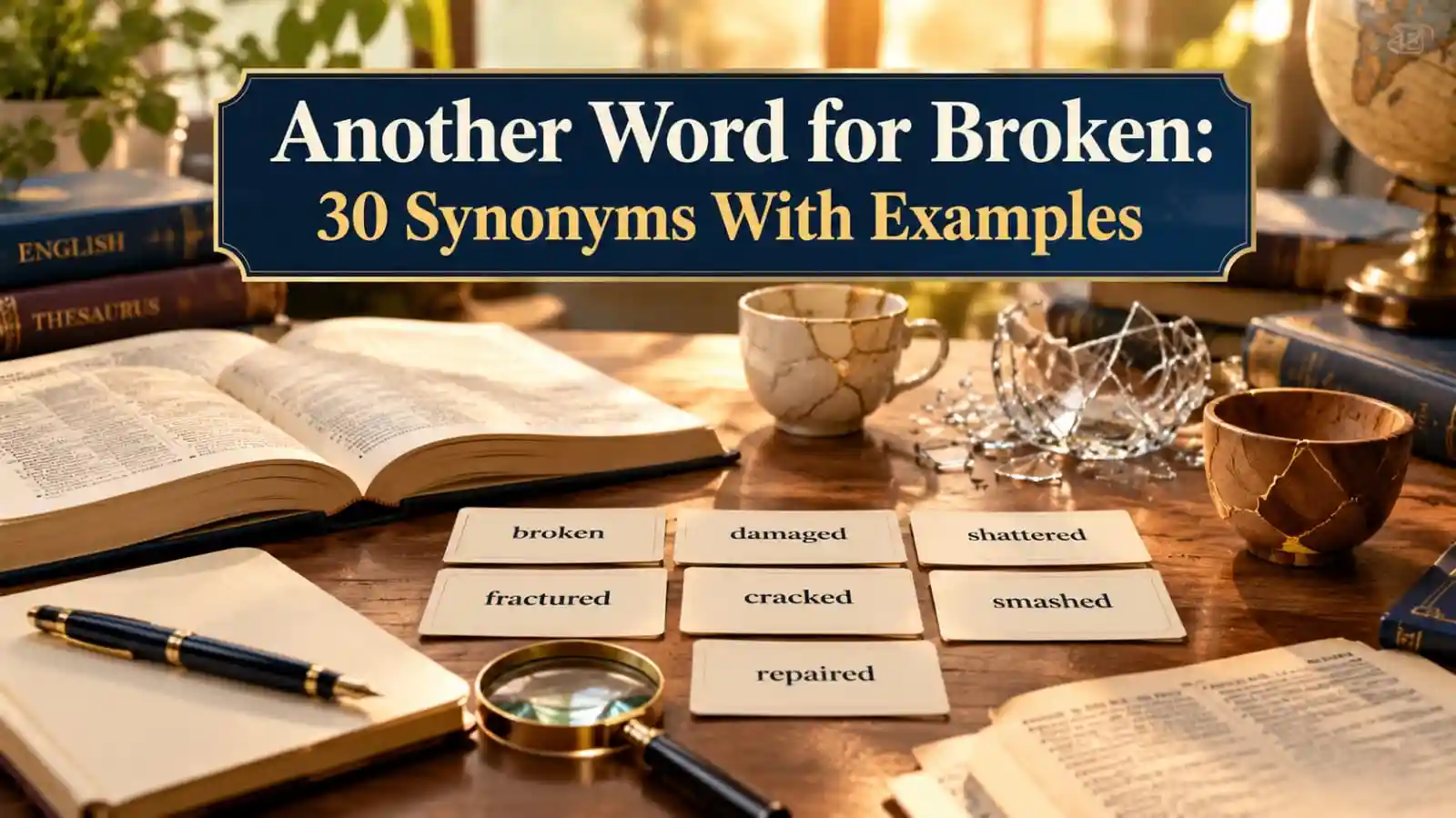
Another Word for Broken: 30 Synonyms With Examples
The closest everyday alternatives to broken are damaged, shattered, fractured, and not working. The best word depends on If you mean a physical object, a bone, a machine, a promise, a relationship, or a person’s feelings.
Broken can describe something split into pieces, something that no longer works, something interrupted or incomplete, or someone who is emotionally crushed. Because it has both literal and figurative meanings, choosing the right alternative makes your writing clearer.
Quick list: damaged, shattered, fractured, cracked, smashed, wrecked, malfunctioning, defective, ruined, split, ruptured, crushed.
This article explains 30 alternatives with meanings, IPA, usage notes, examples, and context.
At a Glance: Broken Synonyms and Related Alternatives
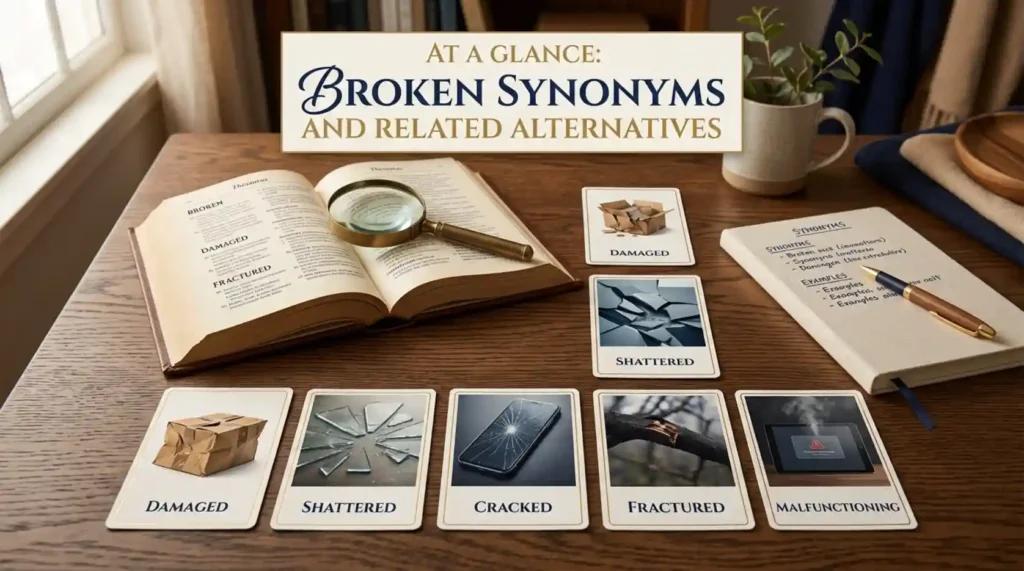
| Alternative | Part of Speech | Meaning | Register / Tone | Ideal Context |
| Damaged | Adjective | Harmed or impaired | Neutral | Objects, property, files, relationships |
| Shattered | Adjective | Broken into many small pieces | Strong, vivid | Glass, hopes, confidence |
| Fractured | Adjective | Cracked or broken, especially a bone | Formal, medical | Bones, rocks, relationships |
| Cracked | Adjective | Having lines or splits but not fully apart | Neutral | Screens, walls, cups, eggs |
| Smashed | Adjective | Violently broken into pieces | Informal, forceful | Windows, phones, cars |
| Malfunctioning | Adjective | Not working correctly | Formal, technical | Machines, devices, systems |
| Defective | Adjective | Having a fault from manufacture or design | Formal | Products, parts, equipment |
| Wrecked | Adjective | Severely damaged or destroyed | Informal to neutral | Cars, buildings, plans |
| Ruptured | Adjective | Burst or torn open | Formal, medical | Pipes, organs, relationships |
| Crushed | Adjective | Pressed until damaged, or emotionally devastated | Literal or figurative | Cans, hopes, spirits |
Which Word Should You Use?
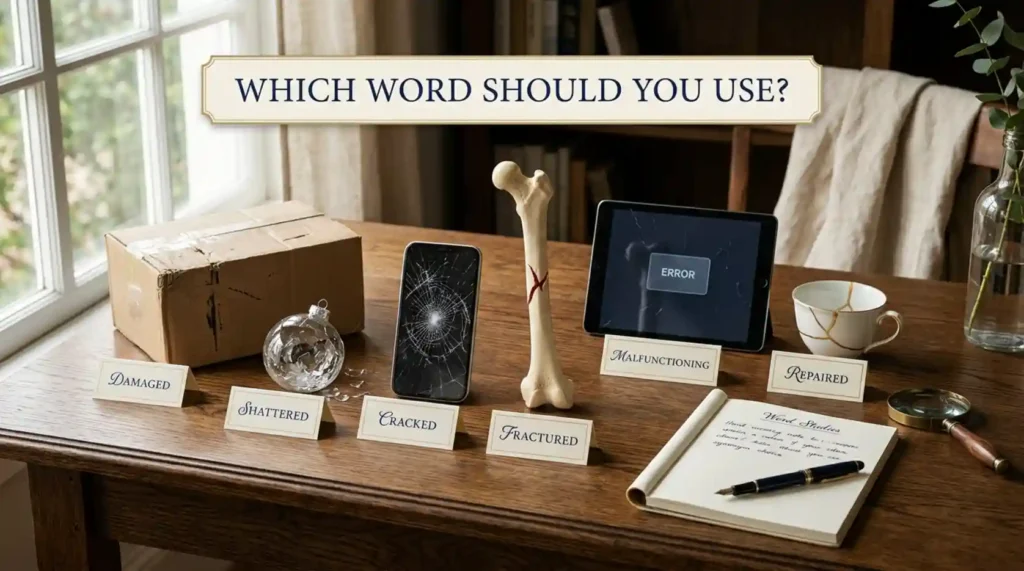
| If you want to… | Use | Why |
| Describe an object with general harm | Damaged | It is neutral and works for almost anything |
| Describe glass or something in many pieces | Shattered | It suggests many small fragments |
| Describe a bone or a crack | Fractured | It is precise and common in medical language |
| Say a machine does not work | Malfunctioning or defective | These focus on failure, not physical pieces |
| Describe violent destruction | Smashed or wrecked | They sound stronger and more dramatic |
| Describe a pipe or organ that burst | Ruptured | It specifically means torn or burst open |
| Describe a promise or rule that was not kept | Violated or breached | These fit agreements, laws, and trust |
| Describe deep emotional pain | Heartbroken or crushed | These are natural figurative alternatives |
Exploring the Multiple Meanings of “Broken”
1. Physically Separated Into Pieces
- Meaning: Split, cracked, or divided into parts by force or damage.
- Explanation: This is the most literal meaning. It can describe a cup, window, toy, bone, or piece of equipment.
- Example: The vase was broken after it fell off the shelf.
2. Not Working Properly
- Meaning: Failing to function as intended.
- Explanation: A broken phone, printer, or elevator may look whole but no longer work correctly.
- Example: The elevator is broken, so please use the stairs.
3. Not Kept, Honored, or Obeyed
- Meaning: Violated, as with a promise, law, rule, or agreement.
- Explanation: Here, broken does not mean physically damaged. It means a commitment or rule was not followed.
- Example: He apologized for his broken promise.
4. Interrupted or Discontinuous
- Meaning: Not continuous, complete, or smooth.
- Explanation: This sense applies to sleep, lines, signals, terrain, or patterns.
- Example: She had a broken night’s sleep because of the storm.
5. Emotionally Defeated or Deeply Hurt
- Meaning: Crushed in spirit, sorrowful, or without hope.
- Explanation: This is figurative. It often appears in phrases such as broken-hearted or a broken man.
- Example: After losing her job, she felt broken for weeks.
6. Weakened or in Poor Condition
- Meaning: Made weak, worn out, or no longer strong.
- Explanation: This can describe health, buildings, systems, or groups that have lost strength.
- Example: The old bridge was broken down and unsafe.
Sources: Merriam-Webster; Cambridge Dictionary; Etymonline.
Analysis of 30 “Broken” Alternatives
Category A: Physical Damage & Fragmentation
1. Damaged
- IPA:
/ˈdæmɪdʒd/(US & UK) - Definition: Harmed, impaired, or made less useful or attractive.
- Usage: The most general and neutral alternative. Applies to objects, buildings, files, skin, or relationships without requiring physical separation into pieces.
- Example: The package arrived with a damaged corner.
2. Shattered
- IPA: US
/ˈʃætərd/| UK/ˈʃætəd/ - Definition: Broken suddenly into many small pieces.
- Usage: Stronger than broken; especially natural for glass, mirrors, windows, and fragile objects. Common figuratively for hopes or confidence.
- Example: The window shattered when the ball hit it.
3. Fractured
- IPA:
/ˈfræktʃərd/(US & UK) - Definition: Cracked or broken, especially in a bone or hard material.
- Usage: Precise, medical, or technical. Implies a crack or structural break without complete separation.
- Example: She fractured her wrist during the game.
4. Cracked
- IPA:
/krækt/(US & UK) - Definition: Having one or more lines or splits, often without being completely apart.
- Usage: Used when damage is visible but the object remains intact. Less severe than shattered.
- Example: My phone screen is cracked, but it still works.
5. Smashed
- IPA:
/smæʃt/(US & UK) - Definition: Broken violently into pieces.
- Usage: Informal and forceful; emphasizes forceful impact or deliberate action.
- Example: Someone smashed the car window.
6. Split
- IPA:
/splɪt/(US & UK) - Definition: Divided into two or more parts, often along a line.
- Usage: Best for wood, seams, lips, ends, or groups.
- Example: The wooden board split down the middle.
7. Splintered
- IPA: US
/ˈsplɪntərd/| UK/ˈsplɪntəd/ - Definition: Broken into long, thin, sharp pieces.
- Usage: Specific to wood, bone, or fibrous materials.
- Example: The old chair leg splintered when he sat down.
8. Fragmented
- IPA:
/ˈfræɡmentɪd/(US & UK) - Definition: Broken into small or separate parts.
- Usage: Applied to physical objects, but frequently used for systems, schedules, information, or societies.
- Example: The ancient pottery was found in fragmented pieces.
9. Shattered to pieces
- IPA:
/ˈʃætərd tə ˈpiːsɪz/(US & UK) - Definition: Completely broken into many fragments.
- Usage: Emphatic phrase used to stress total physical destruction.
- Example: The glass ornament was shattered to pieces.
10. Chipped
- IPA:
/tʃɪpt/(US & UK) - Definition: Having a small piece broken off.
- Usage: Minor surface or edge damage; object remains functional.
- Example: The edge of the plate was chipped.
Category B: Severe Destruction
11. Wrecked
- IPA:
/rekt/(US & UK) - Definition: Severely damaged or destroyed.
- Usage: Common for vehicles, buildings, plans, and relationships.
- Example: The storm wrecked several homes along the coast.
12. Ruined
- IPA:
/ˈruːɪnd/(US & UK) - Definition: Damaged so badly that it is no longer useful, valuable, or successful.
- Usage: Broader context; applies to physical items, food, clothes, reputations, holidays, or opportunities.
- Example: The rain ruined the picnic.
13. Destroyed
- IPA:
/dɪˈstrɔɪd/(US & UK) - Definition: Damaged so completely that it no longer exists in its former form.
- Usage: Stronger than broken; implies repair is impossible or unlikely.
- Example: The fire destroyed the old warehouse.
14. Demolished
- IPA: US
/dɪˈmɑːlɪʃt/| UK/dɪˈmɒlɪʃt/ - Definition: Torn down or completely destroyed.
- Usage: Specific to buildings, structures, or large physical edifices.
- Example: The abandoned hotel was demolished last year.
15. Mangled
- IPA:
/ˈmæŋɡəld/(US & UK) - Definition: Severely and untidily damaged, often with parts twisted or torn.
- Usage: Fits metal, machinery, crash victims/vehicles, or twisted objects.
- Example: The bicycle was mangled after the crash.
16. Crushed
- IPA:
/krʌʃt/(US & UK) - Definition: Pressed or squeezed until damaged, flattened, or destroyed.
- Usage: Physical for cans, cars, or boxes; figurative for spirits, hopes, or confidence.
- Example: The boxes were crushed during delivery.
17. Disintegrated
- IPA:
/dɪˈsɪntɪɡreɪtɪd/(US & UK) - Definition: Broke apart into small pieces or lost physical unity.
- Usage: Formal and often gradual process (e.g., old paper, rocks, organizations).
- Example: The old book’s pages had disintegrated.
Category C: Machines, Technology & Functionality
18. Malfunctioning
- IPA:
/ˌmælˈfʌŋkʃənɪŋ/(US & UK) - Definition: Not working correctly.
- Usage: Formal alternative for devices, software, or technical systems experiencing operational errors.
- Example: The malfunctioning sensor caused the alarm to ring.
19. Defective
- IPA:
/dɪˈfektɪv/(US & UK) - Definition: Having a fault or flaw, especially one present from manufacture.
- Usage: Common for manufactured goods and equipment; suggests an inherent flaw rather than accidental damage.
- Example: The company recalled the defective chargers.
20. Faulty
- IPA: US
/ˈfɔːlti/| UK/ˈfɒlti/ - Definition: Not working correctly because of a fault.
- Usage: Common for electrical items, wiring, or logical arguments.
- Example: The lights went out because of faulty wiring.
21. Out of order
- IPA:
/aʊt əv ˈɔːrdər/(US & UK) - Definition: Not working or not available for use.
- Usage: Standard idiomatic expression used on signage for public machinery, elevators, or appliances.
- Example: The coffee machine is out of order.
22. Nonfunctional
- IPA: US
/ˌnɑːnˈfʌŋkʃənəl/| UK/ˌnɒnˈfʌŋkʃənəl/ - Definition: Not able to perform its intended function.
- Usage: Formal and technical; used in engineering, product reports, and technical manuals.
- Example: The nonfunctional keypad was replaced.
23. Kaput
- IPA:
/kəˈpʊt/(US & UK) - Definition: Completely broken or no longer working.
- Usage: Informal, colloquial, and humorous.
- Example: My old laptop is finally kaput.
Category D: Agreements, Rules & Trust
24. Violated
- IPA:
/ˈvaɪəleɪtɪd/(US & UK) - Definition: Failed to respect or obey a law, right, agreement, or principle.
- Usage: Formal and serious; used for rules, laws, rights, and boundaries.
- Example: The company violated the safety regulations.
25. Breached
- IPA:
/briːtʃt/(US & UK) - Definition: Failed to observe a law, agreement, or duty; made a gap in a barrier.
- Usage: Formal legal, corporate, or security terminology (e.g., contracts, security systems, data).
- Example: The supplier breached the terms of the contract.
26. Unfulfilled
- IPA:
/ˌʌnfʊlˈfɪld/(US & UK) - Definition: Not achieved, completed, or satisfied.
- Usage: Applies to promises, hopes, expectations, or potential.
- Example: She left the city with several unfulfilled plans.
Category E: Interruption & Incompleteness
27. Interrupted
- IPA: US
/ˌɪntəˈrʌptɪd/| UK/ˌɪntəˈrʌptɪd/ - Definition: Stopped for a time or prevented from continuing smoothly.
- Usage: Applies to signals, processes, conversations, sleep, or journeys. No physical damage implied.
- Example: The broadcast was interrupted by a power cut.
28. Discontinuous
- IPA:
/ˌdɪskənˈtɪnjuəs/(US & UK) - Definition: Not continuous; having breaks or gaps.
- Usage: Formal, mathematical, or geographical context (e.g., lines, data, terrain).
- Example: The map showed a discontinuous line of hills.
29. Incomplete
- IPA:
/ˌɪnkəmˈpliːt/(US & UK) - Definition: Not finished or lacking a necessary part.
- Usage: Applied when “broken” implies an interrupted set, sentence, or task.
- Example: The report was returned because it was incomplete.
Category F: Emotional & Figurative
30. Heartbroken
- IPA: US
/ˈhɑːrtbroʊkən/| UK/ˈhɑːtbrəʊkən/ - Definition: Overwhelmed by sadness, especially after a loss or disappointment.
- Usage: Specific figurative alternative describing profound personal emotional anguish.
- Example: She was heartbroken after saying goodbye to her dog.
Sources referenced: Merriam-Webster, Cambridge Dictionary, Collins Dictionary, and Etymonline.
Broken vs. Damaged vs. Shattered
| Word | Main focus | Severity | Typical example |
| Broken | No longer whole or working | Mild to severe | A broken chair |
| Damaged | Harmed or impaired | Mild to severe | A damaged package |
| Shattered | Broken into many small pieces | Usually severe | A shattered mirror |
A broken object may be damaged or stop working. Damaged means something has been harmed, while shattered means it has broken into many small pieces. Merriam-Webster also lists fractured and smashed as similar words for broken.
Sources: Merriam-Webster; Cambridge Dictionary.
Broken and Opposite/Paired Word Pairs
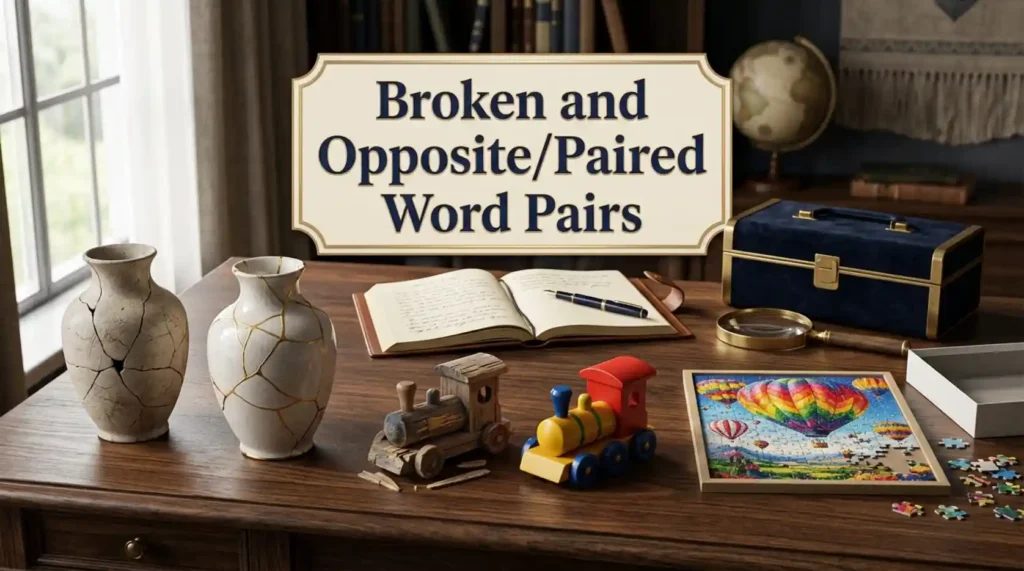
| Word | Paired Word | Note |
| Broken | Fixed | Fixed means repaired or working again |
| Broken | Repaired | Repaired emphasizes restoring function |
| Broken | Unbroken | Unbroken means continuous, whole, or not violated |
| Broken | Intact | Intact means complete and undamaged |
| Broken | Whole | Whole emphasizes completeness |
| Broken promise | Kept promise | A natural contrast for commitments |
| Broken record | New record | Contrasts failure or repetition with achievement |
| Broken heart | Whole heart | Often used in emotional or literary language |
These pairs help show If you are talking about physical repair, emotional recovery, continuity, or keeping an agreement. Merriam-Webster identifies unbroken, repaired, and fixed as antonyms of broken.
Sources: Merriam-Webster; Cambridge Dictionary.
Common Word Partners of “Broken”
| Pattern | Common Partners | Example |
| Broken + object | window, glass, cup, toy, chair | The broken window let in cold air. |
| Broken + technology | phone, computer, printer, elevator | My broken phone needs repair. |
| Broken + body part | arm, leg, bone, rib | He has a broken arm. |
| Broken + commitment | promise, contract, rule, law, trust | She felt hurt by his broken promise. |
| Broken + abstract noun | heart, spirit, sleep, silence, dream | The news broke the silence. |
| Broken + system | system, process, link, supply chain | The broken supply chain delayed deliveries. |
| Broken + language | English, Spanish, French | He spoke broken English. |
These partnerships reflect the main senses of broken: physical damage, malfunction, violated commitments, interruption, and emotional pain
Sources: Merriam-Webster; Cambridge Dictionary.
Idiomatic Phrases Featuring “Broken”
1. Broken-hearted
- Meaning: Extremely sad, usually because of loss, rejection, or disappointment.
- Example: He was broken-hearted when his best friend moved abroad.
2. Broken record
- Meaning: Someone who repeats the same thing again and again.
- Example: I feel like a broken record telling the children to clean their rooms.
3. Broken home
- Meaning: A family affected by divorce, separation, or serious conflict.
- Example: The novel tells the story of a child growing up in a broken home.
4. The broken and the broken-hearted
- Meaning: People who are suffering emotionally or have experienced hardship.
- Example: The charity supports the broken and the broken-hearted in the community.
Sources: Merriam-Webster; Etymonline.
Word Formation of “Broken”
Etymology & Structure
Broken is the past participle of the verb break. It comes from Old English brocken, the past participle of brecan, meaning to divide something forcefully into parts, injure, violate, destroy, or subdue. The verb traces back through Proto-Germanic to the Indo-European root bhreg-, meaning “to break.
Date and History
As an adjective, broken originally meant “separated by force into parts” or “not entire.” Etymonline records the senses “rough,” for terrain, and “imperfect” or “ungrammatical,” for language, from the 1590s.
Word Class Variations
- Verb: break, breaks, breaking, broke, broken
- Adjective: broken
- Related adjective: breakable
- Related noun: break, breakage, breakdown
- Related compounds: broken-hearted, broken-down, broken-in
Sources: Etymonline; Merriam-Webster.
Common Word-Choice Mistakes
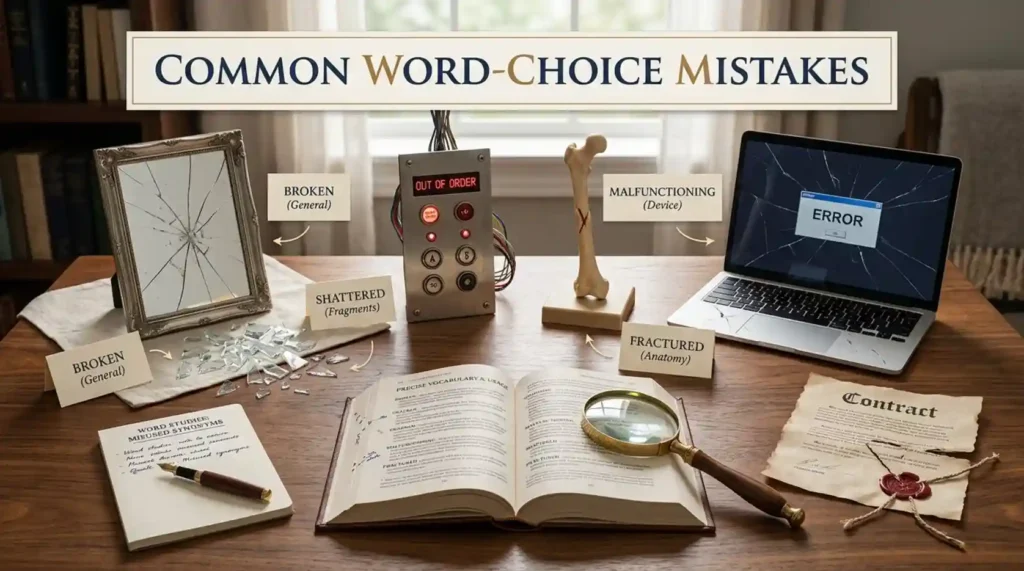
- Wrong: The elevator is shattered. Correction: The elevator is broken or out of order.
- Wrong: She fractured her promise. Correction: She broke her promise or violated her promise.
- Wrong: The mirror is cracked into a thousand pieces. Correction: The mirror shattered into a thousand pieces.
- Wrong: He has a shattered leg. Correction: He has a broken leg or a fractured leg.
- Wrong: The contract was broken by hackers. Correction: The contract was breached; use the system was breached for a security incident.
- Wrong: My laptop is defective because I dropped it. Correction: My laptop is damaged because I dropped it; defective usually suggests a manufacturing fault.
- Wrong: The road was broken. Correction: The road was damaged, washed out, or in poor condition, depending on the problem.
Frequently Asked Questions
What is the closest synonym for broken?
Damaged is usually the closest general synonym. For something in pieces, shattered, fractured, or smashed may be more exact.
What is a formal alternative to broken?
Malfunctioning, defective, impaired, fractured, and breached are formal alternatives, depending on the context.
What is the difference between broken and damaged?
Broken often means something is no longer whole or working. Damaged is broader and can describe any harm, including scratches, dents, or partial impairment.
What is the difference between broken and shattered?
Broken is general. Shattered means broken suddenly into many small pieces and is especially common for glass.
Can broken describe a person?
Yes, but it is figurative and emotionally strong. A broken person suggests deep emotional pain, defeat, or loss of hope.
What is another word for a broken promise?
Use unfulfilled promise, violated promise, or simply a promise that was not kept. In legal contexts, breached agreement is common.
What is another word for a broken machine?
Use malfunctioning, faulty, defective, out of order, or nonfunctional.
What is the opposite of broken?
Common opposites are fixed, repaired, intact, whole, and unbroken. The best choice depends on If you mean repair, completeness, or continuity.
Can broken mean interrupted?
Yes. A broken sleep, signal, line, or journey is interrupted or discontinuous.
Is “busted” the same as broken?
Not exactly. Busted is informal and usually means broken, damaged, or not working. It is common in casual speech but less suitable for formal writing.
Conclusion
The most useful alternatives to broken are damaged, shattered, fractured, cracked, malfunctioning, defective, wrecked, and ruined. For emotional contexts, heartbroken and crushed are often more natural.
The right word depends on what was harmed and how. A screen may be cracked, a bone may be fractured, a machine may be malfunctioning, and a promise may be violated or breached.
Before replacing broken, decide If you mean physical damage, failure to work, interruption, a failed agreement, or emotional pain. Then choose the word that matches that exact meaning.