
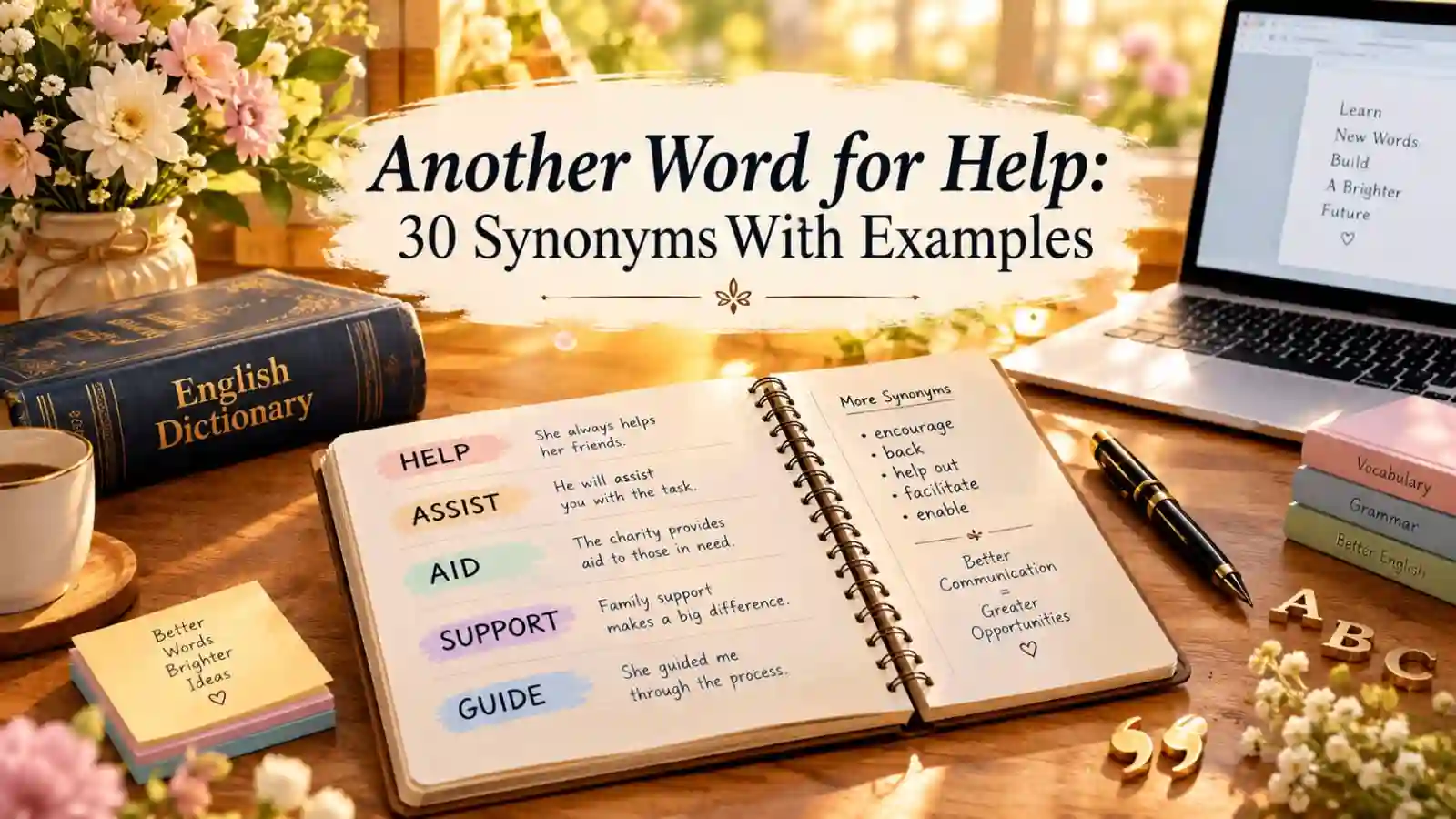
Another Word for Help: 30 Synonyms With Examples
If you need another word for help, the closest everyday choices are assist, aid, support, and guide. However, the best word depends on what kind of help you mean. You may be helping someone complete a task, supporting a person emotionally, giving advice, making a problem easier, or providing emergency assistance.
Some alternatives are nearly interchangeable with help, while others are better in specific situations. For example, assist sounds more formal, support often suggests ongoing practical or emotional help, guide focuses on direction or advice, and facilitate means making an action or process easier.
Quick list: assist, aid, support, guide, encourage, advise, cooperate, back, serve, relieve, ease, facilitate, assist, sustain, rescue, protect, provide, counsel, mentor, nurture.
This guide examines 30 useful alternatives with meanings, IPA pronunciations, usage notes, examples, word relationships, collocations, expressions, and common mistakes.
At a Glance: Help Synonyms and Related Alternatives
| Alternative | Part of Speech | Meaning | Register / Tone | Ideal Context |
| Assist | Verb | To help someone do something | Formal / neutral | Work, services, professional writing |
| Aid | Verb / Noun | To give help or support | Formal | Emergency, medical, humanitarian contexts |
| Support | Verb / Noun | To give practical or emotional help | Neutral | People, causes, teams, projects |
| Guide | Verb / Noun | To help by giving direction | Neutral | Learning, decisions, advice |
| Encourage | Verb | To give confidence or motivation | Neutral / warm | Personal growth, difficult situations |
| Advise | Verb | To recommend what someone should do | Neutral / formal | Decisions, professional situations |
| Facilitate | Verb | To make an action or process easier | Formal | Business, education, administration |
| Relieve | Verb | To reduce pain, difficulty, or pressure | Neutral | Stress, pain, burdens |
| Rescue | Verb / Noun | To save someone from danger | Strong / urgent | Emergencies, danger |
| Cooperate | Verb | To work together to achieve something | Neutral | Teams, projects, problem-solving |
Which Word Should You Use?

| If you want to… | Use | Why |
| Help someone with a task | assist | It is a direct and common alternative, especially in formal situations. |
| Give urgent or necessary help | aid | It often appears in medical, emergency, and humanitarian contexts. |
| Give ongoing practical or emotional help | support | It suggests continued assistance or encouragement. |
| Help someone understand what to do | guide | It emphasizes direction rather than doing the task for them. |
| Give someone confidence | encourage | It focuses on motivation and emotional support. |
| Tell someone what you think they should do | advise | It specifically involves giving recommendations. |
| Make a process easier | facilitate | It means removing difficulties or making something happen more easily. |
| Reduce pain, pressure, or difficulty | relieve | It focuses on making an unpleasant condition less severe. |
Exploring the Multiple Meanings of “Help”
1. Giving Assistance to a Person
- Meaning: To make it easier for someone to do something by providing assistance.
- Explanation: This is the most common meaning of help. The assistance may involve physical work, information, money, time, or another useful resource.
- Example: My brother helped me carry the boxes upstairs.
2. Making Something Easier or Better
- Meaning: To make an action, situation, or result easier or better.
- Explanation: Help does not always involve directly assisting another person. A tool, method, change, or idea can also help.
- Example: A checklist can help you avoid common mistakes.
3. Giving Physical Support
- Meaning: To support someone while they move or change position.
- Explanation: In this sense, help can mean physically assisting someone to stand, walk, climb, enter, or leave a place.
- Example: She helped her grandfather into the car.
4. Reducing Pain, Difficulty, or a Problem
- Meaning: To make something unpleasant or difficult less severe.
- Explanation: Medicine, rest, exercise, or a useful action can help reduce a problem without completely solving it.
- Example: A short walk may help relieve stress.
5. Providing Rescue or Emergency Assistance
- Meaning: To provide assistance to someone in danger or serious difficulty.
- Explanation: This sense appears in situations where someone urgently needs protection, rescue, or immediate assistance.
- Example: The hikers called for help after getting lost.
6. Serving or Providing Something
- Meaning: To serve someone food or provide something for oneself or another person.
- Explanation: This meaning appears in expressions such as help yourself and help someone to some food.
- Example: Please help yourself to some fruit.
Sources: Collins English Dictionary; Collins American English Thesaurus; Etymonline.
Analyzing 30 Help Alternatives in Detail
Some of the following words are direct synonyms of help, while others are context-specific alternatives. The distinction matters because not every alternative works naturally in every sentence.
Core Assistance Words
1. Assist
IPA: US /əˈsɪst/ · UK /əˈsɪst/
Definition: To help someone do something or make something easier.
- Usage: Assist is one of the closest alternatives to help. It is especially common in professional, official, and formal writing. It can sound less conversational than help.
- Example: The technician assisted the customer with the installation.
2. Aid
IPA: US /eɪd/ · UK /eɪd/
Definition: To help or give assistance to someone or something in need.
- Usage: Aid is a direct synonym in many contexts but often sounds more formal. It is common in medical, emergency, humanitarian, and international contexts.
- Example: Volunteers aided families affected by the flood.
3. Support
IPA: US /səˈpɔrt/ · UK /səˈpɔːt/
Definition: To give practical, emotional, or other assistance to someone or something.
- Usage: Support often suggests continued or dependable help. It can describe emotional support, financial support, technical support, or support for a person, group, or cause.
- Example: Her friends supported her during a difficult year.
4. Back
IPA: US /bæk/ · UK /bæk/
Definition: To give support to a person, idea, plan, or organization.
- Usage: Back is a more informal alternative when it means supporting someone or something. It can suggest approval, loyalty, financial support, or practical assistance.
- Example: The team backed their manager’s new plan.
5. Cooperate
IPA: US /koʊˈɑːpəreɪt/ · UK /kəʊˈɒpəreɪt/
Definition: To work together with another person or group to achieve something.
- Usage: Cooperate is related to help but is not always an exact synonym. It focuses on working together rather than simply giving assistance.
- Example: Both departments cooperated to solve the problem.
Guidance, Advice, and Personal Support
6. Guide
IPA: US /ɡaɪd/ · UK /ɡaɪd/
Definition: To show or direct someone toward a particular action, place, or decision.
- Usage: Guide is useful when help involves giving direction, instruction, or advice. It does not necessarily mean doing the work for someone.
- Example: The teacher guided the students through the difficult exercise.
7. Advise
IPA: US /ədˈvaɪz/ · UK /ədˈvaɪz/
Definition: To tell someone what you think they should do.
- Usage: Advise is a specific type of help based on recommendations or professional judgment. It is not a replacement for help in every context.
- Example: The doctor advised him to get more rest.
8. Counsel
IPA: US /ˈkaʊnsəl/ · UK /ˈkaʊnsəl/
Definition: To give advice, especially about an important or difficult matter.
- Usage: Counsel is more formal than advise. It often suggests thoughtful guidance, especially in professional, legal, religious, or personal settings.
- Example: The lawyer counseled her on the legal options.
9. Encourage
IPA: US /ɪnˈkɜːrɪdʒ/ · UK /ɪnˈkʌrɪdʒ/
Definition: To give someone confidence, hope, or support to do something.
- Usage: Encourage is related to emotional help rather than general assistance. Use it when the main purpose is to motivate or strengthen someone’s confidence.
- Example: Her parents encouraged her to apply for the scholarship.
10. Mentor
IPA: US /ˈmentɔːr/ · UK /ˈmentɔː/
Definition: To advise and guide someone over a period of time, usually in learning or professional development.
- Usage: Mentor is more specific than help. It suggests ongoing guidance from someone with experience.
- Example: An experienced designer mentored him during his first year at the company.
Making Things Easier or Less Difficult
11. Facilitate
IPA: US /fəˈsɪləteɪt/ · UK /fəˈsɪlɪteɪt/
Definition: To make an action or process easier.
- Usage: Facilitate is a formal alternative when something helps a process happen more easily. It does not necessarily mean directly helping a person.
- Example: The new software facilitates communication between teams.
12. Ease
IPA: US /iːz/ · UK /iːz/
Definition: To make something less difficult, painful, or severe.
- Usage: Ease is useful when help reduces a burden, problem, pain, or tension. It is not a general replacement for help.
- Example: The new schedule eased the pressure on staff.
13. Relieve
IPA: US /rɪˈliːv/ · UK /rɪˈliːv/
Definition: To reduce or remove pain, worry, difficulty, or pressure.
- Usage: Relieve focuses on reducing something unpleasant. It is especially natural with words such as pain, stress, pressure, and suffering.
- Example: The treatment helped relieve her back pain.
14. Alleviate
IPA: US /əˈliːvieɪt/ · UK /əˈliːvieɪt/
Definition: To make something unpleasant or difficult less severe.
- Usage: Alleviate is a formal alternative to help when the meaning is to reduce a problem or burden. It does not mean completely solve it.
- Example: Better public transport could alleviate traffic problems.
15. Mitigate
IPA: US /ˈmɪtəɡeɪt/ · UK /ˈmɪtɪɡeɪt/
Definition: To make something harmful, serious, or unpleasant less severe.
- Usage: Mitigate is formal and often appears in discussions of risk, damage, harm, or negative effects. It is a contextual alternative, not a general synonym for help.
- Example: The company introduced new rules to mitigate safety risks.
16. Improve
IPA: US /ɪmˈpruːv/ · UK /ɪmˈpruːv/
Definition: To make something better or become better.
- Usage: Improve can replace help when help produces a better condition or result. It does not necessarily involve another person providing assistance.
- Example: Regular practice can help improve your writing.
Protection, Rescue, and Emergency Assistance
17. Rescue
IPA: US /ˈreskjuː/ · UK /ˈreskjuː/
Definition: To save someone from danger, harm, or an unpleasant situation.
- Usage: Rescue is stronger and more specific than help. Use it when someone or something is saved from danger or serious difficulty.
- Example: The firefighters rescued the family from the burning building.
18. Save
IPA: US /seɪv/ · UK /seɪv/
Definition: To prevent someone or something from being harmed, lost, or destroyed.
- Usage: Save can be related to help when the assistance prevents serious harm. It is stronger than ordinary assistance.
- Example: Quick action saved the injured bird.
19. Protect
IPA: US /prəˈtekt/ · UK /prəˈtekt/
Definition: To keep someone or something safe from harm or danger.
- Usage: Protect is not a general synonym for help. It is appropriate when the assistance involves keeping someone safe.
- Example: The helmet helps protect cyclists from head injuries.
20. Defend
IPA: US /dɪˈfend/ · UK /dɪˈfend/
Definition: To protect someone or something against attack, criticism, or harm.
- Usage: Defend is a specialized form of support or help involving protection from opposition or attack.
- Example: The lawyer defended his client in court.
21. Succor
IPA: US /ˈsʌkər/ · UK /ˈsʌkə/
Definition: Help given to someone who is suffering or in difficulty.
- Usage: Succor is a formal and somewhat literary word. It is mainly useful in serious writing about people in distress, disasters, or hardship.
- Example: The organization provided succor to families displaced by the conflict.
Resources, Care, and Practical Assistance
22. Provide
IPA: US /prəˈvaɪd/ · UK /prəˈvaɪd/
Definition: To give someone something that is needed or wanted.
- Usage: Provide is related to help when assistance consists of supplying money, food, information, equipment, or another resource. It is not a complete synonym in every situation.
- Example: The charity provides food for families in need.
23. Supply
IPA: US /səˈplaɪ/ · UK /səˈplaɪ/
Definition: To provide something that is needed or wanted.
- Usage: Supply focuses on giving resources rather than personal assistance. It works especially well for materials, goods, information, and necessities.
- Example: The center supplies clean water to the village.
24. Serve
IPA: US /sɜːrv/ · UK /sɜːv/
Definition: To provide a useful service or perform a function for someone.
- Usage: Serve can overlap with help when the idea is providing a useful service. It is not interchangeable with help in ordinary assistance sentences.
- Example: This guide serves as a useful starting point for new learners.
25. Care for
IPA: US /ker fɔːr/ · UK /keə fɔː/
Definition: To look after someone who needs attention or support.
- Usage: Care for is a context-specific alternative when helping involves looking after a person, especially a child, older adult, or sick person.
- Example: She cares for her aging mother.
26. Tend
IPA: US /tend/ · UK /tend/
Definition: To take care of or give attention to someone or something.
- Usage: Tend is a narrower alternative to help. It often describes caring for an injured person, patient, animal, or situation that needs attention.
- Example: The nurse tended to the injured passenger.
Specialized and Contextual Alternatives
27. Nurture
IPA: US /ˈnɜːrtʃər/ · UK /ˈnɜːtʃə/
Definition: To care for, encourage, and help someone or something develop.
- Usage: Nurture is more specific and often figurative. It is commonly used for children, talent, relationships, ideas, and personal development.
- Example: Good teachers nurture a child’s curiosity.
28. Boost
IPA: US /buːst/ · UK /buːst/
Definition: To increase, improve, or strengthen something.
- Usage: Boost can be a useful informal alternative when help increases confidence, energy, performance, sales, morale, or another positive result.
- Example: Her kind words boosted my confidence.
29. Promote
IPA: US /prəˈmoʊt/ · UK /prəˈməʊt/
Definition: To encourage or help something develop, increase, or succeed.
- Usage: Promote is a contextual alternative when helping means actively encouraging progress, growth, awareness, or success. It is not a general synonym for personal assistance.
- Example: The program promotes healthy eating in schools.
30. Benefit
IPA: US /ˈbenɪfɪt/ · UK /ˈbenɪfɪt/
Definition: To be useful or helpful to someone or something.
- Usage: Benefit focuses on the positive result received rather than the act of giving assistance. It can describe how a person, action, treatment, or policy helps someone.
- Example: Students benefit from regular reading practice.
Sources: Collins English Dictionary; Collins American English Thesaurus; Merriam-Webster; Dictionary.com.
Help in Different Contexts: Choosing the Right Alternative

The word help is unusually broad, so context is important. A single alternative cannot replace it in every sentence.
| Context | Best Alternative | Example |
| General assistance | assist | The staff assisted the visitors. |
| Emergency assistance | aid | Doctors aided the injured passengers. |
| Emotional or ongoing assistance | support | Her family supported her decision. |
| Advice or direction | guide | The coach guided the players. |
| Motivation | encourage | Her teacher encouraged her to continue. |
| Making a process easier | facilitate | The system facilitates online payments. |
| Reducing pain or pressure | relieve | The medicine relieved his pain. |
| Saving someone from danger | rescue | Firefighters rescued the child. |
| Providing resources | provide | The charity provided emergency supplies. |
| Developing a person or ability | nurture | The program nurtures young talent. |
Sources: Collins English Dictionary; Collins Thesaurus.
Help and Opposite/Paired Word Pairs
| Word | Paired Word | Note |
| Help | Hinder | Help makes something easier; hinder makes it harder. |
| Help | Obstruct | Assistance supports progress, while obstruction blocks it. |
| Help | Support | These frequently occur together when discussing assistance. |
| Help | Encourage | Encouragement is one form of emotional help. |
| Help | Advise | Advice can be one way of helping someone. |
| Help | Assist | Both commonly describe practical assistance. |
| Help | Harm | Help aims to benefit; harm causes damage. |
| Help | Rescue | Rescue is a stronger form of help involving danger. |
Hinder is the clearest natural opposite when help means making an action easier. Other contrasts depend on the specific meaning being used.
Sources: Collins English Dictionary; Collins Thesaurus.
Common Word Partners of “Help”
| Pattern | Common Partners | Example |
| help + someone | help me, help him, help students | Can you help me with this task? |
| help + with | help with homework, work, costs | She helped with the housework. |
| help + someone + verb | help someone learn, grow, work | The teacher helped students understand the lesson. |
| help + to + verb | help to improve, reduce, solve | Exercise can help to reduce stress. |
| ask for + help | ask for help, ask for advice | Don’t be afraid to ask for help. |
| need + help | need help, need extra help | I need some help with this form. |
| offer + help | offer help, offer practical help | She offered help to the new student. |
| get + help | get help, get medical help | He went to the clinic to get help. |
| provide + help | provide financial, practical, emergency help | The organization provides emergency help. |
| great + help | great help, valuable help | Your advice was a great help. |
Sources: Collins English Dictionary; Collins English Language Learning Dictionary.
Idiomatic Phrases Featuring “Help”
1. Help yourself
- Meaning: To serve yourself or take something for yourself, especially food or drink offered by someone.
- Example: Please help yourself to some cake.
2. Can’t help
- Meaning: To be unable to stop or avoid doing something.
- Example: I can’t help laughing when I remember that story.
3. Help out
- Meaning: To give someone extra or practical assistance, especially when they need it.
- Example: Can you help out at the store this afternoon?
4. So help me
- Meaning: An emphatic expression used to indicate that someone is being completely serious or truthful.
- Example: So help me, I had never seen the document before.
These are established expressions rather than ordinary collocations. Their meanings cannot always be understood simply by replacing help with another synonym.
Sources: Collins English Dictionary; Etymonline.
Word Formation of “Help”
Etymology & Structure
Help is both a verb and a noun. As a verb, it refers to giving assistance, making something easier, improving a situation, or providing support. As a noun, it can refer to assistance itself, a person or thing that helps, or a remedy.
The verb comes from Old English helpan, meaning to help, support, benefit, or do good to. The noun comes from Old English help and helpe, meaning assistance or succor. The word is related to forms in other Germanic languages, including Old Norse and German.
Date and History
The verb helpan is recorded in Old English. Etymonline notes that the intransitive sense meaning to give aid or assistance is attested from the early 13th century, while the use of help as a cry of distress dates from the late 14th century.
Word Class Variations
- Verb: help, helped, helping
- Noun: help
- Noun: helper
- Adjective: helpable
- Phrasal verb: help out
- Common expression: help yourself
Sources: Etymonline; Collins English Dictionary.
Common Word-Choice Mistakes
- Wrong pairing: assist to someone → assist someone or assist someone with something.
- Wrong pairing: advise someone to help them when the intended meaning is simply to assist → use help or assist.
- Wrong pairing: support someone to carry a box when physical assistance is meant → help someone carry a box is more natural.
- Wrong pairing: provide someone help in standard formal English → provide someone with help or provide help to someone.
- Wrong pairing: help for doing something → usually help with something or help someone do something.
- Wrong pairing: help someone for doing something → help someone do something.
- Wrong pairing: facilitate someone with a task → usually help someone with a task or facilitate the task/process.
Frequently Asked Questions
1. What is the closest synonym for help?
Assist is one of the closest direct synonyms. Aid and support are also close, but each has slightly different usage patterns.
2. What is a simple alternative to help?
Assist is the most useful simple alternative in many contexts, although help itself is usually more natural in everyday conversation.
3. What is a formal word for help?
Assist, aid, and facilitate can sound more formal. The best choice depends on the meaning.
4. Is assist exactly the same as help?
They are often interchangeable, especially when someone gives practical assistance. However, assist is generally more formal than help.
5. What is the difference between help and support?
Help is broad and can describe one-time assistance. Support often suggests continued practical, emotional, financial, or organizational assistance.
6. What is the difference between help and advise?
To help is to provide assistance generally. To advise is specifically to give someone a recommendation or opinion about what they should do.
7. What is a formal alternative to help in business writing?
Assist is often the safest choice. Facilitate is useful when the meaning is making a process or activity easier.
8. What is a strong word for helping someone in danger?
Rescue is appropriate when someone is saved from danger. Aid is broader and can describe emergency assistance without necessarily involving a rescue.
9. Can help mean make something better?
Yes. Help can mean to improve a situation or make something easier. For example, “This treatment may help your symptoms.”
10. What is the opposite of help?
The most direct opposite is often hinder, meaning to make something more difficult or prevent progress. Depending on the context, obstruct, harm, or oppose may also provide a useful contrast.
Conclusion
The closest alternatives to help include assist, aid, support, and guide. Other useful choices include encourage, advise, facilitate, relieve, and rescue, depending on what kind of assistance is meant.
Context matters because these words do not all carry the same meaning. Assist is often formal, support can suggest ongoing help, guide emphasizes direction, and facilitate focuses on making a process easier.
Choosing another word for help depends on the situation. Assist and aid work well for general help, while support is better for emotional or ongoing help. For making something easier, you can use ease or relieve. Always choose the word that best fits your meaning.