

Another Word for Prioritize: 30 Synonyms With Examples
The closest everyday alternatives to “prioritize” are rank, order, and put first. These work when you mean sorting things by importance. If you mean treating something as most important, try favor, emphasize, value, or focus on. “Prioritize” has few exact one-word synonyms, so most good alternatives are close in meaning but not identical.
The best choice depends on what you want to say. You may be ranking a list, giving something special attention, setting aside time or money, or speeding up urgent work. Each of these needs a different word.
Quick list: rank, order, favor, emphasize, focus, value, triage, allocate, schedule, expedite
This article looks at 30 alternatives, with meanings, IPA, usage notes, and examples. It also covers common word partners, opposites, word formation, and mistakes to avoid.
At a Glance: Prioritize Synonyms and Related Alternatives

| Alternative | Part of Speech | Meaning | Register / Tone | Ideal Context |
| rank | verb | place in order of importance | neutral | lists, goals, projects |
| order | verb | arrange in a set sequence | neutral | tasks, steps, lists |
| favor | verb | prefer or give an advantage to | neutral | choices, policies |
| emphasize | verb | give special importance to | neutral to formal | speeches, reports, advice |
| focus | verb | direct attention or effort | neutral | work, study, goals |
| value | verb | consider important | neutral | beliefs, personal choices |
| triage | verb | sort by urgency | semi-formal | emergencies, busy inboxes |
| allocate | verb | set aside for a purpose | formal | budgets, time, staff |
| schedule | verb | plan for a set time | neutral | calendars, work plans |
| expedite | verb | speed up | formal | urgent orders, applications |
Which Word Should You Use?
| If you want to… | Use | Why |
| Put tasks in order of importance | rank or order | They describe the sorting step directly. |
| Decide what to handle first in a crisis | triage | It means sorting by urgency under pressure. |
| Say something matters most to you | value or favor | They show preference without a list. |
| Draw attention to a main point | emphasize or highlight | They are about communication, not sorting. |
| Spend time or money on key needs first | allocate | It fits budgets and resources. |
| Make an urgent job move faster | expedite | It means speeding something up. |
| Point your effort at one thing | focus | It is simple and widely understood. |
| Officially mark something as a top need | designate | It sounds formal and official. |
Exploring the Multiple Meanings of “Prioritize”
1. Sorting by Importance
- Meaning: To list or rate things in order of priority.
- Explanation: This is the main dictionary sense. You look at several items and decide which comes first, second, and so on.
- Example: She prioritized the repairs by cost and safety.
2. Treating Something as Most Important
- Meaning: To give something top importance or attention.
- Explanation: Here there is often no list. You simply put one thing ahead of others in your choices.
- Example: The school prioritizes reading in the early grades.
3. Organizing Work and Time
- Meaning: To decide which tasks to do first.
- Explanation: This is common in offices and study. It is about action, not only ranking. You sort the tasks, then do them in that order.
- Example: If you prioritize your day well, the hardest task gets your best energy.
4. Deciding What Matters Without an Object
- Meaning: To choose what is most important.
- Explanation: “Prioritize” can stand alone with no object. It then means making those choices in general.
- Example: When money is tight, you have to prioritize.
5. Giving Preferential Treatment
- Meaning: To give someone or something first access or handling.
- Explanation: This sense appears in policy, healthcare, and business. It often sets one group or item ahead of others.
- Example: The clinic prioritized patients with the most serious symptoms.
Sources: Merriam-Webster (entries for prioritize and priority). Senses 2 to 5 are common extensions of the dictionary definition, shown through usage.
Analyzing 30 Prioritize Alternatives in Detail

Some of these words are close synonyms, but many are related alternatives that fit only certain meanings of “prioritize.”
Everyday Core Alternatives
1. Rank
IPA: /ræŋk/ (US and UK)
Definition: To place something in a position within a list, from most to least important or from best to worst.
- Usage: Rank is the closest single-word synonym for the “sort by importance” sense. It is neutral and works in any setting. Merriam-Webster’s definition of prioritize uses “rate,” which is close to this idea.
- Example: The committee ranked the projects from most to least urgent.
2. Emphasize
IPA: /ˈɛmfəsaɪz/ (US and UK)
Definition: To give special importance or attention to something.
- Usage: This is a related alternative, not an exact synonym. Use it when you stress that something matters, not when you sort tasks into an order.
- Example: The coach emphasized rest before the final game.
3. Stress
IPA: /strɛs/ (US and UK)
Definition: To give special attention to a point; to emphasize.
- Usage: Stress is related, not exact. It is close to emphasize but is used more often for spoken or written points. It does not mean sorting.
- Example: The report stresses early prevention over later treatment.
4. Highlight
IPA: /ˈhaɪlaɪt/ (US and UK)
Definition: To bring special attention to something so that it stands out.
- Usage: This is a related alternative for the communication sense. It fits presentations and documents, but it does not mean putting something first.
- Example: Her résumé highlights her teaching experience.
5. Favor
IPA: US /ˈfeɪvər/ · UK /ˈfeɪvə/
Definition: To prefer something or to give it an advantage over others.
- Usage: Favor is related and works for the “treat as more important” sense. With people, it can suggest unfair treatment. British English spells it “favour.”
- Example: The new schedule favors morning classes.
Ordering and Sorting Terms
6. Order
IPA: US /ˈɔːrdər/ · UK /ˈɔːdə/
Definition: To arrange things in a particular sequence.
- Usage: Order is related and covers the sorting step. It is neutral, but it does not say why one item comes first.
- Example: Order your tasks from most urgent to least urgent.
7. Sequence
IPA: /ˈsiːkwəns/ (US and UK)
Definition: To arrange things in a set order, especially steps in a process.
- Usage: Sequence is related and more technical than order. It fits project plans where one step must come before another.
- Example: The manager sequenced the jobs so the foundation was finished first.
8. Rate
IPA: /reɪt/ (US and UK)
Definition: To judge the quality, value, or level of something.
- Usage: Rate is related. It judges importance, but it does not say what to do first.
- Example: The team rated each request as high, medium, or low.
9. Grade
IPA: /ɡreɪd/ (US and UK)
Definition: To sort or place something into levels or classes.
- Usage: Grade is related and a little technical. Use it when items are put into set levels, not a strict order.
- Example: The agency grades each complaint by how serious it is.
10. Triage
IPA: US /triˈɑːʒ/ · UK /ˈtriːɑːʒ/
Definition: To sort by how urgent something is, especially in an emergency or when resources are limited.
- Usage: Triage is a strong alternative when time and help are limited. It began in medicine but is now used for tasks and email. It carries a sense of pressure.
- Example: She triaged her inbox before the meeting started.
Giving Importance or Value
11. Value
IPA: /ˈvæljuː/ (US and UK)
Definition: To think that something is important or worth a lot.
- Usage: Value is related. It shows what you care about most, not how you rank a list.
- Example: We value honesty more than speed.
12. Elevate
IPA: US /ˈɛləveɪt/ · UK /ˈɛlɪveɪt/
Definition: To raise something to a higher level or position.
- Usage: Elevate is related and formal. It fits when something moves up in importance, not when you sort a whole list.
- Example: The company elevated customer service to a top goal.
13. Privilege
IPA: /ˈprɪvəlɪdʒ/ (US and UK)
Definition: To give an advantage or special treatment to something.
- Usage: As a verb, privilege is related and formal. It is common in academic and policy writing and can suggest unequal treatment.
- Example: The policy privileges large farms over small ones.
14. Champion
IPA: /ˈtʃæmpiən/ (US and UK)
Definition: To support something strongly and publicly.
- Usage: Champion is related, not exact. It means actively backing a cause, not ranking it.
- Example: She championed the plan for safer crosswalks.
15. Promote
IPA: US /prəˈmoʊt/ · UK /prəˈməʊt/
Definition: To help something grow or move forward, or to raise it to a higher position.
- Usage: Promote is related. It fits when you push one idea or option ahead of others. It can also mean advertise, so check the context.
- Example: The mayor promoted public transport over new roads.
Focus and Attention
16. Focus
IPA: US /ˈfoʊkəs/ · UK /ˈfəʊkəs/
Definition: To direct your attention or effort at one thing.
- Usage: Focus is a very common, neutral alternative, usually as “focus on.” It means choosing where to put your effort, which is close to prioritizing.
- Example: Focus on the biggest problem first.
17. Concentrate
IPA: US /ˈkɑːnsəntreɪt/ · UK /ˈkɒnsəntreɪt/
Definition: To give all your attention or effort to one thing.
- Usage: Concentrate is related. It is slightly stronger than focus and often appears as “concentrate on.”
- Example: The team concentrated its efforts on fixing the main bug.
18. Target
IPA: US /ˈtɑːrɡɪt/ · UK /ˈtɑːɡɪt/
Definition: To aim at something as a goal or focus of action.
- Usage: Target is related and common in business. It means choosing where to aim, not ranking.
- Example: The program targets the neediest schools first.
19. Spotlight
IPA: US /ˈspɑːtlaɪt/ · UK /ˈspɒtlaɪt/
Definition: To make something the center of public attention.
- Usage: Spotlight is related and works for media or reports. It is about attention, not about doing things in order.
- Example: The article spotlights the need for more nurses.
20. Devote
IPA: US /dɪˈvoʊt/ · UK /dɪˈvəʊt/
Definition: To give time, energy, or money to a purpose.
- Usage: Devote is related. It shows what you give priority to by what you spend your time on.
- Example: She devotes her mornings to writing.
Planning and Resource Terms
21. Allocate
IPA: /ˈæləkeɪt/ (US and UK)
Definition: To set aside something, such as money or time, for a purpose.
- Usage: Allocate is related and formal. It shows priority through how you share limited resources.
- Example: The city allocated more money to road repairs.
22. Schedule
IPA: US /ˈskɛdʒuːl/ · UK /ˈʃɛdjuːl/
Definition: To plan something for a certain time.
- Usage: Schedule is related. Putting a task at the best time can be a way of treating it as important, but the word does not mean ranking.
- Example: She scheduled the hardest task for the morning.
23. Designate
IPA: /ˈdɛzɪɡneɪt/ (US and UK)
Definition: To officially name or choose something for a purpose.
- Usage: Designate is related and formal. Use it when an official decision marks something as a top need.
- Example: The agency designated flood repairs as urgent.
24. Expedite
IPA: /ˈɛkspɪdaɪt/ (US and UK)
Definition: To make something happen faster.
- Usage: Expedite is related and formal. It fits when you move an urgent item ahead and speed it up.
- Example: The office expedited the urgent orders.
25. Categorize
IPA: /ˈkætəɡəraɪz/ (US and UK)
Definition: To put things into groups or classes.
- Usage: Categorize is only loosely related. Grouping is often the first step before prioritizing, but it does not mean ranking.
- Example: He categorized the requests as urgent, normal, or low.
Precedence and Preference
26. Precede
IPA: /prɪˈsiːd/ (US and UK)
Definition: To come before something in time, order, or importance.
- Usage: Precede is related and formal. In the importance sense, it says one thing comes before another.
- Example: Safety must precede speed on this project.
27. Outrank
IPA: /aʊtˈræŋk/ (US and UK)
Definition: To rank higher than something else.
- Usage: Outrank is related. It describes the result of ranking between two things, not the act of sorting a list.
- Example: For many families, health outranks every other concern.
28. Preempt
IPA: US /priˈɛmpt/ · UK /priːˈɛmpt/
Definition: To take precedence over something, or to act first so that something else cannot happen.
- Usage: Preempt is related and formal. It is common in law, media, and policy, and it carries a sense of taking priority by force.
- Example: Emergency broadcasts preempt regular programs.
29. Prefer
IPA: US /prɪˈfɜːr/ · UK /prɪˈfɜː/
Definition: To like one thing better than another.
- Usage: Prefer is only loosely related. It shows choice, but it is softer than prioritize and does not suggest ranking or action.
- Example: She prefers early meetings to late ones.
30. Advance
IPA: US /ədˈvæns/ · UK /ədˈvɑːns/
Definition: To move something forward or help it make progress.
- Usage: Advance is related. Use it when you move one project ahead of others.
- Example: The board advanced the safety plan ahead of other projects.
Sources: Merriam-Webster; Collins English Dictionary; Dictionary.com.
Prioritize vs. Rank vs. Triage vs. Schedule
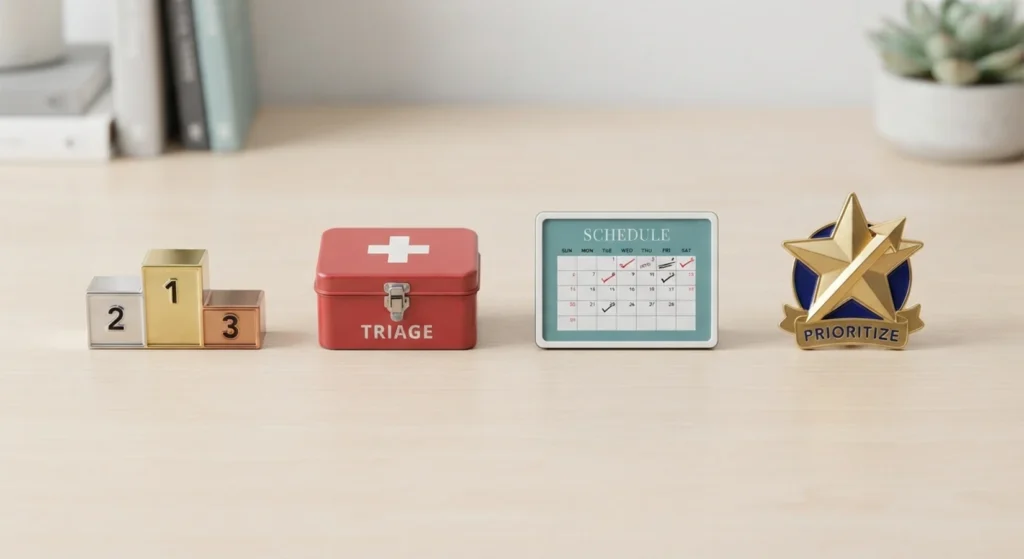
These four words are often used for similar jobs, but each does something different.
| Word | What it does | Best used when | Example |
| prioritize | Decides what matters most and often acts on it | You want the whole process of choosing and acting | I prioritized the urgent emails. |
| rank | Puts items in a list from top to bottom | You want a clear order | I ranked the emails by importance. |
| triage | Sorts by urgency when help is limited | Time is short or things are going wrong | I triaged the emails before lunch. |
| schedule | Puts something at a chosen time | You are planning your calendar | I scheduled the urgent replies for 9 a.m. |
Sources: Merriam-Webster (entries for prioritize, triage, and schedule).
Prioritize and Opposite/Paired Word Pairs
| Word | Paired Word | Note |
| prioritize | deprioritize | Common in business English for lowering something’s importance. |
| prioritize | neglect | Neglect means failing to give needed attention. |
| prioritize | postpone | Postponing moves something to a later time. |
| prioritize | plan | “Plan and prioritize” is a common pairing in work and study. |
| emphasize | downplay | Downplay means making something seem less important. |
| expedite | delay | Delay means making something slower or later. |
| focus | overlook | Overlooking means failing to notice or consider something. |
Most pairs here are contrasts, not strict opposites, because “prioritize” has no single exact opposite. “Deprioritize” is the closest. Words like “neglect” and “postpone” describe what happens to things that are not given priority.
Sources: Merriam-Webster; Collins English Dictionary.
Common Word Partners of “Prioritize”
| Pattern | Common Partners | Example |
| prioritize + noun | tasks, goals, needs, safety, health | You should prioritize your health. |
| prioritize + -ing | saving, learning, building | The team prioritized fixing the bug. |
| prioritize X over Y | quality over speed, people over profit | We prioritize quality over speed. |
| prioritize + by/based on | by urgency, based on need | Prioritize your tasks by urgency. |
| need/have/learn to + prioritize | need to prioritize, learn to prioritize | You have to learn to prioritize. |
| adverb + prioritize | carefully, clearly, strategically | She carefully prioritized the requests. |
Sources: Merriam-Webster example sentences; Collins English Dictionary examples.
Idiomatic Phrases Featuring “Prioritize”
“Prioritize” itself does not appear in any well-known idioms. These established expressions, however, describe the same idea of putting things in order of importance.
1. First things first
- Meaning: Deal with the most important thing before anything else.
- Example: First things first: we need to fix the leak before painting.
2. Take precedence
- Meaning: To be more important than something else and so come first.
- Example: In an emergency, safety takes precedence over everything else.
3. At the top of the list
- Meaning: Being the most important or most urgent thing.
- Example: Fixing the website is at the top of our list this month.
4. On the back burner
- Meaning: Set aside as less urgent, to be dealt with later.
- Example: The new project is on the back burner until spring.
Sources: Merriam-Webster (entries for precedence, first things first, and back burner).
Word Formation of “Prioritize”
Etymology & Structure
“Prioritize” is built from priority plus the verb-forming ending -ize. “Priority” comes from Old French and Medieval Latin, and ultimately from Latin prior, meaning “earlier” or “higher.” The ending -ize comes from Greek through Latin and French and means “to make” or “to treat as.”
Date and History
Merriam-Webster gives 1961 as the first known use of “prioritize.” The noun “priority” is much older and goes back to the Middle Ages. This means “prioritize” is a fairly modern word built on an old one.
Word Class Variations
- Verb: prioritize (prioritizes, prioritized, prioritizing)
- Noun: prioritization; the related base noun is priority
- Adjective: prioritized (as in “a prioritized list”); the related root adjective is prior
- Adverb: none in standard use
- Related derivatives: deprioritize, reprioritize
- British spelling: prioritise, prioritisation
Sources: Merriam-Webster (entries for prioritize, prioritization, priority, and prior); Etymonline.
Common Word-Choice Mistakes
- Wrong: I prioritize about my work. Correct: I prioritize my work.
- Wrong: I prioritize to finish the report. Correct: I prioritize finishing the report.
- Wrong: She gave prioritize to safety. Correct: She gave priority to safety (or: She prioritized safety).
- Wrong: Prioritize is my main goal. Correct: Priority is my main goal (or: Prioritizing is my main goal).
- Wrong: The prioritize of tasks takes time. Correct: The prioritization of tasks takes time.
- Wrong: We emphasize on quality. Correct: We emphasize quality (or: We put emphasis on quality).
- Wrong: I prioritize tea than coffee. Correct: I prefer tea to coffee.
Frequently Asked Questions
What is the closest synonym for prioritize?
“Rank” is the closest for sorting things by importance. “Put first” is the closest everyday phrase for treating something as most important.
What is a formal alternative to prioritize?
“Designate,” “allocate,” and “accord priority to” suit formal writing. The right choice depends on whether you are naming something as urgent or sharing resources.
What is the difference between prioritize and rank?
“Rank” only puts things in order. “Prioritize” often includes acting on that order.
What is the difference between prioritize and emphasize?
“Emphasize” is about showing or saying that something matters. “Prioritize” is about deciding what comes first.
What is the opposite of prioritize?
“Deprioritize” is the closest opposite. “Neglect” and “postpone” describe what often happens to things that are not prioritized.
Can you prioritize people?
Yes, for example, “prioritize patients with serious symptoms.” Be careful with tone, because ranking people can sound cold or unfair in some contexts.
Can prioritize be used without an object?
Yes. A sentence like “You have to learn to prioritize” is standard.
Is “prioritise” correct?
Yes. “Prioritise” is the common British spelling, and “prioritize” is the standard American spelling. Pick one and stay consistent.
Is it okay to use “triage” outside medicine?
Yes. People use it for sorting email, tasks, and projects by urgency. It suggests pressure and limited time.
Is prioritize a new word?
It is fairly modern. Merriam-Webster dates its first known use to 1961, and it is now fully standard in dictionaries.
Conclusion
The closest alternatives to “prioritize” are “rank,” “order,” and “put first.” If you want to show that something matters most, “favor,” “emphasize,” “value,” and “focus” are good options.
Context matters because “prioritize” covers several ideas: sorting, valuing, planning, and giving special treatment. Words like “triage,” “allocate,” and “expedite” fit narrower situations, and many alternatives are related rather than exact synonyms.
To choose the right word, first decide what you really mean. Ask whether you are sorting a list, showing what you care about, using limited resources, or speeding up urgent work. Then pick the word that matches that action.