Another Word for By: 30 Synonyms With Examples
The closest everyday alternatives to by are near, beside, through, via, and before. The right word depends on If by means location (“by the door”), movement (“walk by”), method (“by bus”), time (“by Friday”), or the person who did something (“a book by Austen”).
Quick list: near, beside, next to, alongside, past, through, via, before, during, using
This article explains 30 alternatives with meanings, IPA, usage notes, examples, and context.
At a Glance: By Synonyms and Related Alternatives
| Alternative | Part of Speech | Meaning | Register / Tone | Ideal Context |
| Near | Preposition/adjective | Close to | Neutral | “The shop is near the station.” |
| Beside | Preposition | At the side of | Neutral | “She sat beside her friend.” |
| Next to | Preposition | Immediately beside | Neutral, conversational | “Put it next to the lamp.” |
| Alongside | Preposition | At the side of; together with | Slightly formal | “A path runs alongside the river.” |
| Past | Preposition/adverb | Beyond; having moved beyond | Neutral | “He walked past the café.” |
| Through | Preposition | By way of; using | Neutral | “We entered through the side door.” |
| Via | Preposition | By way of | Formal or neutral | “Send it via email.” |
| Before | Preposition/conjunction | Not later than | Neutral | “Finish it before noon.” |
| During | Preposition | Throughout a period | Neutral | “It rained during the night.” |
| Using | Preposition/participle | With the help of | Neutral | “She fixed it using a screwdriver.” |
Which Word Should You Use?
| If you want to… | Use | Why |
| Say something is close to a place | near, beside, next to | These replace by in its location sense. |
| Describe movement beyond something | past | Past fits “walk by the store” more naturally. |
| Show a route or means of travel | through, via, by way of | These work for “travel by road” or “enter by the door.” |
| Name the person who created something | by | By is usually kept: “a novel by Toni Morrison.” |
| Give a deadline | before, no later than | These replace by in time expressions. |
| Describe an action during a period | during, throughout | These fit “by day” or “by night.” |
| Explain how something is done | using, with, by means of | These replace by in method expressions. |
| State a standard or rule | according to, in accordance with | These are more formal than by the rules. |
Exploring the Multiple Meanings of “By”
1. Near or Beside
- Meaning: Close to a person, place, or object.
- Explanation: This is one of the most common senses of by. It describes position rather than movement.
- Example: The children played by the lake.
2. Past or Beyond
- Meaning: Moving close to something and then beyond it.
- Explanation: By can describe passing a place or person without stopping.
- Example: The train went by the old factory.
3. Through a Route or Means
- Meaning: Using a route, entrance, method, or form of transport.
- Explanation: Here, by answers “how?” or “which way?”
- Example: They traveled by train.
4. Not Later Than
- Meaning: At or before a particular time.
- Explanation: By sets a deadline; the action may happen earlier or exactly at that time.
- Example: Please arrive by 6 p.m.
5. Through the Action of Someone
- Meaning: Identifying the person or force responsible for an action.
- Explanation: This use is common in passive sentences: “The window was broken by the storm.”
- Example: The report was written by two engineers.
6. According To
- Meaning: In agreement with a rule, standard, or measurement.
- Explanation: By can show the basis for a judgment, payment, or action.
- Example: You must play by the rules.
Sources: Merriam-Webster; Collins English Thesaurus; Etymonline
Analyzing 30 By Alternatives in Detail
Some alternatives are direct synonyms in one sense of by, while others work only in particular contexts.
Location and Proximity
1. Near
IPA: /nɪr/ (US and UK)
Definition: At a short distance from someone or something.
- Usage: A direct, natural alternative for by when describing location. It does not always mean “immediately beside.”
- Example: There is a bakery near the school.
2. Beside
IPA: /bɪˈsaɪd/ (US and UK)
Definition: At the side of; next to.
- Usage: A close synonym for by when something or someone is directly at the side of another.
- Example: The dog slept beside the fireplace.
3. Next to
IPA: /nɛkst tu/ (US and UK)
Definition: Immediately adjacent to; beside.
- Usage: Conversational and very common. It emphasizes direct closeness more than near.
- Example: My keys are next to the phone.
4. Alongside
IPA: /əˌlɒŋˈsaɪd/ (US and UK)
Definition: Close to the side of something; parallel to it.
- Usage: Often used for roads, rivers, vehicles, or people working together. It is slightly more formal than beside.
- Example: They parked alongside the curb.
5. At
IPA: /æt/ (US and UK)
Definition: Used to show a specific place or point.
- Usage: A related alternative, not always interchangeable with by. Use at for a general location and by for closeness to a landmark.
- Example: She waited at the corner.
6. Close to
IPA: /kloʊs tu/ (US and UK)
Definition: Near in distance.
- Usage: More explicit than near. It is useful when you want to emphasize that something is only a short distance away.
- Example: The hotel is close to the beach.
7. Adjacent to
IPA: /əˈdʒeɪsənt tu/ (US and UK)
Definition: Next to or adjoining something.
- Usage: Formal and technical. Common in property, legal, and planning language.
- Example: The new building is adjacent to the library.
8. Nigh
IPA: /naɪ/ (US and UK)
Definition: Near in place or time.
- Usage: An old-fashioned or literary alternative to near. Avoid it in everyday writing.
- Example: The village lay nigh the mountains.
Movement and Passing
9. Past
IPA: /pæst/ (US and UK)
Definition: Beyond a place or point.
- Usage: The best replacement for by in “walk by the shop” when the meaning is movement beyond it.
- Example: We drove past the museum.
10. Beyond
IPA: /bɪˈjɒnd/ (US and UK)
Definition: Farther away than; on the other side of.
- Usage: Related rather than exact. Beyond emphasizes a point farther away, while by can mean simply passing close to something.
- Example: The fields stretch beyond the village.
11. Around
IPA: /əˈraʊnd/ (US and UK)
Definition: On all sides of; near; surrounding.
- Usage: A contextual alternative for by in “the house by the ocean,” especially when the location is general rather than exact.
- Example: There are trees around the cabin.
12. Along
IPA: /əˈlɒŋ/ (US and UK)
Definition: Following the length of something.
- Usage: Use it for movement or position following a road, river, wall, or path. It is not an exact substitute for by.
- Example: They walked along the canal.
13. Across
IPA: /əˈkrɒs/ (US and UK)
Definition: From one side to the other side of.
- Usage: A related alternative for routes or movement. It suggests crossing, not simply passing near something.
- Example: They crossed the street by the crossing; they walked across the bridge.
Route, Method, and Means
14. Through
IPA: /θruː/ (US and UK)
Definition: From one side or end to the other; by way of.
- Usage: A strong alternative for by when describing an entrance, route, or process.
- Example: We entered through the back gate.
15. Via
IPA: /ˈvaɪə/ (US and UK)
Definition: By way of; through a place, person, or medium.
- Usage: Formal or neutral. Common for travel routes and communication methods.
- Example: She sent the file via email.
16. By way of
IPA: /baɪ weɪ əv/ (US and UK)
Definition: Through; using a particular route or means.
- Usage: A longer, more formal equivalent of via or by in route and method senses.
- Example: They returned home by way of Chicago.
17. By means of
IPA: /baɪ miːnz əv/ (US and UK)
Definition: With the help or use of.
- Usage: Formal. It replaces by when explaining the tool, method, or process used.
- Example: The data was collected by means of a survey.
18. Using
IPA: /ˈjuːzɪŋ/ (US and UK)
Definition: With the use of; employing.
- Usage: Natural and practical. It works when by introduces a tool or method.
- Example: He opened the package using scissors.
19. With
IPA: /wɪð/ (US and UK)
Definition: Using; having; accompanied by.
- Usage: A close alternative in method expressions such as “cut it with a knife,” but it does not replace by for deadlines or authorship.
- Example: She measured the room with a tape measure.
20. Per
IPA: /pɜːr/ (US and UK)
Definition: For each; according to.
- Usage: Formal, businesslike, and often used in rates, instructions, or standards. It matches by in “sold by the pound” more than in location senses.
- Example: The fee is charged per person.
Time and Deadlines
21. Before
IPA: /bɪˈfɔːr/ (US and UK)
Definition: Earlier than a particular time or event.
- Usage: A useful alternative for by when the deadline does not need to include the exact time. “By 5 p.m.” allows 5 p.m.; “before 5 p.m.” does not.
- Example: Finish the form before Friday.
22. No later than
IPA: /noʊ ˈleɪtər ðæn/ (US and UK)
Definition: At or before a stated time.
- Usage: Formal and precise. It is a clear substitute for by in deadlines and instructions.
- Example: Submit your application no later than March 1.
23. Prior to
IPA: /ˈpraɪər tu/ (US and UK)
Definition: Before a particular time or event.
- Usage: Formal. Common in business, legal, and official writing.
- Example: Please confirm prior to departure.
24. During
IPA: /ˈdʊrɪŋ/ (US and UK)
Definition: Throughout the course of a period of time.
- Usage: Replaces by in expressions such as “by day” or “by night,” but not in deadline expressions.
- Example: The shop is closed during the holidays.
25. Throughout
IPA: /θruːˈaʊt/ (US and UK)
Definition: During the whole of a period; in every part of.
- Usage: Emphasizes that something continues for an entire period. It is broader than by.
- Example: The city was quiet throughout the night.
Agency, Standards, and Measurement
26. Through
IPA: /θruː/ (US and UK)
Definition: As a result of; because of.
- Usage: In this sense, through can replace by when explaining a cause, though the meaning shifts from method to cause.
- Example: She succeeded through hard work.
27. Because of
IPA: /bɪˈkɔːz əv/ (US and UK)
Definition: As a result of; due to.
- Usage: A related alternative, not an exact synonym. Use it for causes, not for location, deadlines, or authorship.
- Example: The flight was delayed because of fog.
28. According to
IPA: /əˈkɔːrdɪŋ tu/ (US and UK)
Definition: As stated or indicated by; in agreement with.
- Usage: A formal alternative for by in “by the rules,” “by the map,” or “by her estimate.”
- Example: According to the schedule, class starts at nine.
29. In accordance with
IPA: /ɪn əˈkɔːrdəns wɪð/ (US and UK)
Definition: In agreement with rules, instructions, or standards.
- Usage: Very formal. It suits legal, official, and business contexts.
- Example: The work was completed in accordance with safety rules.
30. Under
IPA: /ˈʌndər/ (US and UK)
Definition: In accordance with; governed by.
- Usage: A related formal alternative for by in legal or rule-based contexts, especially “under the law” or “under the agreement.”
- Example: Employees are protected under the new policy.
Sources: Merriam-Webster; Merriam-Webster Thesaurus; Collins English Thesaurus.
By in Different Contexts
| Context | Common alternatives | Example |
| Location | near, beside, next to | “Wait by the door” → “Wait beside the door.” |
| Movement | past, through, along | “He walked by the shop” → “He walked past the shop.” |
| Transport | via, by way of | “Travel by air” → “Travel via air” is possible, but “travel by air” is more natural. |
| Deadline | before, no later than | “Due by Monday” → “Due no later than Monday.” |
| Method | using, with, through | “By hand” → “Using her hands” or “by hand” in set phrases. |
| Authorship | by | Keep by: “a painting by Monet.” |
| Rules | according to, under | “By law” → “under the law.” |
By is a function word that connects with a noun phrase to show location, direction, time, or another relationship.
Sources: Merriam-Webster.
By and Opposite/Paired Word Pairs
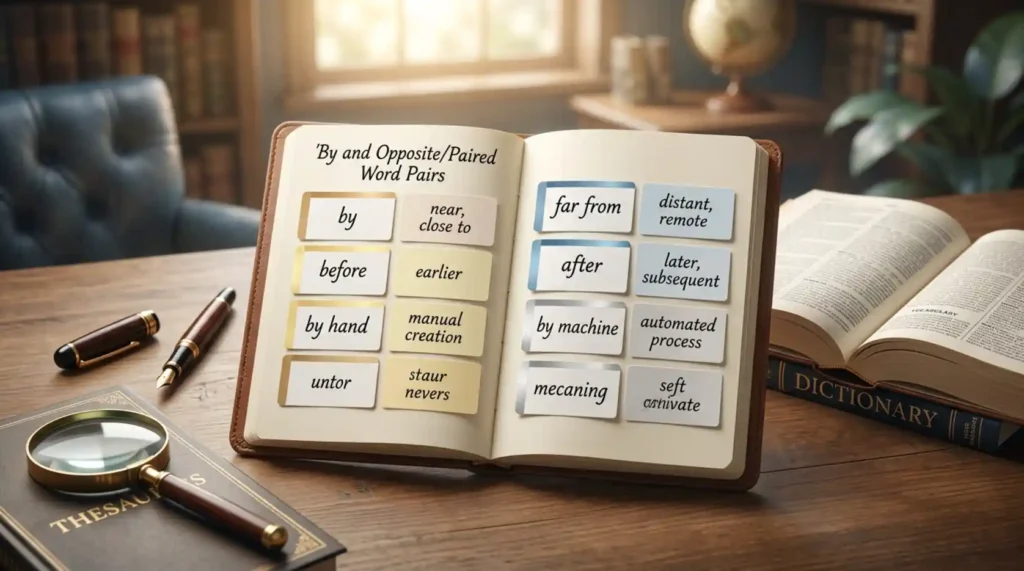
| Word | Paired Word | Note |
| By | Far from | Contrasts closeness with distance. |
| By | Away from | Contrasts being near with moving or being distant. |
| By | Before | Contrasts a deadline with an earlier time. |
| By | After | Contrasts “not later than” with a later time. |
| By hand | By machine | Contrasts manual and mechanical methods. |
| By day | By night | Contrasts daytime and nighttime periods. |
| By chance | By design | Contrasts accident and intention. |
These pairs show how by changes meaning with the noun that follows it: it can describe place, time, method, cause, or intention.
Sources: Merriam-Webster; Etymonline.
Common Word Partners of “By”
| Pattern | Common Partners | Example |
| by + place | the door, the window, the river, the road | “She stood by the window.” |
| by + transport | bus, car, train, plane, bike | “They arrived by train.” |
| by + deadline | Monday, noon, Friday, 5 p.m. | “Please reply by Friday.” |
| by + method | hand, phone, email, chance, accident | “Contact us by email.” |
| by + person | the author, the committee, the teacher | “The song was written by her.” |
| by + standard | the rules, law, the book, the meter | “Judge it by its results.” |
| by + amount | a mile, two points, 10 percent | “The team won by two points.” |
These collocations are useful because by rarely has one fixed replacement across all of them.
Sources: Merriam-Webster; Collins English Thesaurus.
Idiomatic Phrases Featuring “By”
1. By and large
- Meaning: In general; mostly.
- Example: By and large, the event went smoothly.
2. By chance
- Meaning: Without planning; accidentally.
- Example: I met her by chance at the market.
3. By heart
- Meaning: From memory.
- Example: The students learned the poem by heart.
4. By means of
- Meaning: Using a particular method or tool.
- Example: The message spread by means of social media.
Sources: Merriam-Webster; Collins English Thesaurus.
Word Formation of “By”
Etymology & Structure
By comes from Old English be or bi, meaning “near, in, by, during, about.” It developed from Proto-Germanic *bi, meaning “around” or “about,” and ultimately from a reduced form of the Proto-Indo-European root *ambhi-, meaning “around.”
Date and History
By existed in Old English as a word of place and relation. As an adverb meaning “near” or “close at hand,” it is recorded from about 1300. Its original sense of position survives in place names such as Whitby and Grimsby.
Word Class Variations
- Preposition: by the river; by train; by Friday.
- Adverb: “She stopped by.”
- Related compounds: byway, byproduct, bystander, bylaw.
- Related phrase forms: by means of, by way of, by and large.
Sources: Etymonline; Merriam-Webster.
Common Word-Choice Mistakes
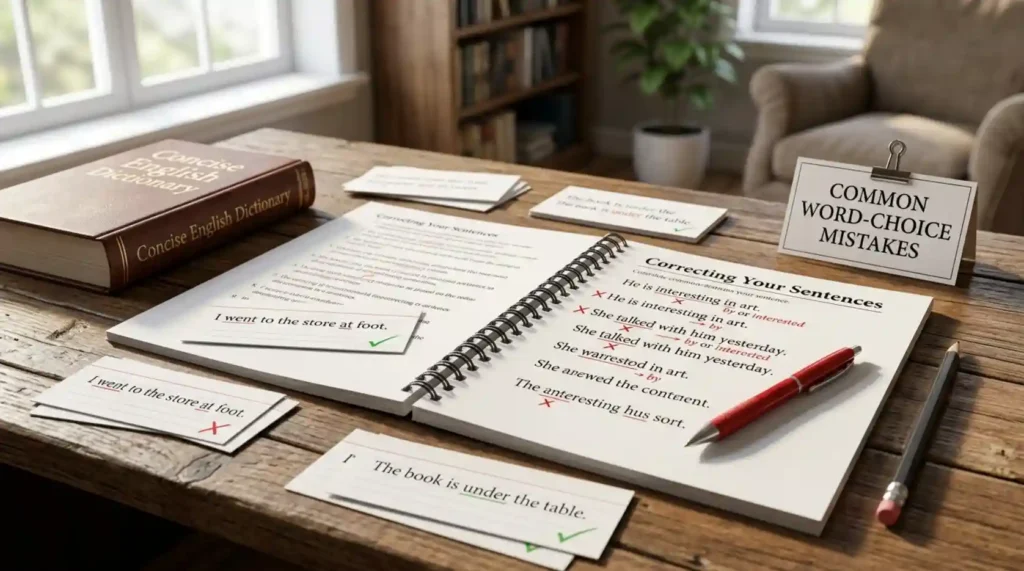
- Wrong: “The hotel is beside to the beach.” Correct: “The hotel is beside the beach.”
- Wrong: “Finish it until Friday.” Correct: “Finish it by Friday.”
- Wrong: “She sent it with email.” Correct: “She sent it by email” or “via email.”
- Wrong: “A poem written from Keats.” Correct: “A poem written by Keats.”
- Wrong: “We traveled with train.” Correct: “We traveled by train.”
- Wrong: “He walked near the shop and continued.” Correct: “He walked past the shop and continued.”
- Wrong: “The decision was made according to the committee.” Correct: “The decision was made by the committee.”
Frequently Asked Questions
What is the closest synonym for by?
For location, near or beside is closest. For movement, past is often best; for method, through, via, or using may fit.
What is the difference between by and beside?
Beside means directly at the side of something. By can mean that, but it also has many other meanings, including time, method, and authorship.
Can I replace by with near?
Often, yes: “by the station” and “near the station” are both natural. But near does not work for “by Friday,” “by train,” or “a book by Austen.”
What is a formal alternative to by?
Use via for routes or communication, prior to or no later than for deadlines, and in accordance with for rules.
What is a simple alternative to by for deadlines?
Use before if the deadline must be earlier than the stated time. Use no later than if the exact time is included.
Does by always mean near?
No. By can mean near, past, through, during, according to, or through the action of someone.
Can by be used for people?
Yes, especially in passive sentences: “The project was led by Dr. Lee.” It also identifies creators: “a film by Hayao Miyazaki.”
Is via the same as by?
Not always. Via works for routes and communication, but “by Friday,” “by the window,” and “by the rules” need different words.
What is the opposite of by?
There is no single opposite. For location, far from or away from contrasts with by; for deadlines, after contrasts with by.
Is by the same as through?
They overlap in route and method senses, but through often suggests movement from one side to another or a process, while by has a wider range of meanings.
Conclusion
The most common alternatives to by are near, beside, next to, past, through, via, before, and using. Each replaces by only in particular senses.
Because by can describe place, movement, time, method, authorship, and rules, context matters more than with most words. A replacement that works in “by the door” may sound wrong in “by Friday” or “by train.”
Choose the alternative by asking what by means in your sentence: where something is, how something happens, when something must be done, or who did it. Then select the word that expresses that exact relationship.