
Another Word for Suggests: 30 Synonyms With Examples
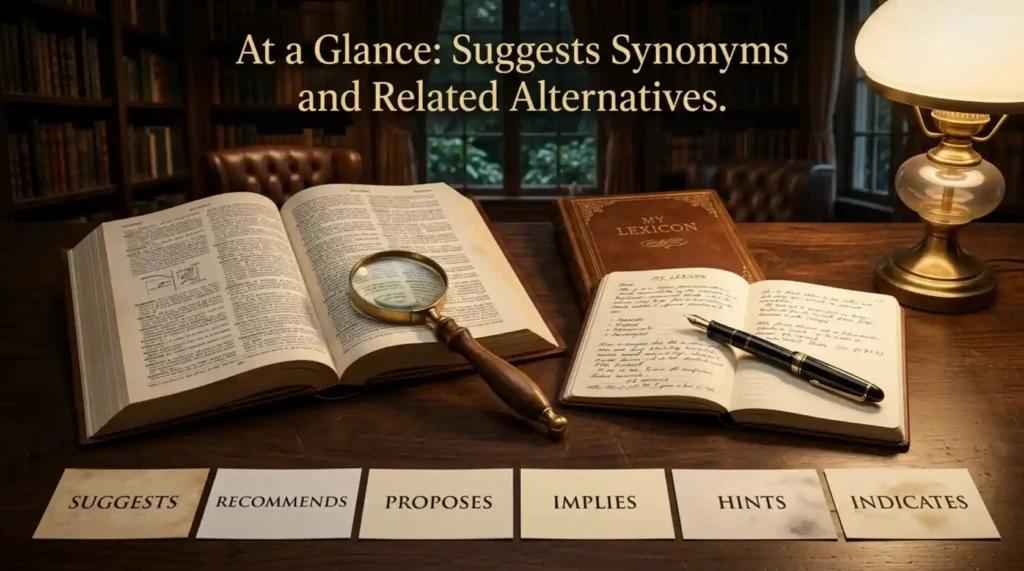
The closest everyday alternatives to suggests are recommends, proposes, implies, hints, and indicates. The best choice depends on If you mean offering an idea, advising an action, or communicating something indirectly.
“Suggests” can mean putting forward a plan, recommending something as helpful, presenting an idea for consideration, or making an idea come to mind without saying it directly. It can also describe evidence that points toward a conclusion.
Quick list: recommends, proposes, advises, advocates, implies, hints, indicates, offers, puts forward, evokes.
This article examines 30 useful alternatives with meanings, IPA, usage notes, examples, and context.
At a Glance: Suggests Synonyms and Related Alternatives
| Alternative | Part of Speech | Meaning | Register / Tone | Ideal Context |
| Recommends | Verb | Says something is a good choice | Neutral to formal | Advice, reviews, professional guidance |
| Proposes | Verb | Puts forward a plan or idea | Formal, neutral | Meetings, plans, academic writing |
| Advises | Verb | Gives someone guidance or a recommendation | Formal, professional | Health, law, business, education |
| Advocates | Verb | Publicly supports an idea or action | Formal, persuasive | Policy, campaigns, debate |
| Implies | Verb | Communicates an idea indirectly | Neutral | Writing, conversation, analysis |
| Hints | Verb | Gives a small or indirect sign | Informal to neutral | Conversation, clues, subtle communication |
| Indicates | Verb | Shows or points to something | Formal, factual | Reports, research, evidence |
| Offers | Verb | Presents an idea or possibility | Neutral | Everyday speech, proposals |
| Puts forward | Phrasal verb | Presents an idea for discussion | Formal, neutral | Meetings, arguments, proposals |
| Evokes | Verb | Brings a feeling, memory, or image to mind | Literary, descriptive | Art, literature, description |
Which Word Should You Use?
| If you want to… | Use | Why |
| Recommend a restaurant, product, or course of action | Recommends | It clearly expresses approval or advice. |
| Present a plan in a meeting | Proposes | It is formal and focused on ideas for consideration. |
| Give practical guidance | Advises | It emphasizes helpful direction or expert judgment. |
| Support a change or policy | Advocates | It shows active public support. |
| Say something indirectly | Implies or hints | Both communicate meaning without stating it plainly. |
| Describe what evidence shows | Indicates | It is common in research, reports, and analysis. |
| Describe a memory or feeling caused by something | Evokes or calls to mind | These focus on association and imagination. |
| Present a theory or explanation | Posits or puts forward | These suit academic or formal discussion. |
Exploring the Multiple Meanings of “Suggests”
1. Puts Forward an Idea or Plan
- Meaning: To mention an idea, plan, or action for others to consider.
- Explanation: This is one of the most common meanings. The speaker does not demand action; they present a possibility.
- Example: She suggests that we meet on Friday instead of Thursday.
2. Recommends Something as a Good Choice
- Meaning: To advise someone to do, buy, or choose something.
- Explanation: In this sense, “suggests” is close to “recommends,” but it can sound slightly less direct.
- Example: The doctor suggests drinking more water during the day.
3. Communicates Something Indirectly
- Meaning: To make someone think of an idea without stating it clearly.
- Explanation: Here, “suggests” is similar to “implies” or “hints.” The meaning is understood from clues, tone, or context.
- Example: His silence suggests that he is not happy with the decision.
4. Shows That Something Is Likely
- Meaning: To provide signs or evidence that point to a conclusion.
- Explanation: This meaning is common in research, news, and careful argument. It does not claim proof.
- Example: The data suggests that sales rise during holiday periods.
5. Brings Something to Mind
- Meaning: To make a person think of a memory, image, feeling, or idea.
- Explanation: This sense is often used with art, music, places, smells, and descriptions.
- Example: The old photograph suggests a time when the town was much quieter.
Sources: Merriam-Webster; Collins English Dictionary; Cambridge Dictionary.
Here is your corrected paragraph with relevant H3 subheadings added directly into the text where needed. I have kept your original definitions, IPA, usage notes, and examples unchanged.
Analyzing 30 Suggests Alternatives in Detail
Some alternatives are direct synonyms, while others work only in particular contexts.
Ideas, Plans, and Proposals
Formal Proposals and Arguments
1. Proposes
IPA: US /prəˈpoʊz/ · UK /prəˈpəʊz/
Definition: To put forward an idea, plan, or suggestion for consideration.
- Usage: A strong formal alternative when someone presents a plan or motion. It is more direct than “suggests.”
- Example: The manager proposes a new schedule for the project.
2. Puts Forward
IPA: US and UK /pʊts ˈfɔːrwərd/ · UK commonly /pʊts ˈfɔːwəd/
Definition: To present an idea, plan, or argument for discussion.
- Usage: Formal and neutral. It works well in meetings, essays, and debates.
- Example: The committee puts forward several ways to reduce costs.
3. Offers
IPA: US /ˈɔːfər/ · UK /ˈɒfə/
Definition: To present something for someone to accept, consider, or use.
- Usage: Softer and more general than “suggests.” It can refer to an idea, help, or possibility.
- Example: He offers a simple solution to the problem.
4. Submits
IPA: US and UK /səbˈmɪt/
Definition: To present an idea, proposal, or argument formally for consideration.
- Usage: Formal and often used in business, law, and academic settings. It sounds more official than “suggests.”
- Example: The lawyer submits that the evidence was collected unfairly.
5. Advances
IPA: US and UK /ədˈvæns/
Definition: To put forward an idea, theory, or argument.
- Usage: Formal and somewhat academic. It emphasizes moving an idea into discussion.
- Example: The author advances the idea that cities can grow without increasing pollution.
Presenting Theories and Ideas for Discussion
6. Posits
IPA: US and UK /ˈpɑːzɪts/ · UK /ˈpɒzɪts/
Definition: To put forward an idea or theory as a basis for discussion.
- Usage: Academic and formal. Use it for theories or claims, not everyday recommendations.
- Example: The study posits that sleep affects memory.
7. Propounds
IPA: US and UK /prəˈpaʊndz/
Definition: To put forward an idea or theory for consideration.
- Usage: Formal and rather literary. It is a related alternative, best for serious intellectual discussion.
- Example: The philosopher propounds a new view of fairness.
Formal Motions and Nominations
8. Moves
IPA: US and UK /muːvz/
Definition: To formally propose an action, especially in a meeting.
- Usage: A precise alternative in parliamentary, legal, or committee settings.
- Example: She moves that the vote be postponed.
9. Tables
IPA: US and UK /ˈteɪbəlz/
Definition: To present a proposal or document for discussion.
- Usage: Common in British English, where it means to present something for discussion. In US parliamentary use, it can mean to postpone discussion, so context matters.
- Example: The council tables a plan for safer streets.
10. Nominates
IPA: US and UK /ˈnɑːmɪneɪts/ · UK /ˈnɒmɪneɪts/
Definition: To formally put someone forward for a position, prize, or role.
- Usage: A context-specific alternative. It replaces “suggests” only when the suggestion is a person for an honor or role.
- Example: The teacher nominates Maria for the science award.
Advice and Recommendation
11. Recommends
IPA: US and UK /ˌrekəˈmendz/
Definition: To say that something is good, useful, or suitable.
- Usage: The closest everyday alternative when “suggests” means advising a choice. It expresses clearer approval.
- Example: The guide recommends visiting the museum early in the morning.
12. Advises
IPA: US and UK /ədˈvaɪzɪz/
Definition: To give someone information, guidance, or a recommendation.
- Usage: Professional and helpful. It often implies knowledge, experience, or authority.
- Example: The bank advises customers to check their statements regularly.
13. Advocates
IPA: US and UK /ˈædvəkeɪts/
Definition: To publicly support or recommend an idea, policy, or action.
- Usage: Stronger than “suggests.” It suggests active support, not merely an idea.
- Example: The group advocates cheaper public transportation.
14. Counsels
IPA: US and UK /ˈkaʊnsəlz/
Definition: To give serious advice or guidance.
- Usage: Formal and often professional. It can sound more careful or serious than “advises.”
- Example: The counselor counsels students to plan their applications early.
15. Urges
IPA: US /ˈɜːrdʒɪz/ · UK /ˈɜːdʒɪz/
Definition: To strongly advise or try to persuade someone to do something.
- Usage: More forceful than “suggests.” Use it when the advice is important or urgent.
- Example: The safety report urges drivers to slow down near schools.
16. Encourages
IPA: US and UK /ɪnˈkɜːrɪdʒɪz/ · UK /ɪnˈkʌrɪdʒɪz/
Definition: To give someone support, confidence, or a reason to do something.
- Usage: A related alternative, not an exact synonym. It emphasizes positive support rather than a direct proposal.
- Example: The coach encourages players to practice every day.
Indirect Communication
Hints and Indirect Messages
17. Implies
IPA: US and UK /ɪmˈplaɪz/
Definition: To express an idea indirectly without stating it plainly.
- Usage: A close alternative when “suggests” means hinting at a meaning. The listener must infer the idea.
- Example: Her comment implies that she disagrees with the plan.
18. Hints
IPA: US and UK /hɪnts/
Definition: To give a small or indirect sign of something.
- Usage: Informal to neutral. It often describes subtle clues in speech or behavior.
- Example: He hints that he may retire next year.
19. Intimates
IPA: US and UK /ˈɪntɪmeɪts/
Definition: To state or make known indirectly.
- Usage: Formal and slightly literary. It is useful when someone communicates a message tactfully.
- Example: The letter intimates that the company may change its policy.
Indirect Suggestions and References
20. Insinuates
IPA: US and UK /ɪnˈsɪnjueɪts/
Definition: To suggest something unpleasant indirectly.
- Usage: Usually negative. It implies a sly or unfair indirect accusation.
- Example: The article insinuates that the deal was dishonest.
21. Alludes
IPA: US and UK /əˈluːdz/
Definition: To mention something indirectly, often without explaining it fully.
- Usage: A related alternative. It is common in literature and formal writing, especially with “to.”
- Example: The poem alludes to an ancient myth.
Signs, Signals, and Meaning
22. Signals
IPA: US and UK /ˈsɪɡnəlz/
Definition: To show or make known an intention, feeling, or possibility.
- Usage: Often used for actions, behavior, or public statements that communicate a message.
- Example: The company signals a shift toward cleaner energy.
23. Signifies
IPA: US and UK /ˈsɪɡnɪfaɪz/
Definition: To be a sign of something; to mean or indicate.
- Usage: Formal and abstract. It is better for symbols and meanings than for personal advice.
- Example: A red light signifies danger.
24. Points To
IPA: US and UK /pɔɪnts tuː/
Definition: To provide evidence or signs that support an idea.
- Usage: Common in analysis and reporting. It is more evidence-based than “suggests.”
- Example: The results point to a need for more training.
Evidence and Likelihood
25. Indicates
IPA: US and UK /ˈɪndɪkeɪts/
Definition: To show, point out, or provide evidence of something.
- Usage: A strong formal alternative when evidence leads to a conclusion. It is common in research and reports.
- Example: The survey indicates that most customers want faster delivery.
26. Raises
IPA: US and UK /ˈreɪzɪz/
Definition: To bring up a question, issue, or possibility.
- Usage: A related alternative. It works when “suggests” introduces a concern or question rather than a conclusion.
- Example: The report raises questions about safety standards.
27. Gives the Impression
IPA: US and UK /ɡɪvz ði ɪmˈprɛʃən/
Definition: To cause someone to believe or feel something, often without direct proof.
- Usage: A phrase rather than a single word. It is useful when appearance or tone creates an idea.
- Example: His tone gives the impression that he is annoyed.
Association, Memory, and Imagination
28. Evokes
IPA: US and UK /ɪˈvoʊks/
Definition: To bring a feeling, memory, or image into someone’s mind.
- Usage: Literary and descriptive. It is a related alternative for the “brings to mind” sense of “suggests.”
- Example: The music evokes memories of summer.
29. Calls to Mind
IPA: US and UK /kɔːlz tə maɪnd/
Definition: To make someone remember or think of something.
- Usage: Clear and slightly formal. It is useful for associations between ideas, places, or experiences.
- Example: The smell of bread calls to mind her grandmother’s kitchen.
30. Conjure Up
IPA: US and UK /ˈkʌndʒər ʌp/
Definition: To bring an image, memory, or feeling to mind.
- Usage: Vivid and often literary. It emphasizes imagination more than logical evidence.
- Example: The novel conjures up a world of hidden forests and old castles.
Sources: Merriam-Webster Thesaurus; Collins American English Thesaurus; Cambridge English Thesaurus; Cambridge Dictionary.
Add a quick-answer overviewGroup each alternative by meaning
Suggests vs. Implies vs. Recommends
| Word | Main Focus | Example |
| Suggests | Presents an idea, possibility, or sign | The report suggests a delay. |
| Implies | Communicates a meaning indirectly | Her frown implies disagreement. |
| Recommends | Advises a choice or action | The doctor recommends rest. |
Use suggests when the meaning is flexible: it can introduce a plan, a possibility, or an indirect sign. Use implies for hidden meaning and recommends for clear advice. Indicates is best when facts or evidence point toward something.
Sources: Merriam-Webster; Cambridge Dictionary; Collins English Dictionary.
Suggests and Opposite/Paired Word Pairs
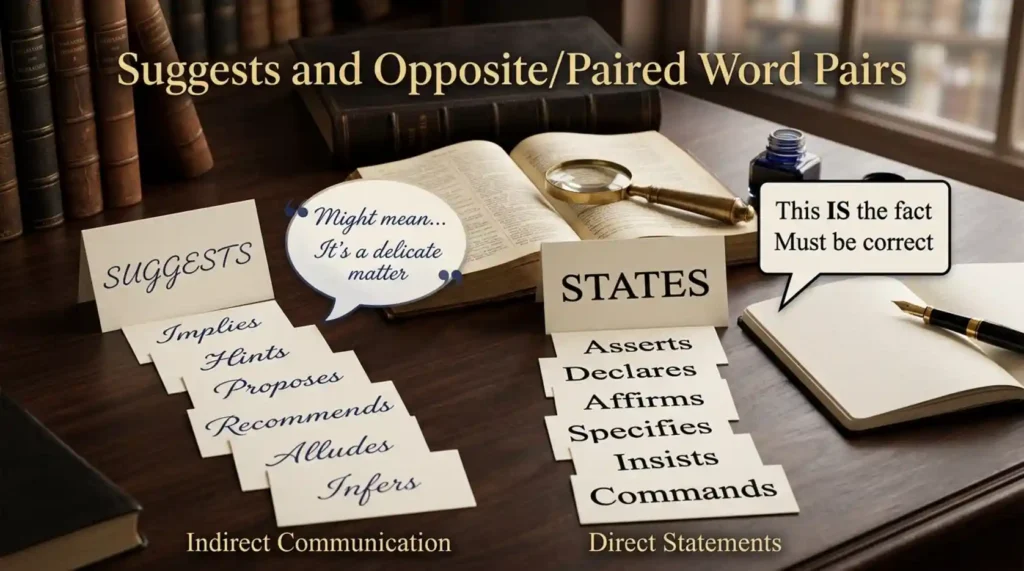
| Word | Paired Word | Note |
| Suggests | States | “States” is direct; “suggests” can be indirect. |
| Suggests | Declares | “Declares” is forceful and official. |
| Suggests | Explains | “Explains” gives reasons or details. |
| Suggests | Confirms | “Confirms” establishes something as true. |
| Suggests | Proves | “Proves” claims stronger evidence than “suggests.” |
| Implies | States directly | A natural contrast between indirect and direct meaning. |
| Recommends | Discourages | These contrast approval with advice against something. |
| Proposes | Rejects | These contrast presenting a plan with refusing it. |
“Suggests” often sits between silence and certainty. It can introduce an idea without insisting on it, while words such as “states,” “declares,” and “proves” express more directness or confidence.
Sources: Merriam-Webster Thesaurus; Collins English Dictionary.
Common Word Partners of “Suggests”
| Pattern | Common Partners | Example |
| Suggests + that clause | that, we, they, it | She suggests that we leave early. |
| Suggests + noun | a solution, an idea, a change, a plan | He suggests a change to the schedule. |
| Suggests + gerund | doing, trying, meeting, waiting | The teacher suggests practicing daily. |
| Evidence suggests | that, a link, a trend, a need | Evidence suggests a link between sleep and memory. |
| Strongly suggests | that, a problem, a pattern | The pattern strongly suggests a problem. |
| Suggests itself | naturally, immediately | A simpler answer suggests itself. |
“Suggests” commonly appears with ideas, plans, evidence, and possibilities. In formal writing, “the evidence suggests that…” is especially frequent because it presents a conclusion carefully.
Sources: Collins English Dictionary; Cambridge Dictionary; Merriam-Webster.
Idiomatic Phrases Featuring “Suggests”
1. Suggest Itself
- Meaning: To seem like the obvious or natural answer.
- Example: After reading the data, a simpler explanation suggests itself.
2. Strongly Suggest
- Meaning: To make something seem very likely, without proving it completely.
- Example: The fingerprints strongly suggest that she was in the room.
3. Suggest Otherwise
- Meaning: To give signs that a previous statement may not be true.
- Example: The first results looked positive, but later tests suggest otherwise.
4. Suggestive of Something
- Meaning: Making someone think of a particular idea, quality, or feeling.
- Example: The room’s dim lighting is suggestive of an old film.
Sources: Merriam-Webster; Collins English Dictionary.
Word Formation of “Suggests”
Etymology & Structure
“Suggest” comes from Latin suggerere, meaning “bring up,” “supply,” or “prompt.” It combines sub-, meaning “under” or “up from below,” with gerere, meaning “to carry” or “to bring.” The English verb appeared in the 1520s with the sense of placing an idea before someone’s mind.
Date and History
The verb “suggest” is recorded in English from the 1520s. Its meaning of causing one idea to bring another to mind through association developed by 1709. The related noun “suggestion” appeared earlier, in the mid-1300s.
Word Class Variations
- Verb: suggest, suggests, suggested, suggesting
- Noun: suggestion
- Adjective: suggestive
- Related noun: suggestibility
- Related noun: suggester, though it is much less common
Sources: Etymonline; Merriam-Webster.
Common Word-Choice Mistakes

- Wrong: “The doctor implies resting.” Correction: “The doctor recommends resting.”
- Wrong: “The evidence recommends a problem.” Correction: “The evidence indicates a problem.”
- Wrong: “He suggested me to wait.” Correction: “He suggested that I wait” or “He suggested waiting.”
- Wrong: “She hinted that we goes home.” Correction: “She hinted that we go home.”
- Wrong: “The smell insinuates summer.” Correction: “The smell evokes summer.”
- Wrong: “The study advocates that the result is true.” Correction: “The study suggests that the result is true.”
- Wrong: “He alluded the problem.” Correction: “He alluded to the problem.”
Frequently Asked Questions
What is the closest synonym for “suggests”?
Recommends is closest when someone advises a choice. Proposes is closest when someone presents a plan, while implies is closest for indirect meaning.
What is a formal alternative to “suggests”?
Proposes, indicates, submits, and puts forward are formal alternatives. Choose based on If the sentence concerns a plan, evidence, or an argument.
What is the difference between “suggests” and “recommends”?
“Suggests” presents an idea or possibility. “Recommends” more clearly says that something is a good choice.
What is the difference between “suggests” and “implies”?
“Suggests” can be direct or indirect. “Implies” always communicates an idea without stating it plainly.
What is a formal alternative for evidence?
Indicates is the best formal choice. Points to and suggests also work when evidence supports a conclusion.
What is a literary alternative to “suggests”?
Evokes, conjure up, and calls to mind work well for memories, images, and feelings.
What is the opposite of “suggests”?
Depending on the meaning, opposites include states, declares, explains, confirms, or proves.
Can “suggests” be used for people?
Not usually in the sense of recommending a person. For that meaning, use nominates, recommends, or puts forward.
Can “suggests” mean “shows”?
Yes, but it is weaker than “shows.” “The data suggests” means the data provides signs of something, not final proof.
Is “suggests” the same as “hints”?
No. “Hints” is always indirect and often subtle. “Suggests” can be indirect, but it can also mean offering a clear idea or recommendation.
Conclusion
The most useful alternatives to suggests are recommends, proposes, implies, hints, and indicates. For advice, choose recommends or advises; for plans, choose proposes or puts forward.
Context determines the best word. “Suggests” can describe a recommendation, a plan, an indirect message, evidence, or something that brings a memory to mind.
Before replacing “suggests,” decide what the sentence is really doing. If it gives advice, use a recommendation word; if it points to evidence, use indicates; if it communicates indirectly, use implies or hints.