
Tired of Saying “Enthusiasm”? Try These 30 Powerful Alternatives
The closest everyday alternatives to enthusiasm are eagerness, excitement, keenness, and passion. The best word depends on If you mean lively interest, strong emotion, willingness to act, or a short-lived popular interest.
Quick list: eagerness, excitement, keenness, passion, zeal, zest, ardor, fervor, gusto, relish
This article explains 30 alternatives with meanings, IPA, usage notes, examples, and context.
At a Glance: Enthusiasm Synonyms and Related Alternatives
| Alternative | Part of Speech | Meaning | Register / Tone | Ideal Context |
| Eagerness | Noun | Strong wish to do or have something | Neutral | Work, learning, invitations |
| Excitement | Noun | A feeling of being excited | Neutral, emotional | Events, news, travel |
| Keenness | Noun | Eager interest or willingness | Slightly formal, common in UK English | Jobs, study, hobbies |
| Passion | Noun | Very strong feeling or interest | Emotional, strong | Careers, causes, hobbies |
| Zeal | Noun | Great energy and dedication for a cause | Formal | Religion, politics, reform |
| Zest | Noun | Lively enjoyment and energy | Positive, vivid | Life, food, work |
| Ardor | Noun | Intense feeling or passion | Formal, literary | Love, beliefs, ambition |
| Fervor | Noun | Very strong emotion or belief | Formal | Speeches, causes, religion |
| Gusto | Noun | Great enjoyment and energy | Informal to neutral | Food, activities, performance |
| Relish | Noun | Keen enjoyment | Neutral | Food, challenges, experiences |
Which Word Should You Use?

| If you want to… | Use | Why |
| Say someone wants to start or join in | Eagerness | It focuses on willingness and readiness |
| Describe a lively, positive feeling | Excitement | It is the most common everyday choice |
| Show strong interest in a subject or job | Keenness | It suggests active, serious interest |
| Describe a deep personal interest | Passion | It is stronger and more emotional than enthusiasm |
| Praise energetic support for a cause | Zeal | It suggests commitment and effort |
| Describe enjoyment of life or an activity | Zest | It adds liveliness and energy |
| Use a formal or literary word | Ardor or fervor | Both emphasize intense feeling |
| Describe doing something with enjoyment | Gusto or relish | Both focus on pleasure and energy |
| Describe a short-lived popular interest | Craze or fad | These refer to trends, not personal feelings |
| Describe excessive interest | Mania or obsession | These can sound negative or extreme |
Exploring the Multiple Meanings of “Enthusiasm”
1. Strong excitement or eagerness
- Meaning: A strong feeling of interest, energy, or eagerness.
- Explanation: This is the main modern meaning. It can describe how someone feels about an activity, idea, person, or event.
- Example: She accepted the job offer with enthusiasm.
2. Intense interest in something
- Meaning: A strong, lasting interest in a subject or activity.
- Explanation: In this sense, enthusiasm is close to passion or interest, but it often suggests active enjoyment rather than deep emotion.
- Example: His enthusiasm for astronomy began in childhood.
3. An activity or interest someone enjoys
- Meaning: Something that inspires strong interest or enjoyment.
- Explanation: This use is usually plural: enthusiasms. It can refer to hobbies, causes, or favorite subjects.
- Example: Her enthusiasms include painting, hiking, and classical music.
4. A short-lived popular interest
- Meaning: A trend, fashion, or activity that many people become interested in for a short time.
- Explanation: This meaning is less common today. Words such as craze, fad, and rage are often clearer.
- Example: The new dance became the latest enthusiasm among teenagers.
5. Intense religious emotion
- Meaning: Strong religious feeling, sometimes believed to come from divine inspiration.
- Explanation: This is an older and specialized sense. In modern everyday English, enthusiasm rarely carries this religious meaning.
- Example: Historical writers sometimes used “enthusiasm” for intense religious experience.
Sources: Merriam-Webster; Collins English Thesaurus; Cambridge English Thesaurus; Etymonline.
Analyzing 30 Enthusiasm Alternatives in Detail
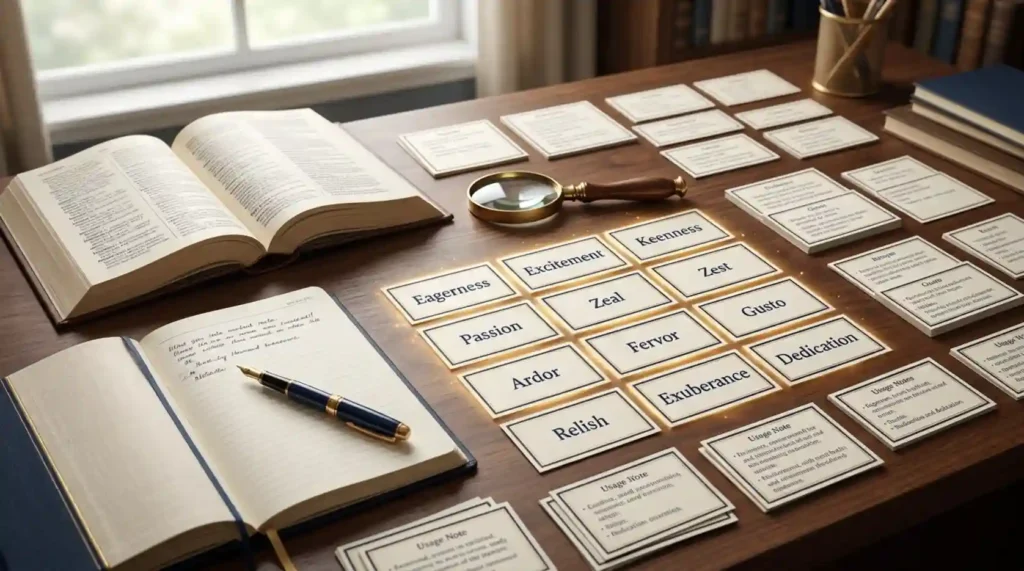
Some alternatives are direct synonyms, while others fit only particular contexts.
Core Synonyms
1. Eagerness
IPA: /ˈiːɡərnəs/ (US and UK)
Definition: A strong wish to do or have something.
- Usage: A direct and very common alternative. It emphasizes readiness or desire, especially before an action.
- Example: The children showed great eagerness to open their presents.
2. Excitement
IPA: /ɪkˈsaɪtmənt/ (US and UK)
Definition: A feeling of being excited or emotionally stirred.
- Usage: A natural everyday synonym when enthusiasm involves anticipation, energy, or a strong reaction.
- Example: There was excitement in the air before the concert began.
3. Keenness
IPA: /ˈkiːnnəs/ (US and UK)
Definition: Eager interest, willingness, or sharpness.
- Usage: Common in British English and slightly more formal than eagerness. It works well for jobs, study, and hobbies.
- Example: Her keenness to learn impressed the interviewer.
4. Interest
IPA: /ˈɪntrəst/ (US and UK)
Definition: A feeling of wanting to know about or take part in something.
- Usage: A related alternative, but milder than enthusiasm. Use it when the feeling is real but not especially intense.
- Example: He has a strong interest in local history.
5. Passion
IPA: /ˈpæʃən/ (US and UK)
Definition: A very strong feeling, especially of love, anger, or enthusiasm.
- Usage: Stronger and more emotional than enthusiasm. It suggests a deep personal connection.
- Example: Teaching is her passion.
6. Zeal
IPA: /ziːl/ (US and UK)
Definition: Great energy and enthusiasm for a cause or goal.
- Usage: Formal and often used for beliefs, reform, religion, or work. It can sometimes suggest too much intensity.
- Example: She campaigned for cleaner rivers with great zeal.
7. Zest
IPA: /zɛst/ (US and UK)
Definition: Great enjoyment, energy, and excitement.
- Usage: A vivid alternative for enthusiasm for life, food, work, or experiences.
- Example: He approached every new project with zest.
Formal and Intense Alternatives
8. Ardor
IPA: US /ˈɑːrdər/ · UK /ˈɑːdə/
Definition: Very strong feeling, passion, or enthusiasm.
- Usage: Formal and literary. Common in American English; British English usually uses ardour.
- Example: He spoke about the environment with youthful ardor.
9. Fervor
IPA: US /ˈfɜːrvər/ · UK /ˈfɜːvə/
Definition: Very strong and sincere emotion or belief.
- Usage: Formal. Best for speeches, causes, religion, and political movements. British English often uses fervour.
- Example: The crowd listened to the speech with fervor.
10. Fervency
IPA: /ˈfɜːrvənsi/ (US and UK)
Definition: The quality of showing intense feeling or belief.
- Usage: A formal, less common alternative to fervor. It emphasizes the expression of strong feeling.
- Example: She argued her case with unusual fervency.
11. Intensity
IPA: /ɪnˈtɛnsəti/ (US and UK)
Definition: The quality of being very strong, serious, or emotional.
- Usage: A related word rather than an exact synonym. It describes the strength of a feeling, not the feeling itself.
- Example: He spoke with intensity about the team’s chances.
12. Earnestness
IPA: /ˈɜːrnɪstnəs/ (US and UK)
Definition: Sincere and serious intention or feeling.
- Usage: Related but not identical. It stresses sincerity and seriousness more than excitement.
- Example: Her earnestness made everyone take the proposal seriously.
13. Vehemence
IPA: /ˈviːəməns/ (US and UK)
Definition: Forceful expression of strong feeling.
- Usage: A related alternative for very forceful enthusiasm, especially in speech or argument. It can sound aggressive.
- Example: He denied the accusation with vehemence.
Enjoyment and Energy
14. Gusto
IPA: /ˈɡʌstoʊ/ (US and UK)
Definition: Great energy, enjoyment, and enthusiasm.
- Usage: Natural and slightly informal. It is especially good for activities done with visible pleasure.
- Example: They tackled the renovation with gusto.
15. Relish
IPA: /ˈrɛlɪʃ/ (US and UK)
Definition: Great enjoyment or appreciation.
- Usage: A close alternative when someone enjoys an experience, challenge, or task. It can also be a verb.
- Example: She accepted the challenge with relish.
16. Exuberance
IPA: /ɪɡˈzuːbərəns/ (US and UK)
Definition: Lively energy, cheerfulness, and high spirits.
- Usage: Describes enthusiasm that is visible and energetic. It is stronger and more outwardly lively than interest.
- Example: The team celebrated with youthful exuberance.
17. Ebullience
IPA: /ɪˈbʊliəns/ (US and UK)
Definition: Cheerful, energetic, and overflowing enthusiasm.
- Usage: Formal or literary. It suggests enthusiasm that is difficult to contain.
- Example: Her ebullience made the long meeting more enjoyable.
18. Vivacity
IPA: /vɪˈvæsəti/ (US and UK)
Definition: Liveliness and spirited energy.
- Usage: Related rather than exact. It describes a lively personality or manner more than interest in one thing.
- Example: The teacher’s vivacity kept the class engaged.
19. Verve
IPA: /vɜːrv/ (US and UK)
Definition: Energy, excitement, and style in an activity or performance.
- Usage: Often used for art, music, writing, and performance. It suggests enthusiastic skill as well as energy.
- Example: The band played the final song with real verve.
20. Energy
IPA: /ˈɛnərdʒi/ (US and UK)
Definition: Physical or mental strength and effort; liveliness.
- Usage: A related alternative. It emphasizes effort and liveliness, not necessarily emotional interest.
- Example: She brought fresh energy to the project.
21. Spirit
IPA: /ˈspɪrɪt/ (US and UK)
Definition: Energy, courage, liveliness, or attitude.
- Usage: A broad related word. Phrases such as team spirit or fighting spirit express enthusiasm indirectly.
- Example: The players showed great spirit after falling behind.
22. Warmth
IPA: /wɔːrmθ/ (US and UK)
Definition: Friendly, kind, or sincere feeling.
- Usage: A related alternative for gentle, friendly enthusiasm, especially in greetings, support, or welcome.
- Example: They welcomed the new students with warmth.
Commitment and Devotion
23. Devotion
IPA: /dɪˈvoʊʃən/ (US and UK)
Definition: Great love, loyalty, or commitment.
- Usage: Related rather than exact. It suits long-term enthusiasm for people, causes, or pursuits.
- Example: His devotion to the charity never faded.
24. Commitment
IPA: /kəˈmɪtmənt/ (US and UK)
Definition: A promise or strong decision to support something.
- Usage: Related alternative that emphasizes responsibility and persistence rather than excitement.
- Example: Her commitment to the project never weakened.
25. Dedication
IPA: /ˌdɛdɪˈkeɪʃən/ (US and UK)
Definition: Hard work and loyalty given to a purpose or person.
- Usage: Related alternative for sustained enthusiasm expressed through effort.
- Example: The hospital praised the nurses’ dedication.
26. Avidity
IPA: /əˈvɪdəti/ (US and UK)
Definition: Extreme eagerness or keen interest.
- Usage: Formal and less common. It is useful when you want a precise, slightly literary word for intense eagerness.
- Example: The young readers took in every story with avidity.
27. Alacrity
IPA: /əˈlækrəti/ (US and UK)
Definition: Cheerful readiness or willingness to act.
- Usage: Formal. It is best when someone responds quickly and happily to a request or opportunity.
- Example: She agreed to help with alacrity.
28. Willingness
IPA: /ˈwɪlɪŋnəs/ (US and UK)
Definition: The quality of being ready or happy to do something.
- Usage: A related alternative that is calmer than enthusiasm. It focuses on agreement and readiness.
- Example: His willingness to learn made training easier.
Popular Trends and Excess
29. Craze
IPA: /kreɪz/ (US and UK)
Definition: A fashion, activity, or interest that becomes very popular for a short time.
- Usage: A contextual alternative for the “popular enthusiasm” sense of the word. It refers to a trend, not a person’s feeling.
- Example: The fitness craze spread quickly through social media.
30. Mania
IPA: /ˈmeɪniə/ (US and UK)
Definition: Extreme or uncontrolled enthusiasm for something.
- Usage: Stronger and often negative or exaggerated. Use it for intense, excessive interest rather than ordinary enthusiasm.
- Example: The city was caught up in soccer mania before the final.
Sources: Merriam-Webster; Collins English Thesaurus; Cambridge English Thesaurus; Etymonline.
Enthusiasm vs. Eagerness vs. Passion
| Word | Main focus | Strength | Typical example |
| Enthusiasm | Lively interest and positive energy | Medium to strong | She joined the club with enthusiasm. |
| Eagerness | Desire or readiness to act | Medium | He waited with eagerness for the results. |
| Passion | Deep, lasting emotional interest | Very strong | Music is his passion. |
Enthusiasm is broader than eagerness: you can be eager to do one thing, while enthusiasm can describe a general positive attitude. Passion is usually deeper and more personal than either word.
Sources: Merriam-Webster; Collins English Thesaurus.
Enthusiasm and Opposite/Paired Word Pairs
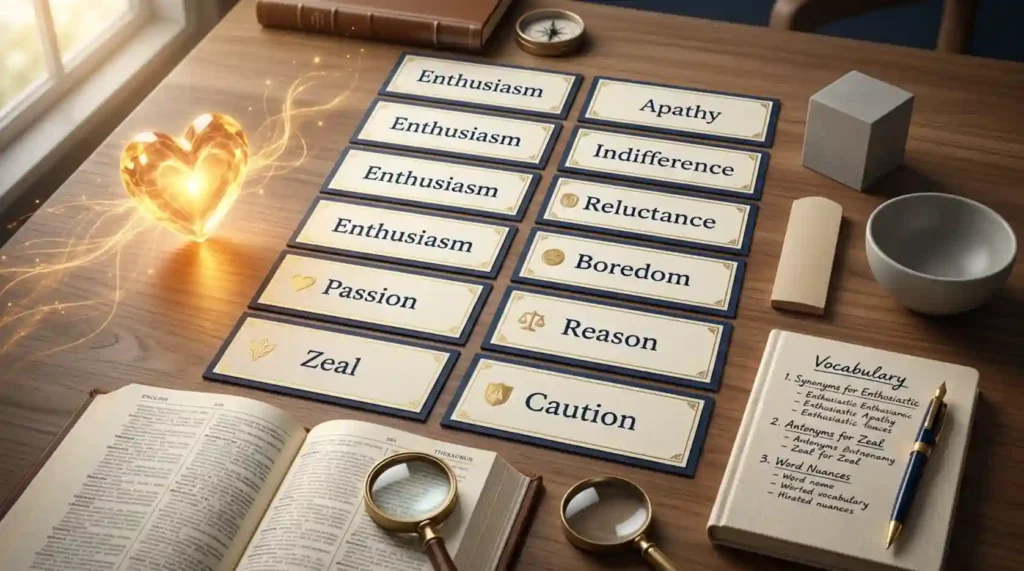
| Word | Paired Word | Note |
| Enthusiasm | Apathy | A common direct contrast: strong interest versus lack of interest |
| Enthusiasm | Indifference | Indifference means not caring or not being interested |
| Enthusiasm | Reluctance | Reluctance means unwillingness to do something |
| Enthusiasm | Boredom | Boredom is the lack of interest or excitement |
| Enthusiasm | Energy | Often paired because enthusiasm often appears as lively effort |
| Passion | Reason | A traditional contrast between emotion and careful thought |
| Zeal | Caution | Zeal can suggest acting boldly; caution suggests care |
These pairs help show the range of enthusiasm: it can be mild or intense, personal or public, and positive or excessive.
Sources: Merriam-Webster; Collins English Thesaurus.
Common Word Partners of “Enthusiasm”
| Pattern | Common Partners | Example |
| Verb + enthusiasm | show, express, share, lose, dampen | She showed great enthusiasm for the plan. |
| Adjective + enthusiasm | great, genuine, obvious, youthful, boundless | His genuine enthusiasm encouraged the team. |
| Enthusiasm + for | learning, life, work, the project, the cause | Her enthusiasm for learning is clear. |
| Enthusiasm + about | the idea, the change, the trip | They were enthusiastic about the new schedule. |
| With + enthusiasm | greet, welcome, embrace, support, tackle | The audience greeted the singer with enthusiasm. |
Sources: Collins English Thesaurus; Merriam-Webster.
Idiomatic Phrases Featuring “Enthusiasm”
1. Bursting with enthusiasm
- Meaning: Feeling or showing so much enthusiasm that it seems impossible to contain.
- Example: The new volunteers arrived bursting with enthusiasm.
2. Full of enthusiasm
- Meaning: Having a lot of interest, energy, or positive feeling.
- Example: The students were full of enthusiasm on their first day.
3. Dampen someone’s enthusiasm
- Meaning: To make someone feel less excited or interested.
- Example: The rainy weather did not dampen their enthusiasm for the hike.
4. Kill someone’s enthusiasm
- Meaning: To completely destroy someone’s interest or excitement.
- Example: Constant criticism can kill a child’s enthusiasm for art.
Sources: Collins English Thesaurus; Cambridge English Thesaurus.
Word Formation of “Enthusiasm”
Etymology & Structure
Enthusiasm comes through French and Late Latin from Greek enthousiasmos, meaning “divine inspiration.” The Greek root combines en- (“in”) and theos (“god”), so the older idea was being “possessed by a god” or divinely inspired.
Date and History
The English noun is recorded from about 1600. In the 1600s, it could refer to excessive religious emotion; by 1716, the modern general sense of “fervor” or “zeal” was established.
Word Class Variations
- Noun: enthusiasm, enthusiast
- Adjective: enthusiastic
- Adverb: enthusiastically
- Verb: There is no common modern verb form directly from enthusiasm; speakers use be enthusiastic about or show enthusiasm for.
Sources: Etymonline; Merriam-Webster.
Common Word-Choice Mistakes
- Wrong: “She has a big enthusiasm for cooking.” Correction: “She has great enthusiasm for cooking.”
- Wrong: “He is enthusiasm about the trip.” Correction: “He is enthusiastic about the trip.”
- Wrong: “I have a passion of music.” Correction: “I have a passion for music.”
- Wrong: “The fad for photography lasted for years.” Correction: Use fad only for a short-lived trend: “The photography craze was short-lived.”
- Wrong: “He did the work with mania.” Correction: “He did the work with gusto.” Mania suggests unhealthy or excessive intensity.
- Wrong: “Her zeal for the plan made her careful.” Correction: “Her zeal for the plan made her determined.” Zeal suggests energetic commitment, not caution.
- Wrong: “They welcomed us with fervor and coldness.” Correction: “They welcomed us with warmth.” Fervor is intense emotion; warmth is friendly feeling.
Frequently Asked Questions
What is the closest synonym for enthusiasm?
Eagerness and excitement are the closest everyday synonyms. For a stronger feeling, use passion.
What is a formal alternative to enthusiasm?
Zeal, ardor, fervor, and alacrity are formal alternatives. Choose based on If you mean dedication, intense emotion, or cheerful readiness.
What is the difference between enthusiasm and eagerness?
Enthusiasm is lively positive interest. Eagerness is a strong wish or readiness to do something.
Is passion stronger than enthusiasm?
Usually, yes. Passion suggests a deep, lasting emotional connection, while enthusiasm can be temporary or lighter.
What is a literary word for enthusiasm?
Ardor is a common literary choice. Fervor, ebullience, and avidity are also more formal or literary.
What is the opposite of enthusiasm?
Common opposites are apathy, indifference, reluctance, and boredom.
Can enthusiasm describe a hobby?
Yes. In the plural, enthusiasms can mean interests or hobbies, as in “Her enthusiasms include photography and gardening.”
Can enthusiasm mean a trend?
Yes, in an older or less common sense. Today, craze, fad, or trend is usually clearer.
Is zeal always positive?
Not always. Zeal can be positive, but phrases such as overzealous suggest too much intensity.
Can I say “with enthusiasm”?
Yes. It is a very natural phrase: “She greeted the news with enthusiasm.”
Conclusion
The most useful alternatives to enthusiasm are eagerness, excitement, keenness, passion, zeal, and zest. For formal writing, consider ardor, fervor, or alacrity.
The right choice depends on context: eagerness highlights readiness, passion highlights deep emotion, zeal highlights commitment, and zest highlights lively enjoyment. Words such as craze and mania apply only to particular senses.
To choose well, first decide If you are describing a feeling, an interest, an action, or a trend. Then select the word whose strength and tone match that situation.