
Another Word for Hostile: 30 Synonyms With Examples
Another word for hostile is unfriendly, antagonistic, or aggressive. The best choice depends on what you mean. Hostile can describe a person who shows ill will, an enemy force, a place that is hard to live in, or a business offer the target does not want.
Some alternatives suit each of those meanings. Belligerent and combative describe people ready to fight. Inimical and malevolent are formal words for harmful intent. Inhospitable and adverse fit places and conditions. Opposed and averse fit people who simply disagree.
Quick list: unfriendly, antagonistic, aggressive, belligerent, inimical, adversarial, malevolent, spiteful, inhospitable, opposed
This article covers 30 alternatives. Each has a definition, IPA pronunciation, a usage note, and an example sentence. Some are close synonyms and others are related words for one narrow context. The notes say which is which.
At a Glance: Hostile Synonyms and Related Alternatives
| Alternative | Part of Speech | Meaning | Register / Tone | Ideal Context |
| Unfriendly | Adjective | Not kind or welcoming | Neutral, mild | Everyday behavior |
| Antagonistic | Adjective | Actively opposed or disliking | Neutral to formal | Disputes, attitudes |
| Aggressive | Adjective | Ready to attack or confront | Neutral, often negative | Behavior, animals, forces |
| Belligerent | Adjective | Eager to fight or argue | Formal, strong | Loud, quarrelsome people |
| Inimical | Adjective | Harmful or unfriendly in effect | Formal | Rules, forces, influences |
| Adversarial | Adjective | Involving opposing sides | Neutral, formal | Rivals, legal and political settings |
| Malevolent | Adjective | Wishing harm on others | Formal, literary | Evil intent, stares |
| Acrimonious | Adjective | Bitter and angry in tone | Formal | Arguments, splits, debates |
| Inhospitable | Adjective | Not offering comfort or shelter | Neutral | Places, climates |
| Opposed | Adjective | Against something | Neutral | Plans, ideas, proposals |
Which Word Should You Use?

| If you want to… | Use | Why |
| Describe someone who is cold but not openly angry | unfriendly | It is mild and works in everyday speech. |
| Describe someone who actively works against another person or idea | antagonistic | It stresses opposition. |
| Describe someone ready to start a fight | belligerent or combative | Both suggest quarrel-seeking behavior. |
| Describe harmful forces or influences in formal writing | inimical | It is a formal word, usually followed by “to”. |
| Describe a wish to cause harm | malevolent | It points to evil intent. |
| Describe a bitter argument or breakup | acrimonious | It fits disputes more than single people. |
| Describe a harsh place or climate | inhospitable | It means a place offers little comfort or shelter. |
| Describe rivals on opposite sides | adversarial | It is neutral and does not require anger. |
| Say someone dislikes an idea | averse or opposed | These are milder and focus on opinion. |
Exploring the Multiple Meanings of “Hostile”
1. Belonging to an Enemy
- Meaning: Of or relating to an enemy or an opposing military force.
- Explanation: This is the oldest sense, tied to the Latin word for “enemy.” It describes forces, territory, or fire. As a noun, hostile can mean an enemy, usually in the plural (hostiles).
- Example: The soldiers entered hostile territory at dawn.
2. Unfriendly or Full of Ill Will
- Meaning: Showing unfriendly feelings or a wish to harm.
- Explanation: This is the most common everyday sense. It covers remarks, looks, attitudes, and acts that show dislike or anger.
- Example: She gave him a hostile look when he walked in late.
3. Openly Opposed
- Meaning: Resisting or opposing something openly.
- Explanation: Here the word is often followed by “to.” The target is usually an idea, change, or group. This sense is about resistance, not necessarily anger.
- Example: The town was hostile to new development.
4. Not Welcoming or Hard to Live In
- Meaning: Not hospitable; very unfavorable to life or growth.
- Explanation: This sense describes places and conditions, such as deserts, climates, and habitats. No person has to be angry for it to apply.
- Example: Few plants can grow in such a hostile environment.
5. Intimidating or Offensive
- Meaning: Having an intimidating, antagonistic, or offensive nature.
- Explanation: This sense appears in workplace and legal language, as in “hostile work environment.” It describes conditions created by behavior that makes people feel unsafe or unwelcome.
- Example: Several employees complained about a hostile work environment.
6. Business and Legal Uses
- Meaning: Unwelcome to a company’s management, or relating to an opposing party in a legal case.
- Explanation: In business, a hostile takeover is an attempt to buy a company against the wishes of its management. In court, a hostile witness is a witness whose testimony is unfavorable to the side that called them.
- Example: The board fought the hostile takeover bid.
Sources: Merriam-Webster (hostile); Dictionary.com (hostile); Vocabulary.com (hostile); Britannica Dictionary (hostile); Oxford Advanced Learner’s Dictionary (hostile); Wiktionary (hostile).
Analyzing 30 Hostile Alternatives in Detail
Some of these words are close synonyms of hostile. Others are related words that fit only one sense, and each usage note says which is which.
Core Synonyms
1. Unfriendly
IPA: /ʌnˈfrɛndli/ (US and UK)
Definition: Not kind, warm, or welcoming toward others.
- Usage: The most common everyday alternative. It is milder than hostile, because it describes a cold manner and not open opposition.
- Example: The neighbors seemed unfriendly, so we only waved from a distance.
2. Antagonistic
IPA: /ænˌtæɡəˈnɪstɪk/ (US and UK)
Definition: Showing active opposition or dislike toward someone or something.
- Usage: A close synonym that stresses opposition. It works for people, groups, and attitudes.
- Example: The two coworkers became antagonistic after the argument over the budget.
3. Inimical
IPA: /ɪˈnɪmɪkəl/ (US and UK)
Definition: Harmful or unfavorable, or unfriendly in spirit.
- Usage: A formal synonym. It often describes things such as rules or forces, and it is usually followed by “to.”
- Example: Such rules are inimical to free speech.
4. Adversarial
IPA: US /ˌædvərˈsɛriəl/ · UK /ˌædvəˈseəriəl/
Definition: Involving opposing sides in a conflict or contest.
- Usage: A related alternative. It describes a setup of opposing sides and does not require anger, so it is often neutral.
- Example: The relationship between the union and the company has been adversarial for years.
Aggressive and Combative Alternatives
5. Aggressive
IPA: /əˈɡrɛsɪv/ (US and UK)
Definition: Ready to attack or confront; forceful in behavior.
- Usage: Dictionary.com lists it as a synonym for hostile. Unlike hostile, it can be positive in business or sport, as in “aggressive goals.”
- Example: The dog grew aggressive when strangers came near the gate.
6. Belligerent
IPA: /bəˈlɪdʒərənt/ (US and UK)
Definition: Eager to fight or argue.
- Usage: Stronger than unfriendly. It describes loud, quarrel-seeking behavior.
- Example: A belligerent customer shouted at the staff until security arrived.
7. Combative
IPA: US /kəmˈbætɪv/ · UK /ˈkɒmbətɪv/
Definition: Ready or eager to fight or argue.
- Usage: Close to belligerent but a little less intense. It often describes a person’s mood or style.
- Example: The senator was in a combative mood during the interview.
8. Pugnacious
IPA: /pʌɡˈneɪʃəs/ (US and UK)
Definition: Having a strong urge to fight or quarrel.
- Usage: A rarer, slightly literary related word. It describes a quarrelsome nature and is not a general synonym for hostile.
- Example: The pugnacious little terrier barked at dogs twice its size.
9. Bellicose
IPA: US /ˈbɛlɪkoʊs/ · UK /ˈbelɪkəʊs/
Definition: Eager to start wars or fights.
- Usage: A formal related word. It is usually used for leaders, nations, and speeches.
- Example: The general’s bellicose speech worried nearby countries.
10. Warlike
IPA: US /ˈwɔːrlaɪk/ · UK /ˈwɔːlaɪk/
Definition: Fond of war, or showing the spirit of war.
- Usage: Dictionary.com lists it as a synonym for the “of an enemy” sense of hostile. It fits nations, groups, and attitudes.
- Example: The neighboring kingdoms feared the warlike crews, beyond the river.
Ill Will and Bitterness
11. Malevolent
IPA: /məˈlɛvələnt/ (US and UK)
Definition: Wishing evil or harm on others.
- Usage: Stronger than hostile. It focuses on the wish to cause harm, and it is formal or literary.
- Example: She felt a malevolent stare from across the room.
12. Spiteful
IPA: /ˈspaɪtfəl/ (US and UK)
Definition: Acting from a petty wish to hurt or annoy someone.
- Usage: A related word. It points to small, mean acts, not open hostility.
- Example: It was a spiteful thing to say, and he regretted it right away.
13. Acrimonious
IPA: US /ˌækrɪˈmoʊniəs/ · UK /ˌækrɪˈməʊniəs/
Definition: Bitter and angry in tone, especially in a dispute.
- Usage: A related formal word. It describes arguments, divorces, and debates better than it describes one person’s character.
- Example: The meeting ended in an acrimonious exchange over money.
14. Rancorous
IPA: /ˈræŋkərəs/ (US and UK)
Definition: Full of deep, lasting bitterness.
- Usage: A formal related word. Merriam-Webster notes that rancor often means bitter brooding over a wrong.
- Example: The rancorous campaign left deep divisions in the town.
15. Hateful
IPA: /ˈheɪtfəl/ (US and UK)
Definition: Full of hate, or deserving hate.
- Usage: Wiktionary lists it as a synonym. It is more emotional than hostile, which can be cold and calm.
- Example: He wrote hateful messages to his former friend.
16. Venomous
IPA: /ˈvɛnəməs/ (US and UK)
Definition: Full of bitter hatred; in its literal sense, poisonous.
- Usage: A figurative related word for words, looks, and tone. It does not replace hostile in every sentence.
- Example: She gave him a venomous look and walked away.
Cold and Unwelcoming Alternatives
17. Cold
IPA: US /koʊld/ · UK /kəʊld/
Definition: Lacking warmth or friendliness.
- Usage: A milder related word. It describes an unfriendly manner without open attack.
- Example: His cold reply made it clear he did not want to talk.
18. Frosty
IPA: US /ˈfrɔːsti/ · UK /ˈfrɒsti/
Definition: Unfriendly in manner, as if cold.
- Usage: A figurative related word, common for greetings, looks, and receptions.
- Example: The new manager got a frosty welcome from the team.
19. Surly
IPA: US /ˈsɜːrli/ · UK /ˈsɜːli/
Definition: Bad-tempered and rude.
- Usage: A related word for grumpy, rude behavior. It does not necessarily mean a wish to harm.
- Example: The surly waiter slammed the plates on the table.
20. Unwelcoming
IPA: /ʌnˈwɛlkəmɪŋ/ (US and UK)
Definition: Not making visitors feel welcome.
- Usage: A mild related word for people, places, and receptions.
- Example: The empty lobby felt cold and unwelcoming.
21. Uncongenial
IPA: /ˌʌnkənˈdʒiːniəl/ (US and UK)
Definition: Not pleasant, or not suited to someone’s nature or needs.
- Usage: Vocabulary.com lists it as a synonym for the “unfavorable to life or growth” sense. It is formal.
- Example: Dry soil is uncongenial to most ferns.
Harsh Places and Conditions
22. Inhospitable
IPA: US /ˌɪnhɑːˈspɪtəbəl/ · UK /ˌɪnhɒˈspɪtəbəl/
Definition: Not offering shelter or comfort; unfriendly to visitors.
- Usage: Close to the “not hospitable” sense of hostile. It is used for places and climates, and sometimes for people.
- Example: The desert is an inhospitable place for most animals.
23. Forbidding
IPA: US /fɚˈbɪdɪŋ/ · UK /fəˈbɪdɪŋ/
Definition: Looking harsh, threatening, or unfriendly.
- Usage: A related word that focuses on how something looks or feels.
- Example: The old fortress had a dark, forbidding look.
24. Adverse
IPA: US /ædˈvɜːrs/ · UK /ˈædvɜːs/
Definition: Harmful or unfavorable.
- Usage: Dictionary.com lists it as a synonym for the “opposed” sense. It suits conditions and effects better than people.
- Example: Adverse weather forced the airline to cancel flights.
25. Harsh
IPA: US /hɑːrʃ/ · UK /hɑːʃ/
Definition: Rough, severe, or unpleasantly strict.
- Usage: A related word. It describes conditions and language, and it only partly overlaps with hostile.
- Example: The explorers survived a harsh winter in the mountains.
Opposition and Specialized Uses
26. Opposed
IPA: US /əˈpoʊzd/ · UK /əˈpəʊzd/
Definition: Against something; in disagreement with it.
- Usage: Plain and neutral. It is much weaker than hostile to.
- Example: Most residents are opposed to the new highway.
27. Averse
IPA: US /əˈvɜːrs/ · UK /əˈvɜːs/
Definition: Having a strong dislike or reluctance toward something.
- Usage: A related word, almost always followed by “to.” It describes feelings about things or actions, not hostility toward people.
- Example: He is averse to taking risks with money.
28. Irreconcilable
IPA: /ɪˌrɛkənˈsaɪləbəl/ (US and UK)
Definition: Impossible to bring into agreement.
- Usage: Vocabulary.com gives it for the “hostile factions” sense. It describes conflicts and differences, not a single mood.
- Example: The two rival groups held irreconcilable views.
29. Unreceptive
IPA: /ˌʌnrɪˈsɛptɪv/ (US and UK)
Definition: Not open to new ideas or suggestions.
- Usage: A mild related word that fits “hostile to new ideas.” It carries no anger.
- Example: The board was unreceptive to the plan.
30. Unsolicited
IPA: /ˌʌnsəˈlɪsɪtɪd/ (US and UK)
Definition: Not asked for; in business, an offer the target did not request.
- Usage: A context-specific related word. It fits hostile takeover bids and is not a general synonym.
- Example: The company rejected the unsolicited offer.
Sources: Merriam-Webster (hostile, hostility); Dictionary.com (hostile, with Collins English Dictionary content); Vocabulary.com (hostile); Wiktionary (hostile, hostility); Oxford Advanced Learner’s Dictionary (hostile). IPA for the alternatives follows standard dictionary conventions and should be checked against a dictionary entry for formal publication.
Hostile vs. Unfriendly vs. Aggressive vs. Antagonistic
These four words are close but not equal. The main difference is how much action they imply.
| Word | Core idea | Typical use | Strength |
| Unfriendly | Not warm or welcoming | A cold neighbor, a quiet room | Mild |
| Antagonistic | Opposed and working against | A rival, a critic | Medium |
| Hostile | Showing ill will or open opposition | A crowd, a remark, an enemy, a harsh place | Medium to strong |
| Aggressive | Ready to attack or push forward | A dog, a driver, a sales plan | Medium to strong |
Unfriendly is the safest choice when someone is cold but not angry. Hostile covers more ground because it also describes enemies, places, and business offers. Aggressive can sound positive in sports or sales, but hostile almost never does.
Sources: Merriam-Webster (hostile); Dictionary.com (hostile); Vocabulary.com (hostile); Oxford Advanced Learner’s Dictionary (hostile).
Hostile and Opposite/Paired Word Pairs
| Word | Paired Word | Note |
| Hostile | Friendly | The most common opposite; Dictionary.com lists it as an antonym. |
| Hostile | Amicable | A more formal opposite, used for relationships and agreements. |
| Hostile | Welcoming | Fits places, receptions, and attitudes. |
| Hostile | Hospitable | The direct opposite of the “not hospitable” sense. |
| Hostile | Sympathetic | Dictionary.com lists it as an antonym for the “antagonistic” sense. |
| Hostility | Friendliness | Wiktionary and Dictionary.com list it as the noun opposite. |
| Hostility | Amity | A formal word for friendly relations, often between nations. |
| Hostilities | Peace | Hostilities means acts of war, so peace is its natural opposite. |
| Hostile takeover | Friendly takeover | Business terms; a friendly takeover has the target’s agreement. |
The best opposite depends on the sense. A hostile crowd is met by a friendly one, a hostile climate by a hospitable one, and a hostile takeover by a friendly one. Pick the opposite that matches the meaning you want.
Sources: Dictionary.com (hostile, hostility); Wiktionary (hostility); Vocabulary.com (hostile).
Common Word Partners of “Hostile”
| Pattern | Common Partners | Example |
| hostile + business term | takeover, bid | The firm launched a hostile takeover. |
| hostile + legal term | witness, work environment | The lawyer questioned the hostile witness. |
| hostile + military term | fire, territory, forces, act | The unit came under hostile fire. |
| hostile + people or reaction | crowd, reception, attitude, remark | The speaker faced a hostile crowd. |
| hostile + place or conditions | environment, climate, habitat | The camel is suited to its hostile habitat. |
| be hostile to / toward | change, outsiders, ideas | The town is hostile to outsiders. |
| adverb + hostile | openly, increasingly, overtly | He was openly hostile to the plan. |
Sources: Merriam-Webster (hostile, usage examples); Oxford Advanced Learner’s Dictionary (hostile); OneLook (phrases containing “hostile”); Dictionary.com (hostile).
Idiomatic Phrases Featuring “Hostile”
Hostile has few true idioms. These are established fixed expressions with a set meaning, and none is an idiom in the strict sense.
1. Hostile Takeover
- Meaning: An attempt to take control of a company against the wishes of its management.
- Example: The small firm tried to block a hostile takeover by a larger rival.
2. Hostile Witness
- Meaning: A witness whose testimony is unfavorable to the side that called them.
- Example: The lawyer asked the judge to treat her own witness as a hostile witness.
3. Hostile Work Environment
- Meaning: A workplace made intimidating or offensive by others’ behavior. It is a legal and workplace term.
- Example: The complaint described a hostile work environment that lasted for months.
4. Hostile Architecture
- Meaning: Design meant to discourage certain uses of public space, such as sleeping on benches.
- Example: Critics say the spiked ledges are an example of hostile architecture.
Sources: Merriam-Webster (hostile, legal definitions); OneLook (phrases containing “hostile”); Wiktionary (hostile).
Word Formation of “Hostile”
Etymology & Structure
Hostile came into English from French hostile or directly from Latin hostilis, meaning “of an enemy.” Merriam-Webster breaks hostilis into hostis (“enemy”) plus -ilis, a suffix meaning “pertaining to.” In early Latin, hostis meant “stranger” before it came to mean “enemy.” Etymonline traces it to a Proto-Indo-European root for “stranger, guest, host.” That root is why hostile is related to host, hospital, and hospitality.
Date and History
Etymonline dates the adjective to the late 15th century. The noun meaning “a hostile person” is recorded in American English in 1838. It came from the Indian Wars, and today it is used mainly in the plural, hostiles.
Word Class Variations
- Adjective: hostile (more hostile, most hostile)
- Noun: hostile (an enemy; mostly plural, hostiles)
- Related nouns: hostility; hostilities (acts of war)
- Adverb: hostilely
Hostile has no standard verb form. Do not confuse it with hostel, a place to stay.
Sources: Etymonline (hostile); Merriam-Webster (hostile, hostility); Wiktionary (hostile, hostility); Vocabulary.com (hostile).
Common Word-Choice Mistakes
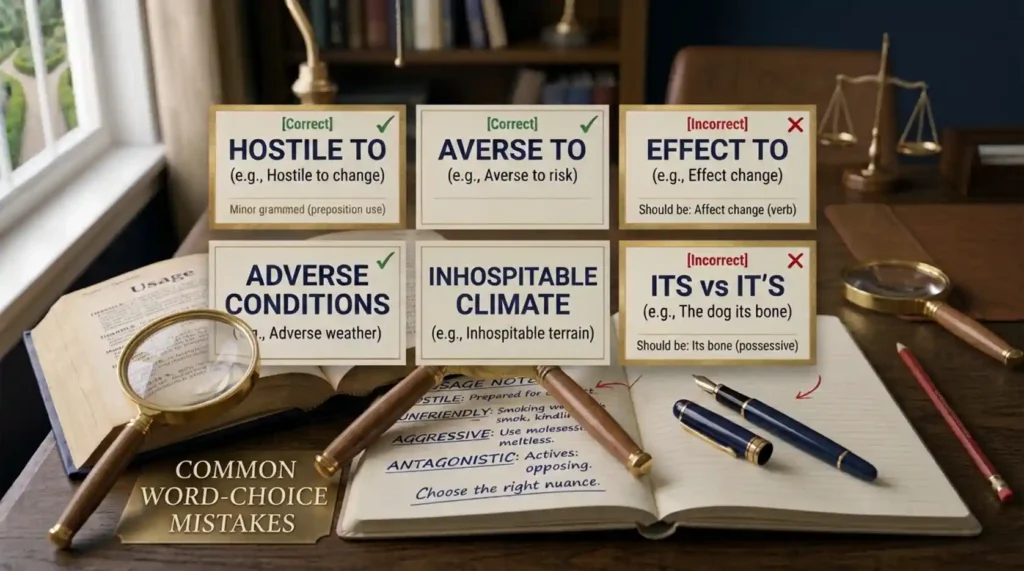
- Wrong: hostile against new ideas. Correct: hostile to (or toward) new ideas.
- Wrong: a hostile for travelers. Correct: a hostel. A hostel is a place to stay, and hostile means unfriendly.
- Wrong: an adverse person. Correct: an antagonistic person. Adverse describes conditions and effects, not people.
- Wrong: averse of risk. Correct: averse to risk.
- Wrong: inimical with free speech. Correct: inimical to free speech.
- Wrong: an unhospitable climate. Correct: an inhospitable climate.
- Wrong: aggressive marketing is hostile marketing. Correct: aggressive can mean bold and forceful, while hostile almost always means ill will.
Frequently Asked Questions
What is the closest synonym for hostile?
Unfriendly and antagonistic are the closest everyday synonyms. Inimical is the formal choice.
What is a stronger word than hostile?
Malevolent and hateful are stronger, because they point to a wish to cause harm or deep hatred.
What is a milder word than hostile?
Unfriendly, cold, and unwelcoming are milder. They describe a cold manner without open opposition.
What is the difference between hostile and aggressive?
Hostile shows ill will or opposition. Aggressive means ready to attack or push hard, and it can be positive in sports or sales.
What is the opposite of hostile?
The most common opposites are friendly and amicable. For places, use hospitable or welcoming.
Can hostile describe places?
Yes. A hostile environment or climate is hard to live in, and the word also describes enemy territory. For milder wording, use inhospitable or harsh.
What does a hostile takeover mean?
It is an attempt to take control of a company against the wishes of its management.
What is a formal alternative to hostile?
Inimical, antagonistic, and adversarial are formal. Malevolent and bellicose are also formal but more specific.
Is hostile the same as angry?
No. A hostile person may be angry, but hostility can also be cold, calm, or silent. Angry describes a feeling, while hostile describes an attitude or stance toward someone.
Is hostile ever a noun?
Yes. As a noun it means an enemy, mostly in the plural (hostiles), but this use is uncommon today.
Conclusion
The closest everyday alternatives to hostile are unfriendly, antagonistic, and aggressive. For formal writing, inimical and adversarial work well. Malevolent, acrimonious, and inhospitable each cover a narrower sense.
Context matters because hostile has several meanings. It can describe a person who dislikes you, an enemy force, a harsh place, or an unwanted business offer. A word that fits one of these may not fit another.
To choose the right word, first decide which meaning you need. Then check how strong you want the word to be. Unfriendly and opposed are mild, while belligerent and malevolent are strong.