
Tired of Using “Never”? Try These 30 Better Alternatives
The closest everyday alternatives to never (US /ˈnɛvər/, UK /ˈnɛvə/) are not ever and at no time. Never is a single adverb, and English has few one-word replacements for it. Most alternatives are short phrases such as on no occasion or under no circumstances. Two single words exist, nevermore and ne’er, but both sound literary or old-fashioned.
The best choice depends on what you mean. Never can mean “at no time,” “not at all,” or “not before now,” and it can work as a firm refusal. Some alternatives only come close. Words like rarely and hardly ever describe something that almost never happens, not something that never happens.
Quick list: not ever, at no time, on no occasion, never once, under no circumstances, by no means, no way, never again, nevermore, hardly ever.
This article looks at 30 alternatives, each with a meaning, IPA, a usage note, and an example. It marks which ones are direct synonyms and which are only related.
At a Glance: Never Synonyms and Related Alternatives
| Alternative | Part of Speech | Meaning | Register / Tone | Ideal Context |
| not ever | adverb phrase | at no time | neutral, emphatic | everyday speech and writing |
| at no time | adverb phrase | not at any moment | formal | reports, statements, denials |
| on no occasion | adverb phrase | not on any occasion | formal | records of events |
| under no circumstances | adverb phrase | in no situation at all | formal, firm | rules and warnings |
| by no means | adverb phrase | not at all | formal | denying a degree or claim |
| no way | interjection / adverb phrase | absolutely not | informal | quick refusals |
| never again | adverb phrase | not at any time from now on | neutral | promises and decisions |
| nevermore | adverb | never again | literary | poetry and dramatic writing |
| hardly ever | adverb phrase | almost never (related) | informal | habits and routines |
| seldom | adverb | not often (related) | neutral to formal | habits and general facts |
Which Word Should You Use?
| If you want to… | Use | Why |
| Say “not at any time” in plain English | not ever, never once | These stay close to the basic meaning. |
| Make a strict rule or ban | under no circumstances, on no account | They sound firm and official. |
| Deny a quality or degree | by no means, in no way, not in the least | They describe how much, not when. |
| Refuse something quickly in speech | no way, not a chance | They are short and informal. |
| Say something ended for good | never again, nevermore | They look forward from a moment in time. |
| Say a habit has stopped | no longer, not anymore | They imply it once happened. |
| Mean “almost zero” | hardly ever, almost never | They leave room for rare exceptions. |
| Joke that something is impossible | when pigs fly, not in a million years | They add humor and exaggeration. |
Exploring the Multiple Meanings of “Never”
1. At No Time
- Meaning: Not ever; at no time.
- Explanation: This is the main sense in Merriam-Webster. It can refer to the past, the present, or the future.
- Example: She has never missed a day of school.
2. Not Before Now
- Meaning: Not on any earlier occasion up to the present.
- Explanation: This is common with the present perfect. It talks about life experience, so never often means “not yet in my life.”
- Example: I have never been on a plane.
3. Not at All
- Meaning: Not to any extent or in any way.
- Explanation: Here never works as an emphatic “not,” as in the fixed phrase never fear. It is less about time and more about force.
- Example: Never fear, the doctor is on her way.
4. A Simple Past Negative (Informal)
- Meaning: Did not.
- Explanation: In casual speech, and in some dialects, never replaces didn’t for a single past event. Wordnik lists this as a colloquial use. It is best avoided in formal writing.
- Example: I never took your pen. (informal)
5. A Cry of Surprise
- Meaning: Surely not! An expression of surprise or disbelief.
- Explanation: A British dictionary entry records this as an interjection in the phrase Well, I never! It is old-fashioned and mostly British.
- Example: “He won the lottery twice.” “Well, I never!”
Sources: Merriam-Webster (never); Dictionary.com (British Dictionary entry for never); Wordnik (entries compiled from the GNU Collaborative International Dictionary of English and other dictionaries).
Analyzing 30 Never Alternatives in Detail
Some alternatives below are direct synonyms for the “at no time” sense. Others are related phrases that only match one use of never, and each Usage note says which is which.
Group 1: Core “At No Time” Alternatives
1. Not ever
IPA: US /nɑːt ˈɛvər/ · UK /nɒt ˈɛvə/
Definition: At no time; on no occasion.
- Usage: This is the plainest direct synonym. It sounds a little more emphatic than never, so it appears most in speech or for stress.
- Example: I will not ever forget that day.
2. At no time
IPA: US /æt noʊ taɪm/ · UK /æt nəʊ taɪm/
Definition: Not at any moment.
- Usage: This is a formal direct synonym. At the start of a sentence it needs inverted word order, as in At no time did…
- Example: At no time did the guards leave the gate.
3. On no occasion
IPA: US /ɑːn noʊ əˈkeɪʒən/ · UK /ɒn nəʊ əˈkeɪʒən/
Definition: Not on any occasion.
- Usage: This is a formal direct synonym. It points to separate events more than to time passing, so it suits reports and records.
- Example: On no occasion did he miss a payment.
4. Never once
IPA: US /ˈnɛvər wʌns/ · UK /ˈnɛvə wʌns/
Definition: Not even one time.
- Usage: This is a stronger form of never. It stresses a complete absence across a whole period, and it is neutral in tone.
- Example: I have never once seen him angry.
5. Never ever
IPA: US /ˈnɛvər ˈɛvər/ · UK /ˈnɛvər ˈɛvə/
Definition: Never, said with extra emphasis.
- Usage: This is informal and common in speech. It is an intensified form of never, so use it for emphasis.
- Example: I will never ever tell anyone your secret.
6. At no point
IPA: US /æt noʊ pɔɪnt/ · UK /æt nəʊ pɔɪnt/
Definition: Not at any stage or moment.
- Usage: This is a direct synonym with a more exact focus. It usually refers to a stage in a process or story.
- Example: At no point did the plan seem risky.
Group 2: Formal Alternatives for Rules and Bans
7. Under no circumstances
IPA: US /ˈʌndər noʊ ˈsɜːrkəmstænsɪz/ · UK /ˈʌndə nəʊ ˈsɜːkəmstənsɪz/
Definition: In no situation, whatever happens.
- Usage: This is related, not an exact synonym. It talks about conditions, not time, and works like a strong ban. It sounds formal and firm.
- Example: Under no circumstances should you open this door.
8. On no account
IPA: US /ɑːn noʊ əˈkaʊnt/ · UK /ɒn nəʊ əˈkaʊnt/
Definition: For no reason; in no case.
- Usage: This is a related alternative with almost the same job as under no circumstances. It is formal and used in instructions and warnings.
- Example: On no account must the children be left alone.
9. In no case
IPA: US /ɪn noʊ keɪs/ · UK /ɪn nəʊ keɪs/
Definition: In no instance or situation.
- Usage: This is a related alternative. It sounds official, so it suits policies and rules. It is less common than the two phrases above.
- Example: In no case should the fee be refunded after thirty days.
Group 3: Alternatives That Deny Degree
10. By no means
IPA: US /baɪ noʊ miːnz/ · UK /baɪ nəʊ miːnz/
Definition: Not at all; in no way.
- Usage: This matches the “not at all” sense of never but not the time sense. It sounds formal.
- Example: The test is by no means easy.
11. In no way
IPA: US /ɪn noʊ weɪ/ · UK /ɪn nəʊ weɪ/
Definition: Not at all; not in any manner.
- Usage: This is a related alternative for the “not at all” sense. It is neutral to formal and is often used to deny blame.
- Example: He is in no way responsible for the mistake.
12. Not at all
IPA: US /nɑːt ət ˈɔːl/ · UK /nɒt ət ˈɔːl/
Definition: Not to any degree.
- Usage: This is related, not a time word. It cannot replace never in a sentence about time. It is also a polite reply to “thank you.”
- Example: I am not at all tired.
13. Not in the least
IPA: US /nɑːt ɪn ðə ˈliːst/ · UK /nɒt ɪn ðə ˈliːst/
Definition: Not even slightly.
- Usage: This is a related alternative for the “not at all” sense. It is a little formal, and it stresses that something is completely absent.
- Example: She was not in the least worried.
Group 4: Informal and Figurative Alternatives
14. No way
IPA: US /noʊ ˈweɪ/ · UK /nəʊ ˈweɪ/
Definition: Absolutely not; impossible.
- Usage: This is a related informal reply, not a time word. It refuses or rejects an idea, so it covers only the “strong refusal” use of never.
- Example: Will I eat that? No way.
15. Not a chance
IPA: US /nɑːt ə ˈtʃæns/ · UK /nɒt ə ˈtʃɑːns/
Definition: There is no possibility.
- Usage: This is a related informal reply. It says something will not happen, usually in answer to a question.
- Example: Will he finish by Friday? Not a chance.
16. Not on your life
IPA: US /nɑːt ɑːn jʊr ˈlaɪf/ · UK /nɒt ɒn jɔː ˈlaɪf/
Definition: Certainly not; under no condition.
- Usage: This is an informal expression of strong refusal. It is related to never but works as an answer.
- Example: Lend him my car? Not on your life!
17. Not in a million years
IPA: US /nɑːt ɪn ə ˈmɪljən jɪrz/ · UK /nɒt ɪn ə ˈmɪljən jɪəz/
Definition: Never, said with exaggeration.
- Usage: This is an informal exaggeration. It is a figurative way of saying “never,” usually about what you would or could do.
- Example: Not in a million years would I sell this house.
18. When pigs fly
IPA: (US and UK) /wɛn pɪɡz flaɪ/
Definition: Used humorously to say something will never happen.
- Usage: This is a figurative expression, not a direct synonym. It is humorous and works only as a joke about the future.
- Example: He’ll clean his room when pigs fly.
19. Absolutely not
IPA: US /ˌæbsəˈluːtli nɑːt/ · UK /ˌæbsəˈluːtli nɒt/
Definition: A firm and complete refusal.
- Usage: This is related, not a synonym. It answers a request or question, and it does not state a time.
- Example: Can I borrow your phone? Absolutely not.
20. Nary
IPA: US /ˈnɛri/ · UK /ˈneəri/
Definition: Not any; not one.
- Usage: This is an informal adjective, so it is related to never but not a synonym. It comes before a or an, and Wordnik notes it developed from the older ne’er a.
- Example: There was nary a cloud in the sky.
Group 5: “Never Again” Alternatives
21. Never again
IPA: (US and UK) /ˈnɛvər əˈɡɛn/
Definition: Not at any time from now on.
- Usage: This is a close alternative for the future. It suggests something has happened before and will not repeat.
- Example: I will never again eat at that restaurant.
22. Nevermore
IPA: US /ˌnɛvərˈmɔːr/ · UK /ˌnɛvəˈmɔː/
Definition: Never again.
- Usage: This is a literary one-word alternative. It sounds dramatic and is best for poetry or serious writing.
- Example: The old king swore he would nevermore leave his land.
23. Ne’er
IPA: US /nɛr/ · UK /neə/
Definition: A short, old-style form of never.
- Usage: This is a direct synonym, but it is poetic or archaic. Use it only in verse or when copying an old style.
- Example: Ne’er did I see a finer sight.
24. No longer
IPA: US /noʊ ˈlɔːŋɡər/ · UK /nəʊ ˈlɒŋɡə/
Definition: Not any more; not now as before.
- Usage: This is related, not a synonym. It says something that once happened has stopped, while never says it did not happen at all.
- Example: My grandfather no longer drives.
25. Not anymore
IPA: US /nɑːt ˌɛniˈmɔːr/ · UK /nɒt ˌɛniˈmɔː/
Definition: Not now, though it was true before.
- Usage: This is an informal relative of no longer. It has the same limit: it cannot mean “at no time.”
- Example: Do you still play the violin? Not anymore.
Group 6: Near-Never Alternatives
26. Rarely
IPA: US /ˈrɛrli/ · UK /ˈreəli/
Definition: Not often.
- Usage: This is related, not an exact synonym. It leaves room for exceptions, so it describes how often, not “never.”
- Example: He rarely eats meat.
27. Seldom
IPA: (US and UK) /ˈsɛldəm/
Definition: Not often; rarely.
- Usage: This is a related alternative with the same limit as rarely. It sounds a little more formal.
- Example: We seldom see snow here.
28. Hardly ever
IPA: US /ˈhɑːrdli ˈɛvər/ · UK /ˈhɑːdli ˈɛvə/
Definition: Almost never.
- Usage: This is a related informal phrase. It is the closest “near-never” option and it still allows rare exceptions.
- Example: She hardly ever misses class.
29. Almost never
IPA: US /ˈɔːlmoʊst ˈnɛvər/ · UK /ˈɔːlməʊst ˈnɛvə/
Definition: On very few occasions.
- Usage: This is a related phrase. It clearly says “not quite never,” so use it when you want to be exact.
- Example: The train is almost never late.
30. Once in a blue moon
IPA: (US and UK) /wʌns ɪn ə bluː muːn/
Definition: Very rarely.
- Usage: This is an informal expression, not a synonym. It means something happens, but extremely seldom.
- Example: We eat out once in a blue moon.
Sources: Merriam-Webster (never, ne’er); Dictionary.com (never, including the British Dictionary entry); Wordnik (nary, never); Etymonline (never, nevermore, ne’er).
Never vs. Near-Never Words: How Often Is “Never”?
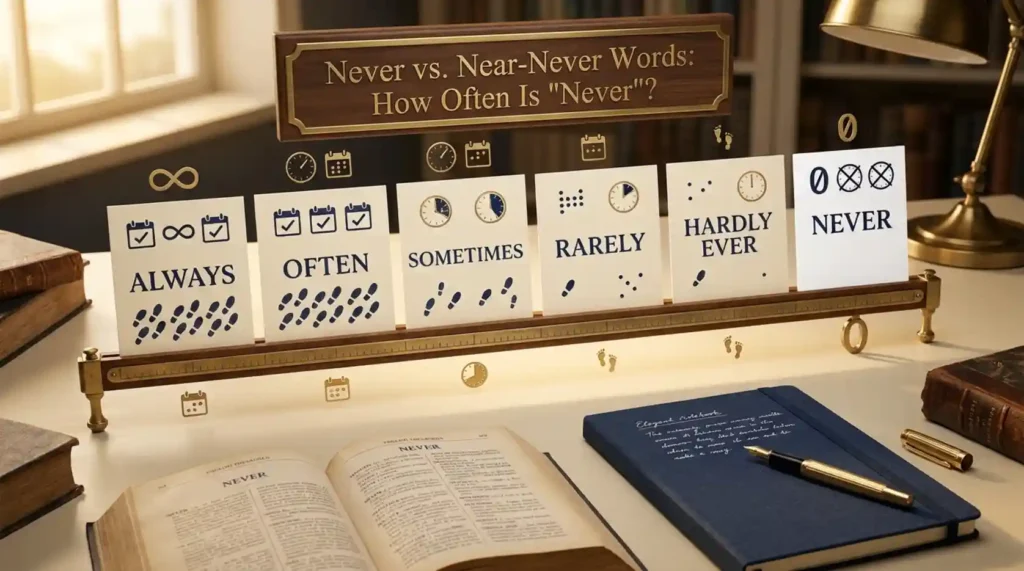
Many learners mix up never with words that mean “almost never.” The words below form a simple scale, from the most frequent to the least.
| Word | Frequency | Can something still happen? |
| always | every time | Yes, every time |
| often | many times | Yes |
| sometimes | some of the time | Yes |
| rarely / seldom | not often | Yes, but not often |
| hardly ever / almost never | very few times | Yes, in rare cases |
| never | zero times | No |
If you can think of even one exception, choose rarely, hardly ever, or almost never. Choose never or one of its direct synonyms only when the answer really is zero.
Sources: Merriam-Webster (never, seldom, rarely).
Never and Opposite/Paired Word Pairs
| Word | Paired Word | Note |
| never | always | The clearest opposite. One means zero times, the other every time. |
| never | ever | They often appear together in questions and negatives (Have you ever…? I have never…). |
| never | often | A contrast of frequency. |
| never | sometimes | Sometimes means at least once, so it is the opposite of “never.” |
| never | once | Never once and at least once show the contrast between zero and one. |
| never again | again | The two describe a repeat or the lack of one. |
| nevermore | evermore | A literary pair: “never again” and “always from now on.” |
Never is a negative word, and its natural pair is the positive word ever. The word ever is also part of the origin of never, as the Word Formation section explains.
Sources: Merriam-Webster (never, always, ever, evermore); Etymonline (never).
Common Word Partners of “Never”
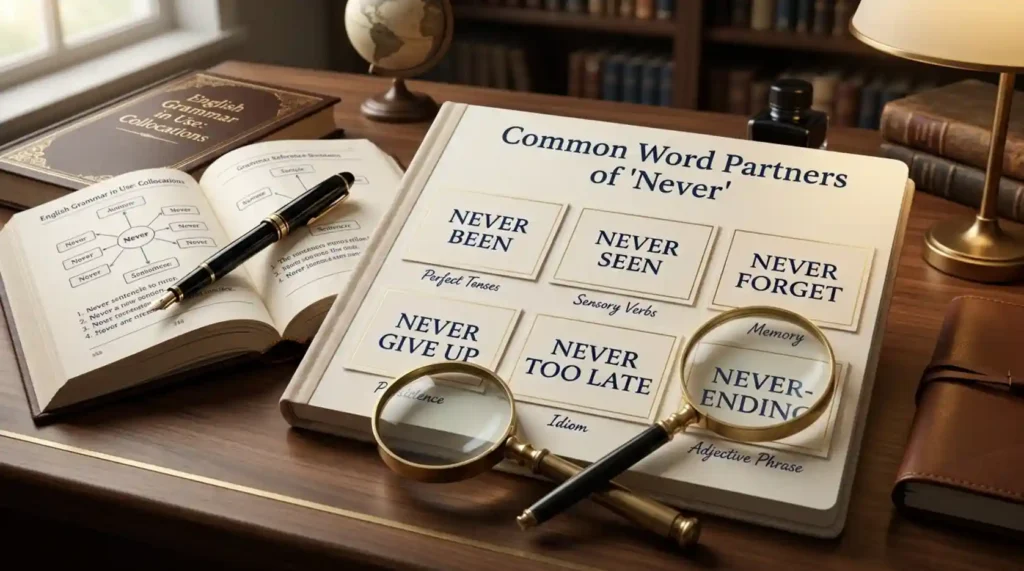
| Pattern | Common Partners | Example |
| never + present perfect | never been, never seen, never heard, never tried | I have never tried sushi. |
| never + imperative | never give up, never forget, never lie | Never give up on your goals. |
| never + too + adjective | never too late, never too old, never too young | It is never too late to learn. |
| never + comparative | never better, never happier, never busier | The team has never been better. |
| never + fail to | never fail to + verb | He never fails to say thank you. |
| adverb + never | almost never, practically never | I almost never eat breakfast. |
| never + adjective (compound) | never-ending, never-before-seen | The film had never-before-seen scenes. |
Sources: Merriam-Webster (never, never-ending); Dictionary.com (never).
Idiomatic Phrases Featuring “Never”
1. Never say die
- Meaning: Do not give up, even when things look bad.
- Example: We are behind by two goals, but never say die.
According to Etymonline, the phrase appeared by 1818.
2. Never mind
- Meaning: Forget it, or do not worry about it.
- Example: I forgot my notebook, but never mind, I’ll share yours.
Etymonline says never mind it was in use by 1795.
3. Better late than never
- Meaning: Doing something late is better than not doing it.
- Example: You came to the meeting an hour late, but better late than never.
4. Never say never
- Meaning: Do not rule out anything, because you cannot know the future.
- Example: I don’t plan to move abroad, but never say never.
Sources: Etymonline (never say die, never mind); Merriam-Webster (never).
Word Formation of “Never”
Etymology & Structure
Never is a compound. It comes from Middle English never, from Old English næfre, made of ne (“not”) plus æfre (“ever”). So the word is literally “not ever.” Etymonline also notes it was once used as an emphatic form of not, as in never mind.
Date and History
Merriam-Webster dates the first known use to before the 12th century. Dictionary.com gives it as first recorded before 900. The short form ne’er is first recorded around 1200 or in the 13th century, depending on the source. Nevermore is first recorded in the early 12th century, and never-ending appears in the 1660s.
Word Class Variations
- Adverb: never (the main use), ne’er, nevermore
- Interjection: Well, I never! (British, old-fashioned)
- Adjective: never-ending, never-before-seen (compound forms)
- Noun: never-was (“a person who never amounted to anything,” from 1911); nevermind (1935)
- Related adverb: nevertheless
- Verb: none. Never has no verb form.
Sources: Etymonline (never, ne’er, nevermore, never-ending, never-was, nevermind); Merriam-Webster (never); Dictionary.com (never).
Common Word-Choice Mistakes
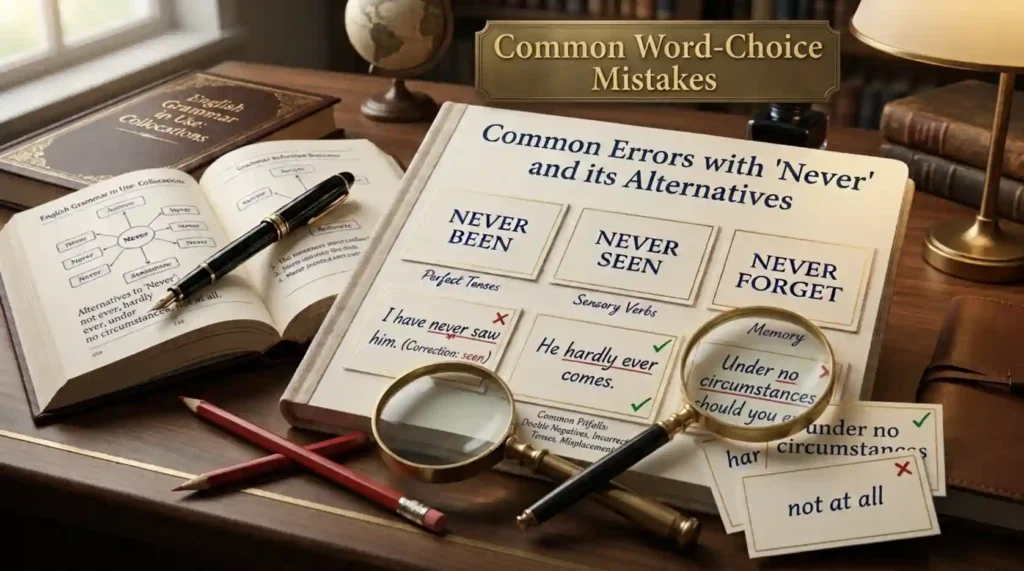
- I don’t never go there. → I never go there or I don’t ever go there. (Avoid the double negative.)
- Never I have seen it. → I have never seen it. (For emphasis, use inversion: Never have I seen it.)
- Hardly never → hardly ever.
- Under no circumstances you should leave. → Under no circumstances should you leave. (Use inversion after this phrase.)
- He not at all called. → He didn’t call at all. (Not at all describes degree and does not replace didn’t.)
- We eat out once in a blue moon, so we never eat out. → These two ideas are different. Once in a blue moon means very rarely, not zero.
- I ne’er finish my homework. → I never finish my homework. (Ne’er is poetic and old-fashioned.)
Frequently Asked Questions
What is the closest synonym for never?
Not ever and at no time are the closest everyday matches. Both mean the same as the basic “at no time” sense.
Is there a one-word synonym for never?
Yes, but both options are literary. Nevermore means “never again,” and ne’er is a poetic short form of never.
What is a formal alternative to never?
At no time, on no occasion, and under no circumstances are formal. Use under no circumstances for rules and bans.
What is the difference between never and never again?
Never means not at any time. Never again means something happened before and will not happen once more.
Is it correct to say “not ever”?
Yes. It is a natural, slightly emphatic alternative, used mostly in speech or when you want to stress the point.
What is the difference between never and rarely?
Never means zero times. Rarely means very few times, so it allows exceptions.
What is the opposite of never?
Always is the usual opposite. Words like sometimes and often are also on the other side of never.
Can never be used for the past and the future?
Yes. I have never been there talks about the past, and I will never go there talks about the future.
Can I use never to mean “didn’t”?
In casual speech, yes (I never took it). Wordnik labels this use colloquial, and it is best avoided in formal writing.
What does “Well, I never!” mean?
It is an old-fashioned, mostly British way to show surprise. It means something like “I can’t believe it!”
Conclusion
The closest everyday alternatives to never are not ever, at no time, on no occasion, and never once. Formal writing may prefer at no time or under no circumstances. For something that will not happen again, never again and the literary nevermore fit best.
Context matters because never has several jobs. It can mean “at no time,” “not before now,” “not at all,” or a strong refusal. Many alternatives cover only one of these jobs. Phrases like by no means talk about degree, and no longer and not anymore say a habit has stopped. Words like rarely and hardly ever leave room for exceptions.
To choose the right word, first decide what you mean: zero times, a ban, a refusal, or a change over time. Then choose a phrase of the right tone, from plain not ever to formal under no circumstances to playful when pigs fly. When the answer really is zero, never is usually the best choice.