Tired of Saying “Empty”? Discover 30 Better Words to Use
The closest everyday alternatives to empty are vacant, bare, blank, hollow, and devoid. The best word depends on If you mean a container with nothing inside, a place with no people, a page with no writing, or something that lacks meaning or value.
Quick list: vacant, bare, blank, hollow, devoid, void, unoccupied, deserted, unfilled, barren.
This article explains 30 alternatives to empty, with meanings, IPA, usage notes, examples, and the contexts in which each word works best.
At a Glance: Empty Synonyms and Related Alternatives
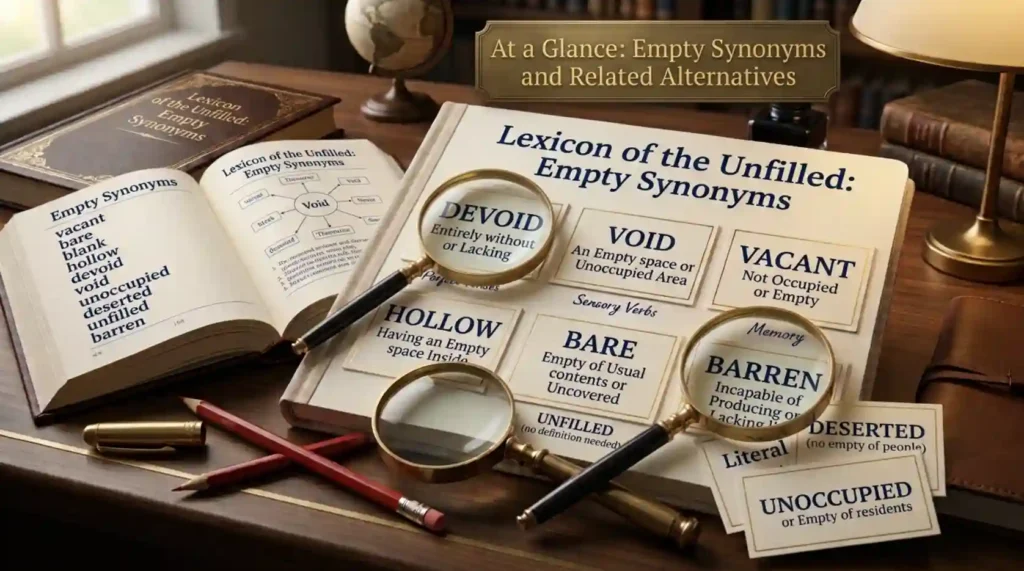
| Alternative | Part of Speech | Meaning | Register / Tone | Ideal Context |
| Vacant | Adjective | Not occupied or filled | Neutral | Rooms, seats, jobs, property |
| Bare | Adjective | Without covering, contents, or decoration | Neutral | Rooms, shelves, walls, feet |
| Blank | Adjective | Having no writing, marks, or expression | Neutral | Paper, screens, faces, minds |
| Hollow | Adjective | Having an empty space inside; lacking real value | Neutral or figurative | Objects, sounds, promises |
| Devoid | Adjective | Completely lacking something | Formal | Abstract or written descriptions |
| Void | Adjective | Completely empty; legally or formally invalid | Formal, literary | Space, contracts, feelings |
| Unoccupied | Adjective | Not being used or lived in | Neutral, slightly formal | Buildings, seats, beds |
| Deserted | Adjective | Left with no people | Descriptive | Streets, buildings, beaches |
| Unfilled | Adjective | Not filled | Neutral | Jobs, positions, containers |
| Barren | Adjective | Producing little or nothing; bare | Literary, descriptive | Land, landscapes, results |
Which Word Should You Use?
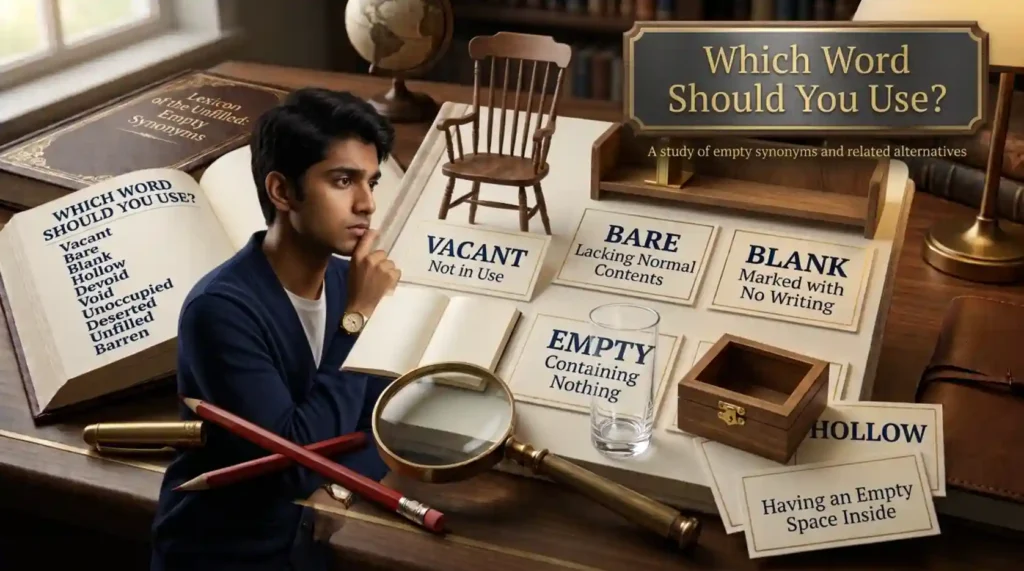
| If you want to… | Use | Why |
| Describe a room or house with no people | Vacant or unoccupied | Both focus on the absence of occupants. |
| Describe shelves or a room with nothing in it | Bare | Bare suggests a lack of contents or decoration. |
| Describe a page, screen, or form with nothing on it | Blank | Blank specifically means without writing or marks. |
| Describe a box, bottle, or container with nothing inside | Empty or unfilled | These are the most direct physical alternatives. |
| Describe an empty feeling or lack of emotion | Hollow, blank, or vacuous | These words work for emotional or figurative emptiness. |
| Describe a place where no one lives | Uninhabited or deserted | Uninhabited is neutral; deserted often sounds lonely. |
| Describe land with few plants or little life | Barren or desolate | These words emphasize bleakness and lack of growth. |
| Describe something without meaning or value | Meaningless, pointless, or worthless | These are figurative alternatives, not physical ones. |
Exploring the Multiple Meanings of “Empty”
1. Containing Nothing
- Meaning: Having nothing inside.
- Explanation: This is the most common literal sense. It applies to containers, spaces, and objects that could normally hold something.
- Example: The refrigerator is empty, so we need to go shopping.
2. Not Occupied or Inhabited
- Meaning: Having no people, residents, or users.
- Explanation: This sense applies to buildings, rooms, seats, vehicles, and places. Vacant and unoccupied are especially close here.
- Example: The office building was empty over the weekend.
3. Lacking Meaning, Substance, or Value
- Meaning: Without real importance, sincerity, or effect.
- Explanation: Empty can describe promises, words, threats, pleasures, or lives that seem shallow or meaningless.
- Example: He made an empty promise to call every week.
4. Showing No Emotion
- Meaning: Expressionless or lacking visible feeling.
- Explanation: This use often describes a look, face, eyes, or voice. Blank and vacant are close alternatives.
- Example: She stared at the letter with an empty expression.
5. Hungry
- Meaning: Feeling a need for food.
- Explanation: In informal English, people may say their stomach feels empty. Hungry is the natural everyday alternative.
- Example: After the long walk, I felt empty and needed lunch.
6. Having No Purpose or Result
- Meaning: Useless, unsuccessful, or without effect.
- Explanation: This sense overlaps with futile, pointless, and fruitless. It often describes effort, time, or activity.
- Example: Their search of the forest proved empty.
Sources: Merriam-Webster; Collins English Thesaurus; Cambridge English Thesaurus.
Analyzing 30 Empty Alternatives in Detail
Some alternatives below are direct synonyms, while others are useful only in particular physical, emotional, or figurative contexts.
Physical Emptiness
1. Vacant
IPA: /ˈveɪkənt/ (US and UK)
Definition: Not occupied or filled.
- Usage: Use vacant for rooms, houses, seats, positions, or land. It emphasizes that something is available or has no occupant.
- Example: There are two vacant apartments on the third floor.
2. Bare
IPA: US /bɛr/ · UK /beə/
Definition: Without the usual or expected contents, covering, or decoration.
- Usage: Use bare for shelves, walls, rooms, tables, or feet. It often suggests plainness rather than a completely sealed container.
- Example: The apartment was bare except for a mattress and a lamp.
3. Blank
IPA: /blæŋk/ (US and UK)
Definition: Having no writing, marks, pictures, or expression.
- Usage: Use blank for paper, screens, forms, spaces, or faces. It is not the best choice for a container such as a bottle.
- Example: Please write your name on the blank line.
4. Hollow
IPA: US /ˈhɑːloʊ/ · UK /ˈhɒləʊ/
Definition: Having an empty space inside.
- Usage: Use hollow for objects with an inside space, such as a tube, drum, or tree trunk. Figuratively, it means lacking sincerity or real value.
- Example: The old tree trunk was hollow inside.
5. Unfilled
IPA: /ʌnˈfɪld/ (US and UK)
Definition: Not filled.
- Usage: Use unfilled for containers, holes, gaps, orders, or positions. It is more literal and technical than empty.
- Example: The company still has several unfilled positions.
6. Devoid
IPA: /dɪˈvɔɪd/ (US and UK)
Definition: Completely lacking something.
- Usage: Devoid is formal and usually needs of: “devoid of life,” “devoid of emotion.” It is stronger and more abstract than empty.
- Example: The report was devoid of any useful detail.
7. Void
IPA: /vɔɪd/ (US and UK)
Definition: Completely empty; without legal force or effect.
- Usage: Use void in formal, legal, scientific, or literary contexts. As an adjective, it often appears after a noun: “a space void of sound.”
- Example: The contract was declared void.
8. Clear
IPA: US /klɪr/ · UK /klɪə/
Definition: Free from objects, obstruction, or contents.
- Usage: Clear is a contextual alternative. It means free or unblocked rather than necessarily containing nothing.
- Example: Keep the doorway clear at all times.
9. Free
IPA: /friː/ (US and UK)
Definition: Not occupied or used; available.
- Usage: Use free for seats, rooms, time, or spaces. It emphasizes availability, not the absence of contents.
- Example: Is this seat free?
10. Dry
IPA: /draɪ/ (US and UK)
Definition: Without liquid or moisture.
- Usage: Dry is a limited alternative to empty. Use it when something has no liquid, such as a well, riverbed, or glass.
- Example: The fountain was dry after weeks without rain.
Places Without People
11. Unoccupied
IPA: US /ʌnˈɑːkjəpaɪd/ · UK /ʌnˈɒkjəpaɪd/
Definition: Not being used or lived in.
- Usage: Use unoccupied for buildings, rooms, seats, beds, or property. It is neutral and slightly more formal than empty.
- Example: The house has been unoccupied since last winter.
12. Deserted
IPA: US /dɪˈzɜːrtɪd/ · UK /dɪˈzɜːtɪd/
Definition: With no people present.
- Usage: Use deserted for streets, beaches, buildings, or towns. It often creates a quiet, lonely, or eerie mood.
- Example: We walked through the deserted station at midnight.
13. Uninhabited
IPA: /ˌʌnɪnˈhæbɪtɪd/ (US and UK)
Definition: Having no people living there.
- Usage: Use uninhabited mainly for islands, regions, buildings, or planets. It is factual rather than emotional.
- Example: The island is uninhabited except during the summer.
14. Abandoned
IPA: /əˈbændənd/ (US and UK)
Definition: Left and no longer used, wanted, or cared for.
- Usage: Abandoned is related to empty but adds the idea that people left something behind. It often suggests neglect.
- Example: They explored an abandoned factory near the river.
15. Desolate
IPA: /ˈdesələt/ (US and UK)
Definition: Empty, bare, and often sad or bleak.
- Usage: Use desolate for landscapes, places, or feelings. It is more literary and emotional than empty.
- Example: They drove across a desolate stretch of desert.
16. Forsaken
IPA: US /fərˈseɪkən/ · UK /fəˈseɪkən/
Definition: Abandoned or deserted, often in a sad or dramatic way.
- Usage: Forsaken is literary and emotional. It is related to empty only when the emphasis is on being left alone or abandoned.
- Example: The village looked forsaken after the flood.
17. Stark
IPA: US /stɑːrk/ · UK /stɑːk/
Definition: Bare, plain, and severe in appearance.
- Usage: Stark is a stylistic alternative for empty spaces or interiors. It suggests simplicity, severity, or lack of comfort.
- Example: The room had stark white walls and no furniture.
18. Unfurnished
IPA: US /ʌnˈfɜːrnɪʃt/ · UK /ʌnˈfɜːnɪʃt/
Definition: Without furniture.
- Usage: Use unfurnished only for rooms, flats, houses, or offices. It is a precise property-related alternative to empty.
- Example: They rented an unfurnished flat near the university.
19. Available
IPA: /əˈveɪləbl/ (US and UK)
Definition: Able to be used, obtained, or occupied.
- Usage: Available is related to empty when describing seats, rooms, appointments, or positions. It focuses on usefulness rather than emptiness.
- Example: There are no available tables until eight o’clock.
Reduced or Drained Contents
20. Drained
IPA: /dreɪnd/ (US and UK)
Definition: Having had liquid or contents removed; very tired.
- Usage: Use drained for pools, batteries, tanks, or people. For people, it means emotionally or physically exhausted rather than literally empty.
- Example: The pool was drained for cleaning.
21. Depleted
IPA: /dɪˈpliːtɪd/ (US and UK)
Definition: Greatly reduced in amount or used up.
- Usage: Use depleted for supplies, resources, energy, or stocks. It means nearly used up, not necessarily completely empty.
- Example: The team’s energy was depleted after the final match.
22. Exhausted
IPA: /ɪɡˈzɔːstɪd/ (US and UK)
Definition: Used up completely; extremely tired.
- Usage: Exhausted is a contextual alternative. For supplies or resources, it means fully used; for people, it means very tired.
- Example: The fuel supply was exhausted before they reached the town.
Figurative Emptiness
23. Vacuous
IPA: /ˈvækjuəs/ (US and UK)
Definition: Lacking intelligence, serious thought, or meaningful content.
- Usage: Use vacuous for comments, expressions, conversations, or people. It is critical and more formal than empty.
- Example: The interview was full of vacuous questions.
24. Meaningless
IPA: /ˈmiːnɪŋləs/ (US and UK)
Definition: Having no meaning or importance.
- Usage: Use meaningless for words, symbols, gestures, or experiences. It is a figurative alternative to empty.
- Example: Without context, the numbers were meaningless.
25. Pointless
IPA: /ˈpɔɪntləs/ (US and UK)
Definition: Having no purpose or useful result.
- Usage: Use pointless for actions, arguments, meetings, or efforts. It emphasizes wasted effort.
- Example: Arguing with him at that moment felt pointless.
26. Futile
IPA: US /ˈfjuːtl/ · UK /ˈfjuːtaɪl/
Definition: Producing no useful result; ineffective.
- Usage: Futile is more formal than pointless. It often describes attempts, resistance, or searches.
- Example: Their attempt to save the business proved futile.
27. Worthless
IPA: US /ˈwɜːrθləs/ · UK /ˈwɜːθləs/
Definition: Having no value or usefulness.
- Usage: Use worthless for things, advice, promises, or efforts. It is harsher than empty and directly judges value.
- Example: The old tickets were worthless after the event ended.
28. Idle
IPA: /ˈaɪdl/ (US and UK)
Definition: Not working, being used, or having a purpose.
- Usage: Idle is a contextual alternative for time, machines, workers, or threats. It suggests inactivity rather than physical emptiness.
- Example: The factory machines sat idle during the strike.
Emotional and Expressive Emptiness
29. Expressionless
IPA: /ɪkˈspreʃənləs/ (US and UK)
Definition: Showing no emotion on the face.
- Usage: Use expressionless for faces, eyes, or voices. It is a precise alternative when empty describes a person’s look.
- Example: He gave an expressionless reply and left the room.
30. Hungry
IPA: /ˈhʌŋɡri/ (US and UK)
Definition: Wanting or needing food.
- Usage: Hungry replaces empty only in the informal sense of an empty stomach. Do not use it for rooms, containers, or promises.
- Example: I skipped breakfast, so I was hungry by noon.
Sources: Merriam-Webster Dictionary and Thesaurus; Collins English Thesaurus; Cambridge English Thesaurus.
Empty vs. Vacant vs. Blank
| Word | Main Focus | Typical Objects | Example |
| Empty | No contents at all | Bottles, boxes, rooms, streets | The bottle is empty. |
| Vacant | No occupant or user | Rooms, seats, jobs, property | The seat is vacant. |
| Blank | No writing, marks, or expression | Paper, screens, faces | The page is blank. |
Empty is the broadest word. Choose vacant when people or users are missing, and blank when writing, images, or expression are missing. Merriam-Webster distinguishes them in exactly this way: empty suggests a complete absence of contents, while vacant suggests an absence of appropriate occupants or contents.
Sources: Merriam-Webster.
Empty and Opposite/Paired Word Pairs
| Word | Paired Word | Note |
| Empty | Full | The most direct opposite for containers and spaces. |
| Vacant | Occupied | Common for rooms, seats, and property. |
| Blank | Completed | Common for forms, pages, and screens. |
| Hollow | Solid | Common for objects and figurative promises. |
| Barren | Fertile | Common for land, soil, and imagination. |
| Meaningless | Meaningful | Common for words, actions, and experiences. |
| Deserted | Crowded | Common for streets, buildings, and places. |
| Unfilled | Filled | Common for jobs, orders, gaps, and containers. |
These pairs show that empty has both literal and figurative opposites. A container can be full, while a promise or life can be meaningful.
Sources: Merriam-Webster; Collins English Thesaurus.
Common Word Partners of “Empty”
| Pattern | Common Partners | Example |
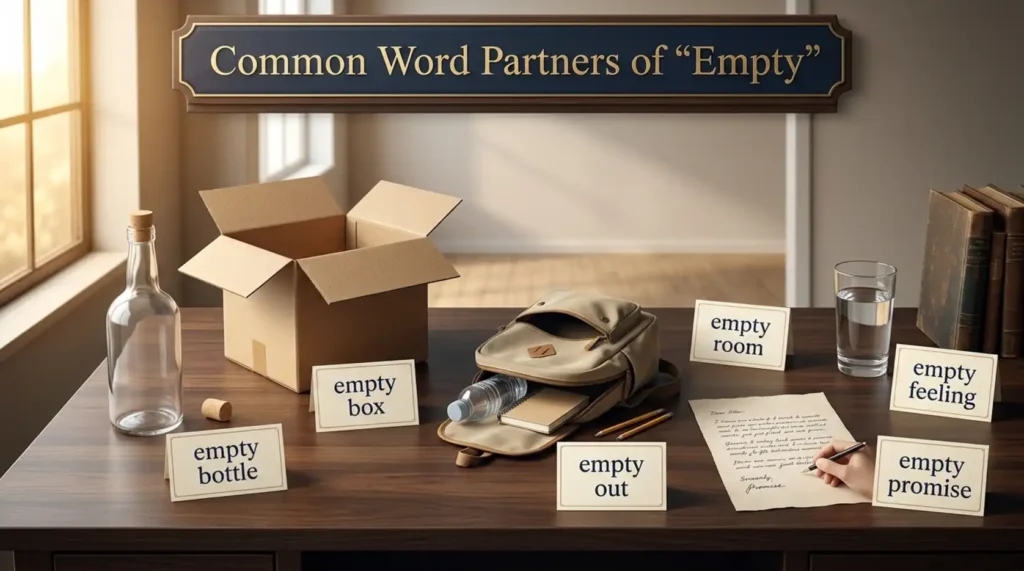
| Empty + container | bottle, box, glass, jar, tank | She threw away the empty bottle. |
| Empty + place | room, street, house, stadium, parking lot | The stadium was empty before the game. |
| Empty + abstract noun | promise, threat, words, gesture, rhetoric | It was just an empty promise. |
| Empty + feeling/expression | look, expression, eyes, feeling, voice | He spoke in an empty voice. |
| Feel + empty | inside, stomach, lonely, lost | I felt empty after saying goodbye. |
| Empty + out | pockets, drawers, backpack, suitcase | He emptied out his backpack. |
These collocations reflect the main senses of empty: physical containers, unoccupied places, meaningless language, and emotional absence.
Sources: Merriam-Webster; Collins English Thesaurus.
Idiomatic Phrases Featuring “Empty”
1. Empty promises
- Meaning: Promises that the speaker does not intend to keep.
- Example: Politicians often make empty promises before an election.
2. Empty threats
- Meaning: Threats that are not serious or will not be carried out.
- Example: His warning was an empty threat; he never acted on it.
3. Empty-handed
- Meaning: Returning without what one hoped to get or bring.
- Example: They searched all day but came home empty-handed.
4. Empty nest
- Meaning: A family home after the children have grown up and moved out.
- Example: After their youngest son left for college, they faced an empty nest.
Sources: Merriam-Webster; Collins English Thesaurus.
Word Formation of “Empty”
Etymology & Structure
Empty comes from Old English æmettig, which could mean “at leisure” or “not occupied” for people, “containing nothing” for containers, and “unoccupied” for places. It developed from æmetta, meaning “leisure.”
Date and History
The adjective empty is recorded in English from about 1200. The verb empty dates from the 1520s, and the noun empty, meaning an empty container or vehicle, is recorded from 1865.
Word Class Variations
- Adjective: empty — “an empty box”
- Verb: empty — “Empty the bin.”
- Noun: empty — “The truck returned with empties.”
- Related noun: emptiness — “a feeling of emptiness”
- Comparative and superlative: emptier, emptiest
- Related adverb: emptily — less common, used in literary contexts
Sources: Etymonline; Merriam-Webster.
Common Word-Choice Mistakes
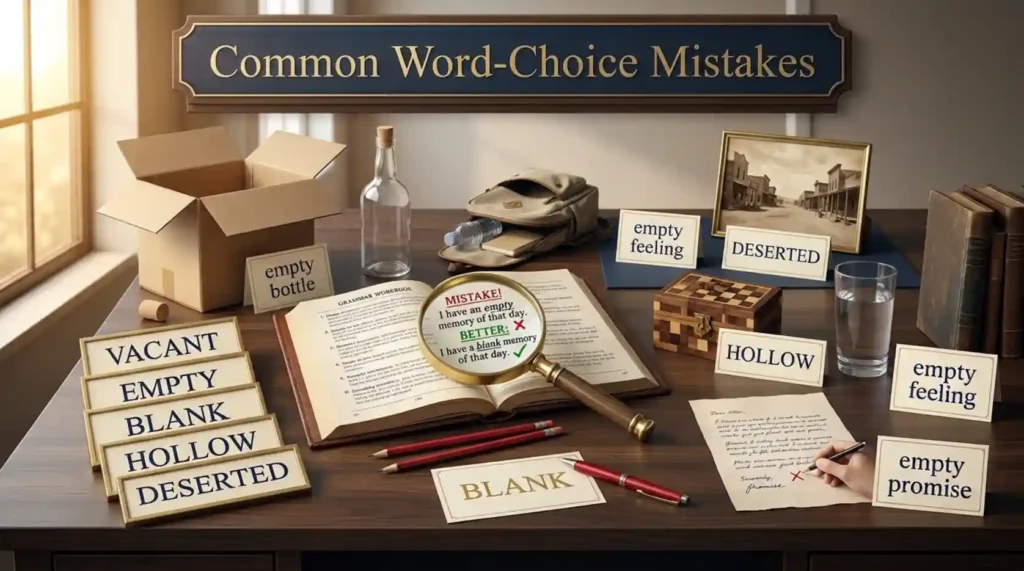
- Wrong: “The page is vacant.” → Correct: “The page is blank.”
- Wrong: “The bottle is vacant.” → Correct: “The bottle is empty.”
- Wrong: “He gave an unfilled look.” → Correct: “He gave a blank look.”
- Wrong: “The desert was vacant.” → Correct: “The desert was barren” or “desolate.”
- Wrong: “The promise was hollow of meaning.” → Correct: “The promise was hollow” or “empty.”
- Wrong: “She was devoid.” → Correct: “She was devoid of emotion.”
- Wrong: “The street was uninhabited.” → Correct: “The street was deserted.” Uninhabited usually describes places where people do not live, such as islands or remote regions.
Frequently Asked Questions
What is the closest synonym for empty?
Vacant is often the closest alternative for rooms, seats, and places. For containers, unfilled is close, while bare works well for shelves and rooms.
What is the difference between empty and vacant?
Empty means containing nothing. Vacant means not occupied, especially by a person, tenant, or user.
What is a formal word for empty?
Devoid, void, and unoccupied are formal alternatives. Devoid needs of, as in “devoid of life.”
What is a poetic word for empty?
Hollow, desolate, barren, void, and forsaken are common literary choices.
Can empty describe a person?
Yes, but usually figuratively. An “empty feeling” means sadness, loss, or lack of purpose; an “empty look” means an expressionless face.
Can empty mean hungry?
Yes. In informal English, “I feel empty” can mean “I feel hungry,” especially when referring to the stomach.
What is the opposite of empty?
Full is the main opposite. Other opposites depend on context: occupied for vacant, meaningful for meaningless, and fertile for barren.
Is blank the same as empty?
No. Blank means without writing, marks, or expression. A blank page is empty of writing, but an empty box is not normally called blank.
What is the difference between hollow and empty?
Hollow means having an empty space inside. Empty means containing nothing at all; a hollow drum may still contain air.
What is a good alternative for an empty promise?
Use hollow promise, empty promise, meaningless promise, or false promise, depending on the exact meaning.
Conclusion
The most useful alternatives to empty are vacant, bare, blank, hollow, devoid, and unoccupied. For a bottle or box, empty or unfilled is usually best; for a room or seat, use vacant or unoccupied.
Context matters because empty can describe physical space, absent people, missing writing, lack of emotion, or lack of meaning. Words such as barren, desolate, meaningless, and futile are related alternatives rather than exact substitutes.
To choose well, identify what is missing: contents, people, writing, emotion, purpose, or value. Then select the word that names that specific absence most naturally.