Stop Repeating “Deeper”! Discover 30 Smarter Alternatives
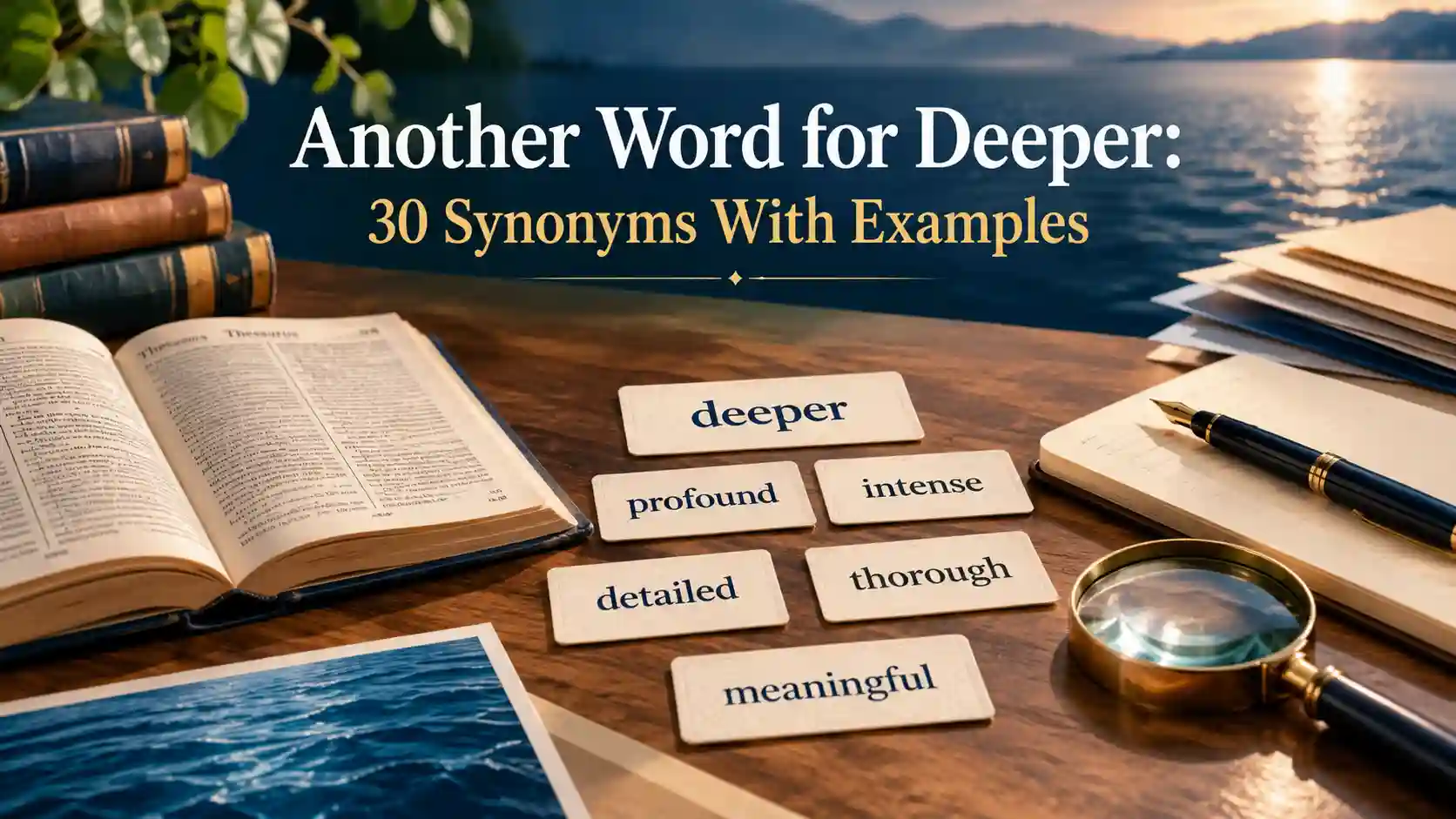
The closest alternatives to deeper are more profound, greater, lower, more intense, and more detailed. The best choice depends on what you mean. For example, a deeper hole may be lower, a deeper understanding may be more complete, and a deeper feeling may be more intense.
The word deeper can describe physical depth, stronger feelings, greater knowledge, serious ideas, lower sounds, or more detailed study. Some alternatives work in several situations, while others fit only one meaning.
Quick list: more profound, greater, lower, more intense, more detailed, stronger, more meaningful, more extensive, more serious, and more thorough.
This guide explores 30 alternatives to deeper, with definitions, pronunciation (IPA), usage notes, and natural examples. It also explains common word pairs, expressions, collocations, and differences that help you choose the right word.
At a Glance: Deeper Synonyms and Related Alternatives
| Alternative | Part of Speech | Meaning | Register / Tone | Ideal Context |
| More profound | Adjective phrase | More thoughtful or meaningful | Formal | Ideas and questions |
| Greater | Adjective | Larger in amount or degree | Neutral | Impact, knowledge, understanding |
| Lower | Adjective | Farther down | Neutral | Holes, levels, sounds |
| More intense | Adjective phrase | Stronger in degree | Neutral | Feelings, pain, focus |
| More detailed | Adjective phrase | Including more information | Neutral | Research and explanations |
| Stronger | Adjective | Having more force or effect | Neutral | Bonds, feelings, influence |
| More meaningful | Adjective phrase | Having greater importance | Neutral | Relationships and experiences |
| More extensive | Adjective phrase | Covering more ground or material | Formal | Research and reviews |
| More serious | Adjective phrase | Having greater importance or concern | Neutral | Problems and discussions |
| More thorough | Adjective phrase | More complete and careful | Neutral to formal | Checks, studies, analysis |
Which Word Should You Use?
| If you want to… | Use | Why |
| Describe a hole that extends farther down | Lower or deeper | Both can describe vertical position or depth, but deeper emphasizes greater depth. |
| Explain an idea with greater meaning | More profound | It suggests thoughtful or important meaning. |
| Describe stronger emotions | More intense | It emphasizes the strength of a feeling. |
| Talk about a closer relationship | Closer or stronger | These words describe greater emotional connection or a stronger bond. |
| Explain a topic with more information | More detailed | It suggests extra facts, points, or explanations. |
| Describe a wider investigation | More extensive | It suggests covering more material or a larger area. |
| Show a greater degree of understanding | Greater or more complete | These alternatives highlight increased knowledge or understanding. |
| Describe a careful, complete review | More thorough | It emphasizes careful attention to all important details. |
Exploring the Multiple Meanings of “Deeper”
The word deeper is the comparative form of deep. It can describe physical distance, emotional strength, understanding, sound, and other qualities. Its exact meaning depends on the sentence.
definition in the Cambridge English Dictionary
+1
1. Greater Physical Depth
- Meaning: Extending farther down or farther inward.
- Explanation: This is the literal meaning of deeper. It describes places or objects with a greater distance from the top, surface, or front.
- Example: The workers dug a deeper well to reach water.
2. Greater Understanding or Meaning
- Meaning: More thoughtful, meaningful, or difficult to understand.
- Explanation: In this sense, deeper describes ideas, knowledge, questions, or understanding that go beyond basic facts.
- Example: The teacher encouraged us to develop a deeper understanding of history.
3. Stronger Feelings or Connections
- Meaning: More strongly felt or more firmly established.
- Explanation: The word can describe love, trust, respect, relationships, and other feelings that grow stronger over time.
- Example: Working together helped them build a deeper friendship.
4. Greater Seriousness or Importance
- Meaning: More serious, important, or far-reaching.
- Explanation: A deeper problem or concern often points to an underlying cause rather than a surface-level issue.
- Example: The disagreement revealed a deeper problem within the team.
5. Lower Sounds or More Intense Colors
- Meaning: Lower in pitch or richer in color.
- Explanation: Deeper can describe a voice that sounds lower or a color that appears richer or stronger.
- Example: His voice became deeper as he grew older.
Analyzing 30 Deeper Alternatives in Detail
Some alternatives are close synonyms for deeper, while others fit only particular situations, such as physical depth, feelings, knowledge, or serious problems.
Group 1: Alternatives for Ideas and Understanding
1. More profound
IPA: US /prəˈfaʊnd/ · UK /prəˈfaʊnd/
Definition: Having great meaning, depth of thought, or importance.
- Usage: Use more profound when an idea, question, or realization has greater meaning. It is not a direct substitute for physical depth.
- Example: The book gave me a more profound understanding of human nature.
2. More insightful
IPA: US /ˈɪnˌsaɪtfəl/ · UK /ˈɪnsaɪtfəl/
Definition: Showing a clear understanding of something.
- Usage: This is a related alternative when deeper refers to better understanding or a more revealing analysis.
- Example: Her second report offered a more insightful view of the problem.
3. More thoughtful
IPA: US /ˈθɔtfəl/ · UK /ˈθɔːtfəl/
Definition: Showing careful thought or consideration.
- Usage: Choose this when someone considers an issue more carefully. It does not always mean greater knowledge.
- Example: We need a more thoughtful discussion about the changes.
4. More meaningful
IPA: US /ˈmiːnɪŋfəl/ · UK /ˈmiːnɪŋfəl/
Definition: Having greater meaning, value, or importance.
- Usage: Use this for conversations, experiences, relationships, or work that has greater personal value.
- Example: Their honest conversation led to a more meaningful friendship.
5. More insightful in nature: More revealing
IPA: US /rɪˈviːlɪŋ/ · UK /rɪˈviːlɪŋ/
Definition: Giving information that was previously unknown or hidden.
- Usage: This is a contextual alternative when a deeper investigation or discussion uncovers facts that were not obvious before.
- Example: The follow-up interview was more revealing than the first one.
Group 2: Alternatives for Research and Detail
6. More detailed
IPA: US /ˈdiːteɪld/ · UK /ˈdiːteɪld/
Definition: Including more facts, information, or parts.
- Usage: Use this when a deeper explanation contains more information. Detail and depth are related, but they are not identical.
- Example: The revised report provides a more detailed account of the event.
7. More thorough
IPA: US /ˈθɝːoʊ/ · UK /ˈθʌrə/
Definition: Complete and careful, including all important parts.
- Usage: This is useful for a deeper review, examination, or investigation that covers important details carefully.
- Example: The team conducted a more thorough review of the evidence.
8. More extensive
IPA: US /ɪkˈstensɪv/ · UK /ɪkˈstensɪv/
Definition: Covering a large area or including many parts.
- Usage: Use this when deeper research also covers more material or a wider range of topics. It does not necessarily mean greater depth.
- Example: The researchers carried out a more extensive study.
9. More comprehensive
IPA: US /ˌkɑːmprɪˈhensɪv/ · UK /ˌkɒmprɪˈhensɪv/
Definition: Including nearly all the important parts of something.
- Usage: Choose this for an explanation or review that covers the subject broadly and completely.
- Example: The new guide gives a more comprehensive account of the issue.
10. More in-depth
IPA: US /ˌɪnˈdepθ/ · UK /ˌɪnˈdepθ/
Definition: Examining a subject carefully and in great detail.
- Usage: This is one of the closest alternatives for deeper research, analysis, or discussion. It usually refers to the amount of examination rather than physical depth.
- Example: The newspaper published a more in-depth investigation of the case.
Group 3: Alternatives for Strength and Intensity
11. More intense
IPA: US /ɪnˈtɛns/ · UK /ɪnˈtens/
Definition: Stronger in degree, force, or feeling.
- Usage: Use this when deeper emotions, pain, pressure, or focus become stronger.
- Example: The competition became more intense in the final round.
12. Stronger
IPA: US /ˈstrɔŋɡər/ · UK /ˈstrɒŋɡə/
Definition: Having greater strength, force, or effect.
- Usage: This works for feelings, relationships, arguments, and influence. It is not a general replacement for physical depth.
- Example: The experience helped them build a stronger bond.
13. More powerful
IPA: US /ˈpaʊərfəl/ · UK /ˈpaʊəfəl/
Definition: Having greater force, influence, or effect.
- Usage: Choose this when a deeper impact or feeling has a greater effect on someone.
- Example: The final scene delivered a more powerful message.
14. More pronounced
IPA: US /prəˈnaʊnst/ · UK /prəˈnaʊnst/
Definition: More noticeable or clearly marked.
- Usage: This is a contextual alternative when a deeper difference, feature, or effect becomes easier to notice.
- Example: The contrast between the two colors became more pronounced.
15. More concentrated
IPA: US /ˈkɑːnsənˌtreɪtɪd/ · UK /ˈkɒnsəntreɪtɪd/
Definition: More strongly focused or present in a smaller space or amount.
- Usage: This can describe more focused thought or a substance with a higher concentration. It is related to depth only in suitable contexts.
- Example: The team made a more concentrated effort to solve the problem.
Group 4: Alternatives for Problems and Importance
16. More serious
IPA: US /ˈsɪriəs/ · UK /ˈsɪəriəs/
Definition: More important, severe, or requiring attention.
- Usage: Use this when a deeper issue is more serious than it first appears.
- Example: Further testing revealed a more serious problem.
17. More fundamental
IPA: US /ˌfʌndəˈmentəl/ · UK /ˌfʌndəˈmentəl/
Definition: Relating to the basic nature or foundation of something.
- Usage: This is useful when a deeper problem concerns the basic cause or structure of an issue.
- Example: The disagreement reflects a more fundamental difference in their values.
18. More underlying
IPA: US /ˌʌndərˈlaɪɪŋ/ · UK /ˌʌndəˈlaɪɪŋ/
Definition: Existing beneath the surface or serving as a hidden cause.
- Usage: Underlying is a related adjective, not a direct comparative synonym. Use it when discussing hidden causes behind a deeper problem.
- Example: The discussion exposed an underlying concern about trust.
19. More significant
IPA: US /sɪɡˈnɪfɪkənt/ · UK /sɪɡˈnɪfɪkənt/
Definition: More important or likely to have an effect.
- Usage: Choose this when a deeper change or issue has greater importance or consequences.
- Example: The latest findings revealed a more significant change than expected.
20. More far-reaching
IPA: US /ˌfɑːr ˈriːtʃɪŋ/ · UK /ˌfɑː ˈriːtʃɪŋ/
Definition: Affecting many people, areas, or future events.
- Usage: This is a related alternative for a deeper impact that extends beyond the immediate situation.
- Example: The decision had more far-reaching effects than the managers expected.
Group 5: Alternatives for Greater Amount or Physical Depth
21. Greater
IPA: US /ˈɡreɪtər/ · UK /ˈɡreɪtə/
Definition: Larger in amount, degree, or importance.
- Usage: Use this when deeper means greater in degree, as in greater understanding or greater concern. It does not replace deeper for a hole or pool.
- Example: The new evidence gave us greater confidence in the results.
22. Lower
IPA: US /ˈloʊər/ · UK /ˈləʊə/
Definition: Situated farther down or at a smaller height or level.
- Usage: This is appropriate when comparing vertical positions, levels, or sound pitch. It may describe a deeper point but not necessarily a greater depth.
- Example: The water level was lower after the dry season.
23. Further down
IPA: US /ˌfɝːðər ˈdaʊn/ · UK /ˌfɜːðə ˈdaʊn/
Definition: At a point farther below or along a downward path.
- Usage: This phrase works when describing a location or position rather than the depth of an object itself.
- Example: The cave entrance continues further down the hillside.
24. More recessed
IPA: US /rɪˈsest/ · UK /rɪˈsest/
Definition: Set back into a surface or surrounding structure.
- Usage: This is a specific alternative for a feature that sits farther inward, such as a window or wall opening. It does not mean deeper in every context.
- Example: The new design has a more recessed window.
25. More sunken
IPA: US /ˈsʌŋkən/ · UK /ˈsʌŋkən/
Definition: Set lower than the surrounding surface or having fallen inward.
- Usage: Use this for physical features such as a sunken floor or a hollow-looking area. It can suggest a lower position, not simply greater depth.
- Example: The renovation added a more sunken seating area.
Group 6: Alternatives for Lasting Feelings and Changes
26. More heartfelt
IPA: US /ˌhɑːrtˈfɛlt/ · UK /ˌhɑːtˈfelt/
Definition: Showing sincere and strong feelings.
- Usage: This is a related alternative for deeper emotions or a more sincere message. It emphasizes honesty and feeling rather than depth itself.
- Example: She wrote a more heartfelt letter to her grandmother.
27. More deeply rooted
IPA: US /ˌdiːpli ˈruːtɪd/ · UK /ˌdiːpli ˈruːtɪd/
Definition: Firmly established and difficult to change.
- Usage: This established phrase describes beliefs, habits, traditions, or problems that have a strong foundation. It is not a universal synonym for deeper.
- Example: The disagreement came from more deeply rooted differences in their beliefs.
28. More ingrained
IPA: US /ɪnˈɡreɪnd/ · UK /ɪnˈɡreɪnd/
Definition: Firmly fixed through habit or long experience.
- Usage: Use this when a deeper habit or belief has become difficult to change.
- Example: The habit was more ingrained than she had first realized.
29. More intimate
IPA: US /ˈɪntəmət/ · UK /ˈɪntɪmət/
Definition: Involving close personal knowledge, feelings, or connection.
- Usage: This works for a deeper personal relationship or a more private conversation. It does not mean greater depth in a literal sense.
- Example: Their conversations became more intimate over time.
30. More mature
IPA: US /məˈtʃʊr/ · UK /məˈtjʊə/
Definition: More fully developed or showing greater judgment.
- Usage: This is a related alternative when deeper thinking reflects better judgment or a more developed understanding. It is not an exact synonym.
- Example: After hearing both sides, she offered a more mature response.
Deeper vs. Deeper Understanding vs. More Profound
These expressions are related, but they are not interchangeable in every sentence.
| Expression | Meaning | Example |
| Deeper | Extending farther down or going beyond the surface | The divers explored deeper waters. |
| Deeper understanding | A fuller grasp of a subject | Reading the book gave me a deeper understanding of the topic. |
| More profound | Having greater meaning or intellectual importance | The speaker raised a more profound question. |
| More detailed | Containing additional facts or information | The second report was more detailed. |
| More thorough | Covering all important points carefully | The team performed a more thorough check. |
| More intense | Stronger in feeling or degree | Her emotions became more intense. |
| More fundamental | Relating to a basic cause or principle | The problem requires a more fundamental change. |
The main difference is that deeper can apply to both physical and figurative depth. More profound usually emphasizes meaning, more detailed emphasizes information, and more thorough emphasizes completeness.
Deeper and Opposite/Paired Word Pairs
The best opposite of deeper depends on the type of depth being described. Some words are natural opposites, while others are commonly paired contrasts.
| Word | Paired Word | Note |
| Deeper | Shallower | The clearest opposite for physical depth |
| Deeper | Higher | Contrasts vertical position or level |
| Deeper | More superficial | Contrasts depth of thought or examination |
| Deeper | More surface-level | Contrasts detailed or underlying analysis |
| Deeper | Lighter | Can contrast depth of color or sound, depending on context |
| Deeper | Less intense | Contrasts strength of feeling or effect |
| Deeper | Less meaningful | Contrasts the amount of meaning or significance |
| Deeper | Less thorough | Contrasts the completeness of an investigation |
Shallower is the most direct opposite when comparing physical depth. For ideas or research, more superficial or less thorough may be more suitable. For feelings, less intense is often clearer than using a general opposite.
Common Word Partners of “Deeper”

A collocation is a combination of words that commonly appears in natural English. These are useful patterns for using deeper correctly.
| Pattern | Common Partners | Example |
| Deeper + physical noun | hole, well, pool, river, water | The workers dug a deeper hole. |
| Deeper + understanding noun | understanding, knowledge, insight | The course gave her a deeper understanding of the subject. |
| Deeper + relationship noun | connection, bond, relationship | They developed a deeper connection. |
| Deeper + feeling noun | love, concern, emotion, respect | He felt a deeper respect for his teacher. |
| Deeper + problem noun | problem, issue, cause | The report revealed a deeper problem. |
| Deeper + investigation noun | investigation, analysis, examination | The case needs a deeper investigation. |
| Deeper + sound noun | voice, tone, pitch | His voice sounded deeper after puberty. |
| Deeper + color noun | shade, color, hue | The artist chose a deeper shade of blue. |
| Verb + deeper | dig, look, go, explore | We need to look deeper into the matter. |
| Verb + a deeper + noun | gain, develop, build | Reading helped him gain a deeper understanding. |
These patterns show why choosing a synonym requires context. You can dig deeper into a problem, develop a deeper connection, or use a deeper shade of paint, but the best replacement differs in each case.
Idiomatic Phrases Featuring “Deeper”
The following expressions use deep or deeper in established ways. Some are idioms, while others are common expressions with figurative meanings.
1. Dig Deeper
- Meaning: Investigate further or make a greater effort to find information.
- Example: The journalist decided to dig deeper into the company’s financial records.
2. Go Deeper
- Meaning: Examine a subject more carefully or explore beyond the basic facts.
- Example: The teacher asked us to go deeper into the reasons behind the historical event.
3. Deep Down
- Meaning: In someone’s innermost thoughts or feelings, often something they do not openly express.
- Example: Deep down, he knew that apologizing was the right thing to do.
4. In Deep Water
- Meaning: In a difficult or dangerous situation.
- Example: After missing several deadlines, the manager found himself in deep water.
These expressions are useful because they show how physical depth can express investigation, private feelings, and difficulty. Dig deeper and go deeper are especially helpful when discussing research or understanding.
Word Formation of “Deeper”

Etymology & Structure
Deeper is the comparative form of the adjective deep. It is formed by adding -er to deep:
- Deep: The basic adjective.
- Deep + -er = Deeper: The comparative form, used to compare two depths or degrees.
- Deep + -est = Deepest: The superlative form, used to describe the greatest depth among three or more things, or within a group.
The word deep comes from Old English dēop, meaning extended far downward and also carrying figurative meanings such as profound or serious. It is related to words in other Germanic languages, including Dutch diep and German tief.
Date and History
The adjective deep is recorded in Old English. Etymonline traces deeper to the comparative formation of this older adjective, while the related noun depth developed in Middle English.
The verb deepen, meaning to make or become deeper, dates to around 1600 in its early recorded use. Its later intransitive use, meaning to become deeper, is recorded from the 1690s.
Word Class Variations
| Word | Part of Speech | Meaning |
| Deep | Adjective / adverb | Extending far down; profoundly or far into something |
| Deeper | Comparative adjective / adverb | To a greater depth or degree |
| Deepest | Superlative adjective / adverb | To the greatest depth or degree |
| Deeply | Adverb | Strongly, profoundly, or to a great depth |
| Deepen | Verb | To make or become deeper |
| Deepened | Verb form | Made or became deeper |
| Deepening | Verb form / noun | The process of becoming or making deeper |
| Depth | Noun | The distance from the top or surface to the bottom; figurative profundity |
| Deepness | Noun | The quality or state of being deep |
Common Word-Choice Mistakes

- Wrong: A more deeper hole. Correction: A deeper hole. Avoid using more with the comparative form deeper.
- Wrong: A deeper in-depth analysis. Correction: A deeper analysis or a more in-depth analysis. Both expressions can communicate depth of examination.
- Wrong: A deeper color means a darker color in every case. Correction: A deeper color may look richer or more intense, depending on the shade.
- Wrong: A deeper voice means a louder voice. Correction: A deeper voice usually has a lower pitch; a louder voice has greater volume.
- Wrong: A deeper relationship always means a longer relationship. Correction: A deeper relationship usually suggests a stronger emotional connection, not simply more time together.
- Wrong: A deeper explanation must be longer. Correction: A deeper explanation explores meaning or reasons more fully, even if it is not much longer.
- Wrong: Deeper and more serious always mean the same thing. Correction: Use more serious when emphasizing importance or severity, and deeper when emphasizing depth, underlying causes, or greater understanding.
Frequently Asked Questions
1. What is the closest synonym for deeper?
The closest alternative depends on the sentence. More profound works for ideas, more intense for feelings, and lower for physical position or sound pitch.
2. What is another word for deeper understanding?
You can use greater understanding, more complete understanding, or more profound understanding. For a more casual sentence, better understanding is also natural.
3. What is a formal alternative to deeper?
More profound, more extensive, more comprehensive, and more thorough are useful formal alternatives. Choose the one that matches the intended meaning.
4. What is a literary word for deeper?
More profound is a good choice for thoughtful or philosophical writing. More abyssal can describe something relating to an abyss or extreme ocean depth, but it is much more specialized.
5. What is the opposite of deeper?
Shallower is the direct opposite when discussing physical depth. For figurative uses, more superficial or less thorough may be more appropriate.
6. Can deeper describe a person?
Yes. It can describe a person’s voice, thoughts, feelings, or understanding. For example, “His voice grew deeper” describes a change in pitch.
7. Is deeper the same as more profound?
No. Deeper has literal and figurative meanings, while more profound usually emphasizes meaning, thought, or importance. You would describe a deeper pool, but a more profound idea.
8. Is deeper the same as more detailed?
No. More detailed means containing more information or facts. Deeper suggests greater depth of understanding, examination, meaning, or physical distance.
9. How do you use deeper in a sentence?
Use deeper when comparing two things or describing an increase in depth or degree. For example, “We need to look deeper into the issue before making a decision.”
10. What is the difference between deeper and further?
Deeper refers to greater depth or a greater degree of something. Further usually means a greater distance or additional progress, although the two words can overlap in some contexts.
Conclusion
The best alternatives to deeper include more profound, more intense, greater, lower, more detailed, and more thorough. Each word fits a different situation, from physical depth to ideas, feelings, and research.
Context matters because deeper has several meanings. A deeper relationship suggests a stronger connection, while a deeper investigation suggests a more detailed examination. Similarly, a deeper voice usually has a lower pitch.
To choose the right alternative, first identify what deeper describes in your sentence. Then select a word that expresses the exact meaning you want. This makes your writing clearer, more natural, and more precise.