Adequate Sounds Too Basic? Try These 30 Better Alternatives
Another word for adequate is sufficient when you mean enough in amount, and satisfactory or acceptable when you mean good enough in quality. Other common choices include decent, reasonable, passable, and suitable. Each one points to a slightly different idea.
Adequate can describe how much there is, how good something is, or If something fits a purpose. It can also sound lukewarm, because it often means “good enough, but not great.” The best alternative depends on which of these meanings you want.
Quick list: sufficient, enough, satisfactory, acceptable, decent, reasonable, passable, suitable, serviceable, ample
This article looks at 30 alternatives, with meanings, IPA, usage notes, and examples, so you can match each word to the right context.
At a Glance: Adequate Synonyms and Related Alternatives
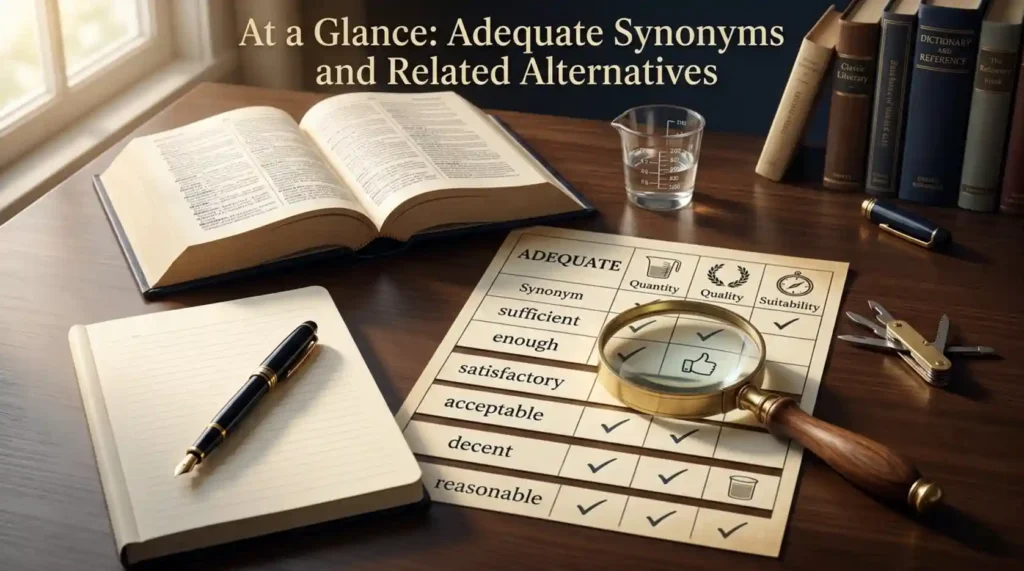
| Alternative | Part of Speech | Meaning | Register / Tone | Ideal Context |
| Sufficient | Adjective | Enough for a need | Neutral to formal | Amounts, resources, evidence |
| Enough | Adjective / adverb | As much as needed | Neutral, everyday | Daily speech and writing |
| Satisfactory | Adjective | Meeting expected standards | Neutral to formal | Grades, reports, performance |
| Acceptable | Adjective | Good enough to be approved | Neutral | Quality, behavior, offers |
| Decent | Adjective | Of a fairly good standard | Informal to neutral | Everyday quality |
| Reasonable | Adjective | Fair and fairly good | Neutral | Prices, quality, explanations |
| Passable | Adjective | Just good enough | Neutral, slightly weak | Skills, food, work |
| Suitable | Adjective | Right for a purpose | Neutral | Tools, candidates, places |
| Serviceable | Adjective | Useful and able to do the job | Neutral to formal | Objects, equipment |
| Ample | Adjective | More than enough | Neutral to formal | Time, space, supplies |
Which Word Should You Use?
| If you want to… | Use | Why |
| Say there is enough of something | sufficient | It focuses on quantity. |
| Keep it simple in conversation | enough | It is the most common everyday word. |
| Say something meets a standard | satisfactory | It suggests the standard was checked and met. |
| Say there is more than enough | ample | It adds the idea of a comfortable surplus. |
| Praise something mildly | decent | It sounds friendly and relaxed. |
| Say something barely works | passable | It hints that the quality is low. |
| Say something is right for a job | suitable | It focuses on fit, not amount. |
| Describe a legal or technical requirement | requisite | It sounds formal and exact. |
Exploring the Multiple Meanings of “Adequate”
1. Enough in Amount
- Meaning: Enough to meet a need.
- Explanation: Here the word is about quantity, not quality. Sufficient and enough are the closest matches.
- Example: The camp had adequate water for all the hikers.
2. Good Enough in Quality
- Meaning: Of a standard that is acceptable.
- Explanation: This sense is about quality. Something can be adequate without being excellent. Satisfactory and acceptable work well here.
- Example: The hotel room was adequate, clean and quiet, but plain.
3. Only Just Good Enough
- Meaning: Barely meeting the minimum.
- Explanation: In a review or a comparison, adequate can sound like faint praise. Context and tone decide If it feels positive or negative. Passable and middling carry a similar feeling.
- Example: His singing was adequate, but nobody remembered it.
4. Suitable or Equal to a Task
- Meaning: Able to do what is needed.
- Explanation: Here the word often follows “for” or “to.” Suitable, capable, and serviceable are close in this sense.
- Example: The old laptop is adequate for simple writing jobs.
5. Legally or Formally Sufficient
- Meaning: Meeting a rule, requirement, or official standard.
- Explanation: In legal, medical, and school settings, adequate often means “meets the required standard.” Requisite and sufficient are the nearest formal alternatives.
- Example: The tenant said the landlord had not given adequate notice.
Sources: Merriam-Webster; Collins English Dictionary; Dictionary.com.
Analyzing 30 Adequate Alternatives in Detail
Some alternatives below are close synonyms, while others are related words that fit only certain contexts, and each Usage note says which is which.
Group 1: Enough in Amount
1. Sufficient
IPA: /səˈfɪʃənt/ (US and UK)
Definition: Enough to meet a need or purpose.
- Usage: A direct synonym for adequate in the “enough in amount” sense. It is neutral to formal and common in reports and instructions.
- Example: Two hours is sufficient time to finish the test.
2. Enough
IPA: /ɪˈnʌf/ (US and UK)
Definition: As much as is needed.
- Usage: The simplest everyday synonym for the quantity sense. It is less formal than sufficient and rarely carries the lukewarm tone adequate can have.
- Example: We have enough chairs for everyone.
3. Ample
IPA: /ˈæmpəl/ (US and UK)
Definition: More than enough; plenty.
- Usage: A related alternative, not an exact synonym. Adequate means enough, while ample means comfortably more than enough.
- Example: The room has ample space for a desk and a bookshelf.
4. Plentiful
IPA: /ˈplɛntɪfəl/ (US and UK)
Definition: Existing in large amounts.
- Usage: A related alternative. It describes supply, not If something meets a standard, and it suggests more than adequate.
- Example: Fresh fruit is plentiful in summer.
5. Abundant
IPA: /əˈbʌndənt/ (US and UK)
Definition: Present in very large amounts.
- Usage: A related alternative that goes well beyond adequate. Use it when there is clearly a lot of something, and not when you mean “just enough.”
- Example: The valley has abundant rainfall.
Group 2: Good Enough in Quality
6. Satisfactory
IPA: /ˌsætɪsˈfæktəri/ (US and UK)
Definition: Good enough to meet a need or standard.
- Usage: A close synonym for the quality sense. It is neutral to formal and common in grading and performance reviews.
- Example: Her work was satisfactory, and she passed the course.
7. Acceptable
IPA: /əkˈsɛptəbəl/ (US and UK)
Definition: Good enough to be allowed or approved.
- Usage: A close synonym. It stresses that something can be approved, not that it is good.
- Example: The quality of the print was acceptable for a draft.
8. Passable
IPA: US /ˈpæsəbəl/ · UK /ˈpɑːsəbəl/
Definition: Good enough to pass, but not very good.
- Usage: A close synonym with a weaker tone than adequate. It often suggests low standards.
- Example: He speaks passable French after one year of study.
9. Tolerable
IPA: US /ˈtɑːlərəbəl/ · UK /ˈtɒlərəbəl/
Definition: Fairly good, or able to be put up with.
- Usage: A related alternative. It often means “not bad, but not pleasant,” so it is more negative than adequate.
- Example: The food was tolerable, but we would not go back.
10. Decent
IPA: /ˈdiːsənt/ (US and UK)
Definition: Of a fairly good standard.
- Usage: A friendly, informal alternative. It is usually warmer than adequate. Note that decent can also mean “modest and proper,” which is a different sense.
- Example: We found a decent hotel near the station.
11. Reasonable
IPA: /ˈriːzənəbəl/ (US and UK)
Definition: Fairly good; fair in amount or standard.
- Usage: A close alternative in neutral contexts. It is common with price, quality, and explanations. It also has other meanings, such as “sensible.”
- Example: The restaurant offers reasonable food at a fair price.
12. Fair
IPA: US /fɛr/ · UK /feə/
Definition: Moderately good.
- Usage: A related alternative. This sense is a little old-fashioned and mild. Do not confuse it with fair meaning “just.”
- Example: Her chances of winning are fair.
13. Respectable
IPA: /rɪˈspɛktəbəl/ (US and UK)
Definition: Fairly good in size, amount, or quality.
- Usage: A related alternative. It sounds more positive than adequate and suggests the result is better than you might expect.
- Example: The team finished with a respectable score.
Group 3: Barely Good Enough
14. Middling
IPA: /ˈmɪdlɪŋ/ (US and UK)
Definition: Of average or moderate quality.
- Usage: A related alternative. It is a little informal and old-fashioned, and it suggests nothing special.
- Example: The film got middling reviews.
15. Mediocre
IPA: US /ˌmiːdiˈoʊkər/ · UK /ˌmiːdiˈəʊkə/
Definition: Not very good; of only average quality.
- Usage: A related alternative that is clearly negative. Adequate can be neutral, but mediocre usually criticizes.
- Example: The service was mediocre, so we left early.
16. So-so
IPA: US /ˈsoʊˈsoʊ/ · UK /ˌsəʊ ˈsəʊ/
Definition: Neither good nor bad.
- Usage: An informal, spoken alternative. It is useful for casual opinions.
- Example: “How was the concert?” “So-so.”
17. Unremarkable
IPA: US /ˌʌnrɪˈmɑːrkəbəl/ · UK /ˌʌnrɪˈmɑːkəbəl/
Definition: Not special or interesting.
- Usage: A related alternative. It does not say If something is good enough, only that it does not stand out.
- Example: The meal was unremarkable but filling.
18. Ordinary
IPA: US /ˈɔːrdəneri/ · UK /ˈɔːdənri/
Definition: Normal; not unusual or special.
- Usage: A related alternative. It describes typical quality and does not directly mean “enough.”
- Example: It was an ordinary hotel, neither bad nor memorable.
Group 4: Works for the Job
19. Serviceable
IPA: US /ˈsɜːrvɪsəbəl/ · UK /ˈsɜːvɪsəbəl/
Definition: Useful and able to do its job, though not fancy.
- Usage: A close alternative for objects and equipment. It suggests function over beauty.
- Example: The coat was old but still serviceable.
20. Workable
IPA: US /ˈwɜːrkəbəl/ · UK /ˈwɜːkəbəl/
Definition: Able to be used or carried out successfully.
- Usage: A related alternative for plans, ideas, and systems. It means “it can work,” not “it is good.”
- Example: The team agreed on a workable schedule.
21. Sound
IPA: /saʊnd/ (US and UK)
Definition: In good condition; reliable.
- Usage: A related alternative. It suggests something is solid and free of faults, which is stronger than adequate.
- Example: The bridge is structurally sound.
22. Competent
IPA: US /ˈkɑːmpətənt/ · UK /ˈkɒmpɪtənt/
Definition: Having enough skill to do something well.
- Usage: A related alternative used for people. It works like adequate for ability, though it is usually more positive.
- Example: She is a competent driver.
23. Capable
IPA: /ˈkeɪpəbəl/ (US and UK)
Definition: Having the ability to do something.
- Usage: A related alternative for people and things. It stresses ability and does not suggest a minimum standard.
- Example: The small engine is capable of pulling the trailer.
Group 5: Suitable for a Purpose
24. Suitable
IPA: US /ˈsuːtəbəl/ · UK /ˈsuːtəbəl/ or /ˈsjuːtəbəl/
Definition: Right or appropriate for a purpose.
- Usage: A close synonym for the “fit for the job” sense. It is about match, not amount.
- Example: This tent is suitable for light rain.
25. Appropriate
IPA: US /əˈproʊpriət/ · UK /əˈprəʊpriət/
Definition: Right for a particular situation.
- Usage: A related alternative. It points to what is fitting or correct, not quantity.
- Example: Please wear appropriate shoes for the trip.
26. Fitting
IPA: /ˈfɪtɪŋ/ (US and UK)
Definition: Right and proper for the occasion.
- Usage: A related alternative with a slightly formal tone. It is often used for something that suits a moment.
- Example: A quiet ending was a fitting end to the day.
27. Fit
IPA: /fɪt/ (US and UK)
Definition: Suitable or good enough for a purpose.
- Usage: A related alternative, usually followed by “for.” It is common in phrases like “fit for use.”
- Example: The water is fit for drinking.
Group 6: Formal and Precise Alternatives
28. Requisite
IPA: /ˈrɛkwəzɪt/ (US and UK)
Definition: Required for a purpose.
- Usage: A formal alternative. It means “needed,” which fits the legal or technical sense of adequate.
- Example: She had the requisite skills for the job.
29. Commensurate
IPA: US /kəˈmɛnsərət/ · UK /kəˈmenʃərət/
Definition: Matching in size, amount, or degree.
- Usage: A related formal alternative. It means adequate in relation to something else, such as pay that fits the work.
- Example: The salary is commensurate with experience.
30. Proportionate
IPA: US /prəˈpɔːrʃənət/ · UK /prəˈpɔːʃənət/
Definition: In the right proportion to something else.
- Usage: A related formal alternative, common in legal and policy writing. It is not a general synonym.
- Example: The punishment should be proportionate to the offense.
Sources: Merriam-Webster; Collins English Dictionary and Collins Thesaurus; Dictionary.com.
Adequate vs. Sufficient vs. Satisfactory vs. Enough
These four words overlap but are not identical.
| Word | Main Focus | Typical Tone | Example |
| Adequate | Meeting a need or minimum | Neutral, can sound lukewarm | The lighting is adequate for reading. |
| Sufficient | Quantity | Neutral to formal | We have sufficient funds. |
| Satisfactory | Meeting a standard | Neutral to formal | Her results were satisfactory. |
| Enough | Quantity, everyday | Casual | There is enough food. |
Adequate is the most flexible of the four. It can describe quantity or quality, but it is the one most likely to sound lukewarm.
Sources: Merriam-Webster; Collins English Dictionary.
Adequate and Opposite/Paired Word Pairs
| Word | Paired Word | Note |
| Adequate | Inadequate | The direct opposite, formed with the prefix in-. |
| Sufficient | Insufficient | The opposite for quantity. |
| Satisfactory | Unsatisfactory | The opposite for quality standards. |
| Adequate | Deficient | A formal opposite meaning lacking something needed. |
| Adequate | Excellent | A contrast of level, not a true opposite. |
| Adequate | Excessive | A contrast of amount, meaning more than needed. |
True opposites of adequate mean “not enough” or “not good enough.” Words like excellent or excessive show a contrast of degree, since they mean much better or much more than needed.
Sources: Merriam-Webster; Collins Thesaurus.
Common Word Partners of “Adequate”
| Pattern | Common Partners | Example |
| adequate + noun | supply, housing, funding, nutrition, sleep, training | Many families lack adequate housing. |
| adequate + for | adequate for the job, purpose, needs | The tool is adequate for this task. |
| adequate + to | adequate to the task, to the demand | His skills were adequate to the task. |
| adverb + adequate | barely, more than, perfectly, hardly, quite | The speech was barely adequate. |
| adequately + verb | explain, prepare, protect, cover | She did not adequately prepare for the exam. |
Sources: Collins English Dictionary; Merriam-Webster.
Idiomatic Phrases Featuring “Adequate”
Adequate has few true idioms. The items below are established expressions, not idioms in the strict sense.
1. More than adequate
- Meaning: Better or larger than what is needed.
- Example: The portions were more than adequate for two people.
2. Barely adequate
- Meaning: Only just good enough or just enough.
- Example: The supplies were barely adequate for the trip.
3. Adequate to the task
- Meaning: Able to do the job that is required.
- Example: The new software proved adequate to the task.
4. Adequate yearly progress
- Meaning: A term used in US school policy, tied to the No Child Left Behind Act, for the yearly progress schools had to show.
- Example: The school did not meet adequate yearly progress that year.
Sources: Merriam-Webster; Collins English Dictionary; US Department of Education.
Word Formation of “Adequate”
Etymology & Structure
Adequate comes from Latin adaequatus, the past participle of adaequare, “to make equal.” That verb combines ad- (“to”) with aequare (“to make level or equal”), from aequus (“equal”). The original idea was “equal to a need.”
Date and History
Dictionaries place the first English use in the early 17th century. The early sense was “equal to the requirement,” and the word gradually took on its modern “enough” and “good enough” meanings.
Word Class Variations
- Adjective: adequate
- Adverb: adequately
- Noun: adequacy, adequateness (rare)
- Opposite forms: inadequate, inadequately, inadequacy
Sources: Etymonline; Merriam-Webster; Collins English Dictionary.
Common Word-Choice Mistakes
- Using “adequate” as high praise: choose excellent or outstanding when you mean very good.
- “Adequate of money”: say “an adequate amount of money” or “adequate funds.”
- Using “ample” to mean just enough: ample means more than enough.
- “Adequate with the job”: say “adequate for the job” or “adequate to the job.”
- Using “tolerable” as a compliment: it often suggests something is only bearable.
- Using “decent” when you need a formal tone: sufficient or satisfactory is better in reports.
- Using “proportionate” for plain quantity: use sufficient or enough instead.
Frequently Asked Questions
What is the closest synonym for adequate?
Sufficient is closest for amount, and satisfactory is closest for quality.
What is a simple everyday alternative?
Enough works in most casual sentences, and decent works for quality.
What is the difference between adequate and sufficient?
Sufficient focuses on amount. Adequate can describe amount, quality, or fit.
Is adequate a positive word?
It is neutral, but it can sound lukewarm. “Adequate” often means “good enough, not great.”
What is a formal alternative to adequate?
Requisite, sufficient, and satisfactory are all formal.
What is a more positive alternative?
Respectable, decent, and sound sound warmer.
What is a more negative alternative?
Mediocre, tolerable, and passable sound weaker.
What is the opposite of adequate?
Inadequate is the direct opposite. Insufficient and deficient also work.
Can adequate describe people?
Yes, but usually for skill or performance, as in “an adequate teacher.” Competent is often clearer.
Is adequate the same as average?
No. Adequate means “good enough for a need,” while average means “typical.”
Conclusion
The closest alternatives to adequate are sufficient for amount and satisfactory or acceptable for quality. Everyday choices include enough, decent, and reasonable.
Context matters because adequate covers several meanings. It can mean enough, good enough, or suitable, and it can sound lukewarm or even negative. Words like ample, mediocre, and proportionate shift the meaning in different directions.
To choose the right word, first decide If you mean quantity, quality, or fit. Then think about tone: use decent or respectable for warmth, passable or mediocre for criticism, and requisite or commensurate for formal writing.