

Another Word for Snow: 30 Synonyms With Examples
The closest everyday alternatives to “snow” are snowfall, flurry, snowflake, and powder. English has no single perfect synonym for “snow” as a substance, so the best choice depends on what you mean. It could be falling snow, snow lying on the ground, snow in a storm, or snow of a certain texture.
The word also has a few informal meanings. As a verb, it can mean to fall as snow, or, in casual speech, to fool someone with smooth talk. For a weather report, a ski trip, or a story, the right word will differ each time.
Quick list: snowfall, flurry, snowflake, snowstorm, blizzard, powder, slush, snowdrift, snowpack, white stuff
This article looks at 30 alternatives with meanings, IPA, usage notes, examples, and context. Some are close synonyms and others are related terms, and each entry says which.
At a Glance: Snow Synonyms and Related Alternatives
| Alternative | Part of Speech | Meaning | Register / Tone | Ideal Context |
| Snowfall | noun | snow falling, or the amount that falls | Neutral | Weather reports |
| Flurry | noun | a brief, light fall of snow | Neutral | Forecasts, everyday talk |
| Snowflake | noun | one ice crystal of snow | Neutral | Science, description |
| Snowstorm | noun | a storm with heavy snow | Neutral | News, weather |
| Blizzard | noun | a severe storm with strong wind and snow | Neutral, strong | Severe weather |
| Powder | noun | light, dry, loose snow | Informal, skiing | Skiing, snowboarding |
| Slush | noun | partly melted snow | Informal | Streets, thaw |
| Snowdrift | noun | snow piled up by wind | Neutral | Roads, doorways |
| Snowpack | noun | snow that builds up over a season | Technical | Water supply, mountains |
| White stuff | noun | casual name for snow | Informal | Chat, humor |
Which Word Should You Use?
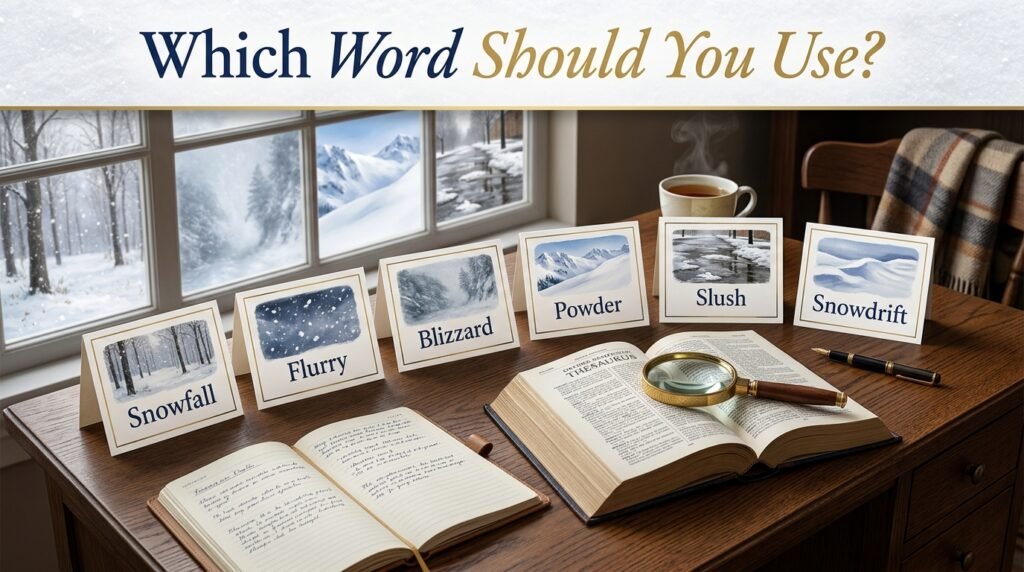
| If you want to… | Use | Why |
| Describe snow falling now | snowfall | It names the act or event of snow falling. |
| Describe a light, short fall | flurry | It suggests a few light flakes. |
| Describe a dangerous storm | blizzard | It implies strong wind and low visibility. |
| Talk about a skier’s favorite snow | powder | It means light, loose, dry snow. |
| Talk about snow turning to water | slush | It means snow that is half melted. |
| Talk about snow piled against things | snowdrift | Wind builds it into a heap. |
| Talk about seasonal mountain snow | snowpack | It is the standard term for water-supply discussions. |
| Sound casual or playful | white stuff | It is informal and light-hearted. |
Exploring the Multiple Meanings of “Snow”
1. Frozen Precipitation
- Meaning: Small white ice crystals that fall from the sky in cold weather.
- Explanation: This is the main meaning. Most synonyms and related words connect to this sense.
- Example: Snow began to fall after lunch.
2. Snow on the Ground
- Meaning: The layer of fallen snow that covers a surface.
- Explanation: Here “snow” means what has already landed, not the falling. Words like snow cover, snowpack, and snowbank fit this sense.
- Example: The snow on the roof was almost a foot deep.
3. To Fall as Snow (Verb)
- Meaning: To fall from the sky as snow.
- Explanation: It is usually used with “it,” as in “it snows.” There is no direct one-word verb synonym, but “flurry” can work in some cases.
- Example: It snowed all night in the mountains.
4. To Deceive Someone (Informal Verb)
- Meaning: To mislead or win over someone with insincere, smooth talk.
- Explanation: This is a figurative US sense. It is closely linked to the phrase “snow job.”
- Example: The salesman tried to snow us with big promises.
5. Visual Static on a Screen
- Meaning: The random white specks on a TV or screen with a weak signal.
- Explanation: This is a specialized sense that is less common today than it once was.
- Example: The old TV showed only snow after the storm.
Sources: Merriam-Webster; Collins English Dictionary; Dictionary.com
Analyzing 30 Snow Alternatives in Detail
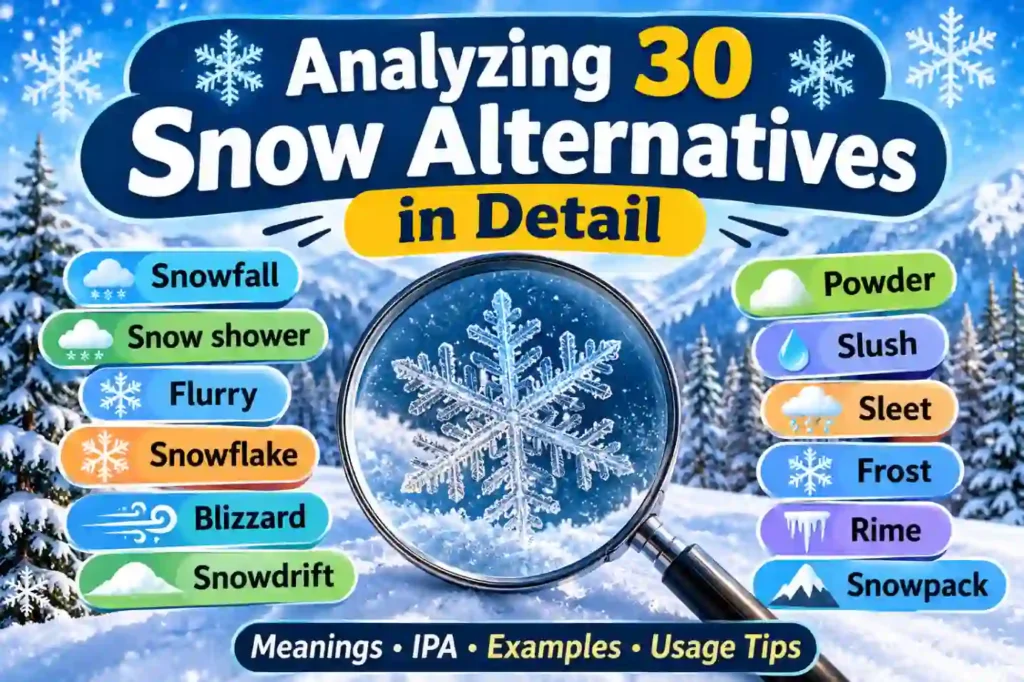
Some of these words are close synonyms, but many are related alternatives that fit only one kind of snow or one situation.
Group 1: Falling Snow Terms
1. Snowfall
IPA: US /ˈsnoʊˌfɔːl/ · UK /ˈsnəʊfɔːl/
Definition: A fall of snow, or the amount of snow that falls in a given time.
- Usage: A close, neutral synonym for snow as an event. It is common in weather and news writing.
- Example: Heavy snowfall closed the highway.
2. Snow shower
IPA: US /snoʊ ˈʃaʊər/ · UK /snəʊ ˈʃaʊə/
Definition: A short period of snow that starts and stops.
- Usage: A related term. It describes brief, scattered snow rather than steady snow.
- Example: Expect a few snow showers this afternoon.
3. Flurry
IPA: US /ˈflɝːi/ · UK /ˈflʌri/
Definition: A light, brief fall of snow, often with swirling flakes.
- Usage: Used for small amounts. It usually suggests light snow, not a storm.
- Example: A flurry of snow dusted the streets.
4. Snowflake
IPA: US /ˈsnoʊfleɪk/ · UK /ˈsnəʊfleɪk/
Definition: A single piece of snow, made of ice crystals.
- Usage: Refers to one unit of snow, not snow in general. Use it when you picture individual crystals.
- Example: A snowflake landed on her sleeve.
5. Flake
IPA: /fleɪk/ (US and UK)
Definition: A small, thin piece of something. In weather, a piece of snow.
- Usage: A shorter, more casual form of snowflake. It often appears in the plural.
- Example: Big flakes drifted past the window.
Group 2: Snowstorms and Severe Weather
6. Snowstorm
IPA: US /ˈsnoʊˌstɔːrm/ · UK /ˈsnəʊstɔːm/
Definition: A storm with a heavy fall of snow.
- Usage: A related term for stormy snow. It is stronger than “snowfall” but less extreme than “blizzard.”
- Example: A snowstorm kept everyone home.
7. Blizzard
IPA: US /ˈblɪzərd/ · UK /ˈblɪzəd/
Definition: A severe snowstorm with strong winds and very low visibility.
- Usage: A related term, not a plain synonym. Use it only when wind and poor visibility are part of the situation.
- Example: The blizzard lasted two days.
8. Whiteout
IPA: /ˈwaɪtaʊt/ (US and UK)
Definition: A condition in which snow or cloud makes it hard to see anything.
- Usage: Describes what snow does to visibility. It is not a word for the snow itself.
- Example: Drivers were stuck in a whiteout.
9. Snow squall
IPA: US /snoʊ skwɔːl/ · UK /snəʊ skwɔːl/
Definition: A short, sudden burst of heavy snow with strong wind.
- Usage: A related weather term. It is more sudden and shorter than a snowstorm.
- Example: A snow squall hit the road without warning.
Group 3: Snow on the Ground
10. Snow cover
IPA: US /ˈsnoʊ ˌkʌvər/ · UK /ˈsnəʊ ˌkʌvə/
Definition: The layer of snow lying on the ground.
- Usage: A fairly formal synonym for snow lying on land. It is common in science and weather reports.
- Example: Snow cover remained until April.
11. Snowpack
IPA: US /ˈsnoʊˌpæk/ · UK /ˈsnəʊpæk/
Definition: Snow that builds up in layers over a season, especially in mountains.
- Usage: A technical related term. It is used for snow that later melts into water supplies.
- Example: The snowpack is deep this winter.
12. Snowdrift
IPA: US /ˈsnoʊdrɪft/ · UK /ˈsnəʊdrɪft/
Definition: A pile of snow heaped up by the wind.
- Usage: A related term. It names a heap of snow, not snow in general.
- Example: A snowdrift blocked the front door.
13. Drift
IPA: /drɪft/ (US and UK)
Definition: A heap of snow or sand blown together by the wind.
- Usage: A short form of snowdrift. It needs context, because “drift” has other meanings.
- Example: They dug through a six-foot drift.
14. Snowbank
IPA: US /ˈsnoʊbæŋk/ · UK /ˈsnəʊbæŋk/
Definition: A raised mass of snow, often piled along a road or path.
- Usage: A related term, often for snow pushed aside by a plow or shovel.
- Example: The car slid into a snowbank.
15. Snowfield
IPA: US /ˈsnoʊfiːld/ · UK /ˈsnəʊfiːld/
Definition: A large area of snow, especially one that lasts through summer on a mountain.
- Usage: A related term for wide, open snow. It is common in mountain and travel writing.
- Example: The climbers crossed a vast snowfield.
Group 4: Snow by Texture and Condition
16. Powder
IPA: US /ˈpaʊdər/ · UK /ˈpaʊdə/
Definition: Light, dry, loose snow, especially good for skiing.
- Usage: A related term for a type of snow. It is informal and used in skiing and snowboarding.
- Example: Skiers waited all week for fresh powder.
17. Slush
IPA: /slʌʃ/ (US and UK)
Definition: Snow that is partly melted and wet.
- Usage: A related term for melting snow, not for fresh snowfall.
- Example: The streets were full of gray slush.
18. Crust
IPA: /krʌst/ (US and UK)
Definition: A hard layer on the surface of something. On snow, a firm icy top layer.
- Usage: A related, specific term used mainly by skiers and hikers. It describes the surface, not snow in general.
- Example: We broke through the crust with every step.
19. Firn
IPA: US /fɪrn/ · UK /fɜːn/
Definition: Old, granular snow that has partly turned to ice, especially on glaciers.
- Usage: A technical related term. It is not a casual synonym.
- Example: The glacier is covered with firn at the top.
20. Névé
IPA: /neɪˈveɪ/ (US and UK)
Definition: Granular snow at the upper end of a glacier, not yet changed into glacier ice.
- Usage: A rare, specialized related term. It is closely linked to firn and used in glaciology.
- Example: The névé feeds the glacier below.
Group 5: Related Winter Precipitation and Ice
21. Sleet
IPA: /sliːt/ (US and UK)
Definition: Frozen or partly frozen rain. In the US, small pellets of ice. In the UK, a mix of rain and snow.
- Usage: Not a synonym. Use it for icy rain or mixed precipitation, and note that its meaning differs between the US and UK.
- Example: Sleet tapped against the glass.
22. Hail
IPA: /heɪl/ (US and UK)
Definition: Balls of ice that fall from storm clouds.
- Usage: Not a synonym. Hail is solid ice and usually falls in thunderstorms, not in cold-season snow.
- Example: Hail damaged the car’s roof.
23. Graupel
IPA: /ˈɡraʊpəl/ (US and UK)
Definition: Soft, small pellets of snow that have collected frozen water droplets.
- Usage: A related weather term, also called snow pellets. It is not the same as ordinary snow.
- Example: Graupel bounced off the ground.
24. Frost
IPA: US /frɔːst/ · UK /frɒst/
Definition: A thin coating of ice crystals that forms on surfaces in freezing weather.
- Usage: Not a synonym. Frost forms on surfaces and does not fall from the sky.
- Example: Frost covered the grass this morning.
25. Rime
IPA: /raɪm/ (US and UK)
Definition: A white coating of ice formed when tiny water droplets freeze on a surface.
- Usage: A related, rarer word. It is used in weather and mountain contexts and is not a word for snow.
- Example: Rime coated the branches.
Group 6: Informal, Specialized and Figurative Alternatives
26. White stuff
IPA: /ˌwaɪt ˈstʌf/ (US and UK)
Definition: An informal, humorous name for snow.
- Usage: Casual and often playful. It is not used in formal writing.
- Example: Kids ran outside to play in the white stuff.
27. Wintry mix
IPA: /ˈwɪntri mɪks/ (US and UK)
Definition: A weather term for a combination of snow, sleet, and freezing rain.
- Usage: A related term used in forecasts. It means mixed precipitation, not snow alone.
- Example: A wintry mix is expected overnight.
28. Static
IPA: /ˈstætɪk/ (US and UK)
Definition: Random noise on a screen, shown as flickering dots.
- Usage: A related term for the screen sense of “snow” only. It does not refer to winter weather.
- Example: The picture dissolved into static.
29. Hoodwink
IPA: /ˈhʊdwɪŋk/ (US and UK)
Definition: To trick or deceive someone.
- Usage: A related alternative for the informal verb “snow.” It does not suggest anything about weather.
- Example: The seller tried to hoodwink buyers.
30. Bamboozle
IPA: /bæmˈbuːzəl/ (US and UK)
Definition: To trick or confuse someone, often with clever talk.
- Usage: A playful related alternative for the informal verb “snow.”
- Example: Don’t let him bamboozle you.
Sources: Merriam-Webster; Collins English Dictionary; Dictionary.com; National Weather Service glossary; National Snow and Ice Data Center
Snow vs. Sleet vs. Hail vs. Graupel
These words are often mixed up, but they describe different kinds of frozen precipitation.
| Word | What It Is | Where It Forms | Typical Feel |
| Snow | Ice crystals, often joined as flakes | Cold clouds | Soft, light |
| Sleet | Frozen or partly frozen rain | Falls through layers of air | Tiny, hard, or wet |
| Hail | Balls of solid ice | Strong storm clouds | Hard, can be large |
| Graupel | Soft pellets of snow coated with frozen droplets | Cold clouds | Crumbly, soft |
Note that the meaning of “sleet” differs between the US and UK, as explained in the entry above.
Sources: National Weather Service glossary; Merriam-Webster; Collins English Dictionary
Snow and Opposite/Paired Word Pairs
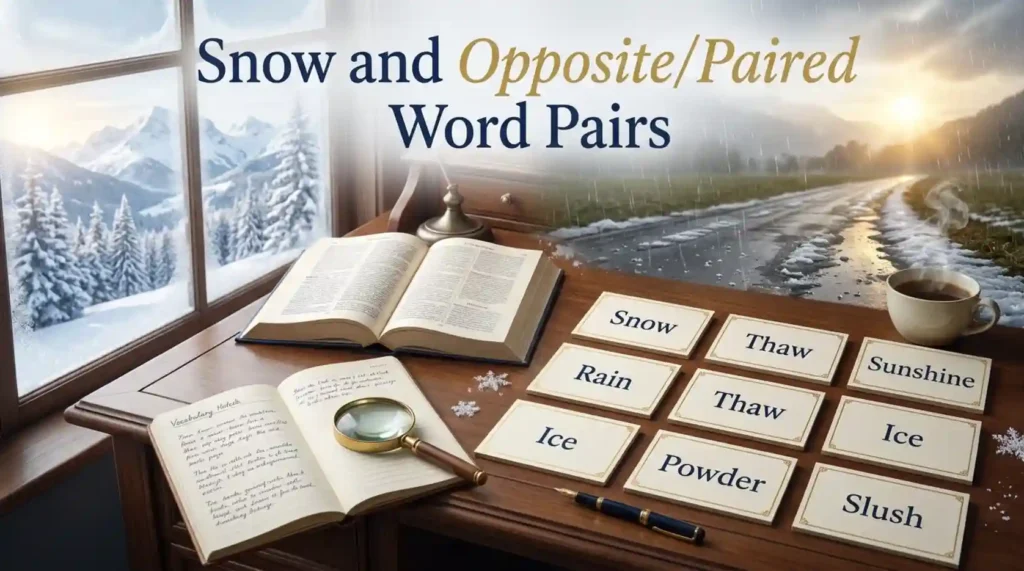
| Word | Paired Word | Note |
| Snow | rain | Both are precipitation. Temperature decides which falls. |
| Snow | thaw | Thaw is the melting of snow and ice. |
| Snow | sunshine | A common weather contrast. |
| Snow | ice | Often paired as “snow and ice.” |
| Powder | slush | Dry, fresh snow versus wet, melting snow. |
| Light snow | heavy snow | A common pair for describing amount. |
“Snow” has no true one-word opposite. Its natural contrasts are weather terms like rain and sunshine, or processes like melting and thawing. Most of these pairs are about weather conditions, not strict opposites.
Sources: Merriam-Webster; Collins English Dictionary
Common Word Partners of “Snow”
| Pattern | Common Partners | Example |
| adjective + snow | heavy, light, fresh, deep, wet, fluffy | Fresh snow covered the yard. |
| snow + verb | falls, melts, piles up | The snow melted by noon. |
| verb + snow | shovel, clear, plow | He shovels snow every winter. |
| snow + noun | day, tire, boot, plow | The school announced a snow day. |
| preposition + snow | in the snow, through the snow | They walked through the snow. |
| snowed + particle | in, under | We were snowed in for three days. |
Sources: Collins English Dictionary; Merriam-Webster
Idiomatic Phrases Featuring “Snow”
1. Snowed under
- Meaning: Overwhelmed by too much work or too many tasks.
- Example: I’m snowed under with emails this week.
2. Snow job
- Meaning: An attempt to mislead or win someone over with smooth, insincere talk. It is mostly American.
- Example: His long explanation was just a snow job.
3. Pure as the driven snow
- Meaning: Completely innocent or pure. It is often used with a hint of irony.
- Example: He claims he is as pure as the driven snow.
4. A snowball’s chance in hell
- Meaning: Almost no chance at all of success.
- Example: We have a snowball’s chance in hell of finishing today.
Sources: Merriam-Webster; Collins English Dictionary; Dictionary.com
Word Formation of “Snow”
Etymology & Structure
“Snow” is a short, native English word. Dictionaries trace it to Old English snāw and to Proto-Germanic roots shared with German Schnee and Dutch sneeuw. It goes back further to an Indo-European root related to snowing. The word is a single base form.
Date and History
The word appears in Old English and has been part of English ever since, which makes it one of the oldest weather words in the language. The informal verb meaning “to deceive” is a much later American development.
Word Class Variations
- Noun: snow
- Verb: snow, snows, snowed, snowing
- Adjective: snowy
- Related compounds: snowfall, snowflake, snowman, snowball, snowstorm, snowdrift
Sources: Etymonline; Merriam-Webster; Collins English Dictionary
Common Word-Choice Mistakes
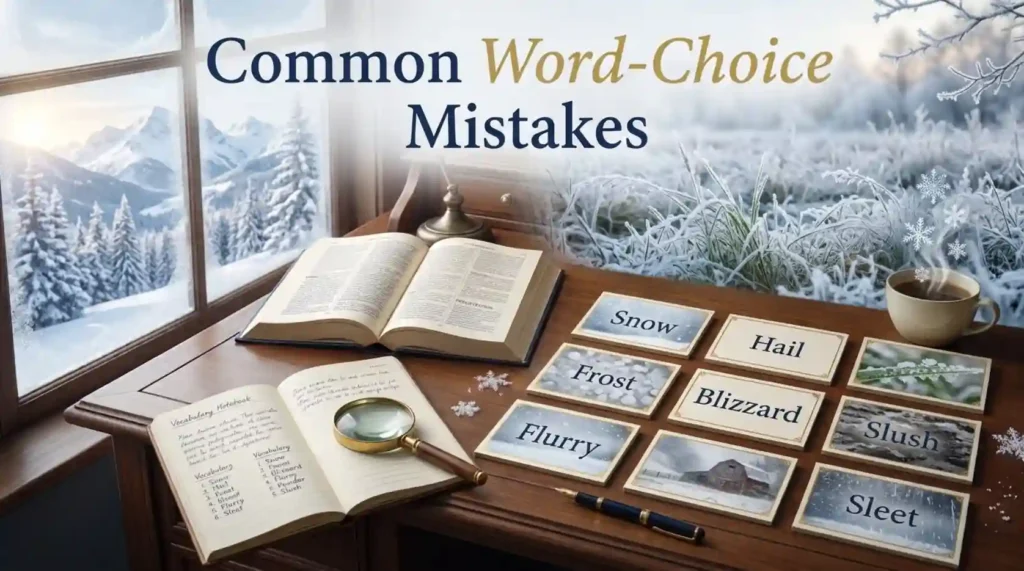
- Using “snow” for solid balls of ice: say “hail” instead.
- Using “frost” for snow falling from clouds: frost forms on surfaces, so use “snow” or “snowfall.”
- Using “blizzard” for any snowfall: use it only for severe snow with strong wind.
- Using “flurry” for heavy snow: use “snowstorm” or “heavy snowfall.”
- Using “slush” for fresh snow: slush is snow that is already melting.
- Using “snowflake” for snow on the ground: it names a single flake, so use “snow cover.”
- Using “sleet” and “snow” as the same thing: sleet is frozen or partly frozen rain.
Frequently Asked Questions
What is the closest synonym for snow?
“Snowfall” is the closest everyday match for snow as an event. For snow on the ground, “snow cover” is the nearest term.
What is another word for light snow?
“Flurry” or “snow shower” works. Both suggest brief, light snow.
What is another word for heavy snow?
“Snowstorm” and “heavy snowfall” fit. For extreme conditions with wind, use “blizzard.”
What is the difference between a blizzard and a snowstorm?
A snowstorm is any storm with a lot of snow. A blizzard also has strong wind and very low visibility.
What is the difference between sleet and snow?
Snow is made of ice crystals. Sleet is frozen or partly frozen rain, and its exact meaning differs between the US and UK.
What do skiers call good snow?
They call it “powder.” It means light, dry, loose snow.
What is a formal word for snow cover?
“Snow cover” or “snowpack” are the most formal and technical choices.
What is the opposite of snow?
There is no exact opposite. People often contrast it with rain, sunshine, or thaw.
Can “snow” be used for something other than weather?
Yes. Informally, it can mean to deceive someone, as in “snow job.” It can also mean the white specks on a screen.
Is hail the same as snow?
No. Hail is made of solid ice balls and usually comes from thunderstorms.
Conclusion
The closest everyday alternatives to “snow” are snowfall, flurry, snowflake, and powder. For storms, snowstorm and blizzard are common choices. Snow on the ground has its own terms, such as snow cover, snowpack, and snowdrift.
Context matters because “snow” can mean falling snow, snow on the ground, or snow of a certain texture. Words like sleet, hail, and frost are related, but they are not the same thing. Informal meanings, such as deceiving someone, need different words altogether.
To choose well, first decide what you are describing: the fall, the storm, the ground, or the texture. Then pick the word that matches that idea and the tone of your writing.