

Another Word for Sink: 30 Synonyms With Examples
“Everyday alternatives to ‘sink’ vary by context: use submerge, go under, or founder for objects going underwater; drop, descend, or subside for downward motion; decline, fall, or plummet for numbers and prices; and basin or washbasin for the fixture.”
“Sink” works as both a verb and a noun, and it has several separate senses. The best alternative depends on If you mean going under water, moving lower, losing value or spirit, pushing something into a surface, or a washing basin. These are the areas this article covers.
Quick list: submerge, founder, descend, drop, subside, plunge, decline, plummet, sag, basin
Below, 30 alternatives are explained with meanings, IPA, usage notes, examples, and context.
At a Glance: Sink Synonyms and Related Alternatives
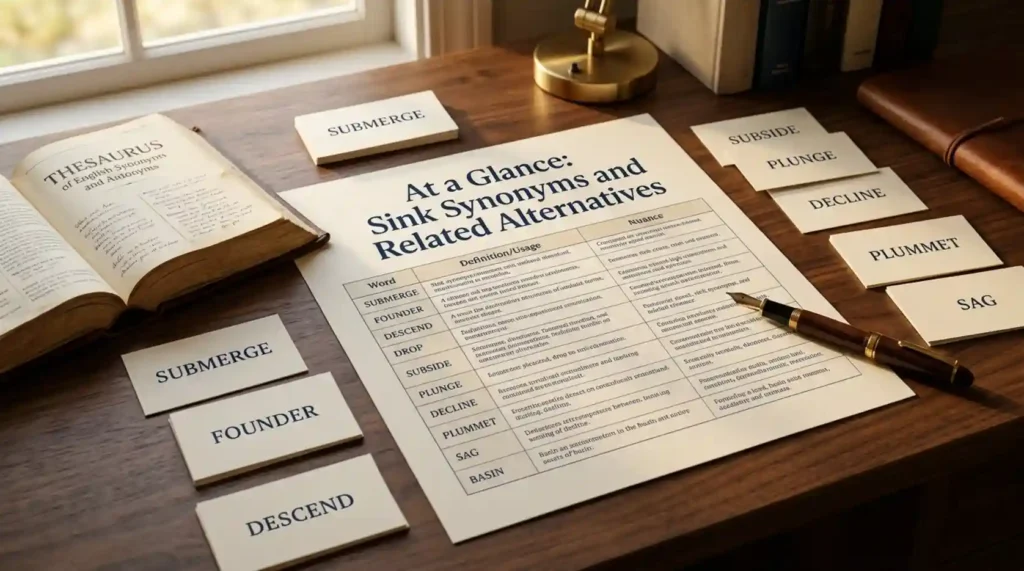
| Alternative | Part of Speech | Meaning | Register / Tone | Ideal Context |
| Submerge | Verb | To go or put under water | Neutral to formal | Objects, vehicles, or people going fully under water |
| Founder | Verb | (Of a ship) to fill with water and sink | Formal, somewhat literary | Ships, and plans that fail |
| Descend | Verb | To move from a higher to a lower place | Neutral to formal | Movement downward in general |
| Drop | Verb | To fall or go to a lower level | Neutral, everyday | Temperatures, voices, objects, levels |
| Subside | Verb | To sink to a lower level or become less intense | Neutral to formal | Floodwater, ground, pain, noise |
| Plunge | Verb | To fall or dive suddenly and steeply | Neutral, vivid | Sudden drops in prices, temperatures, or position |
| Decline | Verb | To become lower, weaker, or less | Neutral to formal | Numbers, health, quality |
| Plummet | Verb | To fall very quickly | Neutral, strong | Sharp drops in prices or morale |
| Sag | Verb | To sink or bend downward under weight | Neutral, everyday | Beds, roofs, shoulders, spirits |
| Basin | Noun | A bowl-shaped container for washing | Neutral | The kitchen or bathroom fixture |
Which Word Should You Use?
| If you want to… | Use | Why |
| Say a ship went under after taking in water | founder | It is the standard word for a ship filling with water and sinking |
| Say something is fully under water | submerge | It stresses being completely covered |
| Describe a slow, gentle lowering | subside | It suggests settling down gradually |
| Describe a sudden fall in price or temperature | plummet | It shows speed and force |
| Describe a gradual weakening in quality or numbers | decline | It suggests a steady downward trend |
| Describe something bending under weight | sag | It is used when a surface or structure dips in the middle |
| Say someone lowered their standards | stoop | It carries a sense of lowering oneself morally |
| Name the washing fixture in a kitchen or bathroom | basin or washbasin | Both are standard, neutral terms for the fixture |
Exploring the Multiple Meanings of “Sink”
1. Going Under a Surface
- Meaning: To go to the bottom of a liquid, or to become partly buried or covered.
- Explanation: This is the central sense of the verb. It is used for ships, stones, and people, and also for feet in mud or snow. The thing moves down into a substance and may stay there.
- Example: The boat sank in less than an hour.
2. Moving to a Lower Place or Level
- Meaning: To fall or drop to a lower position, level, or intensity.
- Explanation: This sense does not need water. A person can sink into a chair, the sun can sink below the horizon, and floodwater can sink after rain. The movement is downward and often slow.
- Example: She sank into the sofa and closed her eyes.
3. Becoming Less in Value, Amount, or Quality
- Meaning: To decrease, or to fall into a worse state.
- Explanation: Prices, profits, and health can all sink. The word suggests a fall that is usually unwelcome. It can also describe a drop in spirit, as in a heart that sinks when bad news arrives.
- Example: Share prices sank after the company reported weak sales.
4. Driving or Putting Something In
- Meaning: To push, dig, or place something deep into something else; to invest money; to score in some sports.
- Explanation: In this transitive sense, a person causes the sinking. People sink a well, sink their teeth into food, sink money into a project, or sink a putt in golf.
- Example: They sank all their savings into the restaurant.
5. A Washing Basin
- Meaning: A fixed basin with a drain and usually a water supply, used for washing dishes, hands, or clothes.
- Explanation: This is the most common noun sense today. It is also the meaning most people have in mind when they type the word on its own.
- Example: Please put the dirty plates in the sink.
6. A Drain, Pit, or Place Where Something Collects
- Meaning: A pool or pit for waste, or in science, a place where something such as carbon or heat is absorbed or removed.
- Explanation: The older meaning is a cesspool or sewer. In science, a “carbon sink” absorbs more carbon than it releases, and a “heat sink” draws heat away from a part.
- Example: Forests act as a sink for carbon dioxide.
Sources: Merriam-Webster; Dictionary.com; Etymonline.
Analyzing 30 Sink Alternatives in Detail
Some of the words below are close synonyms of “sink,” while others are related alternatives that fit only one sense or context, and each entry says which it is.
Group 1: Going Under Water
1. Submerge
IPA: US /səbˈmɝːdʒ/ · UK /səbˈmɜːdʒ/
Definition: To go or put under the surface of water or another liquid.
- Usage: This is a close synonym for the “go under water” sense. It can be intransitive (a submarine submerges) or transitive (she submerged the cloth). It is a little more formal than “sink” and focuses on being covered rather than on moving downward.
- Example: The diver submerged slowly and checked her gauge.
2. Go under
IPA: /ɡoʊ ˈʌndɚ/ US · /ɡəʊ ˈʌndə/ UK
Definition: To sink below the surface; also, to fail, as a business.
- Usage: This is an informal phrasal alternative to “sink.” It works for ships and swimmers, and for failing companies. It is a related alternative for the figurative sense rather than an exact match.
- Example: The little boat went under in the storm.
3. Founder
IPA: US /ˈfaʊndɚ/ · UK /ˈfaʊndə/
Definition: (Of a ship) to fill with water and sink; (of a plan) to fail.
- Usage: This is a close synonym when the subject is a ship. It sounds formal and is more common in writing. In the figurative sense it means “fail,” so it is not a match for every use of “sink.”
- Example: The old trawler foundered in heavy seas off the coast.
4. Capsize
IPA: US /ˈkæpsaɪz/ · UK /kæpˈsaɪz/
Definition: To turn over in the water.
- Usage: This is only a related alternative. A boat that capsizes turns upside down, and it may or may not sink afterward. Use it when the key event is overturning.
- Example: The small sailboat capsized in a sudden gust of wind.
5. Scuttle
IPA: /ˈskʌtl/ (US and UK)
Definition: To sink a ship on purpose, often by making holes in it.
- Usage: This is a transitive alternative for deliberate sinking. It is not a synonym for accidental sinking. It also has a figurative meaning, to ruin a plan, which is a separate sense.
- Example: The crew scuttled the ship so the enemy could not use it.
6. Immerse
IPA: US /ɪˈmɝːs/ · UK /ɪˈmɜːs/
Definition: To put something completely under a liquid.
- Usage: This is a related transitive alternative. It describes the act of putting something under, not the act of sinking. It is more likely to be used about food, hands, or objects than ships.
- Example: Immerse the vegetables in cold water for ten minutes.
Group 2: Moving Downward
7. Descend
IPA: /dɪˈsend/ (US and UK)
Definition: To move from a higher place or level to a lower one.
- Usage: This is a neutral, slightly formal alternative for general downward movement. It does not suggest going under a liquid, so it fits the “move to a lower place” sense but not the “go under water” sense.
- Example: The plane began to descend toward the airport.
8. Drop
IPA: US /drɑːp/ · UK /drɒp/
Definition: To fall or go to a lower level or place.
- Usage: This is one of the most common everyday alternatives. It works for temperatures, voices, prices, and objects. It is less specific than “sink” and does not suggest a slow or gradual movement.
- Example: The temperature dropped sharply after sunset.
9. Subside
IPA: /səbˈsaɪd/ (US and UK)
Definition: To sink to a lower level, or to become less strong.
- Usage: This is a close synonym for water, ground, or feelings that settle down. It suggests a gentle, natural lowering. It is more formal than “drop.”
- Example: The floodwater slowly subsided over the weekend.
10. Settle
IPA: /ˈsetl/ (US and UK)
Definition: To sink gradually to a lower position and stay there.
- Usage: This is a related alternative for things that sink a little and then stop, such as dust, mud, or a building’s foundation. It is not a good match for a ship going under.
- Example: The old house has settled a few inches over the years.
11. Plunge
IPA: /plʌndʒ/ (US and UK)
Definition: To fall, dive, or drop suddenly and steeply.
- Usage: This is a vivid alternative that stresses speed or force. It fits both the physical sense (a car plunging off a cliff) and the figurative sense (prices plunging). It is stronger than “sink,” which can be slow.
- Example: The stock market plunged on Monday morning.
12. Slump
IPA: /slʌmp/ (US and UK)
Definition: To sink or fall heavily, often because of tiredness or weakness.
- Usage: This is a related alternative for a body or posture that sinks down. It is often used for people (“slumped in a chair”) and for sales or performance that drop.
- Example: He slumped into his chair after the long meeting.
Group 3: Decline in Value, Amount, or Level
13. Decline
IPA: /dɪˈklaɪn/ (US and UK)
Definition: To become lower, smaller, or weaker.
- Usage: This is a close synonym for the “decrease or worsen” sense. It suggests a steady, gradual trend. It is neutral to formal and common in news and business writing.
- Example: The number of visitors declined each year.
14. Fall
IPA: /fɔːl/ (US and UK)
Definition: To go down in amount, level, or value.
- Usage: This is a plain, everyday alternative for numbers and levels. It does not suggest speed or slowness, so it is more neutral than “plunge” or “dwindle.”
- Example: Prices fell after the new law was passed.
15. Plummet
IPA: /ˈplʌmɪt/ (US and UK)
Definition: To fall straight down very quickly.
- Usage: This is a stronger alternative than “sink” for sudden drops. It is often used for prices, temperatures, or confidence. It does not fit a slow decline.
- Example: Sales plummeted when the store changed its prices.
16. Dwindle
IPA: /ˈdwɪndl/ (US and UK)
Definition: To become smaller or fewer over time.
- Usage: This is a related alternative for slow shrinking. It describes amounts, supplies, or hopes, not physical movement, so it fits only the “decrease” sense of “sink.”
- Example: Our supply of firewood dwindled during the cold winter.
17. Dip
IPA: /dɪp/ (US and UK)
Definition: To go down slightly, often for a short time.
- Usage: This is a mild alternative. A dip is smaller and usually more temporary than a sink. It suits temperatures, prices, and roads.
- Example: Profits dipped slightly in the second quarter.
Group 4: Weakening and Lowering Oneself
18. Sag
IPA: /sæɡ/ (US and UK)
Definition: To sink or bend downward in the middle, usually under weight or from weakness.
- Usage: This is a close alternative when a surface, roof, or shoulder dips. It can also describe spirits or sales that weaken. It is informal to neutral.
- Example: The old mattress sagged in the middle.
19. Flag
IPA: /flæɡ/ (US and UK)
Definition: To become weaker, tired, or less lively.
- Usage: This is a related alternative for energy, interest, or spirits that sink. It is a little formal and mostly used in writing. It is not used for physical objects going down.
- Example: Her energy flagged near the end of the race.
20. Deteriorate
IPA: US /dɪˈtɪriəreɪt/ · UK /dɪˈtɪəriəreɪt/
Definition: To become worse over time.
- Usage: This is a formal alternative for the “fall into a worse state” sense, such as health or conditions. It stresses gradual worsening, not movement downward.
- Example: His health began to deteriorate over the winter.
21. Stoop
IPA: /stuːp/ (US and UK)
Definition: To lower oneself morally, or to bend the body forward and down.
- Usage: This is a related alternative for the figurative sense. In a phrase like “stoop so low as to lie,” it is close to “sink to.” It is not a match for ships, prices, or water.
- Example: I would never stoop to cheating just to win.
Group 5: Driving, Placing, or Ruining
22. Ruin
IPA: /ˈruːɪn/ (US and UK)
Definition: To damage something so badly that it fails or is lost.
- Usage: This is a related alternative for the informal use “sink a plan.” It does not suggest downward movement. It only matches the sense of destroying someone’s chances.
- Example: One bad review could ruin the restaurant’s reputation.
23. Wreck
IPA: /rek/ (US and UK)
Definition: To destroy or badly damage something.
- Usage: This is a related alternative for “sink” in the sense of spoiling a plan or a ship. As a verb, it is close to “ruin” but also fits ships and vehicles.
- Example: The storm wrecked several boats in the harbor.
24. Embed
IPA: /ɪmˈbed/ (US and UK)
Definition: To fix something firmly into a surrounding mass.
- Usage: This is a related alternative for “sink a post” or “sink a nail.” It stresses that the object is held firmly in place. It is more technical than “sink.”
- Example: The workers embedded the posts deep in the concrete.
25. Invest
IPA: /ɪnˈvest/ (US and UK)
Definition: To put money into something in order to earn a profit.
- Usage: This is a related alternative for “sink money into.” “Sink” often suggests that the money may be lost or tied up, while “invest” is neutral and more hopeful.
- Example: They invested their savings in a small farm.
26. Dig
IPA: /dɪɡ/ (US and UK)
Definition: To make a hole in the ground.
- Usage: This is a related alternative for “sink a well” or “sink a shaft.” It names the action of making the hole, while “sink” stresses going down deep.
- Example: The villagers dug a well near the river.
Group 6: Washing Basins and Drains
27. Basin
IPA: /ˈbeɪsn/ (US and UK)
Definition: A wide, shallow, open container for holding water, especially for washing.
- Usage: This is a close synonym for the noun, mainly in British English and in plumbing contexts. It can also mean a bowl-shaped piece of land, so context matters.
- Example: There is a small basin beside the bathroom mirror.
28. Washbasin
IPA: US /ˈwɑːʃˌbeɪsn/ · UK /ˈwɒʃˌbeɪsn/
Definition: A fixed bowl with taps and a drain, used for washing hands and face.
- Usage: This is a close synonym for the bathroom fixture, especially in British English. For a kitchen fixture used for dishes, “sink” is the more normal word.
- Example: She rinsed her hands in the washbasin.
29. Washbowl
IPA: US /ˈwɑːʃˌboʊl/ · UK /ˈwɒʃˌbəʊl/
Definition: A bowl used for washing; also a fixed washbasin.
- Usage: This is a related alternative that is less common today. It can describe a portable bowl or an older style of fixed basin. It is not a standard word for a modern kitchen sink.
- Example: An old porcelain washbowl stood on the dresser.
30. Drain
IPA: /dreɪn/ (US and UK)
Definition: A pipe or channel that carries away water or waste.
- Usage: This is a related alternative only. A drain is part of a sink, not the same thing, and it also refers to street or floor drains. Use it when the focus is on the outlet.
- Example: The kitchen drain was blocked with food waste.
Sources: Merriam-Webster; Collins Dictionary; Dictionary.com; Etymonline.
Sink vs. Founder vs. Capsize vs. Scuttle
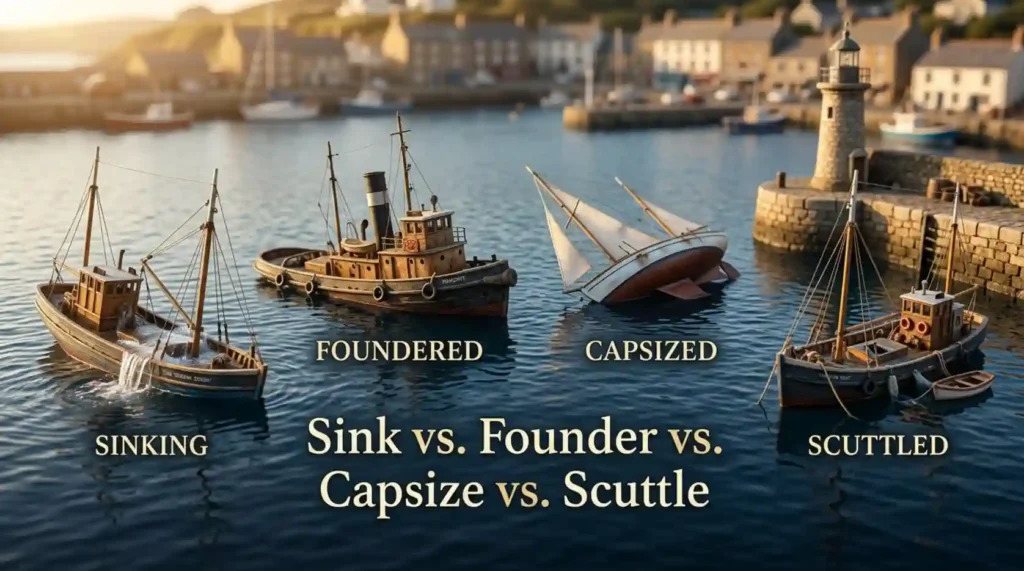
These four words are often mixed up in writing about boats. They all describe something going wrong, but they describe different events.
| Word | What happens | Cause | Example |
| Sink | The vessel goes under water | Any cause | The ferry sank near the harbor. |
| Founder | The vessel fills with water and goes down | Usually storms or damage | The trawler foundered in rough seas. |
| Capsize | The vessel turns over | Waves, wind, or poor balance | The canoe capsized, but nobody was hurt. |
| Scuttle | The vessel is sunk on purpose | Human choice | The crew scuttled the ship. |
“Sink” is the general word. “Founder” and “scuttle” add information about how or why it happened. “Capsize” is about turning over, so a capsized boat is not always a sunk one.
Sources: Merriam-Webster; Collins Dictionary.
Sink and Opposite/Paired Word Pairs
| Word | Paired Word | Note |
| Sink | Float | The standard physical opposite for objects in water |
| Sink | Swim | Used in the pairing “sink or swim” |
| Sink | Rise | The opposite for levels, prices, and the sun |
| Sink | Surface | The opposite when something comes up from under water |
| Sink | Soar | A stronger opposite for prices, hopes, or spirits |
| Sink (noun) | Source | A science pairing, as in carbon sources and carbon sinks |
The best opposite depends on the sense. For objects in water, “float” and “surface” work well. For numbers, moods, and the sun, “rise” is more natural. In science, a “sink” absorbs or removes something, such as carbon or heat, while a “source” gives it off.
Sources: Merriam-Webster; Dictionary.com; Etymonline.
Common Word Partners of “Sink”
| Pattern | Common Partners | Example |
| Verb + object | sink a ship, sink a putt, sink a well | He sank a long putt on the last hole. |
| Verb + preposition | sink into, sink to, sink below | She sank into the armchair. |
| Verb + adverb | sink slowly, sink quickly, sink deeper | The sun sank slowly behind the hills. |
| Noun + noun | kitchen sink, bathroom sink, carbon sink, heat sink | The kitchen sink was full of dishes. |
| Adjective + noun | double sink, deep sink, clogged sink | We installed a double sink in the new kitchen. |
| Verb + money phrase | sink money into, sink savings into | They sank their savings into the business. |
Sources: Merriam-Webster; Dictionary.com.
Idiomatic Phrases Featuring “Sink”
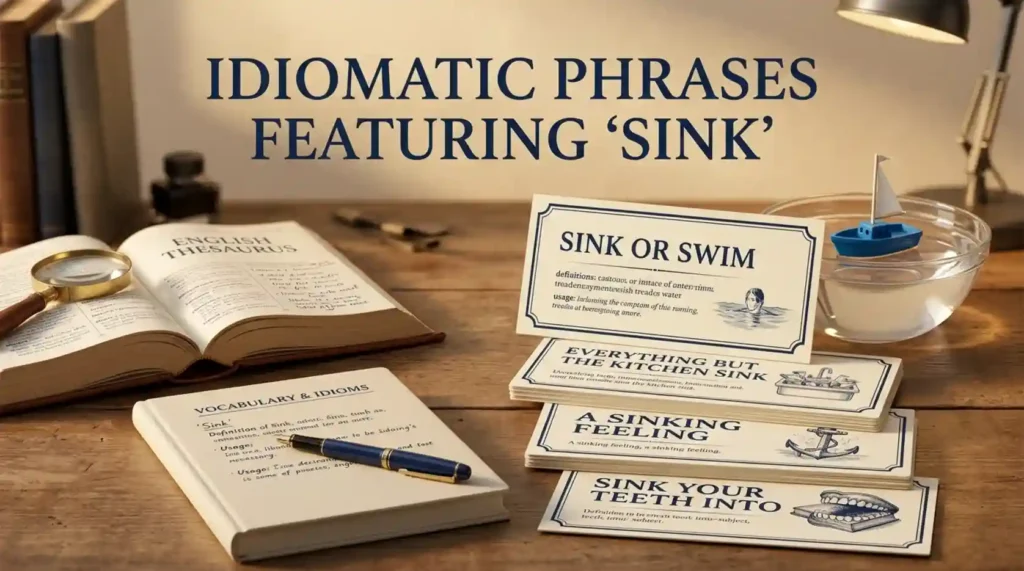
1. Sink or swim
- Meaning: To succeed through one’s own effort or fail completely, with no help from others.
- Example: On her first day, the manager left her alone, and it was sink or swim.
2. Everything but the kitchen sink
- Meaning: Nearly everything possible, often more than is needed.
- Example: For the one-night trip, she packed everything but the kitchen sink.
3. A sinking feeling
- Meaning: A sudden, uneasy feeling that something has gone wrong.
- Example: When he saw the empty parking space, he got a sinking feeling.
4. Sink one’s teeth into (something)
- Meaning: To become fully involved in a task or activity, or to bite into food.
- Example: She was eager to sink her teeth into the new project.
Sources: Merriam-Webster; Dictionary.com; Etymonline.
Word Formation of “Sink”
Etymology & Structure
“Sink” is a short, native English word. The verb comes from Old English sincan, meaning “become submerged, go under, subside.” It traces back to Proto-Germanic senkwan, and from there to a Proto-Indo-European root meaning “to sink.” Related words exist in other Germanic languages, including German sinken and Dutch zinken.
Date and History
The verb is recorded before the 12th century. The transitive use, meaning to force or drag something downward, appears in the late 12th century. The noun is later. In the early 15th century it meant a cesspool or pit for wastewater. The meaning of a shallow basin with a drain, especially in a kitchen, is recorded by the 1560s. The scientific sense of a place where heat or energy is removed from a system dates from 1855. The phrase “sink without a trace” began as military language in the First World War, translating a German phrase.
Word Class Variations
- Verb: sink, sinks, sank, sunk, sinking
- Noun: sink, sinks; also “sinking” as a noun for the act of going down
- Adjective: sinking (a sinking ship), sunken (a sunken ship)
- Related compounds: sinkhole, heat sink, carbon sink, sinking fund
Sources: Etymonline; Merriam-Webster; Dictionary.com.
Common Word-Choice Mistakes
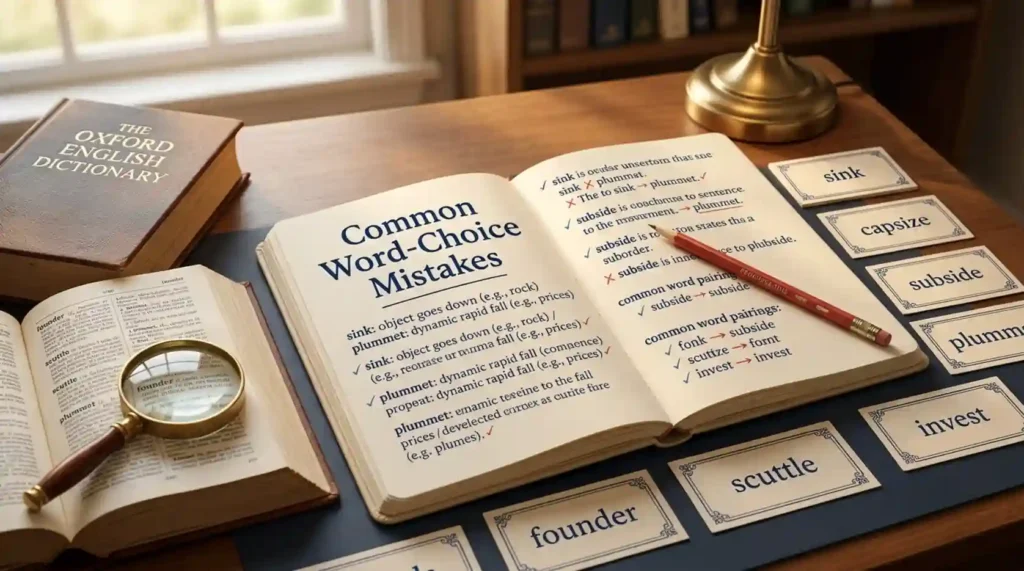
- “The boat capsized to the bottom”: use “sank” if the point is that it went under, since “capsize” only means to turn over.
- “The prices subsided sharply”: use “plunged” or “plummeted” for a sudden fall, since “subside” suggests a gentle settling.
- “The bathroom basin pipe is a drain basin”: say “the drain of the basin,” because a drain is part of the basin, not another word for it.
- “The company foundered the ship”: use “scuttled” for deliberate sinking, because “founder” is used without an object.
- “She sank her teeth in the idea” for an interest: use “sank her teeth into,” because the preposition is “into.”
- “The sun dropped under the horizon” is fine, but “the sun sank down under the sea” repeats the direction: “sank below the horizon” is cleaner.
- “He sank the money to a project”: use “sank the money into a project,” or choose “invested in.”
Frequently Asked Questions
What is the closest synonym for sink?
For a ship or object going under water, “submerge” and “founder” are the closest. For general downward movement, “drop” and “descend” are closest.
What is a formal alternative to sink?
“Descend,” “subside,” and “deteriorate” are formal options, depending on the meaning. “Founder” is a formal word for a ship that sinks.
What is a good word for a sudden sink in prices?
“Plummet” and “plunge” both show speed. “Tumble” is also used, though it is a little more informal.
What is the difference between sink and submerge?
“Sink” focuses on going down, often to the bottom. “Submerge” focuses on being fully under the surface, and it can describe putting something under on purpose.
Is “founder” the same as “sink”?
Not exactly. “Founder” is mainly used for ships that fill with water and go down. It also means “to fail” when used about plans, which “sink” can do only in some contexts.
What is another word for a kitchen sink?
“Basin” and “washbasin” are the usual alternatives. For a kitchen specifically, “sink” is the normal word, and “basin” is more common in bathrooms and in British English.
Can “sink” be used about feelings?
Yes. A person’s heart or spirits can sink when something bad happens. Related words for this sense include “sag,” “flag,” and “plummet.”
What does “sink in” mean?
It means that a fact or idea is slowly understood and accepted. It is a phrasal use of “sink,” not a separate word.
What does “sink” mean in science?
It is a place where something is absorbed or removed from a system. A forest that absorbs carbon is a carbon sink, and a heat sink draws heat away from a part.
Conclusion
The closest alternatives to “sink” are “submerge,” “founder,” “drop,” “descend,” and “decline,” with “basin” and “washbasin” for the washing fixture. Each one covers a different part of the word’s meaning.
Context decides which word is best. A ship may founder, floodwater may subside, prices may plummet, and a bed may sag. “Sink” covers all of these, while the alternatives are more precise. A few of them, such as “capsize” and “drain,” are only related words and do not mean the same thing.
To choose the right alternative, first decide which sense of “sink” you mean: going under, moving lower, losing value, driving something in, or the basin. Then pick the word that fits that sense and the tone you want, from a plain word like “drop” to a more formal one like “descend.”