Another Word for Pattern: 30 Synonyms With Examples
The closest everyday alternatives to pattern are design, motif, arrangement, and model. The best word depends on If you mean a repeated decoration, a regular way something happens, a structure, or a guide for making something.
Pattern can describe a floral design on fabric, a child’s sleep routine, a repeating trend in data, or a paper guide for sewing. Because it covers several ideas, English offers different alternatives for each sense.
Quick list: design, motif, arrangement, configuration, layout, structure, system, sequence, routine, model
This article explains 30 alternatives with meanings, IPA, usage notes, examples, and the contexts where each word works best.
At a Glance: Pattern Synonyms and Related Alternatives
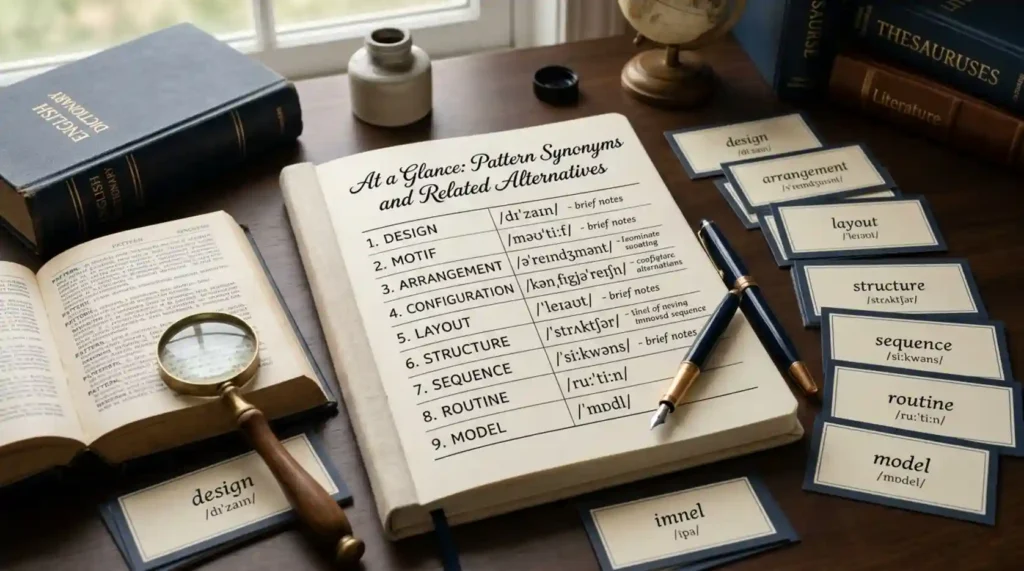
| Alternative | Part of Speech | Meaning | Register / Tone | Ideal Context |
| Design | Noun | A planned arrangement of lines, shapes, or colors | Neutral | Art, fashion, graphics, products |
| Motif | Noun | A repeated decorative element or theme | Slightly formal | Textiles, wallpaper, art, literature |
| Arrangement | Noun | The way parts are organized | Neutral | Objects, events, data, ideas |
| Configuration | Noun | A particular arrangement of parts | Formal, technical | Machines, software, systems |
| Layout | Noun | The placement of items on a page or in a space | Neutral | Design, websites, rooms, documents |
| Structure | Noun | The organized framework of something | Neutral | Writing, organizations, buildings, arguments |
| System | Noun | An organized set of connected parts or rules | Neutral | Science, society, procedures |
| Sequence | Noun | Items or events in a particular order | Neutral | Steps, numbers, events, DNA |
| Routine | Noun | A regular series of actions | Neutral | Daily life, work, exercise |
| Model | Noun | Something used as an example or guide | Neutral | Behavior, products, theories, fashion |
Which Word Should You Use?
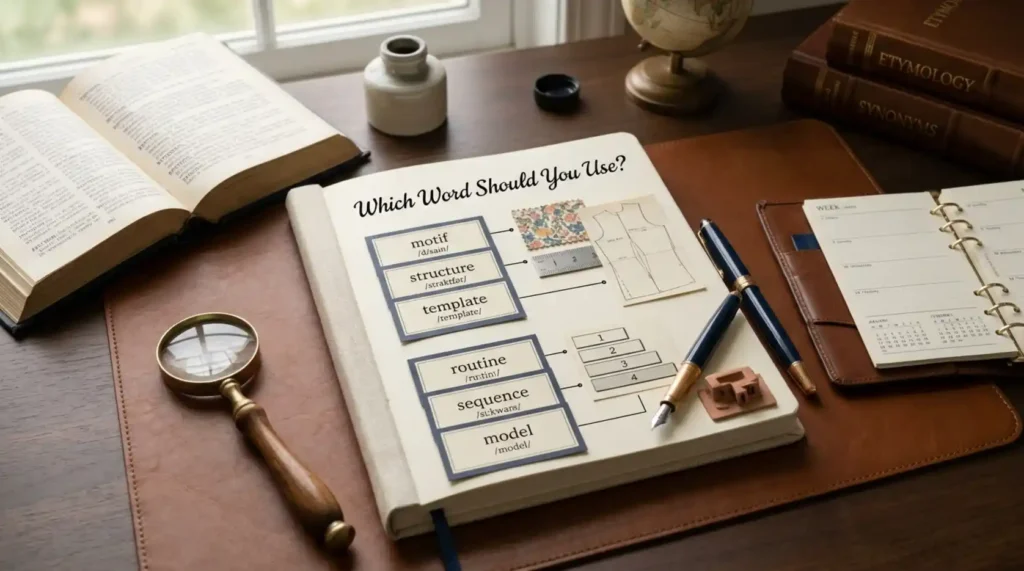
| If you want to… | Use | Why |
| Describe a repeated decoration | Motif or design | A motif is the repeated element; a design is the overall visual arrangement. |
| Talk about how something is organized | Arrangement, structure, or configuration | These focus on the position or relationship of parts. |
| Describe repeated behavior | Routine, habit, or practice | These are more natural than pattern for everyday actions. |
| Refer to a planned guide for making something | Template, blueprint, or model | These emphasize instructions or a guide. |
| Describe an order of events or steps | Sequence or order | These stress what comes first, next, and last. |
| Use a formal word for a typical way of operating | Method, system, or procedure | These suit professional, academic, and technical writing. |
| Describe an ideal example to copy | Model, exemplar, or standard | These emphasize imitation or quality. |
| Talk about a visual shape or marking | Figure or configuration | These work for shapes, markings, and natural forms. |
Exploring the Multiple Meanings of “Pattern”
1. A Repeated Decorative Design
- Meaning: A decorative arrangement of shapes, lines, or colors that repeats.
- Explanation: This is the visual sense of pattern, often used for fabric, wallpaper, tiles, carpets, and artwork.
- Example: The curtains have a simple floral pattern.
2. A Regular or Recognizable Way Something Happens
- Meaning: A usual or repeated way in which events, behavior, or data occur.
- Explanation: Here, pattern does not have to be visual. It can describe trends, habits, weather, speech, or behavior.
- Example: Doctors noticed a pattern in the patients’ symptoms.
3. An Arrangement or Structure
- Meaning: The way parts of something are organized or related.
- Explanation: This sense is common in art, music, language, science, and design. It focuses on form and organization.
- Example: The poem follows a clear rhyming pattern.
4. A Model or Guide for Making Something
- Meaning: A template or plan used to make or copy something.
- Explanation: A sewing pattern, for example, shows the shape and size needed to make a garment.
- Example: She bought a pattern for a winter coat.
5. An Example Worthy of Imitation
- Meaning: A person or thing that serves as a model or ideal.
- Explanation: This use is more formal and less common in everyday speech. It means an example others may follow.
- Example: The school was held up as a pattern of good practice.
Sources: Merriam-Webster; Collins Dictionary; Dictionary.com.
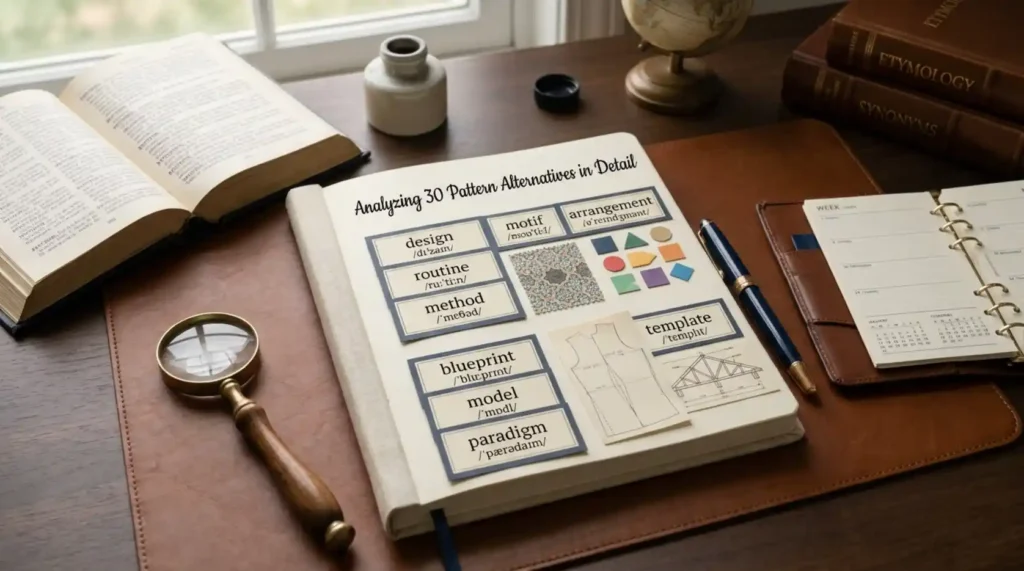
Analyzing 30 Pattern Alternatives in Detail
Some alternatives are direct synonyms, while others are useful only in particular senses of pattern.
Repeated Designs and Visual Forms
1. Design
IPA: /dɪˈzaɪn/ (US and UK)
Definition: A plan or arrangement of lines, shapes, colors, or parts, especially one made for a particular purpose.
Usage: Design is one of the closest general alternatives to pattern for visual or decorative arrangements. It can also mean a broader plan.
Example: The rug has a bold geometric design.
2. Motif
IPA: US /moʊˈtiːf/ · UK /məʊˈtiːf/
Definition: A repeated decorative element, figure, or theme.
Usage: Use motif when one recognizable element repeats across a design. It is common in art, fashion, textiles, music, and literature.
Example: Leaves are the main motif in the wallpaper.
3. Figure
IPA: US /ˈfɪɡjər/ · UK /ˈfɪɡə(r)/
Definition: A shape, form, or decorative design.
Usage: Figure is a related alternative for a visible shape or marking. It is less natural for behavior or routines.
Example: The vase is decorated with figures of animals.
4. Decoration
IPA: /ˌdekəˈreɪʃn/ (US and UK)
Definition: Something added to make something else more attractive.
Usage: Decoration emphasizes ornament rather than repetition. It is a related alternative, not an exact synonym.
Example: The cake had a simple flower decoration.
5. Ornament
IPA: US /ˈɔːrnəmənt/ · UK /ˈɔːnəmənt/
Definition: A decorative object or detail.
Usage: Ornament is more formal and often refers to a physical decorative item or embellishment. It does not naturally mean a behavioral or data pattern.
Example: The building features carved stone ornaments.
Organization and Structure
6. Arrangement
IPA: /əˈreɪndʒmənt/ (US and UK)
Definition: The way things are placed or organized in relation to each other.
Usage: Arrangement is a strong general alternative when pattern means organization rather than decoration.
Example: The chairs were in a circular arrangement.
7. Configuration
IPA: /kənˌfɪɡjəˈreɪʃn/ (US and UK)
Definition: The particular way that parts are arranged or set up.
Usage: This is a formal, technical alternative. It suits computers, machines, systems, and scientific descriptions.
Example: The software supports several network configurations.
8. Layout
IPA: /ˈleɪaʊt/ (US and UK)
Definition: The way items are arranged on a page, screen, or in a space.
Usage: Use layout for visual placement, especially in design, publishing, websites, and rooms. It is narrower than pattern.
Example: The magazine has a clean, modern layout.
9. Structure
IPA: /ˈstrʌktʃər/ (US and UK)
Definition: The way parts are organized to form a whole.
Usage: Structure works when pattern refers to an organized framework, such as in writing, music, society, or an organization.
Example: The essay has a clear three-part structure.
10. System
IPA: /ˈsɪstəm/ (US and UK)
Definition: A group of connected parts or rules that work together.
Usage: System is related rather than exact. Use it when the pattern comes from organized rules or connected parts.
Example: The city has an efficient public transport system.
11. Order
IPA: US /ˈɔːrdər/ · UK /ˈɔːdər/
Definition: The arrangement of things in a particular sequence or condition.
Usage: Order emphasizes organization and regularity. It can replace pattern when you mean a recognizable arrangement.
Example: The names are listed in alphabetical order.
12. Sequence
IPA: /ˈsiːkwəns/ (US and UK)
Definition: A set of things arranged one after another.
Usage: Use sequence when order and succession are important, such as steps, numbers, events, or genetic material.
Example: The dance consists of a repeating sequence of movements.
13. Scheme
IPA: /skiːm/ (US and UK)
Definition: A planned arrangement or system.
Usage: In British English, scheme can mean an organized plan or system. In American English, it more often suggests a secret or dishonest plan, so use it carefully.
Example: The government introduced a new recycling scheme.
Behavior, Habits, and Methods
14. Routine
IPA: /ruːˈtiːn/ (US and UK)
Definition: A usual or fixed series of actions.
Usage: Routine is the best alternative for a regular personal or work pattern. It often suggests repetition.
Example: Her morning routine includes a walk and coffee.
15. Habit
IPA: /ˈhæbɪt/ (US and UK)
Definition: Something a person does regularly, often without thinking.
Usage: Habit is more personal and automatic than pattern. It is not suitable for visual designs.
Example: Biting his nails is an old habit.
16. Custom
IPA: /ˈkʌstəm/ (US and UK)
Definition: A usual way of behaving in a society or group.
Usage: Use custom for social or cultural patterns of behavior. It is a related alternative, not a universal substitute.
Example: It is a local custom to remove your shoes indoors.
17. Practice
IPA: /ˈpræktɪs/ (US and UK)
Definition: A usual or accepted way of doing something.
Usage: Practice is common in professional, business, and academic contexts. It often describes an established method rather than a visual design.
Example: Wearing safety glasses is standard practice in the lab.
18. Procedure
IPA: /prəˈsiːdʒər/ (US and UK)
Definition: A fixed way of doing something, especially in official or technical situations.
Usage: Procedure is formal and specific. Use it for official steps, not for decorative designs.
Example: Follow the emergency procedure during a fire drill.
19. Method
IPA: /ˈmeθəd/ (US and UK)
Definition: A particular way of doing something.
Usage: Method emphasizes a planned approach. It can replace pattern when discussing how something is done.
Example: The teacher uses a question-and-answer method.
20. Tendency
IPA: /ˈtendənsi/ (US and UK)
Definition: A likelihood to behave or develop in a particular way.
Usage: Tendency is a related alternative for behavioral or statistical patterns. It suggests likelihood rather than a fixed rule.
Example: Prices show a tendency to rise in the summer.
Models, Guides, and Examples
21. Model
IPA: US /ˈmɑːdl/ · UK /ˈmɒdl/
Definition: Something used as an example to copy or follow.
Usage: Model is close to pattern in the sense of an example or guide. It is also used for physical miniature representations.
Example: The new school program became a model for other districts.
22. Template
IPA: /ˈtempleɪt/ (US and UK)
Definition: A shaped guide or preformatted model used to make something.
Usage: Template is the best alternative for a reusable guide, especially in sewing, design, documents, and software.
Example: Download the resume template and add your details.
23. Blueprint
IPA: /ˈbluːprɪnt/ (US and UK)
Definition: A detailed plan or design, especially for a building or project.
Usage: Blueprint is a related alternative that stresses a detailed plan. It is often used figuratively for plans for success or change.
Example: The report provides a blueprint for education reform.
24. Guide
IPA: /ɡaɪd/ (US and UK)
Definition: Something that shows how to do or make something.
Usage: Guide is broader than pattern. It works when the pattern helps someone follow instructions.
Example: The booklet is a useful guide for new employees.
25. Prototype
IPA: US /ˈproʊtətaɪp/ · UK /ˈprəʊtətaɪp/
Definition: The first model of something from which copies may be made.
Usage: Prototype is a related alternative for an original model. It is especially common in product design and engineering.
Example: Engineers tested a prototype of the new car.
26. Archetype
IPA: US /ˈɑːrkɪtaɪp/ · UK /ˈɑːkɪtaɪp/
Definition: An original model or a typical example of a type.
Usage: Archetype is formal and often literary or psychological. It refers to a fundamental model or representative example.
Example: The hero’s journey is an archetype found in many stories.
27. Exemplar
IPA: US /ɪɡˈzemplər/ · UK /ɪɡˈzemplɑː(r)/
Definition: A person or thing that is a good or typical example.
Usage: Exemplar is formal and close to pattern in its older sense of a model worthy of imitation.
Example: Her research is an exemplar of careful scholarship.
28. Standard
IPA: US /ˈstændərd/ · UK /ˈstændəd/
Definition: A level of quality, behavior, or measurement used as a model or rule.
Usage: Standard is related rather than exact. Use it when the pattern represents an accepted norm or requirement.
Example: The company follows international safety standards.
29. Example
IPA: /ɪɡˈzæmpl/ (US and UK)
Definition: A person or thing that shows a general rule or serves as a model.
Usage: Example is a broad related alternative. It works when a pattern illustrates a rule or ideal, but not for decorative designs.
Example: The city is an example of successful urban planning.
30. Paradigm
IPA: US /ˈpærədaɪm/ · UK /ˈpærədaɪm/
Definition: A typical model, framework, or way of thinking about something.
Usage: Paradigm is formal and academic. It is related to pattern when referring to a model or framework, but it is too abstract for ordinary visual designs.
Example: The discovery created a new paradigm in medicine.
Sources: Merriam-Webster; Merriam-Webster Thesaurus; Collins American English Thesaurus; Dictionary.com.
Pattern in Different Contexts
| Context | Natural alternatives | Example |
| Fabric, wallpaper, art | Design, motif, figure | The fabric has a repeating floral motif. |
| Behavior and habits | Routine, habit, practice, tendency | His spending habits changed after college. |
| Data and trends | Trend, sequence, configuration, structure | The data reveal a seasonal sequence. |
| Sewing and making things | Template, blueprint, model, guide | She followed the template to cut the fabric. |
| Writing, music, and art | Structure, arrangement, form, motif | The song repeats a simple melodic motif. |
| Science and technology | Configuration, system, structure, sequence | The protein has a repeating molecular structure. |
The word trend is also useful for patterns in data or society, but it emphasizes direction of change rather than repetition. For example, “a pattern of rising prices” and “a rising price trend” are close, but not identical.
Sources: Merriam-Webster; Collins Dictionary.
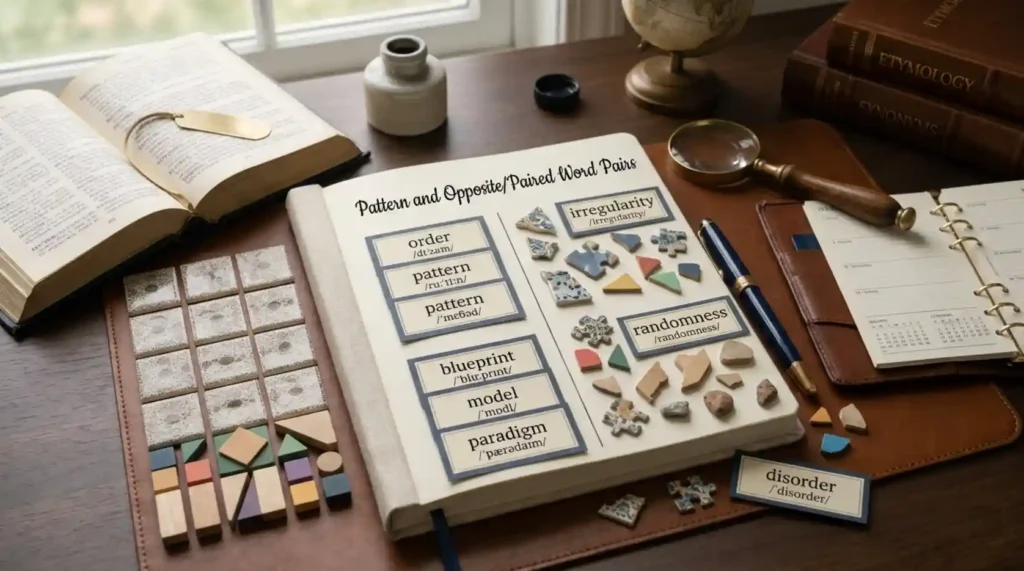
Pattern and Opposite/Paired Word Pairs
| Word | Paired Word | Note |
| Pattern | Irregularity | A pattern is regular or recognizable; an irregularity breaks that regularity. |
| Pattern | Randomness | Randomness lacks a predictable arrangement or repeated order. |
| Pattern | Chaos | Chaos is a strong opposite for disorder or confusion. |
| Design | Accident | A design is planned; an accident is unplanned. |
| Routine | Change | A routine repeats; change interrupts or replaces it. |
| Model | Copy | A model is the original guide; a copy is made from it. |
| Template | Original | A template guides production; an original is the source version. |
| Order | Disorder | These words directly contrast organization and lack of organization. |
Pattern often appears with ideas of repetition, regularity, and predictability. Its natural contrasts include randomness, irregularity, disorder, and chaos.
Sources: Merriam-Webster; Dictionary.com.
Common Word Partners of “Pattern”
| Pattern | Common Partners | Example |
| Pattern of | behavior, events, growth, spending | The report identified a pattern of late payments. |
| Behavioral / spending / speech pattern | pattern | Sleep patterns can affect mood. |
| Geometric / floral / repeating pattern | pattern | The tiles have a geometric pattern. |
| Follow / detect / identify / break a pattern | pattern | Researchers detected a pattern in the results. |
| Set / establish / change a pattern | pattern | The new law may change long-standing patterns. |
| Pattern for | a dress, a jacket, a toy | She bought a pattern for a child’s jacket. |
| Weather / traffic / migration pattern | pattern | Migration patterns change with the seasons. |
These collocations show that pattern commonly describes repetition in behavior, nature, design, and organized systems. The phrase pattern for is especially associated with sewing and making objects.
Sources: Merriam-Webster; Collins Dictionary.
Idiomatic Phrases Featuring “Pattern”
1. Pattern of behavior
- Meaning: A repeated and recognizable way that someone acts.
- Example: The counselor looked for a pattern of behavior across several months.
2. Follow a pattern
- Meaning: To happen or develop in a regular or expected way.
- Example: The company’s sales follow a seasonal pattern.
3. Break the pattern
- Meaning: To stop a usual way of behaving or doing something.
- Example: She decided to break the pattern of avoiding difficult conversations.
4. Pattern after
- Meaning: To make something using another thing as a model.
- Example: The new library was patterned after a famous European building.
Sources: Merriam-Webster; Etymonline.
Word Formation of “Pattern”
Etymology & Structure
Pattern developed from Middle English patron, which came from Old French patron, meaning “patron, protector; model, pattern.” The word ultimately traces to Latin patronus, meaning “legal protector” or “advocate.”
English later separated the spellings and meanings of patron and pattern. Patron retained the sense of a supporter, while pattern developed senses connected with models, guides, and repeated designs.
Date and History
The sense of pattern as a design or guide for making something is recorded from the late 14th century. The meaning “repeated decorative design” dates from the 1580s, and the dressmaking sense is recorded by 1792.
Word Class Variations
- Noun: pattern — “a floral pattern”
- Verb: pattern — “The design is patterned after Japanese textiles”
- Adjective: patterned — “patterned wallpaper”
- Related noun: patterning — “the patterning of animal markings”
- Related adjective: patternless — “a patternless surface”
Sources: Etymonline; Merriam-Webster.
Common Word-Choice Mistakes
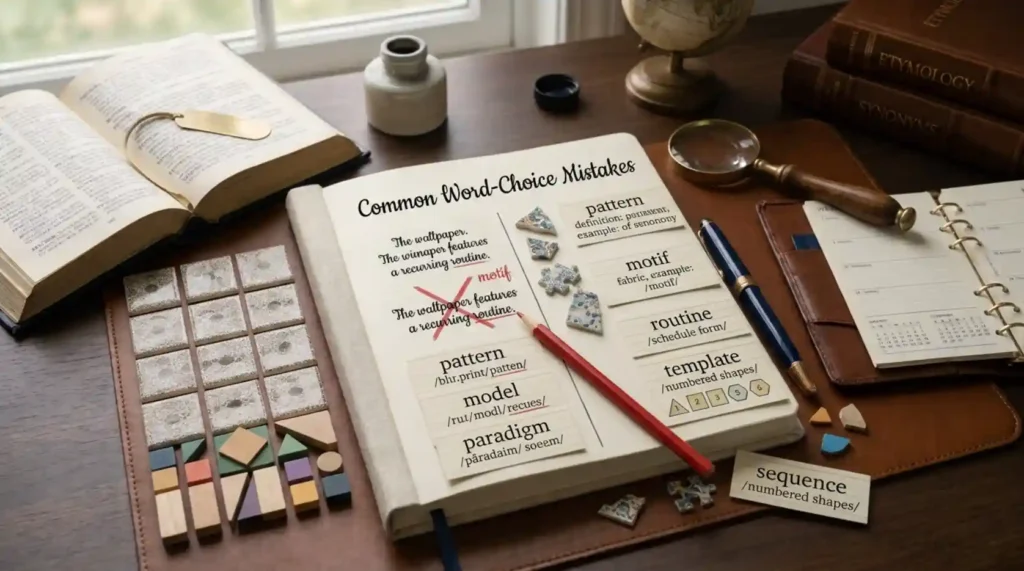
- Wrong: “The wallpaper has a beautiful routine.” Use: “The wallpaper has a beautiful pattern or motif.”
- Wrong: “Scientists studied the design of bird migration.” Use: “Scientists studied the pattern of bird migration.”
- Wrong: “She followed the model to sew the dress.” Use: “She followed the pattern or template to sew the dress.”
- Wrong: “His sleeping design is unhealthy.” Use: “His sleep pattern or sleep routine is unhealthy.”
- Wrong: “The numbers are in a beautiful motif.” Use: “The numbers are in a sequence or pattern.”
- Wrong: “The building has an attractive habit.” Use: “The building has an attractive design or ornament.”
- Wrong: “The company has a dishonest pattern.” Use: “The company has a dishonest scheme or a pattern of dishonest behavior.”
Frequently Asked Questions
What is the closest synonym for pattern?
Design is often the closest general synonym for a visual pattern. For behavior or repeated events, routine, tendency, or sequence may be closer.
What is another word for a repeated design?
Motif is the best choice for a repeated decorative element. Design, figure, and decoration are also useful, depending on the sentence.
What is a formal alternative to pattern?
Configuration, structure, system, paradigm, and exemplar are formal alternatives. Choose based on If you mean arrangement, organization, or a model.
What is another word for a behavioral pattern?
Routine, habit, practice, tendency, and custom are common alternatives. Habit is usually personal, while custom is social or cultural.
What is another word for a sewing pattern?
Template, guide, blueprint, or model can work. In sewing, pattern itself is the standard term.
Is a motif the same as a pattern?
No. A motif is usually one repeated element, while a pattern can be the complete repeated arrangement.
Is a design the same as a pattern?
Not exactly. A design is a broader planned arrangement, while a pattern often emphasizes repetition or regularity.
What is the opposite of pattern?
Common opposites include randomness, irregularity, disorder, and chaos.
Can pattern describe people?
Yes, but usually through phrases such as pattern of behavior, speech pattern, or spending pattern. Calling a person “a pattern” is uncommon and formal.
Can pattern mean a model to copy?
Yes. In this sense, model, exemplar, standard, and example are related alternatives.
Conclusion
The most useful alternatives to pattern are design, motif, arrangement, model, routine, and template. Each fits a different meaning: visual decoration, organization, behavior, or a guide for making something.
Context matters because pattern can describe wallpaper, weather, behavior, data, music, and sewing. A word such as motif fits fabric, while routine fits daily life and configuration fits technology.
To choose the right word, first decide what kind of pattern you mean. Then select the alternative that emphasizes the same idea: repetition, organization, imitation, order, or visual form.