Another Word for Current: 30 Synonyms With Examples
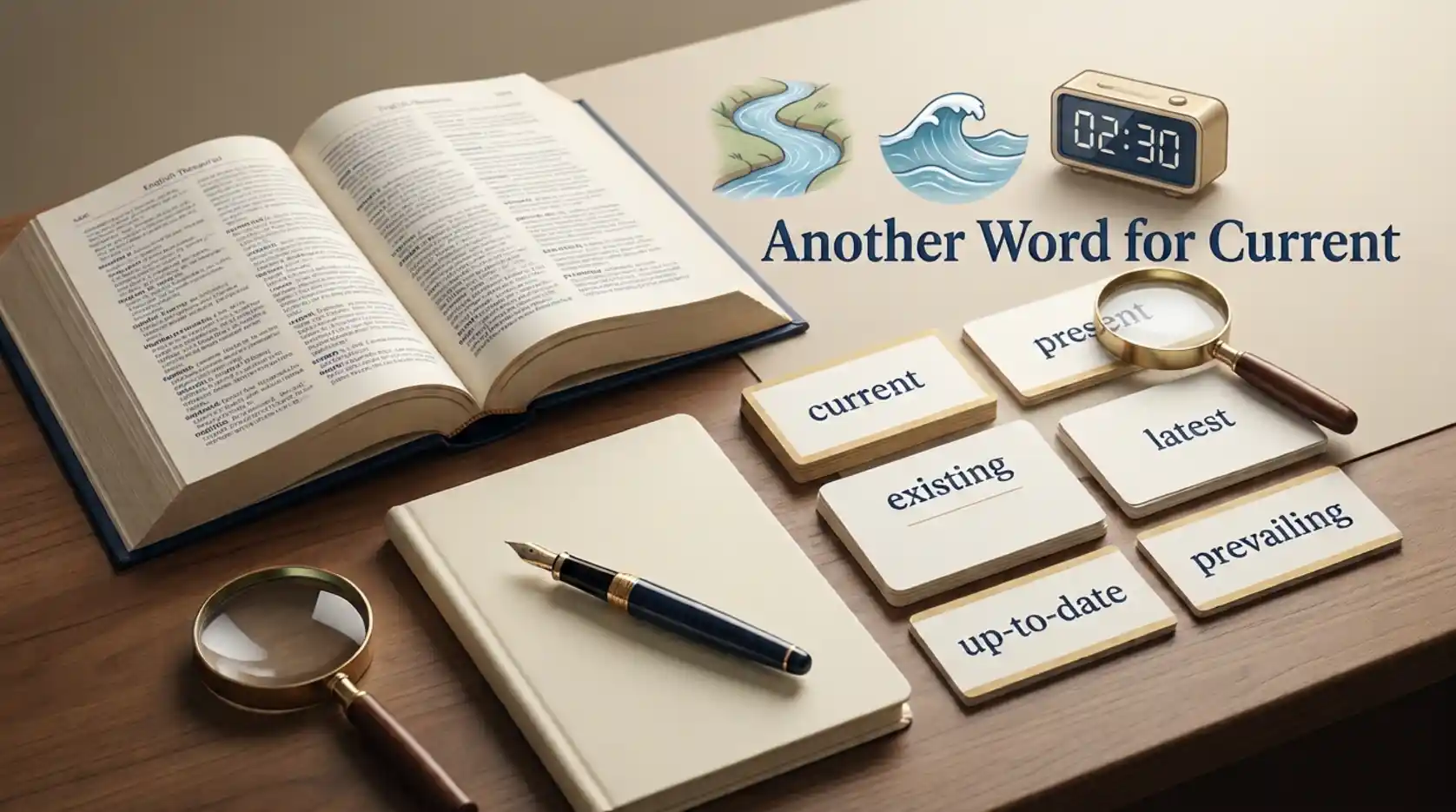
The closest everyday alternatives to “current” are present, existing, latest, and up-to-date. They fit the most common meaning of the word: happening or true now. If you mean “widely accepted at this time,” try prevailing or prevalent. As a noun, “current” has different alternatives, such as stream, flow, tide, or trend.
The best choice depends on which meaning you need. “Current” can describe time (the current manager), freshness (the current edition), general acceptance (current opinion), or movement (a river current, an electric current, a current of opinion). This article covers each of these areas.
Quick list: present, existing, latest, up-to-date, prevailing, contemporary, ongoing, stream, flow, trend
Below, you will find 30 alternatives with meanings, IPA, usage notes, examples, and context. Some are direct synonyms. Others are related words that fit only certain situations.
At a Glance: Current Synonyms and Related Alternatives
| Alternative | Part of Speech | Meaning | Register / Tone | Ideal Context |
| Present | Adjective | Existing or happening now | Neutral | Situations, conditions, roles |
| Existing | Adjective | Already in place now | Neutral, formal | Systems, rules, customers |
| Latest | Adjective | Most recent | Neutral, informal | News, versions, updates |
| Up-to-date | Adjective | Including the newest information | Neutral | Records, software, knowledge |
| Prevailing | Adjective | Most common or widely accepted now | Formal | Opinions, conditions, rates |
| Contemporary | Adjective | Belonging to the present period | Formal | Art, culture, society |
| Ongoing | Adjective | Still continuing | Neutral | Projects, problems, investigations |
| Stream | Noun | A flowing body of water or something like it | Neutral | Water, data, movement |
| Flow | Noun | A steady movement of liquid, air, or electricity | Neutral | Rivers, electricity, traffic |
| Trend | Noun | A general direction of change | Neutral | Opinion, markets, behavior |
Which Word Should You Use?

| If you want to… | Use | Why |
| Describe something true at this moment | Present | It is simple and works in most settings. |
| Refer to something already in place | Existing | It suggests something that is there now, often before a change. |
| Talk about the newest version or news | Latest | It points to the most recent item in a series. |
| Say information has been updated | Up-to-date | It stresses that nothing is outdated. |
| Describe a widely held view or condition | Prevailing | It means common or dominant at this time. |
| Describe modern art, style, or culture | Contemporary | It links the topic to the present period. |
| Say something has not finished | Ongoing | It shows continuing action. |
| Describe moving water or air | Stream, flow, draft | They match the physical sense of “current.” |
Exploring the Multiple Meanings of “Current”
1. Happening or Existing Now
- Meaning: Belonging to the present time.
- Explanation: This is the most common adjective sense. It points to what is true, in use, or in charge at this moment, as opposed to the past or future.
- Example: What is your current address?
2. Up to Date
- Meaning: Including the newest information or most recent version.
- Explanation: This sense is about being kept fresh. A passport, a subscription, or a set of records can be current if it has not expired or fallen behind.
- Example: Please make sure your contact details are current.
3. Generally Accepted or In Common Use
- Meaning: Widely held, used, or believed at the present time.
- Explanation: This sense describes ideas, words, and practices shared by many people. It often appears in phrases such as “current opinion” or “current usage.”
- Example: The word is no longer in current use.
4. A Flow of Water, Air, or Electricity
- Meaning: A steady movement of water, air, or electric charge in one direction.
- Explanation: As a noun, “current” refers to physical movement. “Electric current” is the flow of electric charge, and an ocean current is a large movement of seawater.
- Example: The swimmer struggled against the strong current.
5. A General Tendency or Trend
- Meaning: A general course or drift of opinion, feeling, or events.
- Explanation: This is a figurative noun sense. It treats ideas like moving water, as in a “current of public opinion.”
- Example: A current of unease ran through the crowd.
Sources: Merriam-Webster, Collins Dictionary, Dictionary.com
Here is your original text with the appropriate subheadings added. I have kept your definitions, IPA pronunciations, usage notes, examples, and sources unchanged.
Analyzing 30 Current Alternatives in Detail
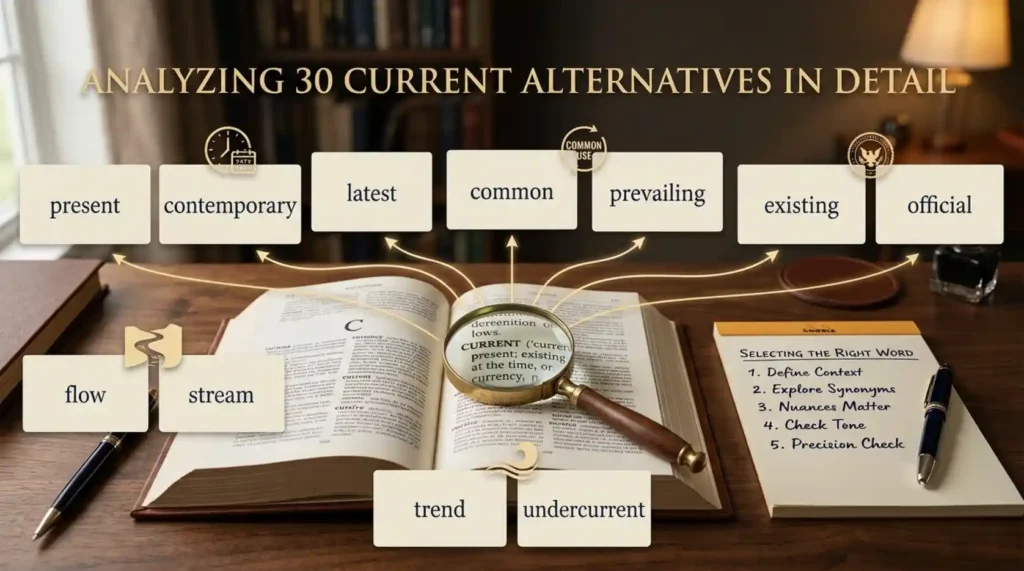
Some alternatives below are direct synonyms of “current,” while others are related words that fit only one sense or context.
Group 1: Present-Time Alternatives
1. Present
IPA: /ˈprɛzənt/ (US and UK)
Definition: Existing or happening now.
- Usage: This is the closest everyday synonym for the “happening now” sense. It is neutral and common, but it does not mean “up to date.”
- Example: The present situation is better than it was last year.
2. Existing
IPA: /ɪɡˈzɪstɪŋ/ (US and UK)
Definition: Already in place or in use at the present time.
- Usage: It is a good fit for systems, rules, and customers that are already there, often in contrast with something new. It is not a synonym for “latest.”
- Example: The new policy replaces the existing one.
3. Present-day
IPA: /ˌprɛzənt ˈdeɪ/ (US and UK)
Definition: Belonging to the current time, as opposed to the past.
- Usage: It is used before nouns and often compares the present with history. It is slightly more descriptive than “current.”
- Example: Present-day Egypt looks very different from the ancient world.
4. Contemporary
IPA: US /kənˈtɛmpəˌrɛri/ · UK /kənˈtemp(ə)rəri/
Definition: Belonging to the same time or to the present period.
- Usage: It is a related alternative, not an exact synonym. It suits art, music, design, and culture, and it is more formal than “current.” It can also mean “from the same time as another thing,” which “current” never means.
- Example: The museum has a large collection of contemporary art.
5. Ongoing
IPA: US /ˈɑːnɡoʊɪŋ/ · UK /ˈɒnɡəʊɪŋ/
Definition: Continuing to happen or exist, and not yet finished.
- Usage: It is a related alternative. It stresses that something has started and has not ended, rather than simply that it exists now.
- Example: The police have an ongoing investigation.
6. Incumbent
IPA: /ɪnˈkʌmbənt/ (US and UK)
Definition: Holding an office or position at the present time.
- Usage: It is a narrow, formal alternative used for the person now holding a post. It is also a noun for that person. It is not a general synonym of “current.”
- Example: The incumbent mayor is running for a second term.
Group 2: Up-to-Date and Recent Alternatives
7. Up-to-date
IPA: /ˌʌp tə ˈdeɪt/ (US and UK)
Definition: Including the newest information, ideas, or features.
- Usage: It is a direct synonym for the “not outdated” sense of “current.” It is more about being updated than about the time itself.
- Example: Make sure your software is up-to-date.
8. Latest
IPA: /ˈleɪtɪst/ (US and UK)
Definition: Most recent; newest.
- Usage: It is a close synonym when you mean the newest item in a series, such as a version, report, or piece of news. It does not describe things that exist but are not new.
- Example: Have you seen the latest figures?
9. Recent
IPA: /ˈriːsənt/ (US and UK)
Definition: Having happened or begun a short time ago.
- Usage: It is a related alternative. It looks back to the near past, while “current” describes the present moment.
- Example: According to recent reports, prices are rising.
10. Modern
IPA: US /ˈmɑːdərn/ · UK /ˈmɒdn/
Definition: Relating to the present or recent times, as opposed to the distant past.
- Usage: It is a related alternative with a wider time range than “current.” It often suggests new styles or technology.
- Example: The hospital uses modern equipment.
11. Topical
IPA: US /ˈtɑːpɪkəl/ · UK /ˈtɒpɪk(ə)l/
Definition: Relating to current events or issues of interest now.
- Usage: It is a related alternative for talks, articles, and jokes that deal with what is being discussed in the news.
- Example: Her speech was short but topical.
12. Timely
IPA: /ˈtaɪmli/ (US and UK)
Definition: Happening at a suitable or useful moment.
- Usage: It is a related alternative, not an exact synonym. It describes good timing rather than being present or up to date.
- Example: The book is a timely look at climate change.
Group 3: Widely Accepted and Common Alternatives
13. Prevailing
IPA: /prɪˈveɪlɪŋ/ (US and UK)
Definition: Most common or widely accepted at a particular time.
- Usage: It is a strong synonym for the “generally accepted now” sense. It is formal and often describes opinions, attitudes, winds, and rates.
- Example: The prevailing view is that the plan is too costly.
14. Prevalent
IPA: /ˈprɛvələnt/ (US and UK)
Definition: Widespread in a particular area or at a particular time.
- Usage: It is a close alternative for the “common now” sense. It often describes diseases, beliefs, or habits and carries a slightly negative feel.
- Example: Flu is prevalent in winter.
15. Common
IPA: US /ˈkɑːmən/ · UK /ˈkɒmən/
Definition: Found often or shared by many.
- Usage: It is a related alternative. It says something is frequent, but it does not say it belongs to the present time.
- Example: This name is common in many countries.
16. Popular
IPA: US /ˈpɑːpjələr/ · UK /ˈpɒpjʊlə/
Definition: Liked or accepted by many people.
- Usage: It is a related alternative. It describes approval, not time, so it only partly matches “current” in the phrase “current fashion.”
- Example: That style is popular this season.
17. Widespread
IPA: /ˈwaɪdsprɛd/ (US and UK)
Definition: Found or happening over a large area or among many people.
- Usage: It is a related alternative. It stresses how far something has spread, not that it is happening now.
- Example: Widespread concern led to a change in the law.
18. Accepted
IPA: /əkˈsɛptɪd/ (US and UK)
Definition: Generally approved or believed to be correct.
- Usage: It is a related alternative for ideas and methods. It fits “current thinking” only when you mean the thinking people now agree on.
- Example: This is the accepted way to cite a source.
Group 4: Formal and Official Alternatives
19. Extant
IPA: /ɛkˈstænt/ or /ˈɛkstənt/ (US and UK)
Definition: Still existing, especially when other similar things have been lost.
- Usage: It is a formal, rare alternative used for old documents or species. It is not suitable for everyday use as a replacement for “current.”
- Example: Only three extant copies of the letter are known.
20. Operative
IPA: US /ˈɑːpərətɪv/ · UK /ˈɒp(ə)rətɪv/
Definition: In effect; working or having force.
- Usage: It is a formal alternative for laws, rules, and plans that are active now. It is narrower than “current.”
- Example: The new rules become operative on Monday.
21. Valid
IPA: /ˈvælɪd/ (US and UK)
Definition: Legally or officially acceptable; not expired.
- Usage: It is a related alternative for documents and tickets. It fits “current passport” only if you mean “not expired.”
- Example: You need a valid ticket to enter.
22. Effective
IPA: /ɪˈfɛktɪv/ (US and UK)
Definition: Officially in use or operating from a particular time.
- Usage: It is a related alternative with a legal meaning. It does not mean “current” in general, and it also means “successful,” which can confuse readers.
- Example: The prices are effective from January 1.
Group 5: Flowing Water and Air
23. Stream
IPA: /striːm/ (US and UK)
Definition: A continuous flow of water, or of something moving like water.
- Usage: It is a related noun alternative. It can mean a small river or a steady flow of things, but a “current” is the movement itself, not the body of water.
- Example: A stream of cold air came through the window.
24. Flow
IPA: US /floʊ/ · UK /fləʊ/
Definition: A steady, continuous movement of liquid, air, or electricity.
- Usage: It is the closest noun alternative for the movement sense. It also works for electricity and traffic.
- Example: The flow of the river slows in summer.
25. Tide
IPA: /taɪd/ (US and UK)
Definition: The regular rise and fall of the sea, or a strong movement of opinion or events.
- Usage: It is a related alternative. A tide is a rhythmic movement of the sea, while a current is a steady flow, though both words are used figuratively for trends.
- Example: The tide of public opinion has turned.
26. Draft
IPA: US /dræft/ · UK /drɑːft/
Definition: A current of air in a room or other enclosed space.
- Usage: It is a specific alternative that only fits air. It is not a general synonym of the noun “current.” (US spelling is also “draft” for the air sense; UK usage often prefers “draught.”)
- Example: Close the door; there is a draft in here.
Group 6: Trends and Undercurrents
27. Trend
IPA: /trɛnd/ (US and UK)
Definition: A general direction in which something is changing.
- Usage: It is a good alternative to the figurative noun sense, but it is less poetic than “current.”
- Example: There is a trend toward remote work.
28. Drift
IPA: /drɪft/ (US and UK)
Definition: A slow, steady movement or change in direction.
- Usage: It is a related alternative that suggests slower, less planned change. It can describe both water movement and general direction of events.
- Example: The drift of the conversation worried her.
29. Undercurrent
IPA: US /ˈʌndərˌkɜːrənt/ · UK /ˈʌndəˌkʌrənt/
Definition: A hidden feeling or influence beneath the surface; also a current below the surface of water.
- Usage: It is a figurative related alternative. It stresses something not openly shown, which “current” alone does not.
- Example: There was an undercurrent of tension in the room.
30. Tendency
IPA: /ˈtɛndənsi/ (US and UK)
Definition: A natural or common direction of behavior or change.
- Usage: It is a related alternative that fits only the “trend of opinion” sense. It is more abstract and less visual than “current.”
- Example: There is a tendency to overlook small details.
Sources: Merriam-Webster, Collins Dictionary, Dictionary.com, Collins Thesaurus
Current vs. Present vs. Latest vs. Up-to-Date
These four words are often treated as the same, but they answer slightly different questions.
| Word | Question it answers | Example |
| Current | What is true or in use now? | Our current manager is Sara. |
| Present | What exists at this moment? | The present conditions are safe. |
| Latest | What is the newest in a series? | The latest model costs more. |
| Up-to-date | Has it been updated? | Keep your records up-to-date. |
Something can be current without being the latest. For example, last year’s phone model may be your current phone, but it is not the latest model. Something can also be the latest without being current for you, such as a new edition you have not bought yet.
Sources: Merriam-Webster, Collins Dictionary
Current and Opposite/Paired Word Pairs
| Word | Paired Word | Note |
| Current | Former | Used for people, roles, and past states: current vs. former employer. |
| Current | Previous | Compares the present item with the one before it. |
| Current | Outdated | Contrasts up-to-date with no longer useful or correct. |
| Current | Obsolete | A stronger contrast: no longer used at all. |
| Current | Future | Contrasts the present with what comes later: current plans vs. future plans. |
| Alternating current | Direct current | A paired technical term in electricity (AC and DC). |
| Current | Still (water) | Contrasts moving water with calm water. |
“Current” has no single perfect opposite. The best contrast depends on the meaning: “former” for roles, “outdated” for information, and “direct current” for the technical electric pair.
Sources: Merriam-Webster, Collins Dictionary, Dictionary.com
Common Word Partners of “Current”
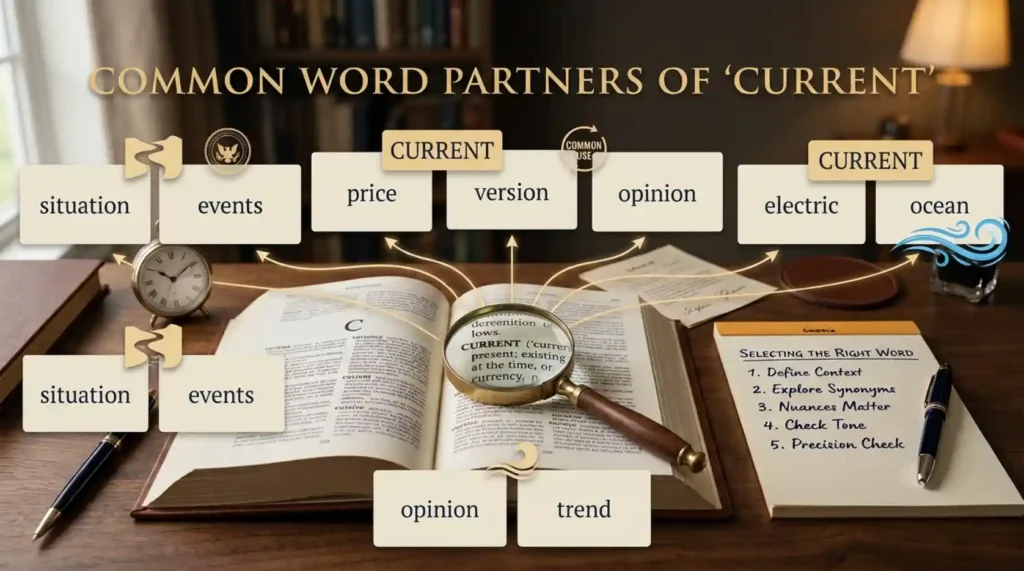
| Pattern | Common Partners | Example |
| current + noun (time) | situation, status, state, level | What is the current situation? |
| current + noun (news) | affairs, events, issues | She follows current events closely. |
| current + noun (money) | account, price, rate | The current price is lower. |
| current + noun (version) | version, edition, model | Is this the current version? |
| adjective + current | strong, powerful, swift | A strong current pulled the boat out. |
| noun + current | ocean, air, electric | An electric current passed through the wire. |
| current + of | opinion, feeling, air | A current of fear spread through the town. |
Sources: Collins Dictionary, Merriam-Webster, Oxford Learner’s Dictionaries
Idiomatic Phrases Featuring “Current”
“Current” has few true idioms. The expressions below are established phrases that use the word in a fixed way.
1. Swim against the current
- Meaning: To do the opposite of what most people are doing or believe.
- Example: She chose to swim against the current and left the big city.
2. Current affairs
- Meaning: Political and social news that is happening now. It is a fixed expression, especially common in British English.
- Example: He watches a current affairs program every evening.
3. Crosscurrents
- Meaning: Opposing influences or ideas existing at the same time.
- Example: The film explores the crosscurrents of love and duty.
4. Current account
- Meaning: A bank account used for everyday transactions, mainly in British English. In economics, it also means a country’s record of trade and payments.
- Example: She pays her bills from her current account.
Sources: Merriam-Webster, Collins Dictionary, Cambridge Dictionary
Word Formation of “Current”
Etymology & Structure
“Current” came into English from Old French corant, the present participle of courre (“to run”), which comes from Latin currere (“to run”). The idea of running or flowing is still part of its meaning today, especially in the noun sense. It is a single base word with no prefix or suffix added.
Date and History
Etymology sources place the word in English in the 14th century, first with the sense of “running” or “flowing.” Meanings tied to the present time and to general acceptance developed later from that idea of something moving along.
Word Class Variations
- Adjective: current (a current address)
- Noun: current (a strong current)
- Adverb: currently (She is currently abroad.)
- Related noun: currency (the state of being in general use; also the money used in a country)
- Related noun (rare): currentness (the quality of being current)
Sources: Etymonline, Merriam-Webster, Collins Dictionary
Common Word-Choice Mistakes
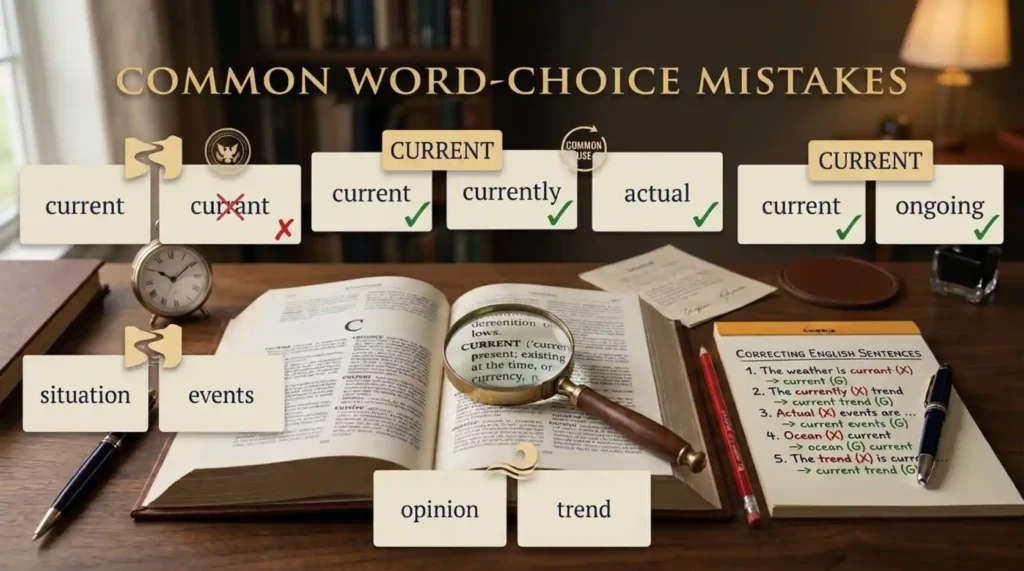
- I am study English at present time: use “at the present time” or “currently.”
- The actual price is $20 (meaning now): use “current price.” In English, “actual” means “real,” not “present.”
- My currently address: use “my current address.” “Currently” is an adverb.
- The currant situation: use “current.” A “currant” is a small dried fruit.
- Electric flow (as a technical term): use “electric current.”
- The prevailing manager: use “current” or “incumbent.” “Prevailing” describes opinions and conditions, not people.
- This ongoing price is low: use “current price.” “Ongoing” means continuing, not existing now.
Frequently Asked Questions
What is the closest synonym for “current”?
“Present” is the closest in most cases. For information that is not outdated, “up-to-date” works better.
What is a formal alternative to “current”?
“Prevailing,” “contemporary,” and “operative” are formal options, depending on the context.
What is the difference between “current” and “latest”?
“Current” means in use or true now. “Latest” means the newest in a series, and it may not be the one you are using.
Is “current” the same as “modern”?
Not exactly. “Modern” refers to a wider recent period, while “current” refers to the present moment.
What is the opposite of “current”?
It depends on the sense. “Former” and “previous” contrast with time, and “outdated” contrasts with freshness.
Can “current” be used for people?
Yes, in the sense of their present role: “my current boss.” It does not describe a person’s character.
What does “current” mean in electricity?
It means the flow of electric charge through a conductor. It is measured in amperes.
What is the difference between “current” and “currently”?
“Current” is an adjective or noun, and “currently” is an adverb meaning “at the present time.”
What is a figurative alternative to the noun “current”?
“Tide,” “trend,” and “undercurrent” can all describe a general direction or hidden feeling.
Is “current” the same as “ongoing”?
No. “Ongoing” means something has started and is still continuing, while “current” only says it is true now.
Conclusion
The closest alternatives to “current” are “present,” “existing,” “latest,” and “up-to-date.” For general acceptance, “prevailing” and “prevalent” fit well. For movement, “flow,” “stream,” “tide,” and “trend” cover the noun senses.
The right word depends on context. Some alternatives point to time, others to freshness, others to common belief, and others to movement. A word that fits one sense may sound wrong in another, so it is worth deciding which meaning you want first.
It is absolutely essential to choose words that precisely match what you are describing. For situations, “present” is generally the most suitable option, while “latest” or “up-to-date” are much better choices for versions or records. Opinions are often best described using the word “prevailing.” When describing water, air, or electricity, “flow” or “stream” provide the most accurate descriptions.