Stop Repeating “Attempt”! Try These 30 Better Words
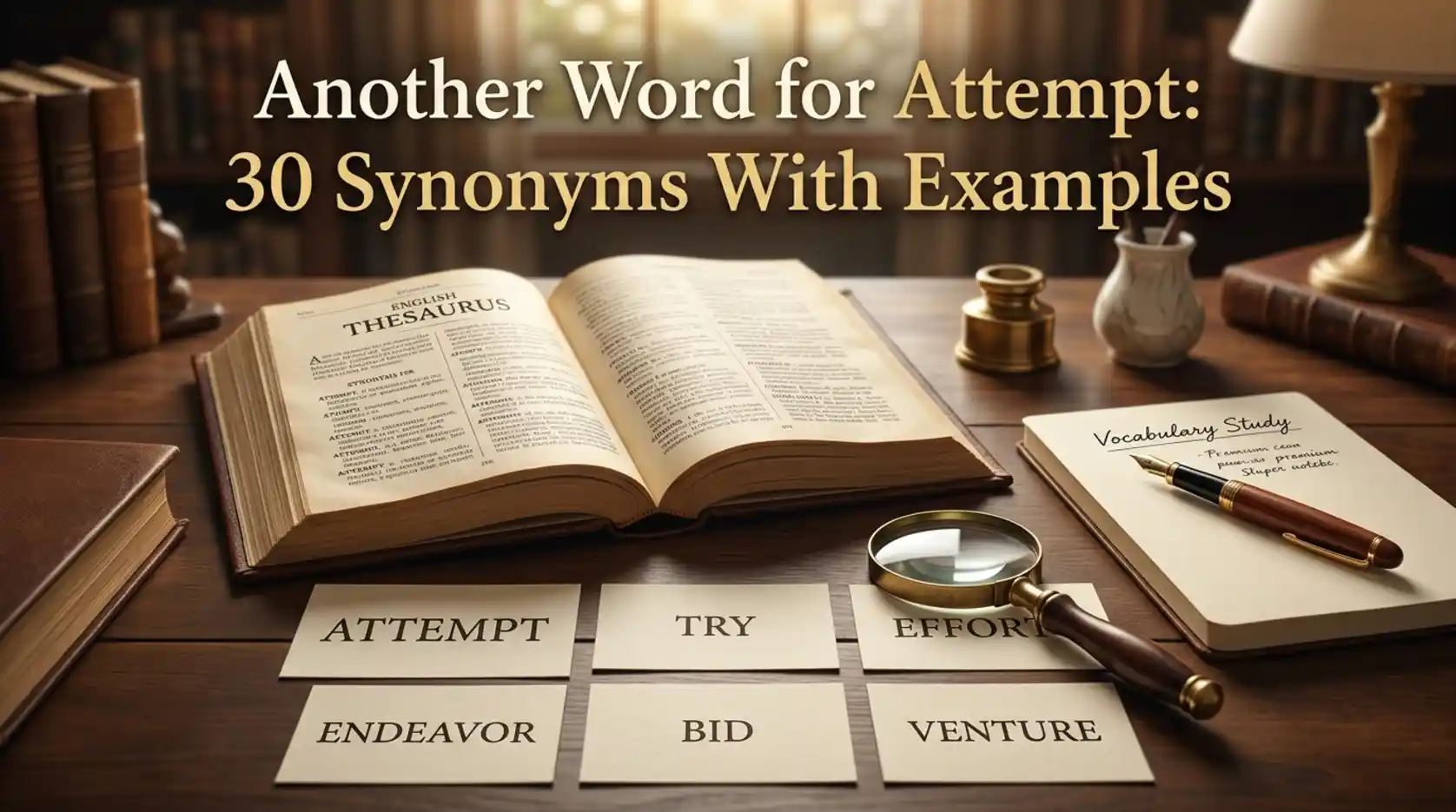
The most common everyday word for “attempt” is try. Other close alternatives are effort, endeavor, go, shot, and bid. As a verb, “attempt” means to make an effort to do something. As a noun, it means the effort itself.
The best alternative depends on what you mean. “Try” and “go” sound casual. “Endeavor” and “undertaking” sound formal. “Bid” and “push” suggest a determined effort toward a goal. “Assault” and “attack” fit when “attempt” means an attack, as in “an attempt on someone’s life.”
Quick list: try, effort, go, shot, crack, stab, endeavor, bid, venture, strive
This article looks at 30 alternatives. Each has a meaning, IPA pronunciation, usage note, and example. Some are direct synonyms and some are related words that only fit certain contexts, and the article marks which is which.
At a Glance: Attempt Synonyms and Related Alternatives
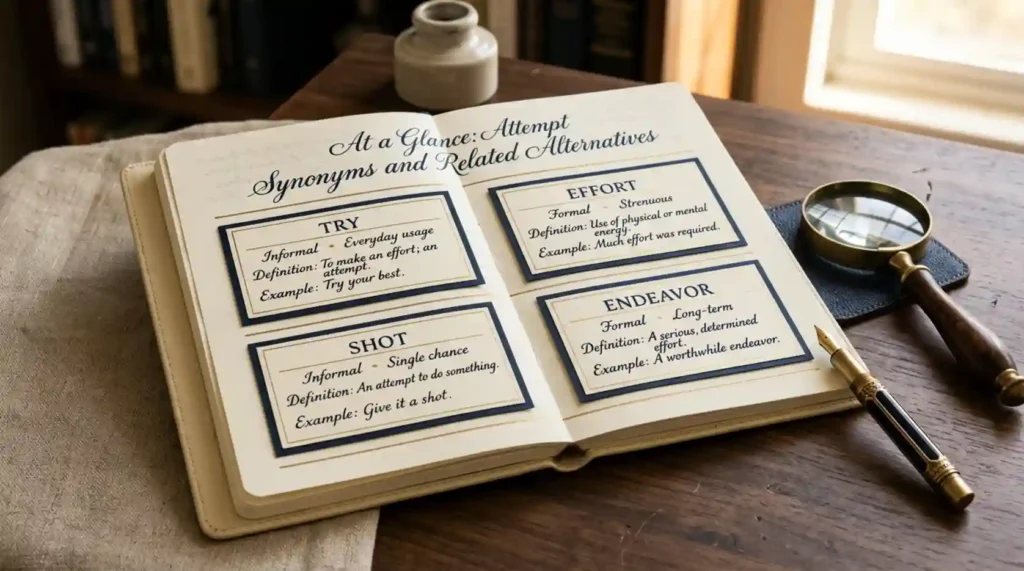
| Alternative | Part of Speech | Meaning | Register / Tone | Ideal Context |
| Try | verb, noun | to make an effort; an effort | Neutral, everyday | Almost any situation |
| Effort | noun | energy used to do something | Neutral | Stressing the work involved |
| Go | noun | a turn or try | Informal | Casual talk, games |
| Shot | noun | a try at something | Informal | Goals, chances |
| Stab | noun | a quick, rough try | Informal | Uncertain or rough tries |
| Endeavor | noun, verb | a serious, sustained attempt | Formal | Writing, official language |
| Undertaking | noun | a task or project taken on | Formal | Large projects |
| Strive | verb | to try very hard | Formal, positive | Goals and ideals |
| Bid | noun | an attempt to win or get something | Neutral, news style | Competitions, politics |
| Assault | noun | a violent or forceful attempt | Strong | Attacks, summit pushes |
Which Word Should You Use?
| If you want to… | Use | Why |
| Sound natural in daily speech | try | It is the simplest, most flexible choice. |
| Stress hard work | effort | It focuses on the energy spent, not the result. |
| Sound relaxed and friendly | go, shot | Both feel casual and low-pressure. |
| Describe a rough, uncertain try | stab, whack | They suggest the try may not succeed. |
| Write formally | endeavor, undertaking | Both suit reports and official writing. |
| Describe a try to win something | bid | It fits contests, offers, and elections. |
| Describe a first step into something new | foray | It means an early try in an unfamiliar area. |
| Describe an attack on a person or place | attack, assault | These carry the “attempt on” meaning of the word. |
Exploring the Multiple Meanings of “Attempt”
1. To Try to Do Something (verb)
- Meaning: To make an effort to do, finish, or reach something.
- Explanation: This is the most common use. It often suggests the task is hard or the result is uncertain, which makes it a little more formal than “try.”
- Example: She attempted to climb the mountain in one day.
2. An Effort or Try (noun)
- Meaning: An act of trying to do something.
- Explanation: The noun names the try itself. It is often used with words like “first,” “failed,” or “last.”
- Example: His first attempt at baking bread was a disaster.
3. An Attack (noun)
- Meaning: An effort to harm, kill, or defeat, usually followed by “on.”
- Explanation: This sense is serious and common in news writing. It does not mean the attack worked. It means someone tried.
- Example: Police stopped an attempt on the senator’s life.
4. To Take On a Task or Challenge (verb)
- Meaning: To begin work on a task, problem, or test.
- Explanation: Here the word often means starting a specific task, such as an exam question or a difficult route.
- Example: Students must attempt all five questions.
Sources: Merriam-Webster, Collins English Dictionary, Dictionary.com
Analyzing 30 Attempt Alternatives in Detail
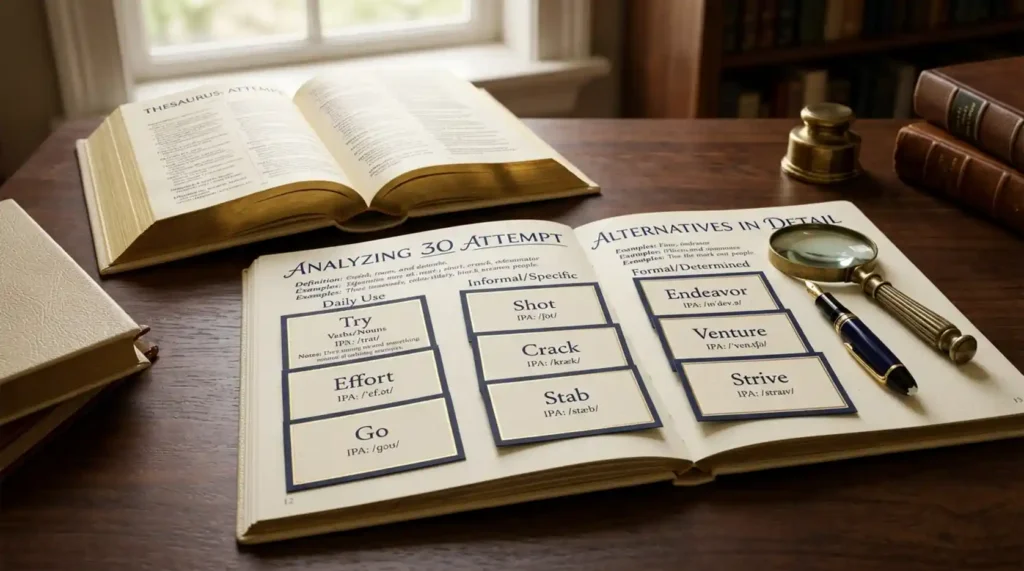
Some of these words are direct synonyms of “attempt,” while others are related words that fit only certain situations. The usage notes below clarify when and how to use each word.
Everyday Alternatives
1. Try
- IPA: /traɪ/ (US and UK)
- Definition: To make an effort to do something; an effort to do something.
- Usage: The closest everyday synonym. It works as a verb and a noun and fits nearly every informal or neutral context.
- Example: Please try to arrive early.
2. Effort
- IPA: US /ˈɛfərt/ · UK /ˈefət/
- Definition: The physical or mental energy used to do something.
- Usage: A near synonym when “attempt” means a try. It focuses on the work involved rather than on the try itself.
- Example: It was a good effort, even though we lost.
3. Go
- IPA: US /ɡoʊ/ · UK /ɡəʊ/
- Definition: A turn or a try at doing something.
- Usage: An informal noun, common in British English (“have a go”). It sounds relaxed and low-pressure.
- Example: Let me have a go at fixing it.
4. Shot
- IPA: US /ʃɑːt/ · UK /ʃɒt/
- Definition: An attempt to do or achieve something.
- Usage: Informal. It often suggests a single chance, as in “give it a shot.”
- Example: She took a shot at writing a novel.
5. Crack
- IPA: (US and UK) /kræk/
- Definition: An attempt at something, often a difficult task.
- Usage: Informal, mostly used in “have a crack at.” It suggests a bold try at something hard.
- Example: I’ll have a crack at solving the puzzle.
6. Stab
- IPA: (US and UK) /stæb/
- Definition: An attempt, often a quick or uncertain one.
- Usage: Informal, mostly in “take a stab at.” It suggests a rough first try, so it is a close synonym with a casual tone.
- Example: He took a stab at translating the poem.
Casual and Playful Tries
7. Whack
- IPA: (US and UK) /wæk/
- Definition: An attempt (informal), as in “have a whack at it.”
- Usage: Very casual and more common in British English. It is a related informal synonym, not a neutral one.
- Example: Do you want a whack at the crossword?
8. Bash
- IPA: (US and UK) /bæʃ/
- Definition: An attempt at something (informal, mainly British).
- Usage: Used in “have a bash at it.” It suggests a cheerful try with no pressure.
- Example: I had a bash at fixing the bike myself.
9. Swing
- IPA: (US and UK) /swɪŋ/
- Definition: In “take a swing at,” to try to do something.
- Usage: A related informal alternative, only in the phrase “take a swing at.” It borrows the idea of swinging at a ball.
- Example: The company took a swing at the smartphone market.
10. Punt
- IPA: (US and UK) /pʌnt/
- Definition: An attempt or a bet on something uncertain (informal, British).
- Usage: A related alternative from “have a punt.” It suggests a risky try and is uncommon in American English.
- Example: I’ll have a punt at the job application.
Formal Nouns
11. Endeavor
- IPA: US /ɛnˈdɛvər/ · UK /ɪnˈdevə/ (British spelling: endeavour)
- Definition: A serious and determined attempt or effort.
- Usage: A formal synonym. It suggests effort over time, not a quick try. It works as a noun and a verb.
- Example: Learning a language is a worthwhile endeavor.
12. Essay
- IPA: Verb: US /ɛˈseɪ/ · UK /eˈseɪ/. Noun: /ˈɛseɪ/ (US and UK).
- Definition: An attempt or effort to do something (formal, old-fashioned).
- Usage: A formal, somewhat literary synonym. Do not confuse it with the common noun “essay,” a short piece of writing. This sense is rare today.
- Example: He essayed a smile, but his eyes were sad.
13. Undertaking
- IPA: US /ˌʌndərˈteɪkɪŋ/ · UK /ˌʌndəˈteɪkɪŋ/
- Definition: A task or project that someone takes on.
- Usage: A related formal alternative. It stresses a large task, not the try itself.
- Example: Building the bridge was a huge undertaking.
Verb Alternatives
14. Venture
- IPA: US /ˈvɛntʃər/ · UK /ˈventʃə/
- Definition: To dare to do something risky or new.
- Usage: A related verb. It suggests risk and boldness, more than “attempt” does.
- Example: She ventured to ask for a raise.
15. Strive
- IPA: (US and UK) /straɪv/
- Definition: To try very hard to do or get something.
- Usage: A formal, positive verb. It is stronger than “attempt” and suggests long, hard effort.
- Example: They strive to improve every year.
16. Seek
- IPA: (US and UK) /siːk/
- Definition: To try to find or get something; to try to do something.
- Usage: Formal, usually followed by “to.” It means “attempt” in phrases like “seek to understand.”
- Example: The company seeks to reduce waste.
17. Tackle
- IPA: US /ˈtækəl/ · UK /ˈtækl/
- Definition: To try to deal with a problem or task.
- Usage: A related verb. It fits difficult problems and jobs, not every kind of try.
- Example: We need to tackle the problem now.
18. Aim
- IPA: (US and UK) /eɪm/
- Definition: To try or plan to achieve something.
- Usage: Usually followed by “to.” It emphasizes the goal more than the effort.
- Example: She aims to finish by Friday.
19. Struggle
- IPA: US /ˈstrʌɡəl/ · UK /ˈstrʌɡl/
- Definition: To try hard to do something difficult.
- Usage: A related verb. It suggests difficulty or pain, so it is not neutral like “attempt.”
- Example: He struggled to lift the heavy box.
Tests and Trials
20. Trial
- IPA: US /ˈtraɪəl/ · UK /ˈtraɪəl/
- Definition: A test of something to see how well it works.
- Usage: A related alternative. It fits experiments and product testing, not ordinary tries.
- Example: The new app is in its trial period.
21. Test
- IPA: US /tɛst/ · UK /test/
- Definition: An action to find out how good or effective something is.
- Usage: A related alternative. It suggests checking a result, not just making an effort.
- Example: They ran a test to see if the plan worked.
22. Experiment
- IPA: US /ɪkˈspɛrəmənt/ · UK /ɪkˈsperɪmənt/
- Definition: A trial of a new idea or method to learn what happens.
- Usage: A related alternative. It suggests trying something new with an unknown result.
- Example: Her first experiment with watercolors was messy but fun.
23. Tryout
- IPA: (US and UK) /ˈtraɪaʊt/
- Definition: A test of someone’s ability, often for a team or role.
- Usage: A related alternative for sports and performing. It is more specific than “attempt.”
- Example: He went to the tryout for the soccer team.
Pushes, Bids, and Attacks
24. Foray
- IPA: US /ˈfɔːreɪ/ · UK /ˈfɒreɪ/
- Definition: An early attempt to do something in a new area.
- Usage: A related alternative. It suggests a first step into unfamiliar territory.
- Example: The bakery made its first foray into online sales.
25. Bid
- IPA: (US and UK) /bɪd/
- Definition: An attempt to win, reach, or get something.
- Usage: A close synonym in news and business writing. It suggests aiming at a prize or goal.
- Example: Her bid for mayor failed.
26. Push
- IPA: (US and UK) /pʊʃ/
- Definition: A determined effort to achieve something.
- Usage: A related alternative. It suggests energy and drive, often by a group.
- Example: The school made a big push to raise money.
27. Drive
- IPA: (US and UK) /draɪv/
- Definition: An organized effort to achieve something.
- Usage: A related noun. It often describes a planned campaign, such as a fundraising drive.
- Example: The town started a drive to plant trees.
28. Campaign
- IPA: (US and UK) /kæmˈpeɪn/
- Definition: A planned series of actions to reach a goal.
- Usage: A related alternative. It is much longer and more organized than a single attempt.
- Example: The group ran a campaign to save the library.
29. Assault
- IPA: US /əˈsɔːlt/ · UK /əˈsɒlt/
- Definition: A violent attack, or a strong effort to defeat or reach something.
- Usage: A related alternative. It fits the “attack” meaning of attempt and strong efforts such as “an assault on the summit.”
- Example: The team made an assault on the mountain peak.
30. Attack
- IPA: (US and UK) /əˈtæk/
- Definition: A violent action meant to hurt or defeat.
- Usage: A related alternative that fits only the “attempt on” sense. It cannot replace “attempt” in ordinary uses.
- Example: The attack on the castle failed.
Sources: Merriam-Webster, Collins English Dictionary and Thesaurus, Dictionary.com, Oxford Learner’s Dictionaries
Attempt vs. Try vs. Endeavor vs. Effort
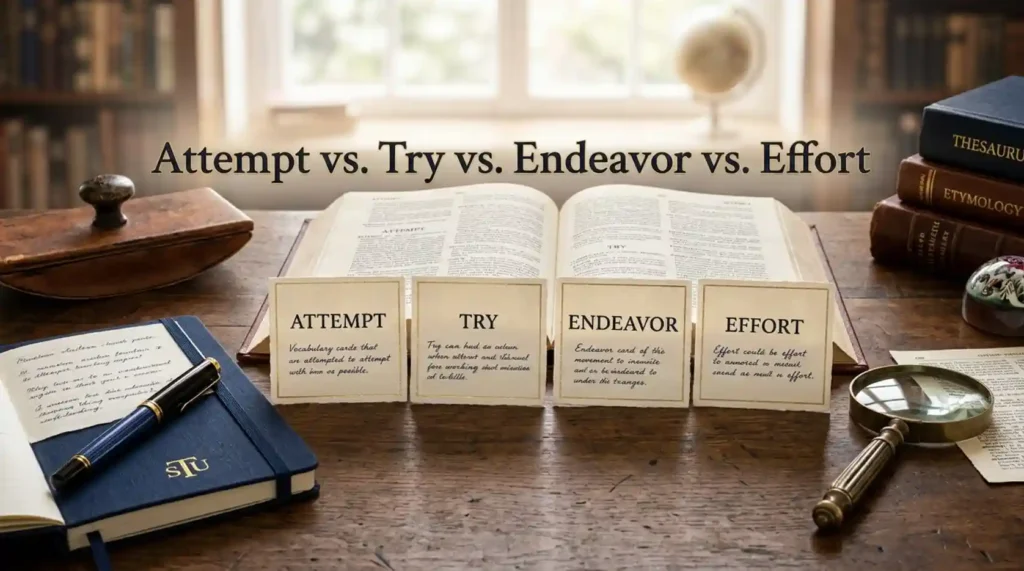
These four words overlap but feel different.
| Word | Main Focus | Tone | Example |
| Attempt | The try itself, often hard or uncertain | Neutral to formal | They attempted the climb in winter. |
| Try | The try, in simple terms | Casual | Try the soup. |
| Endeavor | Serious, sustained effort | Formal | He endeavored to finish the book. |
| Effort | The energy spent | Neutral | She put a lot of effort into it. |
“Attempt” is a good middle choice. It sounds more serious than “try” but less formal than “endeavor.” “Effort” is the odd one out, because it describes the energy used, not the try itself.
Sources: Merriam-Webster, Collins English Dictionary
Attempt and Opposite/Paired Word Pairs
| Word | Paired Word | Note |
| Attempt | Success | The most common pair. An attempt can end in success or failure. |
| Attempt | Failure | “A failed attempt” is a very common phrase. |
| Attempt | Achievement | Shows the difference between trying and reaching a goal. |
| Attempt | Give up | Often paired as the choice between trying and stopping. |
| Attempt | Succeed | The verb form of the same contrast. |
“Attempt” has no true antonym. The closest contrast is not trying at all, or the result of the try, which is success or failure. The words above are best understood as natural pairs, not exact opposites.
Sources: Merriam-Webster, Collins English Thesaurus
Common Word Partners of “Attempt”
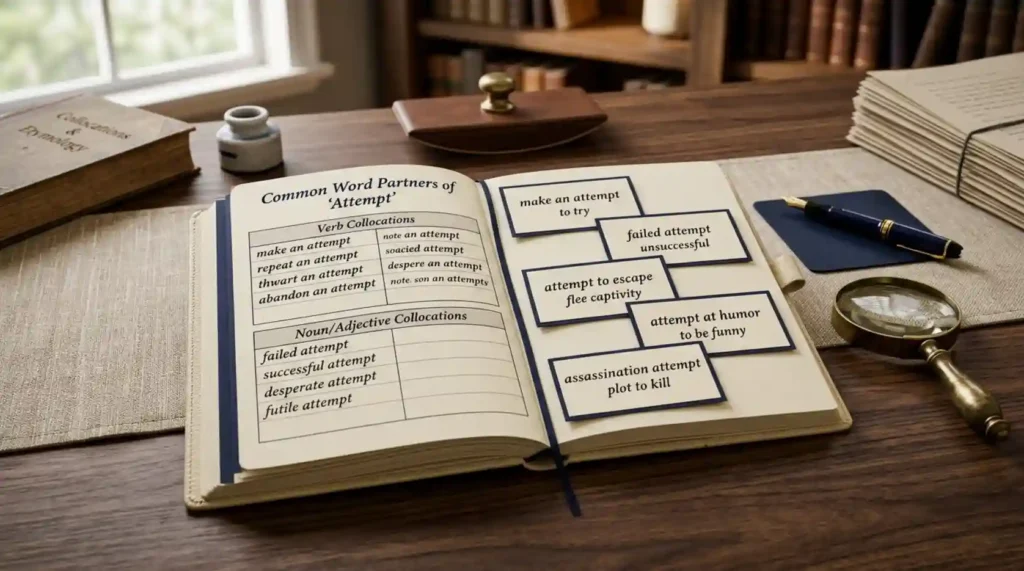
| Pattern | Common Partners | Example |
| verb + attempt | make, abandon, repeat | They made another attempt to call. |
| adjective + attempt | first, failed, vain, desperate | It was a desperate attempt to win. |
| attempt + to + verb | attempt to escape, attempt to solve | He attempted to leave quietly. |
| attempt + at + noun | attempt at humor, attempt at peace | It was a clumsy attempt at humor. |
| attempt + on | attempt on his life, attempt on the record | She made an attempt on the world record. |
| noun + attempt | assassination attempt, escape attempt | The guards stopped an escape attempt. |
Sources: Collins English Dictionary, Oxford Learner’s Dictionaries, Merriam-Webster
Idiomatic Phrases Featuring “Attempt”
“Attempt” has few true idioms. The items below are established expressions that appear often in speech and writing.
1. In an attempt to
- Meaning: With the aim of doing something.
- Example: She woke early in an attempt to beat the traffic.
2. An attempt on someone’s life
- Meaning: An effort to kill someone.
- Example: The leader survived an attempt on his life.
3. Attempted murder
- Meaning: The crime of trying to kill someone and failing.
- Example: The man was charged with attempted murder.
4. At the first attempt
- Meaning: On the first try.
- Example: She passed her driving test at the first attempt.
Sources: Collins English Dictionary, Merriam-Webster, Oxford Learner’s Dictionaries
Word Formation of “Attempt”
Etymology & Structure
“Attempt” comes from Old French attempter, which comes from Latin attemptare, meaning “to try” or “to make an attempt on.” The Latin word joins ad- (to) with temptare (to test or try). It is related to the word “tempt.”
Date and History
The verb appears in English in the late 1300s. The noun use came later, in the 1500s, according to Etymonline.
Word Class Variations
- Verb: attempt, attempts, attempted, attempting
- Noun: attempt
- Adjective: attempted (as in “attempted robbery”)
- Related forms: attempter (rare), unattempted
Sources: Etymonline, Merriam-Webster, Collins English Dictionary
Common Word-Choice Mistakes
- He attempted to success: he attempted to succeed (use a verb after “to”).
- She made an attempt for the job: an attempt at or an attempt to get the job.
- I will attempt to doing it: I will attempt to do it.
- They did an attempt: they made an attempt.
- An attempt of murder: an attempt on his life, or attempted murder.
- He attempted me to go: he tried to make me go, or he attempted to persuade me.
- Endeavour and endeavor as different words: they are the same word, spelled differently in British and American English.
Frequently Asked Questions
What is the closest synonym for “attempt”?
“Try” is the closest and most common. It works as both a verb and a noun.
What is a formal alternative to “attempt”?
“Endeavor” and “undertaking” are formal. “Strive” is a formal verb that means trying very hard.
What is a casual alternative?
“Go,” “shot,” “stab,” and “crack” are all informal.
What is the difference between “attempt” and “try”?
They mean almost the same thing. “Attempt” sounds more formal and often suggests a harder or less certain task.
Can “attempt” mean an attack?
Yes. In phrases like “an attempt on his life,” it means an attempt to harm or kill someone.
What is the opposite of “attempt”?
There is no exact opposite. The closest ideas are success, failure, or giving up.
Is “attempt” a verb or a noun?
Both. “He will attempt the jump” is a verb. “It was a good attempt” is a noun.
Does “attempt” always mean the try failed?
No. It means the try was made. The result may be success or failure, though “attempt” often hints at difficulty.
Which word is best for a first step into something new?
“Foray” fits well, as in “a first foray into acting.”
Is “endeavour” the same as “endeavor”?
Yes. “Endeavour” is the British spelling and “endeavor” is the American spelling.
Conclusion
The closest everyday alternative to “attempt” is “try.” For a casual tone, use “go,” “shot,” or “stab.” For a formal tone, “endeavor” and “undertaking” work well.
Context matters most. “Bid” fits a try to win something, “foray” fits a first try in a new area, and “assault” or “attack” fit the meaning of an attempt to harm. Words like “trial,” “test,” and “campaign” are related but not exact synonyms.
To choose well, ask three questions: How formal is the setting? Is the focus on the effort or the goal? Does the sentence mean an ordinary try or an attack? The answers will point you to the right word.