
Need Another Word for “Gave”? These 30 Choices Will Help
The closest everyday alternatives to “gave” are handed, offered, provided, and presented. If someone gave money or a gift, donated, gifted, or contributed may fit better. “Gave” is the past tense of “give,” and it covers many ideas: passing an object, offering help, causing a feeling, giving a speech, or collapsing under pressure. The best alternative depends on which of these you mean.
Formal writing often prefers words like granted, awarded, conferred, or bestowed. Other contexts call for different words: lent for temporary giving, imparted or conveyed for information, produced or caused for results, and sacrificed or surrendered for giving up something important.
Quick list: handed, offered, provided, presented, donated, granted, awarded, lent, delivered, imparted
This article looks at 30 alternatives to “gave.” Each one comes with a meaning, IPA, usage note, and example sentence, so you can see when it works and when it does not.
At a Glance: Gave Synonyms and Related Alternatives

| Alternative | Part of Speech | Meaning | Register / Tone | Ideal Context |
| handed | verb | passed something to someone by hand | Neutral, everyday | Physical objects |
| offered | verb | held out something for someone to accept | Neutral | Help, food, advice, money |
| provided | verb | made something available | Neutral to formal | Needs, services, supplies |
| donated | verb | gave to a cause or charity | Neutral to formal | Charity, blood, money, goods |
| granted | verb | formally allowed or gave | Formal | Permission, requests, rights |
| awarded | verb | gave as a prize or official honor | Formal | Prizes, grades, contracts |
| lent | verb | gave for a limited time | Neutral | Borrowed items, money |
| delivered | verb | brought and handed over | Neutral | Packages, speeches, results |
| imparted | verb | passed on knowledge or a quality | Formal, literary | Knowledge, skills, feelings |
| yielded | verb | produced a result, or gave way | Neutral to formal | Crops, results, pressure |
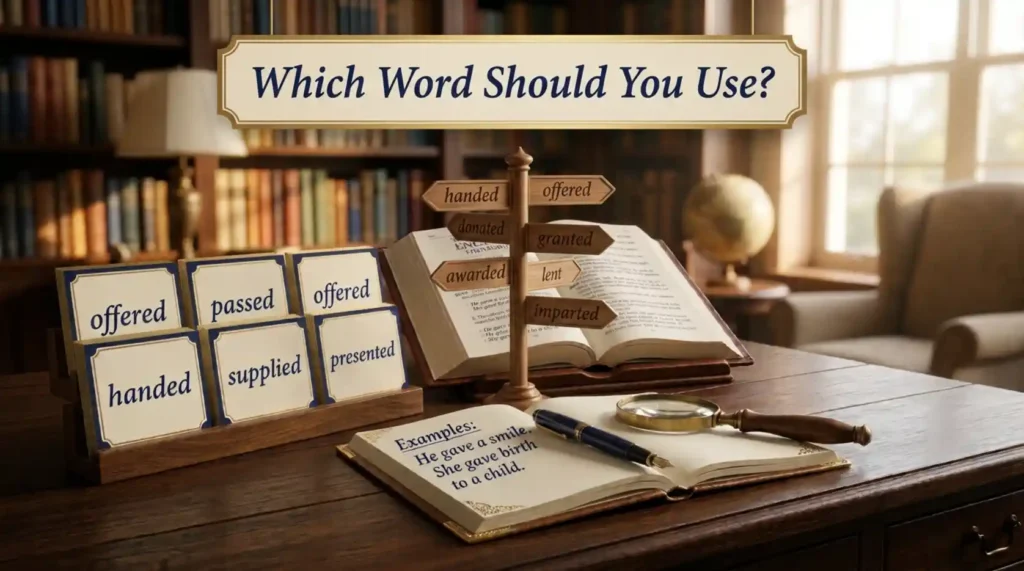
Which Word Should You Use?
| If you want to… | Use | Why |
| Say someone passed an object by hand | handed | It is simple and shows the physical action. |
| Say someone made an offer | offered | The other person may or may not accept. |
| Describe a gift to charity | donated | It suggests giving to a cause or organization. |
| Describe official permission | granted | It sounds formal and shows authority. |
| Describe a prize or honor | awarded | It fits competitions, schools, and contracts. |
| Say something was given for a short time | lent | It means the item will be returned. |
| Say someone taught or passed on knowledge | imparted | It fits skills, wisdom, and information. |
| Say something collapsed or gave way | buckled | It describes structures failing under pressure. |
Exploring the Multiple Meanings of “Gave”
1. Handed Over or Transferred
- Meaning: Put something into someone’s hands or possession.
- Explanation: This is the most basic sense. The giver passes an object to another person, often without payment. Words like handed and passed fit this sense best.
- Example: She gave him the keys before she left.
2. Provided, Offered, or Supplied
- Meaning: Made something available to someone, such as help, advice, or information.
- Explanation: Nothing may physically change hands here. The thing given is often not an object, such as advice, a chance, or support.
- Example: The coach gave the players clear advice.
3. Donated or Presented as a Gift
- Meaning: Handed over something freely, often for a cause or as a gift.
- Explanation: This sense stresses generosity or a formal gift. It includes money, time, blood, and prizes.
- Example: The family gave a large sum to the local library.
4. Caused or Produced
- Meaning: Made something happen or brought about a result.
- Explanation: “Gave” can describe results and feelings, as in “gave me a fright.” It can also describe what a plant or animal produces.
- Example: The loud noise gave me a headache.
5. Performed or Carried Out an Action
- Meaning: Did a particular act, often with a noun such as “speech,” “smile,” or “push.”
- Explanation: Here “gave” works as a light verb. The noun carries most of the meaning, so a stronger verb often exists, such as smiled or pushed.
- Example: He gave a short speech at the dinner.
6. Gave Way or Collapsed
- Meaning: Bent, broke, or failed under pressure.
- Explanation: This sense usually appears in the phrase “gave way,” or on its own for things such as ice, floors, or knees.
- Example: The old bridge gave way under the heavy truck.
Sources: Merriam-Webster (give); Collins English Dictionary (give); Dictionary.com (give)
Analyzing 30 Gave Alternatives in Detail

Some alternatives below are direct synonyms of “gave,” while others are related words that fit only certain contexts, and each Usage note says which is which.
Everyday Handing Over and Offering
1. Handed
IPA: /ˈhændɪd/ (US and UK)
Definition: Passed something to someone using the hand.
- Usage: A direct synonym for the physical sense of “gave.” It is neutral and very common.
- Example: He handed me a cup of tea.
2. Passed
IPA: US /pæst/ · UK /pɑːst/
Definition: Moved something from one person to another.
- Usage: A close synonym when an object moves between people, especially at a table or in a line. It is less warm than “gave.”
- Example: She passed the salt to her brother.
3. Offered
IPA: US /ˈɔːfərd/ · UK /ˈɒfəd/
Definition: Held out or proposed something for another person to accept.
- Usage: A related alternative. “Gave” says the person received it, while “offered” does not.
- Example: The neighbor offered us a ride to the station.
4. Provided
IPA: /prəˈvaɪdɪd/ (US and UK)
Definition: Made something available for use.
- Usage: A close synonym for giving what is needed. It sounds more formal than “gave” and suits services, help, and supplies.
- Example: The school provided free lunches for the students.
5. Supplied
IPA: /səˈplaɪd/ (US and UK)
Definition: Gave something that is needed, often in quantity.
- Usage: A related alternative for goods, materials, or information. It is often followed by “with.”
- Example: The farm supplied the shop with fresh eggs.
6. Presented
IPA: /prɪˈzentɪd/ (US and UK)
Definition: Gave something formally or with some ceremony.
- Usage: A close synonym in formal settings such as awards and gifts. It is stronger than plain “gave.”
- Example: The mayor presented her with a medal.
Gifts, Donations, and Formal Honors
7. Donated
IPA: US /ˈdoʊneɪtɪd/ · UK /dəʊˈneɪtɪd/
Definition: Gave something, such as money or goods, to a charity or cause.
- Usage: A narrower synonym. It fits charity and public causes, not everyday handing over.
- Example: They donated their old books to the library.
8. Contributed
IPA: /kənˈtrɪbjuːtɪd/ (US and UK)
Definition: Gave something, such as money or effort, along with others toward a shared goal.
- Usage: A related alternative. It suggests the giver is one of several people giving.
- Example: Every student contributed a few dollars to the class gift.
9. Gifted
IPA: /ˈɡɪftɪd/ (US and UK)
Definition: Gave something as a present.
- Usage: A close synonym for giving a present. Some writers still prefer “gave” or “presented” in formal writing, though dictionaries list “gift” as a verb.
- Example: Her uncle gifted her a camera for her birthday.
10. Granted
IPA: US /ˈɡræntɪd/ · UK /ˈɡrɑːntɪd/
Definition: Gave or allowed something, often officially.
- Usage: A formal alternative for permission, requests, rights, or money from an authority. It does not fit physical objects.
- Example: The court granted him extra time.
11. Awarded
IPA: US /əˈwɔːrdɪd/ · UK /əˈwɔːdɪd/
Definition: Gave something as a prize, honor, or official decision.
- Usage: A formal alternative for prizes, marks, damages, or contracts.
- Example: The committee awarded the prize to a young scientist.
12. Bestowed
IPA: US /bɪˈstoʊd/ · UK /bɪˈstəʊd/
Definition: Gave something valuable or important, often as an honor.
- Usage: A formal and somewhat old-fashioned alternative. It is often followed by “on” or “upon,” as in “bestowed a title on someone.”
- Example: The queen bestowed a knighthood on the doctor.
Official Transfers and Responsibility
13. Conferred
IPA: US /kənˈfɜːrd/ · UK /kənˈfɜːd/
Definition: Gave a title, degree, or honor.
- Usage: A formal alternative used mainly for degrees, titles, and honors. It is narrower than “gave.”
- Example: The university conferred an honorary degree on the author.
14. Allotted
IPA: US /əˈlɑːtɪd/ · UK /əˈlɒtɪd/
Definition: Gave a share or portion, often by plan or rule.
- Usage: A related alternative for shares of time, money, or space. It suggests a fixed amount.
- Example: The teacher allotted ten minutes to each speaker.
15. Assigned
IPA: /əˈsaɪnd/ (US and UK)
Definition: Gave a task, role, or item to a particular person.
- Usage: A related alternative for duties, seats, or homework. It does not mean giving a gift.
- Example: The manager assigned the project to two new employees.
16. Delivered
IPA: US /dɪˈlɪvərd/ · UK /dɪˈlɪvəd/
Definition: Brought something to a person or place and handed it over.
- Usage: A related alternative. It suits packages, messages, and speeches, and it can also mean “gave birth to” in some contexts.
- Example: The courier delivered the parcel before noon.
17. Entrusted
IPA: /ɪnˈtrʌstɪd/ (US and UK)
Definition: Gave someone the care of something important.
- Usage: A related alternative. It suggests trust and responsibility, and the item is usually valuable or important.
- Example: She entrusted her neighbor with a spare key.
18. Distributed
IPA: /dɪˈstrɪbjuːtɪd/ (US and UK)
Definition: Gave out shares or items to several people.
- Usage: A related alternative for giving to many people. “Gave” is more general.
- Example: The volunteers distributed blankets to families in the shelter.
Lending, Sharing, and Passing On Knowledge
19. Lent
IPA: /lent/ (US and UK)
Definition: Gave something for a short time, expecting it back.
- Usage: A related alternative with an important limit. “Gave” suggests the person keeps the item, while “lent” does not.
- Example: I lent her my umbrella.
20. Loaned
IPA: US /loʊnd/ · UK /ləʊnd/
Definition: Lent something, especially money or valuable items.
- Usage: A close relative of “lent.” It is common in financial and museum contexts.
- Example: The museum loaned the painting to a gallery in Paris.
21. Imparted
IPA: US /ɪmˈpɑːrtɪd/ · UK /ɪmˈpɑːtɪd/
Definition: Gave knowledge, a quality, or a feeling to someone.
- Usage: A formal and slightly literary alternative. It fits knowledge, skills, and qualities, not physical objects.
- Example: The old teacher imparted his love of history to his students.
22. Conveyed
IPA: /kənˈveɪd/ (US and UK)
Definition: Made an idea, feeling, or message known to someone.
- Usage: A related alternative for messages and feelings. It does not suit gifts or objects in this sense.
- Example: Her smile conveyed her thanks.
23. Shared
IPA: US /ʃerd/ · UK /ʃeəd/
Definition: Gave part of something to another person or let them use it.
- Usage: A related alternative. It means the giver also keeps some of the item or information.
- Example: He shared his notes with the whole class.
Producing and Causing
24. Produced
IPA: US /prəˈduːst/ · UK /prəˈdjuːst/
Definition: Made or brought forth something.
- Usage: A related alternative for the “caused or brought forth” sense. It suits plants, animals, and results.
- Example: The apple tree produced a large crop this year.
25. Caused
IPA: /kɔːzd/ (US and UK)
Definition: Made something happen.
- Usage: A close synonym for “gave” in phrases such as “gave me a fright.” It does not suit physical objects.
- Example: The long trip caused her a lot of back pain.
26. Yielded
IPA: /ˈjiːldɪd/ (US and UK)
Definition: Produced a result, or gave way.
- Usage: A related alternative with two uses: crops and results (“yielded good fruit”) and giving way (“yielded to pressure”). Context makes the meaning clear.
- Example: The experiment yielded surprising results.
Giving Up, Giving Way, and Devoting
27. Devoted
IPA: US /dɪˈvoʊtɪd/ · UK /dɪˈvəʊtɪd/
Definition: Gave time, effort, or attention to a purpose.
- Usage: A related alternative for time, energy, or attention. It is not used for objects.
- Example: She devoted ten years to her research.
28. Sacrificed
IPA: /ˈsækrɪfaɪst/ (US and UK)
Definition: Gave up something valuable for a greater purpose.
- Usage: A related alternative that suggests loss. “Gave” can be neutral, but “sacrificed” always implies a cost.
- Example: He sacrificed his free time to care for his mother.
29. Surrendered
IPA: US /səˈrendərd/ · UK /səˈrendəd/
Definition: Gave up control or possession, often under pressure.
- Usage: A related alternative for “gave up” or “gave in.” It suggests defeat, not generosity.
- Example: The soldiers surrendered their weapons.
30. Buckled
IPA: /ˈbʌkəld/ (US and UK)
Definition: Bent or collapsed under pressure.
- Usage: A related alternative for the “gave way” sense only. It fits knees, beams, and roofs, and it cannot replace “gave” when someone hands something over.
- Example: The old shelf buckled under the weight of the books.
Sources: Merriam-Webster; Collins English Dictionary and Collins Thesaurus; Dictionary.com
Gave vs. Given vs. Give: Which Form to Use
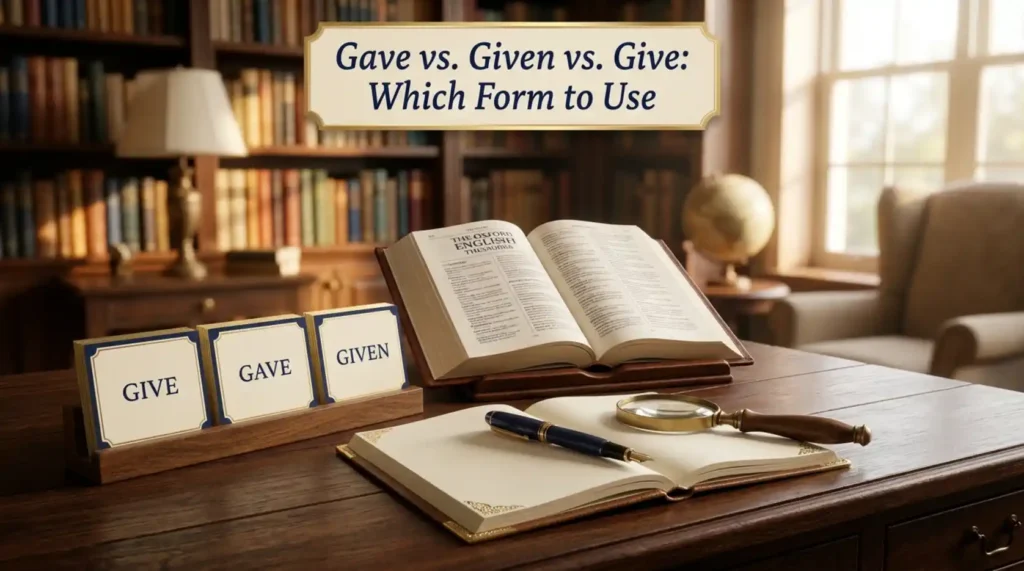
“Gave” is easy to confuse with “given,” and the mistake is common in everyday English.
| Form | Role | Example |
| give | base form (present tense) | I give my sister a book every year. |
| gave | simple past tense | I gave my sister a book last year. |
| given | past participle (used with have, has, had, or be) | I have given my sister a book. |
The rule is simple. Use “gave” alone for a finished past action. Use “given” when a helping verb comes before it, as in “has given,” “had given,” or “was given.”
Sources: Merriam-Webster (give); Collins English Dictionary (give)
Gave and Opposite/Paired Word Pairs
| Word | Paired Word | Note |
| gave | took | The most direct opposite of giving. |
| gave | received | Shows the other side of the same action. |
| gave | got | Everyday and informal. |
| gave | kept | Contrasts handing over with holding on. |
| gave | withheld | Formal; means refused to give. |
| gave | borrowed | The opposite of “lent,” a type of giving. |
“Took” is the best true opposite, since giving and taking move an item in opposite directions. “Received” and “got” show the same event from the receiver’s side, so they are partners more than opposites. For other senses of “gave,” the contrast changes: “kept” or “withheld” fits generosity, while “held firm” contrasts with “gave way.”
Sources: Merriam-Webster Thesaurus (give); Collins English Thesaurus (give)
Common Word Partners of “Gave”
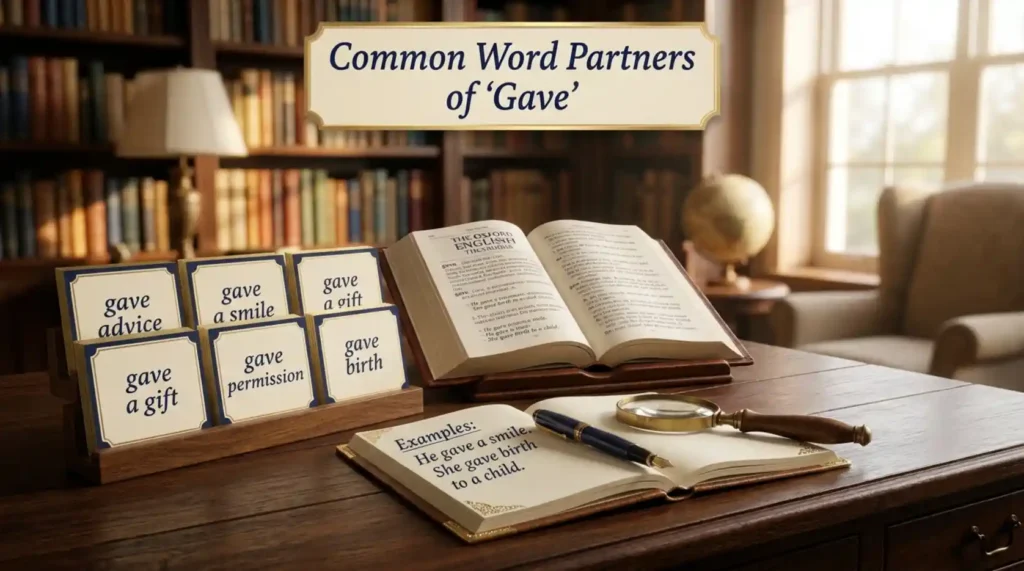
| Pattern | Common Partners | Example |
| gave + noun (communication) | a speech, a talk, a lecture, advice, an answer, a warning | The mayor gave a short speech. |
| gave + person + noun | her a gift, him a chance, us a lift | They gave us a lift home. |
| gave + noun (action) | a smile, a shrug, a push, a hug | She gave him a warm smile. |
| gave + noun (permission/support) | permission, consent, support, approval | The parents gave their consent. |
| gave + noun (life events) | birth, a party | She gave birth to twins. |
| gave + particle | away, back, up, in, out, off | He gave back the borrowed book. |
Sources: Collins English Dictionary (give); Merriam-Webster (give); Cambridge Dictionary (give)
Idiomatic Phrases Featuring “Gave”
1. Gave way
- Meaning: Collapsed or broke under pressure, or gave in to someone or something.
- Example: The wooden floor gave way under the piano.
2. Gave rise to
- Meaning: Caused something to begin or develop.
- Example: The new road gave rise to a busy shopping area.
3. Gave up the ghost
- Meaning: Stopped working or, in older use, died. It is often used humorously for machines.
- Example: My old laptop finally gave up the ghost last night.
4. Gave as good as he got
- Meaning: Defended himself equally well when attacked, in words or in a fight.
- Example: The younger player gave as good as he got in the match.
Sources: Merriam-Webster (give way, give rise to, give up the ghost); Collins English Dictionary (give as good as you get)
Word Formation of “Gave”
Etymology & Structure
“Gave” is the past tense of the verb “give,” which comes from Old English and has relatives across the Germanic languages. The modern hard “g” sound is usually traced to influence from Old Norse. “Gave” is a strong (irregular) past form, which changes the vowel instead of adding “-ed.” The pattern is give, gave, given.
Date and History
“Give” goes back to Old English. Etymonline lists the early forms and the Germanic roots. Exact dates for the earliest use of the past form “gave” should be checked in the Oxford English Dictionary or Etymonline.
Word Class Variations
- Verb: give, gives, gave, given, giving
- Noun: giver (a person who gives), giveaway, give (as in “a bit of give” in a material)
- Adjective: given (as in “at a given time”), giving (as in “a giving person”)
- Related forms: forgive, giveaway, given name
Sources: Etymonline (give); Merriam-Webster (give)
Common Word-Choice Mistakes
- “I have gave him the book”: I have given him the book.
- “She gave me an advice”: She gave me advice (or a piece of advice).
- “He donated me some money”: He gave me some money, or he donated money to the school.
- “She supplied me of fresh fruit”: She supplied me with fresh fruit.
- “He lent from me a pen”: He borrowed a pen from me, or he lent me a pen.
- “The title was bestowed me”: The title was bestowed on me.
- “The rain gave a flood”: The rain caused a flood.
Frequently Asked Questions
What is the closest synonym for “gave”?
“Handed” is the closest for physical objects. For broader uses, “provided” and “offered” work in many sentences.
What is a formal word for “gave”?
“Granted,” “awarded,” “bestowed,” and “conferred” are formal. Choose based on what was given.
What is the difference between “gave” and “given”?
“Gave” is the simple past tense. “Given” is the past participle, used after “have,” “has,” “had,” or a form of “be.”
What is the difference between “gave” and “lent”?
“Gave” usually means the person keeps the item. “Lent” means it must be returned.
Can “gave” mean “caused”?
Yes. In “The noise gave me a headache,” “gave” means caused. “Caused” is a clear alternative there.
What does “gave way” mean?
It means collapsed under pressure, or gave in to someone. “Buckled” and “yielded” can replace it in some sentences.
What is a good word for gave money to charity?
“Donated” is the best fit. “Contributed” also works when many people give.
What is the opposite of “gave”?
“Took” is the most direct opposite. “Kept” and “withheld” also work in some contexts.
Is “gifted” correct as a verb?
Yes, dictionaries list it, and it means gave as a present. Some people still prefer “gave” or “presented” in formal writing.
Can “gave” be used for non-physical things?
Yes. People give advice, time, support, permission, and attention.
Conclusion
The closest alternatives to “gave” are “handed,” “offered,” “provided,” and “presented.” For gifts and charity, “donated,” “gifted,” and “contributed” fit well. For official or formal giving, “granted,” “awarded,” “conferred,” and “bestowed” are better choices.
Context matters because “gave” has many senses. It can mean handing over, providing, causing, performing an action, or collapsing under pressure. A word that fits one sense, such as “lent” or “buckled,” may not work in another.
To choose the right word, first decide what “gave” means in your sentence. Then ask If the giving is permanent or temporary, formal or casual, and physical or not. The answer will usually point to one clear alternative.