Say It More Clearly! 30 Alternatives to the Word “Even”
The closest everyday alternatives to even are still, flat, level, equal, and smooth—but the right word depends on If you mean emphasis, a flat surface, fairness, a steady amount, or an even number. Because even works as an adjective, adverb, and verb, no single synonym replaces it in every sentence.
Quick list: still, yet, flat, level, smooth, equal, uniform, steady, fair, balanced
This article examines 30 alternatives for even, with meanings, IPA, usage notes, natural examples, and the contexts where each word works best.
At a Glance: even Synonyms and Related Alternatives
| Alternative | Part of Speech | Meaning | Register / Tone | Ideal Context |
| Still | Adverb | Used to strengthen a comparative | Neutral | “even better,” “even more useful” |
| Yet | Adverb | Used to strengthen a comparative, often formal | Formal / literary | “a yet stronger argument” |
| Flat | Adjective | Having a level, smooth surface | Neutral | “a flat road” |
| Level | Adjective | Flat or at the same height | Neutral | “a level table” |
| Smooth | Adjective | Without bumps, roughness, or breaks | Neutral | “a smooth surface” |
| Equal | Adjective | The same in size, amount, or value | Neutral | “equal shares” |
| Uniform | Adjective | The same throughout; not varying | Formal | “a uniform temperature” |
| Steady | Adjective | Regular, stable, or unchanging | Neutral | “a steady pace” |
| Fair | Adjective | Treating people equally; impartial | Neutral | “a fair decision” |
| Balanced | Adjective | Fairly divided or stable | Neutral | “a balanced budget” |
Which Word Should You Use?
| If you want to… | Use | Why |
| Emphasize a comparison | Still, yet | “Even better” means “better still”; yet sounds more formal. |
| Describe a surface | Flat, level, smooth | Flat means not curved; level means horizontal; smooth means not rough. |
| Talk about equal amounts | Equal, identical, matching | These stress sameness in quantity, size, or appearance. |
| Describe a regular rate or temperature | Steady, uniform, constant | These emphasize lack of change over time. |
| Describe fairness | Fair, impartial, balanced | These apply to decisions, treatment, or competition. |
| Describe a tied score | Level, tied, all square | These are natural in sports and contests. |
| Make a surface flat | Level, smooth, flatten | These are verb alternatives to “even out.” |
| Refer to numbers divisible by two | Even | There is no exact everyday synonym; “divisible by two” is the clearest explanation. |
Exploring the Multiple Meanings of “even”
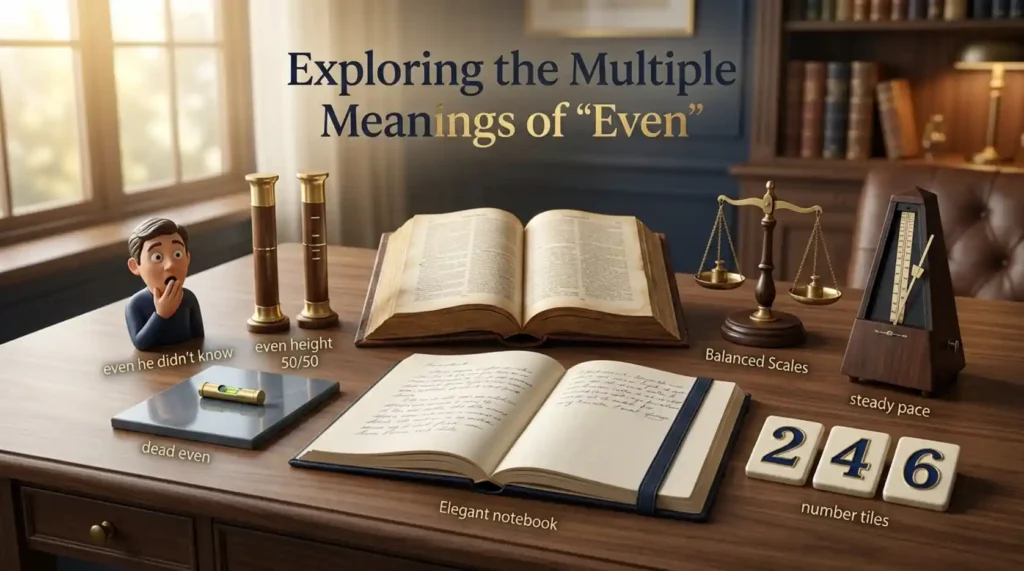
1. Emphasis or Surprise
- Meaning: Used to stress something surprising, extreme, or unexpected.
- Explanation: As an adverb, even points to an unusual or extreme case, such as “even a child” or “not even once.”
- Example: She was so tired that she did not even hear the phone ring.
2. Stronger Comparison
- Meaning: Used before a comparative to mean “still” or “yet.”
- Explanation: It increases the degree expressed by words such as better, more, faster, or harder.
- Example: The second draft was even clearer than the first.
3. Flat or Smooth
- Meaning: Having a level surface without bumps or irregularities.
- Explanation: As an adjective, even describes physical smoothness or a surface that is level.
- Example: Spread the paint over an even surface.
4. Equal or Fair
- Meaning: The same in amount, degree, or status; also fair or impartial.
- Explanation: This sense covers equal shares, balanced scores, and fair treatment.
- Example: The teams were even at halftime.
5. Regular or Unchanging
- Meaning: Steady, consistent, or without variation.
- Explanation: It can describe a calm voice, a regular rhythm, or a stable temperature.
- Example: He spoke in an even tone during the meeting.
6. Divisible by Two
- Meaning: A number that can be divided exactly by two.
- Explanation: This is the mathematical sense: 2, 4, 6, 8, and 10 are even numbers; 1, 3, 5, 7, and 9 are odd.
- Example: Choose an even number between 1 and 20.
Sources: Merriam-Webster; Collins English Dictionary; Cambridge Dictionary; Dictionary.com.
Analyzing 30 Even Alternatives in Detail
Some alternatives below are direct synonyms in one sense of “even,” while others work only in a particular context.
1. Emphasis and Comparison
1. Still
IPA: /stɪl/ (US and UK)
Definition: Used to emphasize a comparative, meaning “even more” or “to a greater degree.”
Usage: A direct replacement in phrases such as “even better” or “even more difficult.” It is neutral and very common.
Example: The mountain trail became still steeper after the bridge.
2. Yet
IPA: /jɛt/ (US and UK)
Definition: Used to emphasize a comparative, often meaning “even more.”
Usage: A formal or literary alternative to still before comparatives. It is less common in casual speech.
Example: The final chapter is yet more moving than the opening.
3. Indeed
IPA: /ɪnˈdiːd/ (US and UK)
Definition: Used to add emphasis or confirm something strongly.
Usage: Related rather than exact: it can replace even when even emphasizes identity or truth, as in “even the manager agreed.”
Example: The plan was ambitious—indeed, almost impossible.
4. In Fact
IPA: /ɪn fækt/ (US and UK)
Definition: Used to introduce a stronger or more accurate statement.
Usage: A natural phrase alternative when even introduces a stronger point, but it cannot replace even before a comparative.
Example: The problem was serious; in fact, it affected every department.
5. At All
IPA: /æt ɔːl/ (US and UK)
Definition: Used in negative sentences to emphasize “not in any way” or “not to any degree.”
Usage: A contextual alternative for “not even” in sentences such as “He did not even try.”
Example: She was not worried at all.
6. So Much As
IPA: /soʊ mʌtʃ æz/ (US and UK)
Definition: Used mainly in negatives to mean “as much as” or “even.”
Usage: A more formal alternative to even in expressions such as “without so much as a goodbye.”
Example: He left without so much as a word.
7. Much
IPA: /mʌtʃ/ (US and UK)
Definition: Used to strengthen a comparative, meaning “by a large amount.”
Usage: A close alternative in “even more” or “even better,” though much emphasizes degree rather than surprise.
Example: The new route is much faster.
8. Far
IPA: /fɑːr/ (US and UK)
Definition: Used to strengthen a comparative, meaning “by a large degree.”
Usage: A contextual alternative for even before comparatives, especially in formal writing.
Example: The results were far better than expected.
2. Flat, Level, and Smooth Surfaces
9. Flat
IPA: /flæt/ (US and UK)
Definition: Having a level, smooth surface; not curved or sloping.
Usage: A direct adjective synonym for even when describing ground, roads, or surfaces.
Example: Find a flat area for the tent.
10. Level
IPA: /ˈlɛvəl/ (US and UK)
Definition: Flat and horizontal; at the same height throughout.
Usage: A direct synonym for even in physical descriptions. It can also mean tied in a competition.
Example: Make sure the shelf is level before attaching it.
11. Smooth
IPA: /smuːð/ (US and UK)
Definition: Having no roughness, bumps, or irregular parts.
Usage: A close synonym when even describes texture or motion, such as “an even surface” or “an even movement.”
Example: The table has a smooth finish.
12. Plane
IPA: /pleɪn/ (US and UK)
Definition: Completely flat or level; forming a flat surface.
Usage: More technical than even, common in geometry, construction, and formal description.
Example: The wall must be perfectly plane before tiling.
13. Horizontal
IPA: /ˌhɔːrəˈzɑːntəl/ (US and UK)
Definition: Parallel to the ground or to a flat base line.
Usage: A related alternative when even means level, but it describes direction rather than smoothness.
Example: Keep the line horizontal while drawing.
14. Flush
IPA: /flʌʃ/ (US and UK)
Definition: Exactly level with another surface.
Usage: A useful related alternative when two surfaces are aligned, though it does not mean simply “flat.”
Example: The cabinet doors sit flush with the frame.
3. Equality and Fairness
15. Equal
IPA: /ˈiːkwəl/ (US and UK)
Definition: The same in size, amount, value, or status.
Usage: A direct synonym for even in “equal shares,” “equal amounts,” or “equal treatment.”
Example: Divide the cake into equal pieces.
16. Identical
IPA: /aɪˈdɛntɪkəl/ (US and UK)
Definition: Exactly the same in every detail.
Usage: Related rather than exact: use it when even means “matching” or “the same,” not when it means fair or smooth.
Example: The twins wore identical jackets.
17. Matching
IPA: /ˈmætʃɪŋ/ (US and UK)
Definition: Having the same color, pattern, size, or design.
Usage: A contextual alternative for even when describing paired or corresponding items.
Example: She bought matching curtains for both windows.
18. Fair
IPA: /fɛr/ (US and UK)
Definition: Treating people equally; based on what is right or impartial.
Usage: A strong alternative for even in “an even decision” or “an even contest,” where fairness is meant.
Example: The referee made a fair call.
19. Impartial
IPA: /ɪmˈpɑːrʃəl/ (US and UK)
Definition: Not favoring one person or side more than another.
Usage: A formal alternative for even in the sense of fair judgment or treatment.
Example: The committee remained impartial throughout the review.
20. Balanced
IPA: /ˈbælənst/ (US and UK)
Definition: Divided fairly; stable because different parts are in the right proportion.
Usage: A natural alternative for even when discussing budgets, diets, arguments, or competitions.
Example: The report gives a balanced view of both options.
21. Equitable
IPA: /ˈɛkwɪtəbəl/ (US and UK)
Definition: Fair and reasonable, especially in the way things are shared or decided.
Usage: A formal alternative for even when fairness involves justice or distribution.
Example: They proposed an equitable division of the costs.
4. Steady, Regular, and Uniform
22. Uniform
IPA: /ˈjuːnəfɔːrm/ (US and UK)
Definition: The same in all parts; not varying.
Usage: A direct formal synonym for even in “an even temperature,” “an even color,” or “an even texture.”
Example: Keep the oven at a uniform temperature.
23. Steady
IPA: /ˈstɛdi/ (US and UK)
Definition: Regular, controlled, and not likely to change suddenly.
Usage: A close synonym for even describing a pace, rhythm, hand, or voice.
Example: She kept a steady pace during the race.
24. Constant
IPA: /ˈkɑːnstənt/ (US and UK)
Definition: Happening continuously or staying the same over time.
Usage: A contextual alternative when even means unchanging, especially for temperature, speed, or pressure.
Example: The machine needs a constant supply of power.
25. Consistent
IPA: /kənˈsɪstənt/ (US and UK)
Definition: Always behaving or happening in the same way.
Usage: A related alternative for even when describing performance, quality, or behavior over time.
Example: Her work has been consistent all semester.
26. Regular
IPA: /ˈrɛɡjələr/ (US and UK)
Definition: Happening with the same amount of time or space between things; following a pattern.
Usage: A useful alternative when even describes spacing, rhythm, or intervals.
Example: The fence posts were placed at regular intervals.
5. Tied Scores and Equal Standing
27. Tied
IPA: /taɪd/ (US and UK)
Definition: Having the same score or result in a game or contest.
Usage: A direct sports alternative for “even” in “The teams were even.”
Example: The game was tied 2–2 at the end.
28. All Square
IPA: /ɔːl skwɛr/ (US and UK)
Definition: Having equal scores, especially in golf or other competitions.
Usage: An established sports expression rather than a single-word synonym for even.
Example: After nine holes, the players were all square.
29. On a Par
IPA: /ɒn ə pɑːr/ (US and UK)
Definition: At the same level or standard as someone or something else.
Usage: A contextual alternative when even means equally matched in ability, quality, or status.
Example: The new model is on a par with the previous version.
30. Divisible by Two
IPA: /dɪˈvɪzəbəl baɪ tuː/ (US and UK)
Definition: Able to be divided exactly by two, with no remainder.
Usage: This is not a single-word synonym, but it is the clearest replacement for the mathematical sense of even.
Example: Every number divisible by two is an even number.
Sources: Merriam-Webster Dictionary and Thesaurus; Collins English Dictionary and Thesaurus; Cambridge Dictionary; Dictionary.com
Would you like me to generate a matching educational graphic or visual card set for this list as well?
even vs. still vs. level
| Word | Main use | Example | Key difference |
| Even | Emphasis, comparison, flatness, equality | “Even my brother liked it.” | Broadest word; changes meaning by context |
| Still | Strengthening a comparative | “The water was still colder.” | Only replaces the comparative sense |
| Level | Flat, horizontal, or tied | “The floor is level.” | Physical height or equal standing, not emphasis |
Even is unusually flexible: it can emphasize an extreme case, intensify a comparison, describe a surface, indicate fairness, or identify a number divisible by two. Choose the alternative that matches the exact sense, not the word alone.
Sources: Merriam-Webster; Cambridge Dictionary; Collins English Dictionary.
even and Opposite/Paired Word Pairs
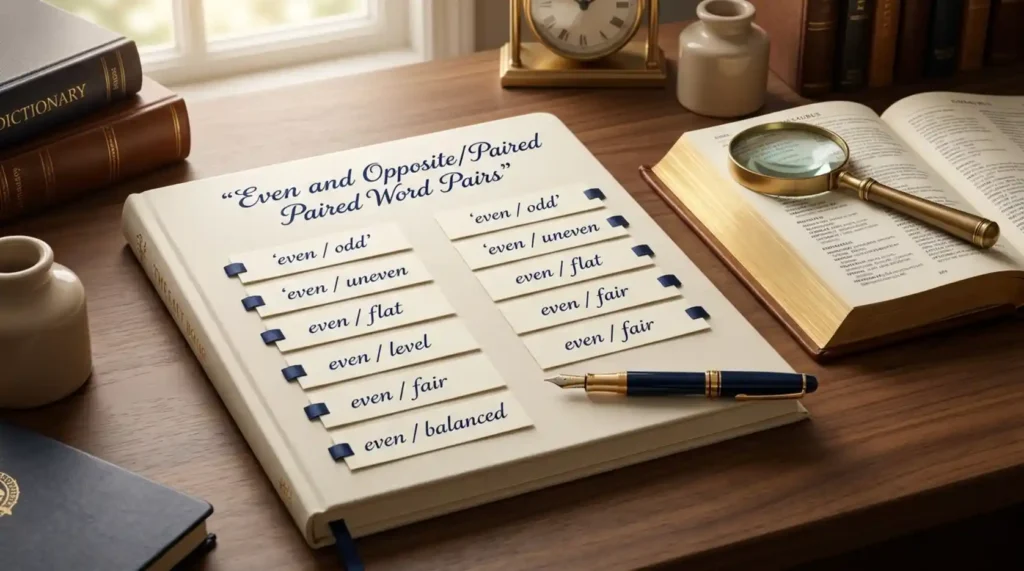
| Word | Paired Word | Note |
| Even | Odd | The standard pair for numbers divisible and not divisible by two. |
| Even | Uneven | Uneven means not level, regular, equal, or smooth. |
| Even | Flat | Often paired in descriptions of surfaces and terrain. |
| Even | Level | Common pair in construction, measurement, and sports. |
| Even | Fair | Connected through impartial treatment and equal conditions. |
| Even | Steady | Associated through regular rhythm, pace, or temperament. |
| Even | Balanced | Often used for budgets, arguments, diets, and competitions. |
The most important contrast is even versus odd in mathematics. In everyday description, even versus uneven is the broader opposite pair, covering rough surfaces, irregular patterns, unequal amounts, and inconsistent performance.Sources: Merriam-Webster; Dictionary.com; Etymonline.
Common Word Partners of “even”
| Pattern | Common Partners | Example |
| even + comparative | better, more, worse, faster, harder | The second attempt was even better. |
| even + noun | a child, the teacher, my best friend | Even my best friend was surprised. |
| even + if / though | if, though, when | Even though it rained, we continued. |
| even + number | number, digits, total | Pick an even number. |
| even + surface | surface, ground, road, floor | The road was even after repairs. |
| even + tone / pace | tone, voice, pace, rhythm | He answered in an even tone. |
| even + out | out, up | Stir the batter to even it out. |
| get even | with someone | She wanted to get even with her rival. |
These combinations show why context matters: “even better” needs a comparison word, while “even surface” needs an adjective describing physical formSources: Merriam-Webster; Collins English Dictionary; Cambridge Dictionary.
Idiomatic Phrases Featuring “even”
1. Get even
- Meaning: To punish or harm someone because they harmed you; to take revenge.
- Example: He refused to get even and chose to move on.
2. Break even
- Meaning: To earn as much money as you spend, with neither profit nor loss.
- Example: The café finally broke even in its second year.
3. Even so
- Meaning: Despite that; nevertheless.
- Example: The task was difficult. Even so, she finished it on time.
4. Even odds
- Meaning: An equal chance that something will or will not happen.
- Example: There are even odds that the flight will be delayed.
Sources: Merriam-Webster; Etymonline; Collins English Dictionary.
Word Formation of “even”
Etymology & Structure
Even comes from Old English efen, meaning “level,” “equal,” “like,” “calm,” or “fully.” It is related to words in other Germanic languages, including German eben and Old Norse jafn. The adverb developed from the adjective, and the verb means “to make even.
Date and History
The adjective and verb are recorded in Old English, before 900. The modern adverbial use that introduces an extreme or surprising case appears to have developed in the sixteenth century. The use of even for numbers divisible by two dates from the 1550s.
Word Class Variations
- Adjective: even — “an even surface”
- Adverb: even — “even better”
- Verb: even, evens, evened, evening — “even out the edges”
- Related derivative: evenly — “spread the icing evenly”
- Related derivative: evenness — “the evenness of the surface”
- Related derivative: uneven — “an uneven road”
- Related compound: break-even — “reach break-even”
Sources: Merriam-Webster; Etymonline; Dictionary.com.
Common Word-Choice Mistakes
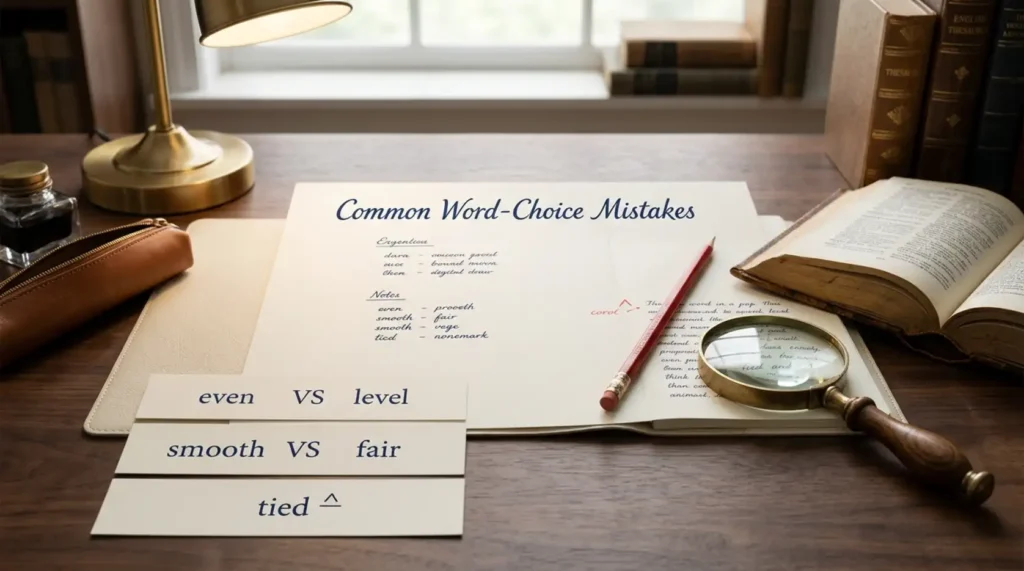
- Wrong: “This book is even interesting.” Correct: “This book is even more interesting.”
- Wrong: “The road was very even.” Correct: “The road was very smooth” or “very level,” depending on the meaning.
- Wrong: “The two teams were equal at 2–2.” Correct: “The two teams were level” or “tied at 2–2.”
- Wrong: “Even although it rained…” Correct: “Even though it rained…”
- Wrong: “He did not even tried.” Correct: “He did not even try.”
- Wrong: “Please even the picture on the wall.” Correct: “Please level the picture on the wall.”
- Wrong: “The judge was very even.” Correct: “The judge was very fair” or “impartial.”
Frequently Asked Questions
What is the closest synonym for even?
There is no single closest synonym because even has several meanings. For comparisons, use still; for surfaces, use flat, level, or smooth; for equality, use equal or fair.
What can replace “even better”?
Use still better, yet better, much better, or far better. “Still better” is the most direct everyday replacement.
What is a formal alternative to even?
For a regular or unchanging quality, use uniform, constant, or consistent. For fairness, use impartial or equitable.
What is the opposite of even?
For numbers, the opposite is odd. For surfaces, amounts, or patterns, the broader opposite is uneven.
Can even describe a person?
Yes, but usually through a related phrase such as “an even temper,” “an even tone,” or “an even hand.” It suggests calmness, steadiness, or fairness.
Does even always mean “flat”?
No. Even can mean flat, but it can also mean equal, fair, steady, surprising, or divisible by two. Context decides the meaning.
What is the difference between even and level?
Even can describe a smooth, regular, or equal quality. Level specifically means horizontal or at the same height, and it can also mean tied in a contest.
Is “even though” the same as “although”?
They are similar, but even though adds stronger emphasis. “Although it rained” simply gives a contrast; “even though it rained” stresses that the rain makes the action more surprising.
Can I say “even more better”?
No. Use either “even better” or “much better.” Do not combine even with a double comparative.
What does “break even” mean?
It means a business or person has neither made a profit nor suffered a loss. Income and costs are equal.
Conclusion
The most useful alternatives to even are still for comparisons, flat, level, and smooth for surfaces, and equal, fair, and balanced for fairness or equality. For steady qualities, steady, uniform, and constant are especially helpful.
Because even has several distinct meanings, always match the replacement to the sentence’s purpose. A word that works in “even better” will not work in “an even number” or “an even surface.”
A simple method is to identify the sense first: emphasis, comparison, physical form, equality, regularity, or mathematics. Then choose the alternative that expresses that exact idea naturally.