

What’s Another Word for Trend? 30 Powerful Alternatives to Make Your Writing Stand Out
The closest everyday alternatives to trend are tendency, direction, movement, and shift. If you mean a popular style, the best choices are usually fashion, vogue, fad, or craze.
The right word depends on what kind of trend you mean: a general change over time, a direction of development, a popular style, or a short-lived enthusiasm. This article explains 30 useful alternatives, including their meanings, pronunciation, usage notes, and examples.
Quick list: tendency, direction, movement, shift, drift, current, fashion, vogue, fad, craze
The sections below examine 30 alternatives in detail, with IPA, meanings, usage notes, examples, and context.
At a Glance: Trend Synonyms and Related Alternatives
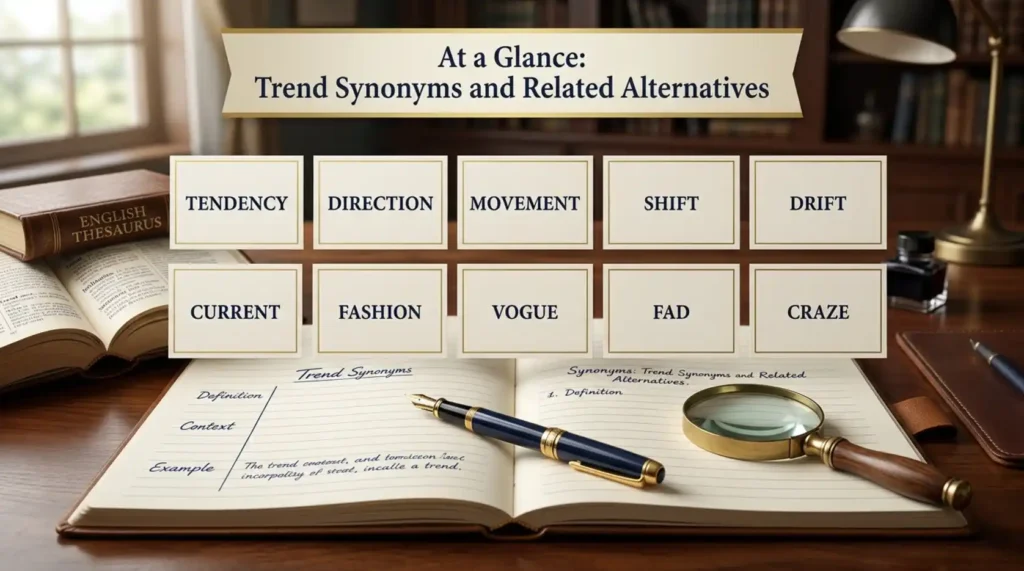
| Alternative | Part of Speech | Meaning | Register / Tone | Ideal Context |
| Tendency | Noun | A likelihood to move, behave, or develop in a particular way | Neutral | Research, behavior, opinions |
| Direction | Noun | The general way something is developing or moving | Neutral | Business, planning, policy |
| Movement | Noun | A gradual change or development in a particular direction | Neutral | Markets, society, statistics |
| Shift | Noun | A noticeable change from one state or position to another | Neutral | Work, culture, technology |
| Drift | Noun | A slow, often unplanned movement or change | Neutral to slightly negative | Prices, opinions, habits |
| Current | Noun | A general flow of opinion, activity, or development | Neutral, sometimes figurative | Public opinion, events |
| Fashion | Noun | A popular style or practice at a particular time | Neutral | Clothing, design, culture |
| Vogue | Noun | The current popular style or preference | Formal or stylish | Fashion, culture, design |
| Fad | Noun | A short-lived popular interest or activity | Often mildly negative | Products, hobbies, social media |
| Craze | Noun | A sudden, intense but usually short-lived enthusiasm | Informal | Toys, challenges, consumer products |
Which Word Should You Use?
| If you want to… | Use | Why |
| Describe a general pattern of change | Tendency | It is the most direct and neutral everyday alternative. |
| Talk about where something is heading | Direction | It emphasizes future development rather than popularity. |
| Describe a measurable change over time | Movement or pattern | These work well in reports, statistics, and analysis. |
| Emphasize a clear change | Shift | It suggests movement from one position, attitude, or method to another. |
| Describe a popular style | Fashion or vogue | Both refer to what is currently preferred or stylish. |
| Describe something popular only briefly | Fad or craze | Both suggest short-lived popularity. |
| Sound formal in business or research writing | Development, progression, or trajectory | These are precise analytical alternatives. |
| Describe a hidden or developing attitude | Undercurrent or drift | These suggest a gradual or less obvious movement. |
Exploring the Multiple Meanings of “Trend”
1. A General Tendency or Inclination
- Meaning: A general way in which something changes, develops, or is likely to happen.
- Explanation: This is the broadest sense of trend. It can describe opinions, prices, behavior, technology, or social habits.
- Example: There is a growing trend toward remote work.
2. A General Movement or Direction
- Meaning: The overall direction in which something moves or develops.
- Explanation: This sense often appears in business, economics, science, and planning. It focuses on direction rather than popularity.
- Example: The trend in sales has been upward for three months.
3. A Popular Style or Preference
- Meaning: A style, activity, or preference that is popular at a particular time.
- Explanation: This sense is common in fashion, design, entertainment, and social media. It does not necessarily imply a long-term change.
- Example: Oversized jackets are a major trend this season.
4. A Short-Lived Popular Interest
- Meaning: A practice or interest that becomes popular quickly but may not last.
- Explanation: Words such as fad and craze fit this meaning. They often suggest that the popularity is temporary.
- Example: The fitness challenge became a brief online trend.
5. A Physical Line or Direction
- Meaning: The general direction in which something such as a coastline, river, or mountain range extends.
- Explanation: This is a more literal and technical use. It is common in geography and earth science.
- Example: The coastline trends eastward for several miles.
6. Widespread Online Attention
- Meaning: A topic that attracts a lot of attention online, especially on social media.
- Explanation: In this modern use, trending describes visibility and discussion rather than a lasting pattern.
- Example: The singer’s new video was trending all morning.
Sources: Merriam-Webster; Etymonline.
Analyzing 30 Trend Alternatives in Detail
Some alternatives below are direct synonyms, while others are useful only in particular contexts.
General Tendencies and Patterns
1. Tendency
- IPA: /ˈtɛn.dən.si/ (US and UK)
- Definition: A likelihood to behave, develop, or move in a particular way.
- Usage: This is the closest general synonym for trend when you mean an inclination or pattern. It works well in neutral and formal writing.
- Example: There is a tendency for prices to rise before the holidays.
2. Inclination
- IPA: /ˌɪn.kləˈneɪ.ʃən/ (US and UK)
- Definition: A feeling or preference that makes someone likely to act in a certain way.
- Usage: Use this for people’s preferences, attitudes, or choices. It is more personal than trend.
- Example: Younger consumers show an inclination toward sustainable products.
3. Direction
- IPA: /dəˈrɛk.ʃən/ (US and UK)
- Definition: The general way in which something is moving or developing.
- Usage: This is a strong alternative when discussing plans, markets, research, or social change. It emphasizes where something is heading.
- Example: The company is moving in a more digital direction.
4. Movement
- IPA: /ˈmuːv.mənt/ (US and UK)
- Definition: A change in position, activity, or development over time.
- Usage: Use this for measurable or gradual change. It can also mean an organized social or political effort, so context matters.
- Example: Analysts noticed a movement toward smaller, more efficient homes.
5. Pattern
- IPA: /ˈpæt.ərn/ (US and UK)
- Definition: A regular or repeated way in which something happens or develops.
- Usage: This is a related alternative rather than an exact synonym. It is best when the trend repeats or can be observed in data.
- Example: The data shows a pattern of higher demand in summer.
Unplanned Movements and Shifts
6. Drift
- IPA: /drɪft/ (US and UK)
- Definition: A slow or gradual movement, especially one without a clear planned goal.
- Usage: Use this when the change is gradual or unplanned. It can suggest uncertainty or lack of control.
- Example: There has been a drift away from traditional television.
7. Current
- IPA: /ˈkɝː.ənt/ (US and UK)
- Definition: A flow of water, air, or, figuratively, opinion or activity.
- Usage: As a figurative alternative, it describes the general flow of public opinion or events. It is more literary than trend.
- Example: The current of public opinion is turning against the policy.
8. Tide
- IPA: /taɪd/ (US and UK)
- Definition: The regular rise and fall of the sea; figuratively, a powerful general movement or mood.
- Usage: This is a figurative alternative for a strong, widespread change in opinion or circumstances.
- Example: The tide of support for the proposal is growing.
9. Shift
- IPA: /ʃɪft/ (US and UK)
- Definition: A change in position, direction, or approach.
- Usage: Use this when something changes noticeably from one state to another. It is especially common in business and social commentary.
- Example: There has been a major shift toward electric vehicles.
10. Swing
- IPA: /swɪŋ/ (US and UK)
- Definition: A noticeable change from one opinion, situation, or condition to another.
- Usage: This is best for changes in mood, opinion, results, or political support. It often implies a back-and-forth movement.
- Example: The election showed a swing toward independent candidates.
Formal and Analytical Alternatives
Progress and Path-Based Synonyms
11. Development
- IPA: /dɪˈvɛl.əp.mənt/ (US and UK)
- Definition: The process of growing, changing, or becoming more advanced.
- Usage: This is a formal alternative that emphasizes progress or change over time, not popularity.
- Example: Recent developments in AI have changed the industry.
12. Progression
- IPA: /prəˈɡrɛʃ.ən/ (US and UK)
- Definition: A gradual movement or development from one stage to another.
- Usage: Use this when you want to stress orderly, step-by-step change. It is common in academic and professional writing.
- Example: The chart shows a steady progression toward lower emissions.
13. Trajectory
- IPA: /trəˈdʒɛk.tər.i/ (US and UK)
- Definition: The path followed by a moving object; figuratively, the likely course of development.
- Usage: This is a more formal and analytical alternative. It is useful for forecasting or describing long-term direction.
- Example: The company’s growth trajectory remains strong.
14. Momentum
- IPA: /moʊˈmɛn.təm/ (US and UK)
- Definition: The force or speed of a continuing movement or development.
- Usage: This is a related alternative, not an exact synonym. Use it when a trend is gaining strength.
- Example: The campaign has gained momentum among younger voters.
15. Orientation
- IPA: /ˌɔːr.i.ənˈteɪ.ʃən/ (US and UK)
- Definition: A general position, attitude, or direction of interest.
- Usage: Use this for a broad strategic or ideological direction. It is more formal than trend.
- Example: The school’s orientation toward practical skills has changed.
Research and Strategic Terminology
16. Propensity
- IPA: /prəˈpɛn.sə.ti/ (US and UK)
- Definition: A natural likelihood to behave in a particular way.
- Usage: This is a formal synonym for tendency. It is common in research and statistical writing.
- Example: The study examined consumers’ propensity to buy online.
17. Leaning
- IPA: /ˈliː.nɪŋ/ (US and UK)
- Definition: A preference or partiality toward a particular view, group, or choice.
- Usage: Use this for opinions, political views, or preferences. It is less suitable for sales figures or fashion.
- Example: The report found a leaning toward locally made goods.
18. Course
- IPA: /kɔːrs/ (US and UK)
- Definition: The direction in which something moves or develops.
- Usage: This is a broader, more abstract alternative. It works well when discussing history, policy, or long-term change.
- Example: The new law could change the course of the industry.
Fashion and Popular Culture
Styles and Prevailing Customs
19. Fashion
- IPA: /ˈfæʃ.ən/ (US and UK)
- Definition: A popular style of clothing, behavior, or design at a particular time.
- Usage: This is a close alternative when trend refers to style. It can also mean a general custom or practice.
- Example: Minimalist interiors are back in fashion.
20. Vogue
- IPA: /voʊɡ/ (US and UK)
- Definition: The current popular style or preference.
- Usage: This is a stylish, somewhat formal alternative to trend. The phrase “in vogue” is especially common.
- Example: Bright colors are in vogue this spring.
21. Craze
- IPA: /kreɪz/ (US and UK)
- Definition: A sudden, intense, and usually short-lived enthusiasm for something.
- Usage: Use this for a popular activity or product that spreads quickly. It often implies excitement and impermanence.
- Example: The puzzle game became a nationwide craze.
22. Fad
- IPA: /fæd/ (US and UK)
- Definition: A style, activity, or interest that is popular for a short time.
- Usage: This is a close alternative for a short-lived trend. It often sounds slightly dismissive.
- Example: Many people treated the diet as just another fad.
Aesthetics and Fleeting Popularity
23. Style
- IPA: /staɪl/ (US and UK)
- Definition: A particular way of designing, dressing, or doing something.
- Usage: This is a related alternative rather than an exact synonym. Use it when the trend concerns appearance or design.
- Example: Retro sneakers are a popular style right now.
24. Mode
- IPA: /moʊd/ (US and UK)
- Definition: A fashion or prevailing style; also, a way of operating or doing something.
- Usage: In the fashion sense, mode is formal and less common in everyday speech. It can also mean a method or setting.
- Example: The designer helped define the mode of the 1990s.
25. Rage
- IPA: /reɪdʒ/ (US and UK)
- Definition: A sudden, widespread enthusiasm for something.
- Usage: This is an informal, slightly old-fashioned alternative to craze. The phrase “all the rage” is still common.
- Example: Personalized phone cases were all the rage last year.
26. Look
- IPA: /lʊk/ (US and UK)
- Definition: A particular style of appearance or fashion.
- Usage: This is a related alternative used mainly in fashion and beauty contexts. It refers to a visual style, not a general pattern.
- Example: The soft, natural makeup look is popular this season.
Attention, Change, and Opposition
27. Wave
- IPA: /weɪv/ (US and UK)
- Definition: A sudden increase in activity, interest, or feeling.
- Usage: Use this for a wave of interest, support, innovation, or concern. It emphasizes a surge rather than a steady pattern.
- Example: A wave of new coffee shops opened downtown.
28. Buzz
- IPA: /bʌz/ (US and UK)
- Definition: Excited interest or discussion about something.
- Usage: This is an informal related alternative for a trend that is generating attention, especially online.
- Example: The startup created a lot of buzz before its launch.
29. Bandwagon
- IPA: /ˈbænd.wæɡ.ən/ (US and UK)
- Definition: An activity or cause that becomes popular because many people join it.
- Usage: This is a related alternative, not a neutral synonym. It often suggests that people are joining because others have.
- Example: Several brands jumped on the sustainability bandwagon.
30. Countertrend
- IPA: /ˈkaʊn.tər.trɛnd/ (US and UK)
- Definition: A development that moves against a prevailing trend.
- Usage: This is a specialized related term. Use it when you want to describe opposition to a dominant trend.
- Example: While digital reading grows, printed books remain a countertrend.
Sources: Merriam-Webster; Merriam-Webster Thesaurus; Thesaurus.com.
Trend vs. Tendency vs. Fashion
| Word | Main Focus | Typical Context | Example |
| Trend | A general direction of change or a popular style | Business, culture, fashion, data | The trend toward online shopping continues. |
| Tendency | A likelihood or inclination | Behavior, research, habits | Students show a tendency to procrastinate. |
| Fashion | A popular style or practice | Clothing, design, culture | Wide-leg trousers are in fashion. |
Trend can cover both long-term change and short-term popularity. Tendency is usually about likelihood or habit, while fashion is specifically about what is currently considered stylish or preferred.
Sources: Merriam-Webster.
Trend and Opposite/Paired Word Pairs
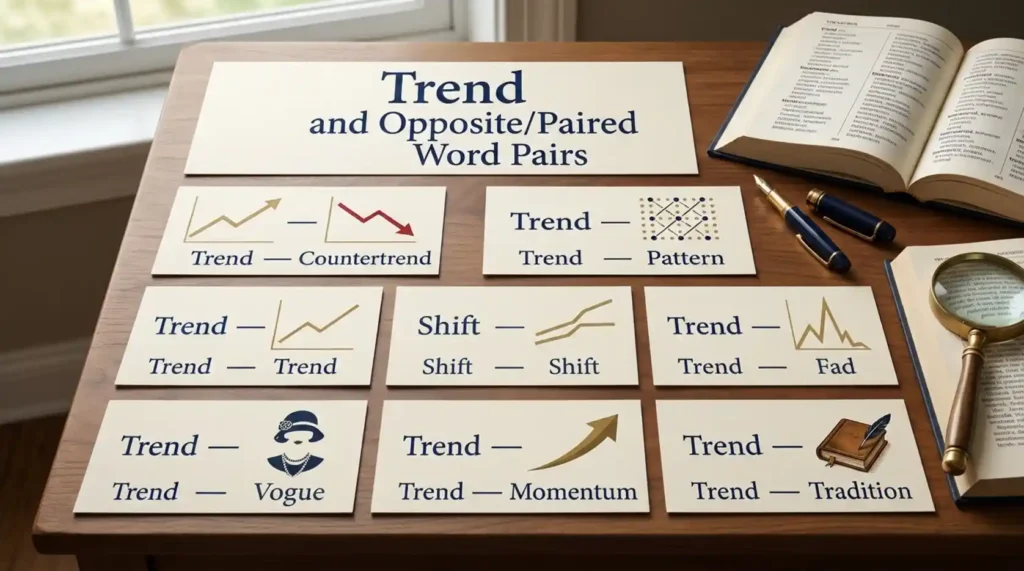
| Word | Paired Word | Note |
| Trend | Countertrend | A countertrend moves against the main trend. |
| Trend | Pattern | A trend often becomes visible as a pattern over time. |
| Trend | Fad | A fad is a short-lived trend. |
| Trend | Vogue | Both can describe what is currently popular. |
| Trend | Shift | A shift is a noticeable change in direction or attitude. |
| Trend | Momentum | Momentum describes the strength or speed of a trend. |
| Trend | Tradition | Tradition can contrast with a new trend. |
| Trend | Constant | A constant does not change, unlike a trend. |
These pairs help show whether you are describing the main direction of change, a temporary enthusiasm, or something that goes against it.
Sources: Merriam-Webster; Etymonline.
Common Word Partners of “Trend”
| Pattern | Common Partners | Example |
| Trend + toward | remote work, sustainability, automation | There is a trend toward flexible working. |
| Trend + in | fashion, technology, education, sales | The trend in fashion favors comfort. |
| Growing/rising + trend | demand, interest, popularity, concern | The growing trend for plant-based food continues. |
| Follow/set + a trend | style, fashion, market, social media | Influencers often set trends online. |
| Reverse/counter + a trend | decline, inequality, decline in sales | New policies may reverse the trend. |
| Spot/identify + a trend | data, behavior, market, consumer habits | Analysts identified a trend in spending. |
| Trend + line | graph, chart, sales, data | The trend line rises steadily. |
Sources: Merriam-Webster; Thesaurus.com.
Idiomatic Phrases Featuring “Trend”
1. Set a trend
- Meaning: To start a style, practice, or way of doing something that other people copy.
- Example: The designer set a trend with simple, colorful sneakers.
2. Follow a trend
- Meaning: To do, wear, or support something because it has become popular.
- Example: Many cafés followed the trend for oat-milk drinks.
3. Buck the trend
- Meaning: To act or develop in a way that is opposite to the general trend.
- Example: The small bookstore bucked the trend and increased its sales.
4. Jump on the bandwagon
- Meaning: To join an activity or support an idea because it has become popular.
- Example: Several companies jumped on the bandwagon and launched similar apps.
Sources: Merriam-Webster; Cambridge Dictionary.
Word Formation of “Trend”
Etymology & Structure
Trend began as a verb meaning “to turn, revolve, or roll.” It comes from Middle English trenden and Old English trendan, meaning “to turn round” or “revolve.” The modern idea of a general direction or tendency developed from the older physical sense of bending or moving in a direction.
Date and History
The verb trend was recorded in English in the 1590s in the sense of running or bending in a direction. The noun appeared in 1777, meaning a general course or direction. The sense of “tendency” dates to 1884, and the sense of a popular cultural or fashion trend dates to about 1950.
Word Class Variations
- Noun: trend, trends
- Verb: trend, trends, trending, trended
- Adjective: trendy, trendier, trendiest
- Related nouns: trendsetter, trendsetting, trendspotter, countertrend
- Related adverb: trendily
Sources: Etymonline; Merriam-Webster.
Common Word-Choice Mistakes
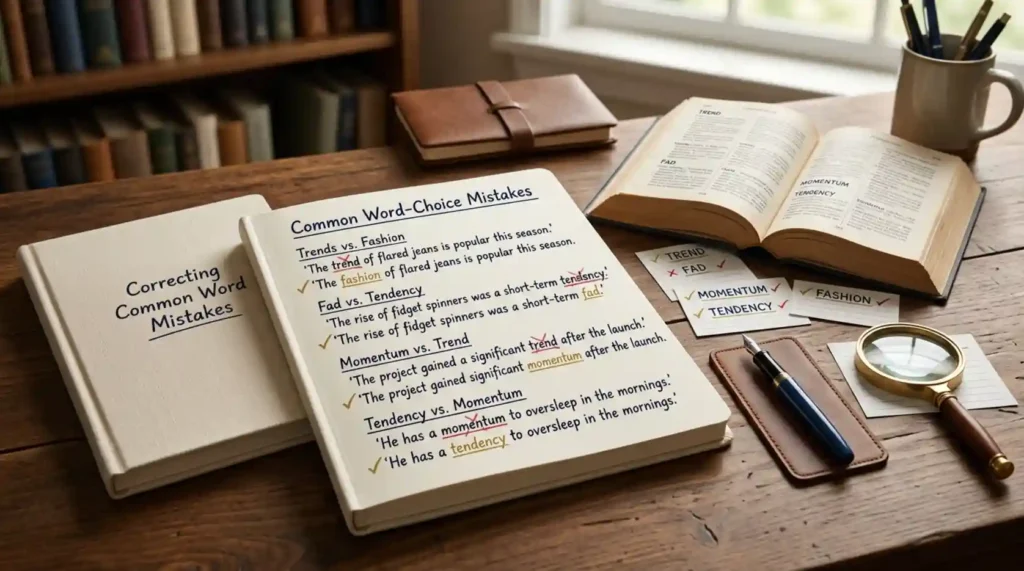
- Wrong: “There is a fashion toward remote work.” Correct: “There is a trend toward remote work.”
- Wrong: “Sustainable packaging is a long-term fad.” Correct: “Sustainable packaging is a long-term trend.”
- Wrong: “The graph shows a clear fashion.” Correct: “The graph shows a clear trend.”
- Wrong: “He has a trend to arrive late.” Correct: “He has a tendency to arrive late.”
- Wrong: “The company is gaining a trend.” Correct: “The company is gaining momentum.”
- Wrong: “The new policy reversed the fashion.” Correct: “The new policy reversed the trend.”
- Wrong: “This style is on the bandwagon.” Correct: “This style is in vogue” or “This style is trending.”
Frequently Asked Questions
What is the closest synonym for trend?
Tendency is the closest general synonym. Use direction or movement when you mean the way something is developing.
What is a formal alternative to trend?
Development, progression, trajectory, and propensity are useful formal alternatives.
What is another word for a short-lived trend?
Fad and craze are the best choices. Both suggest popularity that is likely to fade.
What is another word for a fashion trend?
Fashion, vogue, style, look, and mode are common alternatives.
What is the difference between trend and tendency?
A trend is a broader pattern or direction of change. A tendency is more often a likelihood or habit.
Can trend refer to social media?
Yes. In social media, a trending topic is one receiving a lot of attention or discussion. Buzz is a related informal word.
What is the opposite of trend?
There is no single opposite. Countertrend means a movement against a trend; tradition or constant can contrast with a new or changing trend.
Can trend be used as a verb?
Yes. For example: “Sales are trending upward.” It can also mean a topic is receiving attention online.
Is a trend always popular?
No. A trend can describe any general direction of change, including declining sales, rising costs, or changing opinions.
What is a literary alternative to trend?
Current, tide, and undercurrent are more figurative alternatives, especially for public opinion or social change.
Conclusion
The most common alternatives to trend are tendency, direction, movement, and shift. For popular styles, choose fashion, vogue, fad, or craze.
Context matters because trend can mean a long-term pattern, a short-lived enthusiasm, a physical direction, or online attention. Words such as fad and craze add the idea that something may not last.
To choose the best word, decide whether you are describing change, popularity, direction, or data. Then select the alternative that matches that exact meaning.