

Another Word for Integrating: 30 Synonyms With Examples
“Integrating” is the present participle of the verb integrate. The closest everyday alternatives are combining, merging, incorporating, and blending. For systems and tools, connecting and linking are also common. When people are involved, assimilating, including, and welcoming fit better.
The best alternative depends on what is being brought together and how. Some words suggest a loss of separate identity (merging, fusing). Some suggest one thing joining a larger whole (incorporating, absorbing). Others describe social change (desegregating, mainstreaming) or technical work (syncing, interfacing).
Quick list: combining, merging, incorporating, blending, uniting, linking, connecting, unifying, consolidating, assimilating
This article covers 30 alternatives. Each has a definition, IPA, a usage note, and an example, so you can pick the word that matches your meaning.
At a Glance: Integrating Synonyms and Related Alternatives
| Alternative | Part of Speech | Meaning | Register / Tone | Ideal Context |
| Combining | verb (participle) | Putting two or more things together | Neutral | Everyday writing, recipes, plans |
| Merging | verb (participle) | Joining so the parts lose separate identity | Neutral to formal | Companies, files, roads |
| Incorporating | verb (participle) | Taking something in as part of a whole | Neutral to formal | Ideas, features, feedback |
| Blending | verb (participle) | Mixing so the parts are hard to tell apart | Neutral | Styles, flavors, cultures |
| Connecting | verb (participle) | Making a link so things work together | Neutral | Devices, software, networks |
| Unifying | verb (participle) | Making separate parts into one whole | Formal | Teams, countries, systems |
| Consolidating | verb (participle) | Combining into one stronger or simpler unit | Formal, business | Accounts, offices, data |
| Assimilating | verb (participle) | Taking in and absorbing fully | Formal | Ideas, newcomers, information |
| Welcoming | verb (participle) | Receiving people into a group with acceptance | Warm, neutral | Communities, workplaces |
| Desegregating | verb (participle) | Ending forced separation of groups | Formal | Schools, housing, workplaces |
Which Word Should You Use?

| If you want to… | Use | Why |
| Describe two things becoming one | merging | It suggests the parts lose their separate identity. |
| Add a new idea or feature to an existing plan | incorporating | It means taking something in as part of a larger whole. |
| Talk about software or tools working together | connecting, linking, syncing | These match technical language. |
| Describe new people joining a group | welcoming, including | They sound warmer and less about changing the person. |
| Describe someone fully taking on a new culture | assimilating | It stresses absorbing the new way of life. |
| Describe reducing many things to one | consolidating | It suggests simplifying and strengthening. |
| Describe ending separation by race or group | desegregating | It is the precise term for this sense. |
| Describe a smooth mix with no clear lines | blending | It shows the parts mix softly. |
Exploring the Multiple Meanings of “Integrating”
1. Combining Parts Into a Whole
- Meaning: Bringing separate parts together to form a unified whole.
- Explanation: This is the core sense. The parts can be ideas, materials, or services. The result feels complete rather than a pile of pieces.
- Example: The team is integrating customer feedback into the new design.
2. Bringing People Into a Group or Community
- Meaning: Helping people become full members of a group, society, or workplace.
- Explanation: Here the verb usually takes into or with. It is about belonging and participation, not just joining.
- Example: The school is integrating new students into its classes through a buddy program.
3. Making Systems or Tools Work Together
- Meaning: Connecting software, devices, or processes so they operate as one.
- Explanation: In technology and business, integrating usually means linking separate systems so they share data or work smoothly together.
- Example: She spent the week integrating the payment system with the online store.
4. Ending Separation Between Groups
- Meaning: Ending the segregation of a school, neighborhood, or workplace.
- Explanation: This sense is common in history and social policy. Dictionaries list it as a separate meaning.
- Example: The city began integrating its public schools in the 1960s.
5. Finding an Integral in Mathematics
- Meaning: Performing the operation of integration, which finds the integral of a function.
- Explanation: In calculus, integrating is the opposite process of differentiating. It has no true everyday synonym, so the alternatives in this article do not apply to this sense.
- Example: The students practiced integrating simple functions in calculus class.
Sources: Merriam-Webster (integrate), Oxford Learner’s Dictionaries (integrate), Dictionary.com (integrate)
Analyzing 30 Integrating Alternatives in Detail

Some alternatives below are direct synonyms of “integrating,” while others are related words that fit only certain contexts. Each usage note says which is which.
Core Synonyms
1. Combining
IPA: /kəmˈbaɪnɪŋ/ (US and UK)
Definition: Joining two or more things together into one.
- Usage: The most general everyday synonym. It is less specific than integrating because it does not require the parts to work as a unified whole.
- Example: She is combining two recipes to make a new dish.
2. Merging
IPA: US /ˈmɜːrdʒɪŋ/ · UK /ˈmɜːdʒɪŋ/
Definition: Joining so that the parts become one and lose their separate identity.
- Usage: A close synonym, but stronger than integrating. Integrated parts can stay recognizable, while merged parts often cannot.
- Example: The two banks are merging their branches in the city.
3. Incorporating
IPA: US /ɪnˈkɔːrpəreɪtɪŋ/ · UK /ɪnˈkɔːpəreɪtɪŋ/
Definition: Including something as part of a larger whole.
- Usage: A very close synonym for the “add into a whole” sense. It suggests one main thing taking in a smaller addition.
- Example: The writer is incorporating the editor’s suggestions into the final draft.
4. Blending
IPA: /ˈblendɪŋ/ (US and UK)
Definition: Mixing things so smoothly that the parts are hard to tell apart.
- Usage: A related alternative. It stresses a smooth, natural mix rather than a planned system.
- Example: The architect is blending old stone with modern glass.
5. Unifying
IPA: /ˈjuːnɪfaɪɪŋ/ (US and UK)
Definition: Making separate parts into one whole.
- Usage: A formal synonym. It stresses oneness and common purpose, so it fits teams, countries, and systems.
- Example: The new platform is unifying the company’s three databases.
Joining and Linking Words
6. Connecting
IPA: /kəˈnektɪŋ/ (US and UK)
Definition: Joining things so that they are linked or can work together.
- Usage: A related alternative common in technology. It describes the link itself, not necessarily a full combination.
- Example: The engineer is connecting the sensors to the main control system.
7. Linking
IPA: /ˈlɪŋkɪŋ/ (US and UK)
Definition: Making a connection between two or more things.
- Usage: A related alternative. It is lighter than integrating: linked items stay separate but connected.
- Example: The app is linking users’ calendars with their email.
8. Joining
IPA: /ˈdʒɔɪnɪŋ/ (US and UK)
Definition: Putting or bringing two things together.
- Usage: A basic, plain-English alternative. It is physical or simple and lacks the idea of a smooth, working whole.
- Example: The workers are joining the two sections of the pipe.
9. Uniting
IPA: US /juˈnaɪtɪŋ/ · UK /juːˈnaɪtɪŋ/
Definition: Bringing people or things together for a shared purpose.
- Usage: A related alternative, mostly used for people, groups, or causes. It has an emotional tone that integrating lacks.
- Example: The project is uniting teachers from several schools.
10. Fusing
IPA: /ˈfjuːzɪŋ/ (US and UK)
Definition: Joining things so closely that they become one.
- Usage: A related alternative. It is stronger and more dramatic than integrating, and often used for styles, ideas, or materials.
- Example: The chef is fusing Japanese and Italian flavors.
Formal and Business Alternatives
11. Consolidating
IPA: US /kənˈsɑːlɪdeɪtɪŋ/ · UK /kənˈsɒlɪdeɪtɪŋ/
Definition: Combining several things into one stronger or more efficient unit.
- Usage: A related business term. It often means reducing and simplifying, not just connecting.
- Example: The company is consolidating its regional offices into one headquarters.
12. Amalgamating
IPA: /əˈmælɡəmeɪtɪŋ/ (US and UK)
Definition: Combining separate organizations or elements into one.
- Usage: A formal, somewhat British-leaning synonym for merging organizations. It is rare in casual speech.
- Example: The council is amalgamating three small libraries into one.
13. Synthesizing
IPA: /ˈsɪnθəsaɪzɪŋ/ (US and UK)
Definition: Combining separate ideas or elements to form something new.
- Usage: A related alternative for ideas and research. Unlike integrating, it implies creating a new whole.
- Example: The report is synthesizing findings from twenty studies.
14. Coordinating
IPA: US /koʊˈɔːrdɪneɪtɪŋ/ · UK /kəʊˈɔːdɪneɪtɪŋ/
Definition: Organizing different parts so they work well together.
- Usage: A related alternative. It describes making things work together without necessarily combining them.
- Example: She is coordinating the sales and support teams.
15. Harmonizing
IPA: US /ˈhɑːrmənaɪzɪŋ/ · UK /ˈhɑːmənaɪzɪŋ/
Definition: Making different parts consistent or agreeable with each other.
- Usage: A related alternative common for rules, standards, and policies. It means bringing parts into agreement.
- Example: The agency is harmonizing safety rules across regions.
Fitting Into a Group or Community
16. Assimilating
IPA: /əˈsɪməleɪtɪŋ/ (US and UK)
Definition: Taking in and fully absorbing ideas, information, or people into a larger group.
- Usage: A related alternative. It often suggests the newcomer takes on the group’s ways, so it is stronger than integrating in social contexts.
- Example: The students are assimilating a lot of new information each week.
17. Absorbing
IPA: US /əbˈsɔːrbɪŋ/ · UK /əbˈsɔːbɪŋ/
Definition: Taking something in so that it becomes part of something larger.
- Usage: A related alternative. The larger body takes in the smaller one, which may lose its separate identity.
- Example: The larger firm is absorbing the smaller company’s staff.
18. Including
IPA: /ɪnˈkluːdɪŋ/ (US and UK)
Definition: Making someone or something part of a group or whole.
- Usage: A related, everyday alternative for the people sense. It is simpler and warmer than integrating.
- Example: The club is including members of all ages in its events.
19. Welcoming
IPA: /ˈwelkəmɪŋ/ (US and UK)
Definition: Receiving someone into a group in a friendly way.
- Usage: A related alternative only for the people sense. It describes attitude, not the full process of integration.
- Example: The town is welcoming new families with a community dinner.
20. Mainstreaming
IPA: /ˈmeɪnstriːmɪŋ/ (US and UK)
Definition: Placing students with functional needs in regular classes, or making an idea part of the main culture.
- Usage: A context-specific alternative, mostly for education and policy. It does not work for technical systems.
- Example: The district is mainstreaming students with learning differences into regular classrooms.
Bringing Together and Adding In
21. Bringing together
IPA: US /ˈbrɪŋɪŋ təˈɡeðər/ · UK /ˈbrɪŋɪŋ təˈɡeðə/
Definition: Gathering separate things or people in one place or group.
- Usage: A plain-English phrase. It is broader and less technical than integrating.
- Example: The event is bringing together designers, engineers, and writers.
22. Pooling
IPA: /ˈpuːlɪŋ/ (US and UK)
Definition: Combining resources, money, or knowledge so that they are shared.
- Usage: A related alternative. It fits shared resources, not systems or people.
- Example: The neighbors are pooling their money to repair the road.
23. Bundling
IPA: /ˈbʌndlɪŋ/ (US and UK)
Definition: Packaging things together, especially products or services.
- Usage: A related alternative for business and marketing. The items are sold or delivered together but may stay separate.
- Example: The provider is bundling internet and phone service in one plan.
24. Folding in
IPA: US /ˈfoʊldɪŋ ɪn/ · UK /ˈfəʊldɪŋ ɪn/
Definition: Gently adding one thing into another, in cooking or in general.
- Usage: An informal, figurative alternative. It suggests careful, gradual adding.
- Example: The manager is folding the new tasks into the team’s routine.
25. Embedding
IPA: /ɪmˈbedɪŋ/ (US and UK)
Definition: Fixing something firmly within a larger whole.
- Usage: A related alternative for building one thing inside another, as in software, curricula, or habits.
- Example: The school is embedding digital skills across every subject.
Descriptive and Specialized Alternatives
26. Meshing
IPA: /ˈmeʃɪŋ/ (US and UK)
Definition: Fitting or working together smoothly, like gears.
- Usage: A related, descriptive alternative. It stresses how well parts fit, not the act of combining them.
- Example: The two teams are meshing well after a rocky start.
27. Interweaving
IPA: US /ˌɪntərˈwiːvɪŋ/ · UK /ˌɪntəˈwiːvɪŋ/
Definition: Weaving or blending things closely together.
- Usage: A literary or descriptive alternative. It suggests threads that cross and connect, as in stories or themes.
- Example: The author is interweaving three timelines in one novel.
28. Syncing
IPA: /ˈsɪŋkɪŋ/ (US and UK)
Definition: Making data or devices match and update together.
- Usage: A narrow, informal technology term. It means keeping things matched, not building one system.
- Example: She is syncing her phone with her laptop.
29. Interfacing
IPA: US /ˈɪntərfeɪsɪŋ/ · UK /ˈɪntəfeɪsɪŋ/
Definition: Connecting or communicating with another system, device, or group.
- Usage: A related technical alternative. It describes the point of contact between systems, not a full merger.
- Example: The new tool is interfacing with the company’s older software.
30. Desegregating
IPA: /diːˈseɡrɪɡeɪtɪŋ/ (US and UK)
Definition: Ending the separation of people by race, class, or group in a school, workplace, or public place.
- Usage: A direct synonym only for the social sense of integrating. It does not work for technology or ideas.
- Example: The district is desegregating its schools through new attendance zones.
Sources: Merriam-Webster (integrate and related entries), Oxford Learner’s Dictionaries (integrate), Dictionary.com (integrate). Definitions were written in plain language from standard dictionary senses.
Integrating vs. Incorporating vs. Merging vs. Combining
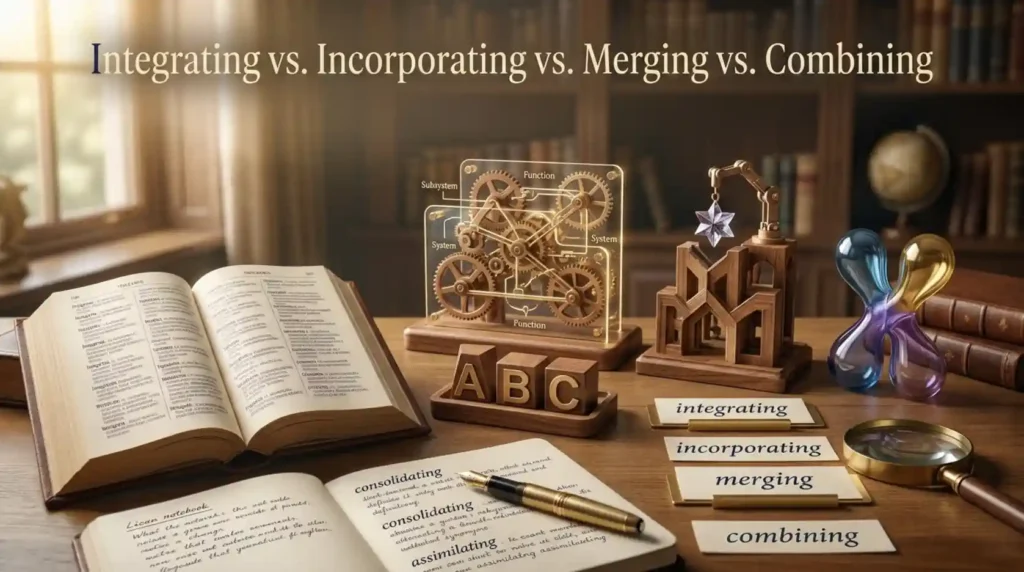
These four words are often swapped, but they differ in how much of the original parts remain.
| Word | What happens to the parts | Typical use | Example |
| Combining | Parts are put together and may stay distinct | General, everyday | Combining flour and sugar |
| Integrating | Parts work together as a unified whole | Systems, people, ideas | Integrating a payment tool into a store |
| Incorporating | A new part is added into an existing whole | Features, feedback, ideas | Incorporating feedback into a report |
| Merging | Parts join and lose separate identity | Companies, files, lanes | Merging two companies |
A simple test: if the parts must keep working side by side, choose integrating. If one thing joins a bigger one, choose incorporating. If the originals disappear, choose merging.
Sources: Merriam-Webster and Oxford Learner’s Dictionaries (integrate); sense distinctions are summarized from standard dictionary definitions.
Integrating and Opposite/Paired Word Pairs
| Word | Paired Word | Note |
| Integrating | Segregating | The standard opposite in the social sense; Oxford Learner’s Dictionaries lists segregate as the contrast. |
| Integrating | Separating | A general opposite for combining parts. |
| Integrating | Dividing | Fits both physical and organizational splits. |
| Integrating | Fragmenting | Suggests breaking a whole into small, disconnected pieces. |
| Integrating | Isolating | Fits people, systems, and ideas kept apart. |
| Integrating (math) | Differentiating | In calculus, the two are inverse operations. |
Opposites depend on the sense. For people and groups, segregating is the clearest opposite. For systems and ideas, separating or fragmenting works better. Disintegrating is related in form but means falling apart, not simply keeping things separate.
Sources: Oxford Learner’s Dictionaries (integrate, compare segregate); Merriam-Webster (integrate)
Common Word Partners of “Integrating”

| Pattern | Common Partners | Example |
| integrating + noun | technology, systems, data, ideas, services | The school is integrating technology into daily lessons. |
| integrating into | society, the workplace, the curriculum, a team | He had no trouble integrating into the new team. |
| integrating with | existing systems, the local community | The app is integrating with other tools. |
| adverb + integrating | fully, successfully, gradually, seamlessly | The company is gradually integrating its two platforms. |
| integrating X and Y | work and life, old and new methods | She is integrating research and practice in her course. |
| difficulty in integrating | newcomers, new software | The team faced difficulty in integrating the new software. |
Sources: Oxford Learner’s Dictionaries (integrate, with its patterns “integrate into/with”); Merriam-Webster (integrate, example sentences)
Idiomatic Phrases Featuring “Integrating”
“Integrating” has few true idioms. These are established technical or business expressions, not figurative idioms.
1. Integrated circuit
- Meaning: A small electronic circuit with many parts built onto one tiny chip.
- Example: Every modern phone contains many integrated circuits.
2. Vertical integration
- Meaning: A business strategy in which a company controls several stages of making and selling its product.
- Example: The brand grew through vertical integration, owning both its farms and its stores.
3. Integrating factor
- Meaning: A mathematical tool used to solve certain differential equations.
- Example: The teacher showed how an integrating factor simplifies the equation.
4. Integration by parts
- Meaning: A calculus method for integrating a product of two functions.
- Example: Integration by parts helped the student solve the problem quickly.
Sources: Merriam-Webster (integrated circuit, integration); standard calculus references
Word Formation of “Integrating”
Etymology & Structure
“Integrating” is the present participle of integrate, formed with the ending -ing. Integrate comes from Latin integratus, the past participle of integrare, meaning “to make whole” or “to renew.” That verb comes from integer, meaning “whole” or “untouched.” The same Latin root gives English integer, integral, and integrity.
Date and History
Dictionaries give slightly different dates. Merriam-Webster lists the first known use of integrate as circa 1586, in its first transitive sense. Dictionary.com records it from 1630–40. Both place the word in the late 1500s to mid-1600s.
Word Class Variations
- Verb: integrate, integrates, integrated, integrating
- Noun: integration, integrator
- Adjective: integrated, integrative, integral
- Adverb: integrally
Sources: Merriam-Webster (integrate, word history); Dictionary.com (integrate, origin); Wiktionary (etymology of integrate, supporting)
Common Word-Choice Mistakes

- Integrating to the team: use integrating into the team.
- Integrating in the system: use integrating into the system, or integrating with when two systems work together.
- The integrity of the two apps: use the integration of the two apps. Integrity means honesty or being whole and sound.
- Intergrating: the correct spelling is integrating.
- Assimilating the new software: use integrating or adopting. Assimilating fits ideas, information, and people.
- Mainstreaming two systems: use integrating or connecting. Mainstreaming is mostly for education and policy.
- Disintegrating the two teams, when you mean combining them: use integrating or merging. Disintegrating means falling apart.
Frequently Asked Questions
What is the closest synonym for integrating?
Combining is the most general everyday synonym. Incorporating is closest when something is added into a larger whole.
What is a formal alternative to integrating?
Consolidating, amalgamating, and synthesizing are formal options, depending on If you mean simplifying, merging organizations, or creating something new.
What is the difference between integrating and merging?
Integrating usually keeps the parts working together as a whole. Merging usually makes the parts one, with no separate identity.
Is integrating the same as incorporating?
They overlap, but incorporating usually means adding a new piece into an existing whole. Integrating focuses on the parts working together.
What is a good alternative for integrating technology?
Connecting, linking, syncing, and embedding all work, depending on how closely the tools work together.
What can I say instead of integrating new employees?
Welcoming, including, and onboarding are natural choices. Assimilating suggests the employees must adopt the group’s ways.
What is the opposite of integrating?
For people and groups, segregating. For general use, separating, dividing, or fragmenting.
Can integrating mean desegregating?
Yes. Dictionaries list the sense of ending segregation, such as in schools. In that context, desegregating is a direct synonym.
Is there a literary alternative to integrating?
Interweaving works well for stories, themes, and ideas.
Does integrating have a math meaning?
Yes. In calculus, integrating means finding the integral of a function. None of the everyday synonyms in this article apply to that sense.
Conclusion
The closest everyday alternatives to integrating are combining, merging, and incorporating. For technology, connecting, linking, and syncing are common. For people, including, welcoming, and assimilating are the main choices, and desegregating covers the social-policy sense.
Context decides which word fits. Merging means the parts lose their identity, incorporating means adding into a whole, and integrating means the parts work together as one. Words like assimilating and mainstreaming carry extra meaning that can change your message.
To choose the right alternative, first decide what is being brought together: ideas, systems, or people. Then decide how closely they join. Use the tables above as a quick guide when you need a precise word.