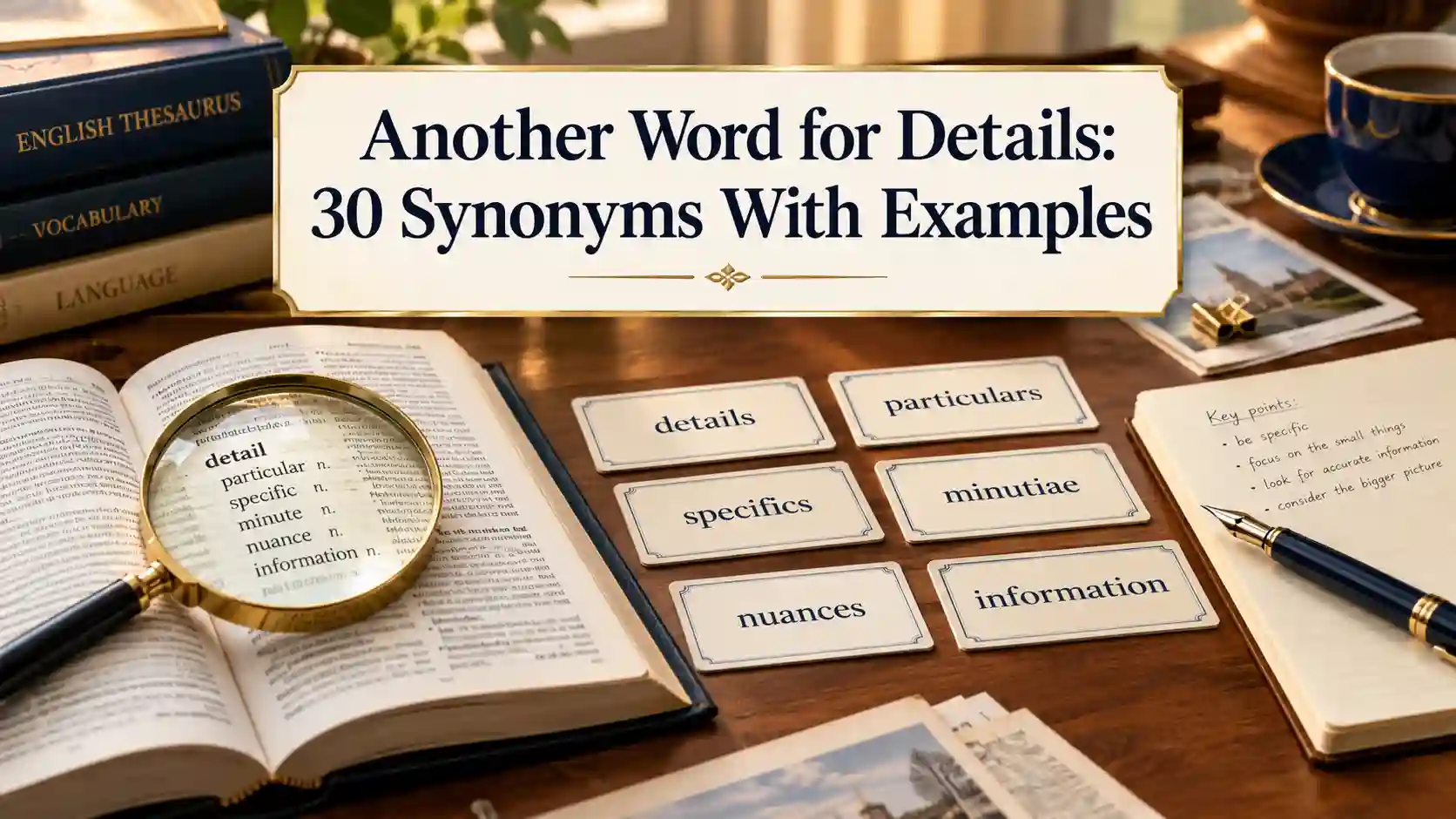
Another Word for Details: 30 Synonyms With Examples
The closest everyday alternatives to “details” are particulars and specifics. Both mean the individual facts or parts that make up a whole. If you mean the very small, fine points, use minutiae or nuances. If you mean facts about something, information or facts may be better.
The best word depends on what you mean. “Details” can mean separate facts (the details of a plan), tiny parts (fine details in a painting), or items of information (contact details). It can also mean parts or features of something, or small points that may not matter. Each meaning has its own good alternatives.
Quick list: particulars, specifics, facts, information, minutiae, nuances, features, specifications, nitty-gritty, rundown
This article looks at 30 alternatives. Each one comes with a meaning, IPA, a usage note, and an example, so you can pick the word that fits your sentence.
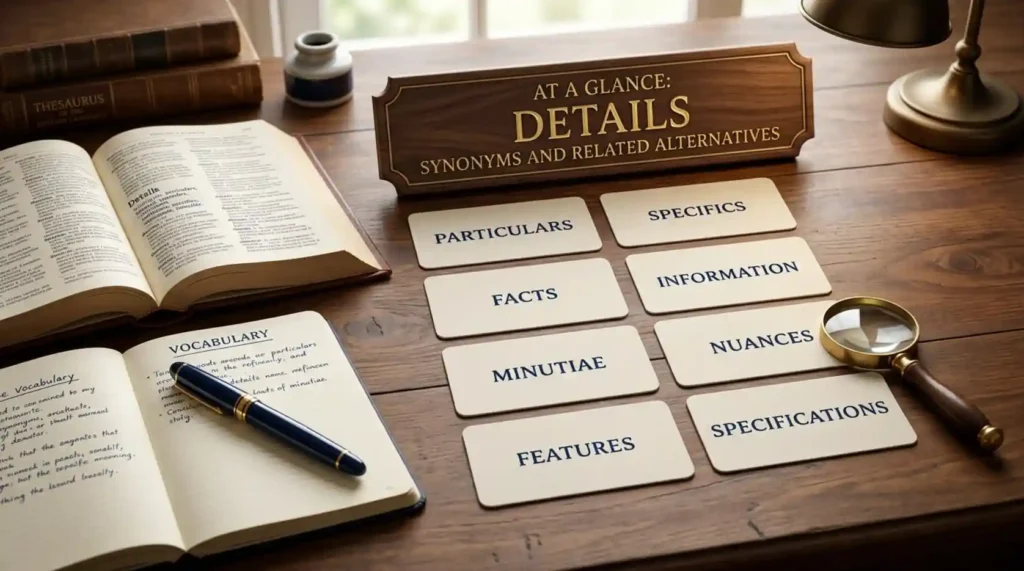
At a Glance: Details Synonyms and Related Alternatives
| Alternative | Part of Speech | Meaning | Register / Tone | Ideal Context |
| Particulars | noun (plural) | individual facts or items | Formal | Contracts, reports, legal writing |
| Specifics | noun (plural) | exact, concrete points | Neutral | Plans, questions, instructions |
| Facts | noun (plural) | things known to be true | Neutral | News, reports, explanations |
| Information | noun (uncountable) | facts given or learned | Neutral | Forms, notices, general writing |
| Minutiae | noun (plural) | very small, exact points | Formal | Describing tiny or trivial points |
| Nuances | noun (plural) | very slight differences | Formal, thoughtful | Meaning, tone, art, language |
| Aspects | noun (plural) | parts or sides of a subject | Neutral | Analysis, discussion |
| Features | noun (plural) | notable parts or qualities | Neutral | Products, places, descriptions |
| Specifications | noun (plural) | exact requirements or measurements | Technical | Engineering, design, purchasing |
| Nitty-gritty | noun (informal) | the basic, practical details | Informal | Everyday talk about how things work |
Which Word Should You Use?
| If you want to… | Use | Why |
| Write formal facts in a contract or report | particulars | It sounds official and is common in legal and business writing. |
| Ask for exact points in normal conversation | specifics | It is clear, direct, and not too formal. |
| Talk about very tiny points | minutiae | It stresses how small and fine the points are. |
| Describe slight differences in meaning or tone | nuances | It is about subtle differences, not just small facts. |
| List what a product or place has | features | It points to noticeable parts. |
| Give exact measurements or requirements | specifications | It is the standard technical word. |
| Give a quick, casual explanation | rundown | It means a short summary of the main points. |
| Talk about the practical side of a job | nitty-gritty | It is informal and means the basic, hands-on details. |
| Say something is not important | trifles | It signals that the points are small and of little value. |
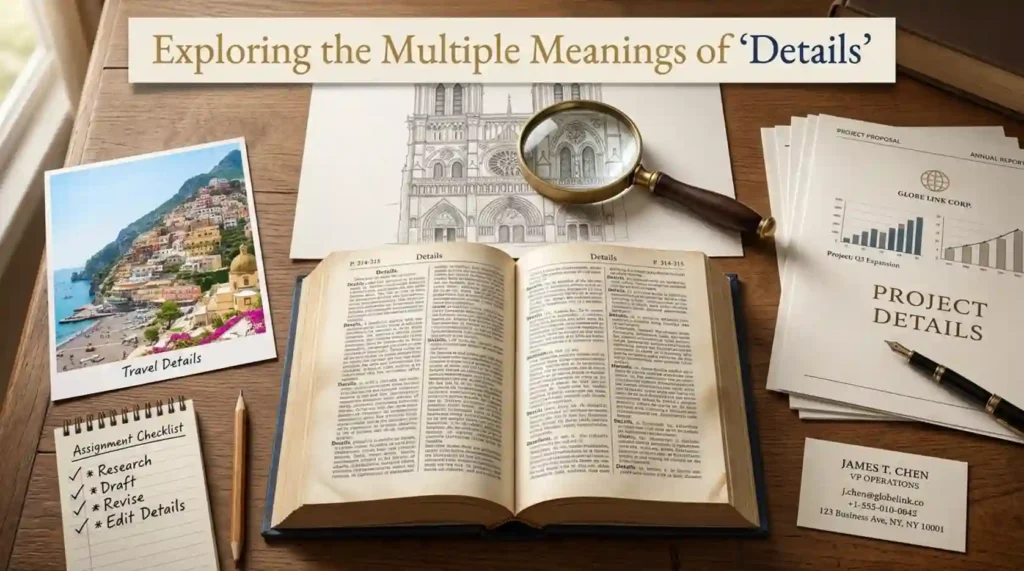
Exploring the Multiple Meanings of “Details”
1. A Small Part or Single Fact
- Meaning: A small item or part that is considered on its own.
- Explanation: This is the most common sense. A detail is one piece of a bigger whole. It can be important or minor, and the word “details” is the plural.
- Example: She remembered every detail of the trip.
2. Close Attention to Small Points
- Meaning: Treatment of a subject item by item, or a high level of precision.
- Explanation: Here the word is often uncountable. “Detail” means how much fine information is given, as in “fine detail” or “attention to detail.”
- Example: The report goes into great detail about the costs.
3. Information or Facts
- Meaning: Facts or information about a person, event, or plan.
- Explanation: This sense is common in forms and announcements. The plural “details” often means “information about something,” as in “contact details.”
- Example: Please send me the details of the meeting.
4. Fine Parts of a Design or Artwork
- Meaning: Small elements in a painting, building, or object, or intricate decoration.
- Explanation: Artists and designers use “detail” for small parts that add richness. A “detail” of a painting can also mean a close-up view of one part.
- Example: The carved details on the old door were beautiful.
5. A Small Group Given a Task
- Meaning: A small group of people, especially soldiers or police, assigned to a particular duty.
- Explanation: This comes from the idea of picking part of a larger group for a job. It is found in military and security contexts.
- Example: A guard detail stood outside the building.
6. To Describe Fully, to Assign, or to Clean Thoroughly (Verb)
- Meaning: As a verb, “detail” can mean to explain item by item, to assign someone to a duty, or to clean a vehicle thoroughly.
- Explanation: These are three different verb uses. The car-cleaning sense is common in everyday American English.
- Example: The manager detailed the steps in an email.
Sources: Merriam-Webster (detail); Dictionary.com, citing Collins English Dictionary (detail); Etymonline (detail); Wiktionary (detail).
Analyzing 30 Alternatives to “Details” in Detail
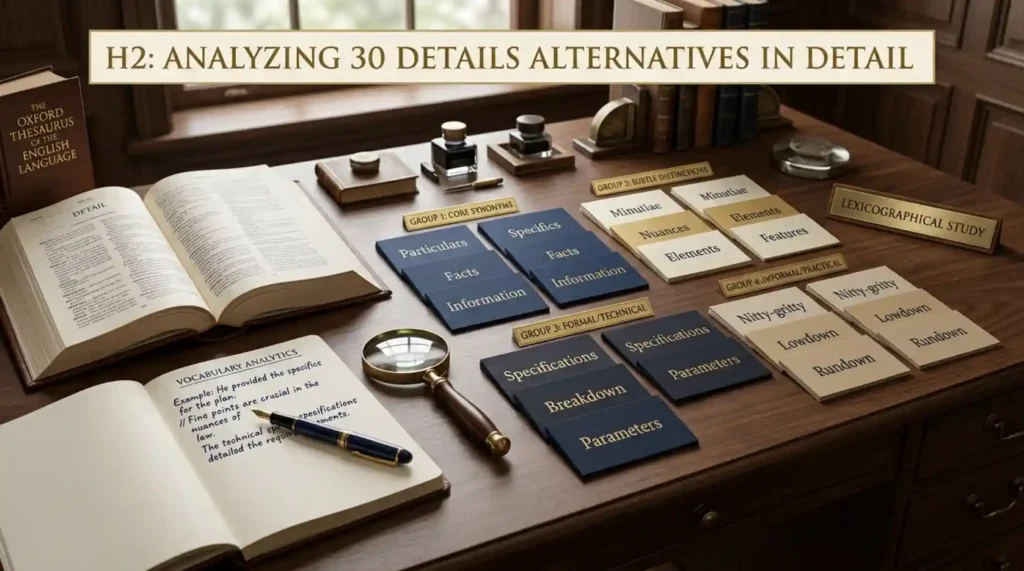
The word “details” is used when we talk about facts, information, small parts, or specific points about something. It is a common word in everyday conversations, professional writing, academic work, and personal messages. However, repeating the same word too often can make your writing sound less interesting. Choosing another word for details can help you express your ideas more clearly and naturally.
There are many alternatives to “details,” but not all of them have the same meaning. For example, particulars and specifics are useful when you need exact information. The word facts works better when you are talking about things that are known to be true. Similarly, features describes the important qualities of something, while circumstances refers to the conditions surrounding an event.
Some words are also suitable for particular situations. In formal writing, you might use “specifications” to describe exact requirements. During a casual conversation, “lowdown” or “rundown” may sound more natural. If you are discussing small differences in meaning, “nuances” or “subtleties” could be a better choice. Therefore, understanding the meaning of each alternative is important before using it.
In this guide, you will discover 30 alternatives to “details,” along with their definitions, pronunciations, usage notes, and example sentences. The list includes everyday words, formal expressions, technical terms, and informal alternatives. You will also learn which words are close synonyms and which ones are suitable only for specific meanings or contexts.
Whether you are writing an email, preparing a report, explaining a situation, or improving your vocabulary, these alternatives can help you communicate more effectively. Read through the examples to find the word that best matches your intended meaning.
Core Everyday Alternatives
These words are useful in everyday conversations and general writing. They refer to exact information, individual facts, or separate points within a larger subject.
1. Particulars
Keep your existing definition, IPA, usage note, and example.
2. Specifics
Keep your existing definition, IPA, usage note, and example.
3. Facts
Keep your existing definition, IPA, usage note, and example.
4. Information
Keep your existing definition, IPA, usage note, and example.
5. Points
Keep your existing definition, IPA, usage note, and example.
6. Items
Keep your existing definition, IPA, usage note, and example.
Fine Points and Subtle Differences
These alternatives describe small, delicate, or easily overlooked parts of a subject. Some refer to tiny details, while others highlight slight differences in meaning, tone, or behavior.
7. Minutiae
Keep your existing definition, IPA, usage note, and example.
8. Fine Points
Keep your existing definition, IPA, usage note, and example.
9. Nuances
Keep your existing definition, IPA, usage note, and example.
10. Subtleties
Keep your existing definition, IPA, usage note, and example.
11. Niceties
Keep your existing definition, IPA, usage note, and example.
Parts, Features, and Qualities
Sometimes, “details” refers to the parts of a whole or the qualities that describe a person, object, or situation. These alternatives are useful when explaining how something is made, what it contains, or what makes it different.
12. Elements
Keep your existing definition, IPA, usage note, and example.
13. Aspects
Keep your existing definition, IPA, usage note, and example.
14. Features
Keep your existing definition, IPA, usage note, and example.
15. Components
Keep your existing definition, IPA, usage note, and example.
16. Characteristics
Keep your existing definition, IPA, usage note, and example.
17. Attributes
Keep your existing definition, IPA, usage note, and example.
Formal and Technical Alternatives
Formal and technical writing often requires precise words to explain requirements, recorded information, surrounding conditions, or complex processes. These alternatives work well in professional reports, research, legal discussions, and technical documents.
18. Specifications
Keep your existing definition, IPA, usage note, and example.
19. Data
Keep your existing definition, IPA, usage note, and example.
20. Circumstances
Keep your existing definition, IPA, usage note, and example.
21. Technicalities
Keep your existing definition, IPA, usage note, and example.
22. Intricacies
Keep your existing definition, IPA, usage note, and example.
Informal Alternatives
In casual conversations, informal expressions can make your writing sound more natural. These alternatives are especially useful when asking for a summary, requesting inside information, or discussing the practical parts of a task.
23. Rundown
Keep your existing definition, IPA, usage note, and example.
24. Lowdown
Keep your existing definition, IPA, usage note, and example.
25. Breakdown
Keep your existing definition, IPA, usage note, and example.
26. Ins and Outs
Keep your existing definition, IPA, usage note, and example.
27. Nitty-Gritty
Keep your existing definition, IPA, usage note, and example.
Alternatives for Minor or Unimportant Details
Some alternatives are appropriate when the information being discussed is small or unimportant. However, these words can suggest that something does not deserve much attention, so consider the tone before using them.
28. Trivia
Keep your existing definition, IPA, usage note, and example.
29. Trifles
Keep your existing definition, IPA, usage note, and example.
30. Trivialities
Keep your existing definition, IPA, usage note, and example.
Detail vs. Details: Singular, Plural, and Uncountable Use
Many learners wonder when to write “detail” and when to write “details.” Both are correct, but they are used differently.
| Form | How it works | Example |
| a detail | One small point or fact. | You left out an important detail. |
| details | Several points, or information about something. | Please send me the details. |
| detail (uncountable) | The amount of fine information given. | The report includes a lot of detail. |
| in detail | Item by item, fully. | She explained the plan in detail. |
| attention to detail | Care about small points. | The job needs strong attention to detail. |
Use “details” when you mean separate points or information, and “detail” when you mean the quality or level of fine information. Merriam-Webster’s own examples include “attention to detail” and “further details.”
Sources: Merriam-Webster (detail, example sentences); Dictionary.com (detail, idioms); Wiktionary (detail).
Details and Opposite/Paired Word Pairs
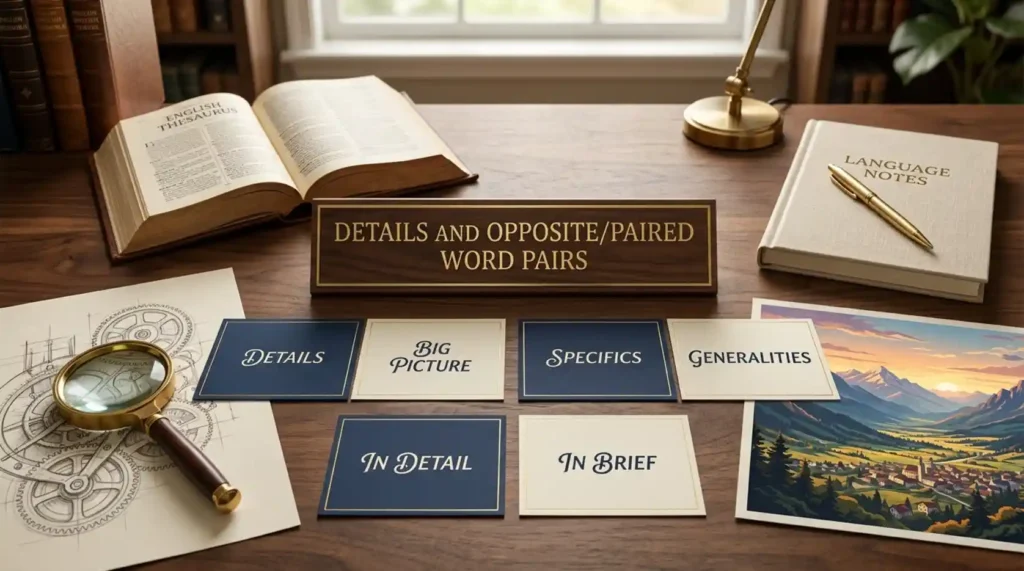
| Word | Paired Word | Note |
| details | big picture | The “big picture” is the general view, as opposed to small points. |
| details | overview | An overview gives a general summary instead of fine points. |
| specifics | generalities | Specifics are exact; generalities are broad statements. |
| in detail | in brief | “In brief” means in short form. |
| in detail | in general | “In general” means without going into small points. |
| minutiae | essentials | Minutiae are tiny points; essentials are the most important points. |
“Details” has no single perfect opposite. The natural contrasts are words for the general view, such as “overview” and “big picture.” When people say someone “loses sight of the big picture,” they often mean that person is too focused on details.
Sources: Merriam-Webster (detail); Dictionary.com (detail).
Common Word Partners of “Details”
| Pattern | Common Partners | Example |
| verb + details | give, provide, share, reveal, release, check, confirm | The company will release more details soon. |
| adjective + details | fine, small, minor, key, exact, full, further | Please give me the full details. |
| noun + details | contact details, personal details, bank details, flight details | Enter your contact details below. |
| detail + of | the details of the plan, the details of the case | We discussed the details of the contract. |
| in + detail | in detail, in great detail, in more detail | He described the trip in great detail. |
| attention / eye for + detail | attention to detail, an eye for detail | She has a keen eye for detail. |
| down to + detail | down to the last detail, down to the smallest detail | They planned the party down to the smallest detail. |
Sources: Merriam-Webster (detail, example sentences); Dictionary.com (detail).
Idiomatic Phrases Featuring “Details”
1. In detail
- Meaning: Item by item, with full particulars.
- Example: The teacher explained the rules in detail.
2. Go into detail
- Meaning: To give a full, item-by-item explanation.
- Example: I won’t go into detail, but the trip was a disaster.
3. The devil is in the details
- Meaning: A saying that warns that small points in a plan can cause serious problems if they are ignored.
- Example: The deal sounds great, but the devil is in the details.
4. Attention to detail
- Meaning: An established expression for care about small points. It is not a true idiom, but it is a very common fixed phrase.
- Example: Good editors have strong attention to detail.
Sources: Dictionary.com (detail, idioms); Merriam-Webster (detail, example sentences).
Word Formation of “Details”
Etymology & Structure
“Detail” comes from French. Wiktionary traces it to Middle French détail, from Old French detaillier, formed from de- and taillier (“to cut”). The idea is a thing “cut into pieces,” or a small part cut from a whole. This matches the modern meaning of a small part of something larger.
Date and History
Etymonline records the military noun sense (“selection of troops for a particular service”) in 1708 and the verb sense “divide or set off,” especially for military duty, in 1793. The general noun was in English earlier, in the 1600s. A more exact earliest date for the general noun sense should be confirmed in the Oxford English Dictionary before publication.
Word Class Variations
- Noun: detail, details
- Verb: detail, details, detailed, detailing
- Adjective: detailed, as in “a detailed report”
- Related forms: detailer (a person who details, as in car detailing), detailing (noun), predetail (verb)
- Compound: detail-oriented (adjective)
Sources: Etymonline (detail); Wiktionary (detail); Merriam-Webster (detail); Dictionary.com (detail).
Common Word-Choice Mistakes
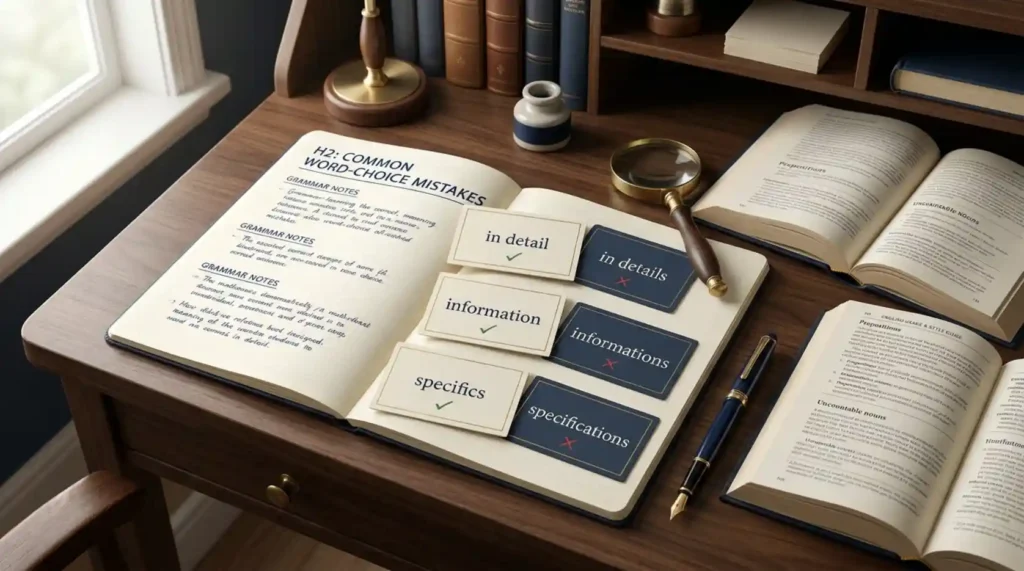
- Wrong: “informations” → Correct: “information” (it is uncountable).
- Wrong: “the minutiae is” → Correct: “the minutiae are” (it is a plural noun).
- Wrong: “She explained in details” → Correct: “She explained in detail.”
- Wrong: “I need the specifications of the trip” → Correct: “I need the specifics of the trip” (specifications are technical requirements).
- Wrong: “Nuances of the flight, such as time and gate” → Correct: “details of the flight” (nuances are slight differences, not facts).
- Wrong: “Please send your contact particulars by text” → Correct: “contact details” (particulars sounds too formal in everyday use).
- Wrong: “He loves trivialities of history” when you mean important facts → Correct: “He loves historical facts.”
Frequently Asked Questions
What is the closest synonym for details?
“Particulars” and “specifics” are the closest. “Particulars” is more formal, and “specifics” is more everyday.
What is a formal word for details?
“Particulars” is formal, and “specifications” is formal and technical. “Minutiae” is also formal but suggests very small points.
What is a casual word for details?
“Specifics,” “rundown,” “lowdown,” and “nitty-gritty” are all informal ways to talk about details.
What is the difference between details and nuances?
Details are facts or small parts. Nuances are very slight differences in meaning, tone, or feeling.
What is the difference between details and minutiae?
Minutiae are very small or unimportant details. The word can sound critical, while “details” is neutral.
What is the opposite of details?
There is no exact opposite. Words like “overview,” “big picture,” and “generalities” are the natural contrasts.
Can “details” mean information?
Yes. In phrases like “contact details” or “event details,” it means information about something.
Is it “attention to detail” or “attention to details”?
“Attention to detail” is the standard, most common form. It uses “detail” as an uncountable noun.
What does “detail” mean as a verb?
It can mean to describe fully, to assign someone to a duty, or to clean a vehicle thoroughly. The meaning depends on the context.
What does “the devil is in the details” mean?
It means small points can cause big problems if you ignore them. People use it to warn that a plan needs careful checking.
Conclusion
The closest alternatives to “details” are “particulars” and “specifics.” For information, “facts” and “information” work well. For very small points, “minutiae” and “fine points” fit, and for slight differences in meaning, “nuances” and “subtleties” are better.
Context matters because “details” has several meanings. It can mean facts, parts, features, fine points, or minor items. A word that fits one meaning, such as “specifications,” can be wrong for another, such as “contact details.”
To choose the right word, first decide what you mean. For formal writing, try “particulars” or “specifications.” For casual talk, try “specifics,” “rundown,” or “nitty-gritty.” When the points are small or unimportant, “minutiae,” “trifles,” or “trivia” show that clearly.