
Another Word for Compassion: 30 Synonyms With Examples
The closest everyday alternatives to compassion are kindness, sympathy, empathy, and mercy. The best word depends on If you mean feeling for someone’s pain, wanting to help, showing forgiveness, or acting generously.
Compassion usually combines awareness of another person’s suffering with a desire to ease it. Related ideas include care, tenderness, humanity, charity, understanding, and concern.
Quick list: sympathy, empathy, kindness, mercy, humanity, tenderness, charity, benevolence, understanding, care
This article examines 30 alternatives for compassion, with meanings, IPA, usage notes, natural examples, and the contexts where each word works best.
At a Glance: Compassion Synonyms and Related Alternatives
| Alternative | Part of Speech | Meaning | Register / Tone | Ideal Context |
| Sympathy | Noun | Sorrow or concern for another person’s trouble | Neutral | Condolences, personal support |
| Empathy | Noun | The ability to understand and share another person’s feelings | Neutral, modern | Counseling, relationships, leadership |
| Kindness | Noun | Friendly, caring, or generous behavior | Neutral, warm | Everyday care and helpfulness |
| Mercy | Noun | Kindness or forgiveness shown to someone under one’s power | Formal, moral | Law, religion, forgiveness |
| Humanity | Noun | Kindness and concern for other people | Formal | Ethics, public life, humanitarian work |
| Tenderness | Noun | Gentle affection or care | Emotional, literary | Family, love, caregiving |
| Charity | Noun | Kindness toward others, especially through giving or help | Formal, moral | Giving, volunteering, religious contexts |
| Benevolence | Noun | Desire to do good for others | Formal | Character descriptions, ethics |
| Understanding | Noun | Willingness to accept and support someone’s situation | Neutral | Workplace, friendship, family |
| Care | Noun | Concern, attention, or protection given to someone | Neutral, everyday | Health, relationships, daily life |
Which Word Should You Use?

| If you want to… | Use | Why |
| Express sorrow for someone’s loss | Sympathy | It is the standard word for condolences and shared sorrow. |
| Describe feeling another person’s emotions | Empathy | It emphasizes understanding or sharing feelings. |
| Describe a caring act | Kindness | It is simple, warm, and works in everyday speech. |
| Talk about forgiveness or sparing punishment | Mercy | It suggests compassion shown by someone with power or authority. |
| Describe humane concern for all people | Humanity | It is broader and often used in ethical or public contexts. |
| Describe gentle, loving care | Tenderness | It highlights softness and emotional warmth. |
| Describe giving help or resources | Charity | It often involves practical support, donations, or aid. |
| Describe a person who wants to do good | Benevolence | It is formal and focuses on good intentions. |
Exploring the Multiple Meanings of “Compassion”
1. Concern for someone’s suffering
- Meaning: A feeling of sorrow or concern for a person who is suffering.
- Explanation: This is the central sense of compassion. It includes noticing another person’s pain and caring about it.
- Example: She felt deep compassion for the families affected by the flood.
2. A desire to help or relieve suffering
- Meaning: Compassion often includes a wish to reduce another person’s distress.
- Explanation: Unlike simple pity, compassion usually leads toward action, support, or practical help.
- Example: His compassion led him to volunteer at the shelter every weekend.
3. Mercy or forgiveness
- Meaning: Compassion can mean choosing not to punish or harm someone who may deserve it.
- Explanation: In this sense, the word overlaps with mercy and clemency. It is common in legal, religious, and moral discussions.
- Example: The judge showed compassion by giving the young offender a second chance.
4. Kindness in dealing with people
- Meaning: Compassion can describe a generally caring attitude toward others.
- Explanation: Here, it is close to kindness, humanity, and consideration, especially when someone treats others gently.
- Example: A good teacher needs patience, fairness, and compassion.
5. Emotional understanding
- Meaning: Compassion can involve understanding what another person is going through.
- Explanation: This sense is close to empathy, though compassion adds concern and a wish to help.
- Example: Her compassion made it easy for patients to trust her.
Sources: Merriam-Webster; Collins English Thesaurus; Etymonline.
Analyzing 30 Compassion Alternatives in Detail

Some alternatives are direct synonyms, while others are useful only in particular contexts.
Core Synonyms of Compassion
1. Sympathy
- IPA: /ˈsɪm.pə.θi/ (US and UK)
- Definition: A feeling of sorrow or concern for someone else’s trouble or suffering.
- Usage: Sympathy is one of the closest everyday alternatives to compassion. It is especially common when comforting someone after a loss or difficulty.
- Example: We sent our sympathy to the family after their loss.
2. Empathy
- IPA: /ˈem.pə.θi/ (US and UK)
- Definition: The ability to understand and share another person’s feelings.
- Usage: Empathy focuses on emotional understanding. It is related to compassion, but compassion usually adds a desire to help.
- Example: Her empathy helped her understand why he was upset.
3. Kindness
- IPA: /ˈkaɪnd.nəs/ (US and UK)
- Definition: The quality of being friendly, generous, and considerate.
- Usage: Kindness is broader than compassion because it can apply to everyday politeness and helpfulness, not only suffering.
- Example: Thank you for your kindness during a difficult week.
4. Pity
- IPA: /ˈpɪt.i/ (US and UK)
- Definition: A feeling of sorrow for someone’s suffering or misfortune.
- Usage: Pity is close to compassion, but it can sometimes sound distant or slightly superior. Use it carefully.
- Example: He looked at the injured bird with pity.
5. Mercy
- IPA: /ˈmɜː.si/ US · /ˈmɝː.si/ UK
- Definition: Kindness or forgiveness shown to someone over whom one has power.
- Usage: Mercy is a strong formal alternative when compassion involves forgiveness, leniency, or sparing someone.
- Example: The prisoners begged for mercy.
6. Humanity
- IPA: /hjuːˈmæn.ə.ti/ (US and UK)
- Definition: The quality of being kind, caring, and humane toward other people.
- Usage: Humanity works well in ethical, social, and humanitarian contexts. It suggests compassion as a basic human value.
- Example: The rescue workers treated everyone with humanity.
7. Tenderness
- IPA: /ˈten.də.nəs/ US · /ˈten.də.nəs/ UK
- Definition: Gentle affection, care, or sensitivity.
- Usage: Tenderness emphasizes emotional softness. It is more personal and affectionate than compassion.
- Example: She held the baby with great tenderness.
8. Care
- IPA: /keər/ US · /keər/ UK
- Definition: Concern, attention, or protection given to someone or something.
- Usage: Care is a practical, everyday related word. It often describes actions rather than the feeling itself.
- Example: The nurses showed excellent care for their patients.
Formal and Moral Alternatives
9. Benevolence
- IPA: /bəˈnev.əl.əns/ (US and UK)
- Definition: A desire to do good to others; kindness.
- Usage: Benevolence is formal and often describes a person’s character or intentions rather than a single act.
- Example: The charity was founded out of benevolence toward poor families.
10. Charity
- IPA: /ˈtʃer.ə.ti/ (US and UK)
- Definition: Kindness and generosity toward others, especially through giving help or money.
- Usage: Charity is related to compassion but often emphasizes giving, aid, or organized help.
- Example: She donated to the charity to support families in need.
11. Humaneness
- IPA: /hjuːˈmeɪn.nəs/ (US and UK)
- Definition: The quality of being kind, gentle, and compassionate.
- Usage: Humaneness is more formal than humanity and often appears in discussions of treatment, ethics, or animal welfare.
- Example: The report praised the humaneness of the new animal-care policy.
12. Humanitarianism
- IPA: /hjuːˌmæn.ɪˈter.i.ə.nɪ.zəm/ (US and UK)
- Definition: Concern for human welfare, especially through efforts to reduce suffering.
- Usage: This is a related alternative, not an exact synonym. It usually describes organized public action or principles.
- Example: The organization is guided by humanitarianism and respect for human dignity.
13. Clemency
- IPA: /ˈklem.ən.si/ (US and UK)
- Definition: Mercy or leniency shown by a person in authority.
- Usage: Clemency is a narrow, formal alternative used mainly in legal or official contexts.
- Example: The governor granted clemency to the prisoner.
14. Magnanimity
- IPA: /ˌmæɡ.nəˈnɪm.ə.ti/ (US and UK)
- Definition: Generosity, especially toward a rival or someone less powerful.
- Usage: Magnanimity is formal and literary. It suggests noble forgiveness rather than ordinary compassion.
- Example: She accepted the apology with magnanimity.
15. Altruism
- IPA: /ˈæl.tru.ɪ.zəm/ (US and UK)
- Definition: Unselfish concern for the well-being of others.
- Usage: Altruism is related to compassion but focuses on selfless action. It does not necessarily involve emotional sorrow.
- Example: His altruism inspired others to volunteer.
Emotional and Personal Alternatives
16. Fellow Feeling
- IPA: /ˌfel.oʊ ˈfiː.lɪŋ/ US · /ˌfel.əʊ ˈfiː.lɪŋ/ UK
- Definition: Sympathy or understanding shared with other people.
- Usage: Fellow feeling is a natural two-word alternative. It emphasizes a sense of shared human experience.
- Example: There was real fellow feeling among the survivors.
17. Commiseration
- IPA: /kəˌmɪz.əˈreɪ.ʃən/ (US and UK)
- Definition: Sympathy or sorrow expressed for someone’s misfortune.
- Usage: Commiseration is formal and often used for expressing sympathy after disappointment, failure, or loss.
- Example: He offered his commiseration after she lost the competition.
18. Condolence
- IPA: /kənˈdoʊ.ləns/ US · /kənˈdəʊ.ləns/ UK
- Definition: An expression of sympathy to someone who has experienced loss or grief.
- Usage: Condolence is not a general synonym for compassion. It is specifically used for grief, especially after a death.
- Example: Please accept our condolences on the death of your father.
19. Warmheartedness
- IPA: /ˌwɔːrmˈhɑːr.tɪd.nəs/ US · /ˌwɔːmˈhɑː.tɪd.nəs/ UK
- Definition: The quality of being kind, sympathetic, and affectionate.
- Usage: This is a descriptive alternative that emphasizes emotional warmth rather than action.
- Example: Her warmheartedness made newcomers feel welcome.
20. Tenderheartedness
- IPA: /ˌten.dəˈhɑːr.tɪd.nəs/ US · /ˌten.dəˈhɑː.tɪd.nəs/ UK
- Definition: The quality of being easily moved by other people’s suffering.
- Usage: Tenderheartedness is more emotional and literary than compassion. It can suggest sensitivity as well as care.
- Example: His tenderheartedness showed whenever he saw an animal in distress.
21. Softheartedness
- IPA: /ˌsɒftˈhɑːr.tɪd.nəs/ US · /ˌsɒftˈhɑːr.tɪd.nəs/ UK
- Definition: The quality of being kind, sympathetic, and easily moved.
- Usage: This related term is informal and can sometimes imply that a person is too easily persuaded.
- Example: Her softheartedness made it hard for her to say no.
22. Sensitivity
- IPA: /ˌsen.səˈtɪv.ə.ti/ (US and UK)
- Definition: Awareness of and responsiveness to other people’s feelings.
- Usage: Sensitivity is related but not identical. It can mean emotional awareness without necessarily including a wish to help.
- Example: Handle the situation with sensitivity.
Action-Based Alternatives
23. Generosity
- IPA: /ˌdʒen.əˈrɒs.ə.ti/ US · /ˌdʒen.əˈrɒs.ə.ti/ UK
- Definition: Willingness to give money, time, help, or kindness freely.
- Usage: Generosity is related to compassion, especially when help involves giving. It does not always involve suffering.
- Example: Their generosity helped the school buy new books.
24. Goodwill
- IPA: /ˌɡʊdˈwɪl/ (US and UK)
- Definition: Friendly, helpful, or cooperative feeling toward others.
- Usage: Goodwill is a related alternative that emphasizes positive intention rather than sorrow for suffering.
- Example: The two groups worked together in a spirit of goodwill.
25. Consideration
- IPA: /kənˌsɪd.əˈreɪ.ʃən/ (US and UK)
- Definition: Thoughtful attention to other people’s needs, feelings, or wishes.
- Usage: Consideration is a practical alternative when compassion appears as polite, thoughtful behavior.
- Example: He showed consideration by keeping quiet while she rested.
26. Support
- IPA: /səˈpɔːrt/ US · /səˈpɔːt/ UK
- Definition: Help, encouragement, or practical assistance given to someone.
- Usage: Support describes compassionate action rather than the feeling itself.
- Example: She offered support to her friend during the illness.
Literary and Less Common Alternatives
27. Ruth
- IPA: /ruːθ/ (US and UK)
- Definition: Sorrow or pity for another person’s distress; compassion.
- Usage: Ruth is an archaic or literary synonym for compassion. It is rare in modern everyday English.
- Example: The old tale describes a king who ruled with ruth.
28. Heart
- IPA: /hɑːrt/ US · /hɑːt/ UK
- Definition: Kindness, compassion, or emotional sensitivity, especially in phrases such as “have a heart.”
- Usage: Heart is a related alternative, usually used in fixed expressions rather than as a direct replacement.
- Example: She has a lot of heart.
29. Kindliness
- IPA: /ˈkaɪnd.li.nəs/ (US and UK)
- Definition: Gentle kindness or a kindly manner.
- Usage: Kindliness is a slightly formal or old-fashioned alternative to kindness. It often describes a person’s manner.
- Example: He spoke to the children with kindliness.
30. Good-Heartedness
- IPA: /ˌɡʊdˈhɑːr.tɪd.nəs/ US · /ˌɡʊdˈhɑː.tɪd.nəs/ UK
- Definition: The quality of being kind, generous, and sincere.
- Usage: This is a related descriptive alternative. It describes a person’s general character more than a response to suffering.
- Example: Her good-heartedness made her popular in the neighborhood.
Sources
- Merriam-Webster
- Collins English Thesaurus
- Etymonline
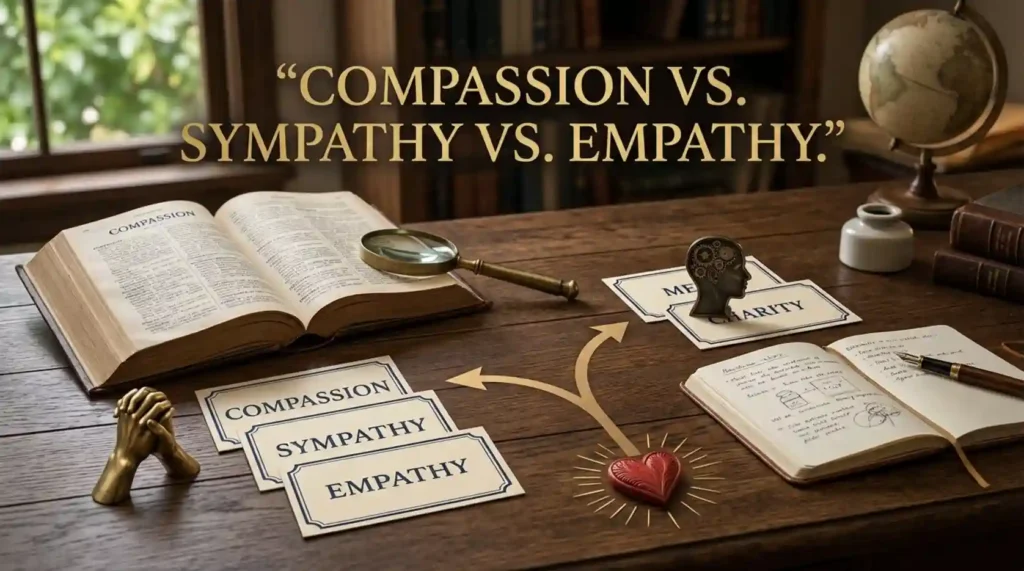
Compassion vs. Sympathy vs. Empathy
| Word | Main Focus | Example Use |
| Compassion | Feeling concern for suffering and wanting to relieve it | Her compassion led her to help the refugees. |
| Sympathy | Feeling sorrow or concern for someone else’s difficulty | I expressed my sympathy after her loss. |
| Empathy | Understanding or sharing another person’s feelings | His empathy allowed him to listen without judging. |
Sympathy often means acknowledging someone’s hardship. Empathy means understanding or sharing their emotional experience. Compassion goes further by including care and a desire to help.
Sources: Merriam-Webster; Collins English Thesaurus.
Compassion and Opposite/Paired Word Pairs
| Word | Paired Word | Note |
| Compassion | Cruelty | Cruelty is a direct moral opposite. |
| Compassion | Callousness | Callousness means emotional hardness or indifference. |
| Compassion | Indifference | Indifference means lack of concern. |
| Mercy | Severity | Severity emphasizes harsh punishment or treatment. |
| Sympathy | Antipathy | Antipathy means strong dislike or opposition. |
| Kindness | Unkindness | Unkindness is the direct opposite of kindness. |
| Charity | Selfishness | Selfishness describes concern mainly for oneself. |
| Empathy | Apathy | Apathy means lack of interest or emotional concern. |
These pairs are useful for contrasting caring behavior with coldness, harshness, or indifference. In writing, they often appear in moral, social, and emotional discussions.
Sources: Merriam-Webster; Collins English Thesaurus.
Common Word Partners of “Compassion”

| Pattern | Common Partners | Example |
| Adjective + compassion | Deep, great, genuine, profound, heartfelt | She showed deep compassion for the victims. |
| Compassion + for | someone, others, animals, People experiencing poverty, refugees. | He has compassion for people in need. |
| Verb + compassion | show, feel, express, demonstrate, lack | The doctor showed compassion toward her patients. |
| Compassion + in | a crisis, difficult times, leadership, caregiving | Compassion is important in leadership. |
| Act with + compassion | compassion, mercy, kindness, understanding | They acted with compassion and patience. |
These collocations are natural in everyday English, news writing, healthcare language, and discussions of ethics.
Sources: Merriam-Webster; Collins English Thesaurus.
Idiomatic Phrases Featuring “Compassion”
1. Have a heart
- Meaning: To show compassion, understanding, or mercy.
- Example: Have a heart—let her stay until the storm passes.
2. A heart of gold
- Meaning: A very kind and generous nature.
- Example: Everyone trusts her because she has a heart of gold.
3. Wear one’s heart on one’s sleeve
- Meaning: To show feelings openly rather than hiding them.
- Example: He wears his heart on his sleeve, so everyone knows when he is worried.
4. The milk of human kindness
- Meaning: Natural human kindness and compassion.
- Example: The volunteers showed the milk of human kindness by helping strangers rebuild their homes.
Sources: Merriam-Webster; Collins English Thesaurus.
Word Formation of “Compassion”
Etymology & Structure
Compassion comes from Late Latin compassio, meaning “sympathy.” It developed from Latin compati, formed from com-, meaning “with,” and pati, meaning “to bear” or “to suffer.” The literal idea is “suffering with another.”
Date and History
The word entered English in the mid-14th century as compassioun. It came through Old French from Late Latin. In Middle English, it could sometimes mean literally sharing another person’s suffering.
Word Class Variations
- Noun: compassion, compassionateness
- Adjective: compassionate
- Adverb: compassionately
- Verb: compassionate, meaning “to pity,” though this use is rare and formal
Sources: Merriam-Webster; Etymonline.
Common Word-Choice Mistakes
- Wrong pairing: “I have compassion for your loss.” Better: “I have sympathy for your loss.”
- Wrong pairing: “She showed empathy by donating food.” Better: “She showed compassion by donating food.”
- Wrong pairing: “The judge showed empathy by reducing the sentence.” Better: “The judge showed mercy or clemency by reducing the sentence.”
- Wrong pairing: “He felt condolence for the sick child.” Better: “He felt compassion for the sick child.”
- Wrong pairing: “Please accept my compassion on your father’s death.” Better: “Please accept my condolences on your father’s death.”
- Wrong pairing: “Her humanity for the injured dog was touching.” Better: “Her compassion for the injured dog was touching.”
- Wrong pairing: “He treated the prisoners with empathy.” Better: “He treated the prisoners with mercy or compassion.”
Frequently Asked Questions
What is the closest synonym for compassion?
Sympathy and kindness are the closest everyday alternatives. Empathy is also very close when the focus is on understanding another person’s feelings.
What is the difference between compassion and empathy?
Empathy means understanding or sharing someone’s feelings. Compassion includes that concern but also a desire to help or reduce suffering.
What is a formal word for compassion?
Benevolence, humaneness, mercy, and clemency are formal alternatives. Choose clemency only for forgiveness or leniency from someone in authority.
What is a literary word for compassion?
Ruth is a literary and archaic synonym. Tenderness and magnanimity can also sound literary in the right context.
What is the opposite of compassion?
Common opposites include cruelty, callousness, and indifference. Cruelty is the strongest moral opposite.
Can compassion be used for animals?
Yes. People often speak of compassion for animals, especially when discussing their welfare or treatment.
Is pity the same as compassion?
No. Both involve sorrow for someone’s suffering, but pity can sound distant or superior. Compassion more strongly suggests care and help.
Can compassion be an adjective?
No. The noun is compassion; the adjective is compassionate. For example, “a compassionate nurse.”
What is a simple word for compassion?
Kindness, care, and sympathy are simple, natural choices for everyday English.
Is compassion always emotional?
Not necessarily. Compassion begins as a feeling, but it often appears through practical actions such as comforting, forgiving, donating, or helping.
Conclusion
The most useful alternatives to compassion are sympathy, empathy, kindness, mercy, humanity, tenderness, charity, and benevolence. For everyday speech, kindness and sympathy are usually the safest choices.
The right word depends on context. Use empathy for emotional understanding, mercy for forgiveness, charity for giving or aid, and tenderness for gentle personal care.
When choosing a synonym, ask If you are describing a feeling, an understanding of someone’s emotions, or an act of help. That distinction will guide you to the most accurate word.